


Portable horse stalls at a showground are bought twice: once as steel and panels, and again as a slot in a venue’s schedule. The second purchase is the question nobody puts in writing: how fast a crew gets a bank standing on turf that turns to mud, and how fast it comes down again. No setup figure means anything without its assumptions, and making a supplier state those is your job before the order.
DB HorseStable builds portable and temporary stabling as modular frames with adjustable dimensions and interchangeable bamboo, HDPE or pine linings, hot-dip galvanized steel carrying a stated 20-year rust protection, made in Anping since 2013 for nine markets. What decides event work is a setup commitment you can enforce, anchoring answered venue by venue, and pack-down choices that set the cost of your next season.
Key Takeaways
- Setup time needs five assumptions in writing: crew size, tools, ground condition, timed scope, and who holds the stopwatch.
- Hole alignment decides speed: CNC machining and automated 360-degree welding at a stated 500-plus stall sets a month keep bolt patterns repeatable.
- Anchoring is a site decision: fixing method, wind exposure assumption and reinstatement liability named per venue.
- Repeated assembly is a corrosion test: hot-dip galvanizing coats the welded component; a pre-galvanized build leaves cut edges and welds bare.
- Linings swap in the field: bamboo, HDPE or pine on adjustable frames, so one bank reconfigures between venues.
- The commercial frame is fixed: minimum 10 stall sets, 5%-15% volume discounts, 4-6 weeks globally, 1-2 weeks expedited from Sydney or Warsaw.
Why Portable Horse Stalls Are a Different Product Brief
A permanent barn is built once and then used by horses. A showground bank is used by a crew — lifted, aligned, bolted, packed, driven and unloaded. That duty cycle separates portable event stabling from a modular indoor system parked outside. If a fixed facility is your larger project, our indoor horse stall systems guide covers the planning a temporary bank skips.
The failure point is the connection, not the panel. A bolt hole that drifts across a production run is invisible in a building that never moves, and fatal at six in the morning when a frame will not line up. DB HorseStable runs CNC machining and automated 360-degree welding at a stated 500-plus stall sets a month, which is what holds hole patterns consistent within a batch and across next spring’s extension order. A manufacturer can match an earlier batch’s specifications; it cannot guess them.
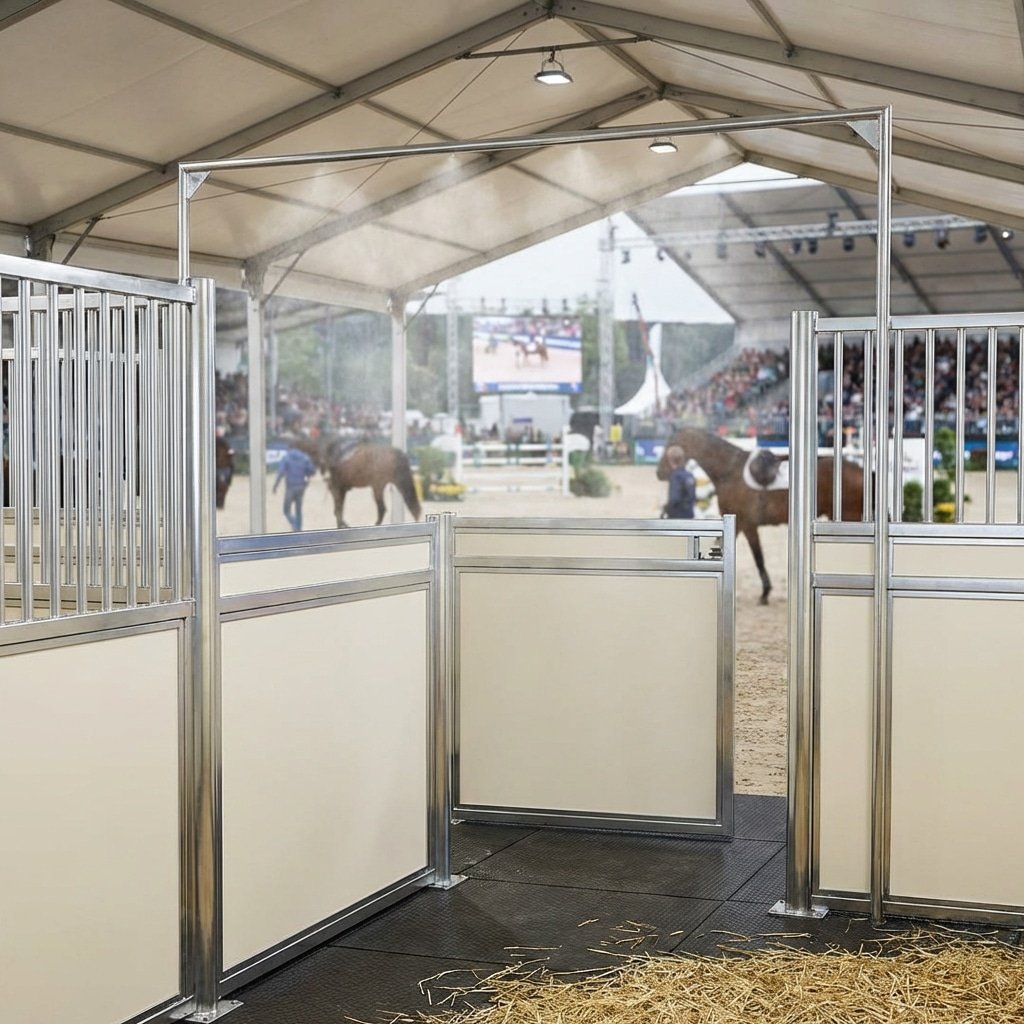
Setup Time: Getting a Commitment You Can Enforce
Setup times get quoted fast; the conditions behind them rarely do. Ask where a quoted figure was measured: a demo unit, the crew who built it, concrete, linings already fitted — each one changes the answer. Five assumptions make a setup claim verifiable, and all five belong in writing: crew size, hand tools or powered drivers, level paved ground or uneven turf, whether linings, gates and hardware sit inside the timed scope, and who performs the timing. A number with those attached is a commitment; without them it is a slogan.
Then change who runs the trial. Ask for a timed assembly of your delivered batch, by staff who have never seen the product, in your own warehouse before the first event. That converts a marketing figure into a scheduling input and exposes what a factory demo never shows: whether the hardware bag matches the pack list, and whether a panel fits first time. If the trial fails, you learned it with weeks in hand.
Two features decide whether the number holds in year three. Bolted field joints meant to be re-tightened outlast fast-acting fittings whose threads wear; ask what reuse interval the manufacturer assumes. Part count and single-person weight set the pace: a bank rises quickly when the heaviest component is one a handler can place alone. Ask for the piece count and the heaviest panel per stall set — the manufacturer already has both figures.
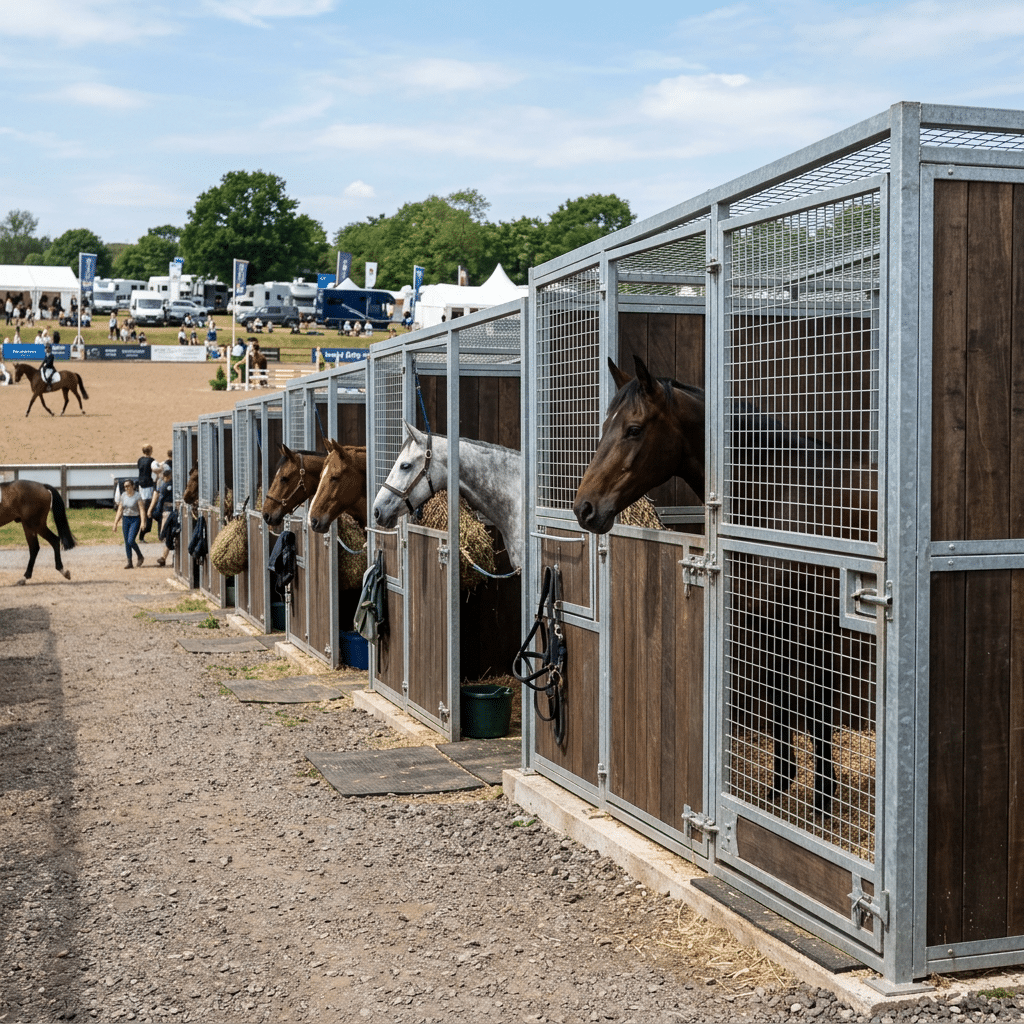
Anchoring and Ground Protection per Venue
No universal anchoring specification exists for temporary stabling, and a supplier who offers one without seeing your site is guessing. Three families do exist: a base that bears on the surface, ground anchors driven into it, or ballast where the ground cannot be penetrated — the case on historic showgrounds, paved yards and marquee floors. Which applies changes venue to venue, and the answer belongs on your order document.
Wind is the question behind the question. A bank on open turf presents sail area a walled barn does not, and an exposed site differs from a sheltered paddock. Do not accept a wind figure lifted off a datasheet. Ask the manufacturer to state the exposure assumption behind their recommendation, then confirm it with the venue’s structural authority. Requirements vary by market and site; the venue’s answer governs your pitch.
Ground protection is where the venue’s invoice arrives. Turf carrying a stall bank, a water trailer and foot traffic for days needs a load-spreading decision before delivery: base plates, matting or decking under the frame, and a named party responsible for reinstatement. In wet climates that is a drainage problem first, which is why our UK regional stabling page leads with drainage and BHS-aligned design. Put the surface inside your anchoring question.
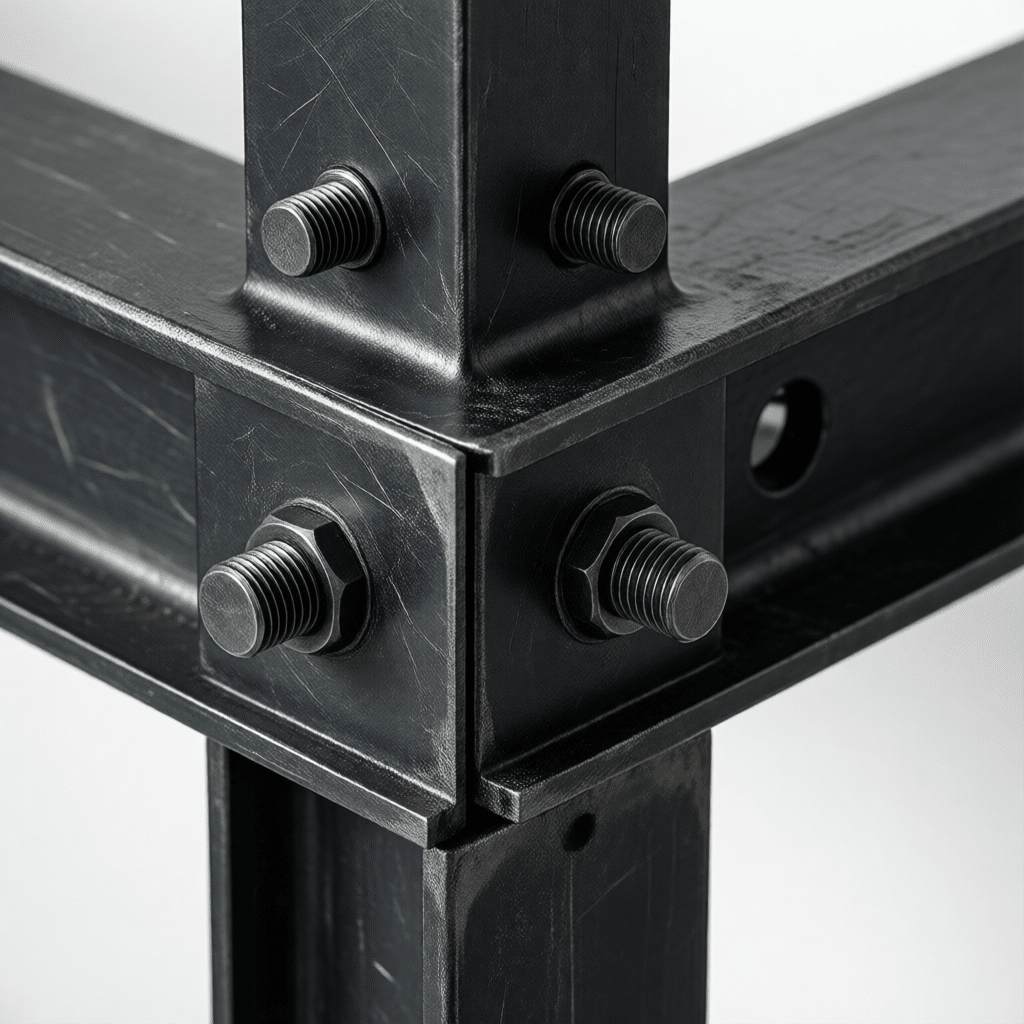
The Inquiry Checklist: What to Get in Writing
All of this reduces to a table you paste into your request for quotation. Seven rows answered in writing, and you can build a schedule and price the risk. Three, and you are carrying that risk yourself.
| Inquiry item | A verifiable answer looks like | Why it matters at the venue |
|---|---|---|
| Setup time per bank | Timed trial on your batch, with crew, tools and ground stated | Your crew and your turf, not a demo day |
| Field connections | Bolted fixings named, with an assumed reuse interval | Worn threads slow a bank by year three |
| Anchoring method | Method named per venue, plus who calculates exposure | Grass, paving and arena footing differ |
| Ground protection | Base plates, matting or decking listed; reinstatement owner named | Reinstatement bills reach whoever never asked |
| Packing for return | Pack list per set and a spare-hardware allowance | One missing bolt ends an exhibitor’s day |
| Linings and dimensions | Bamboo, HDPE or pine per order; adjustable sizes stated | Swap speed decides reuse across a circuit |
| Show-window support | Named contact and hours; regional manager for larger set counts | Time zones decide whether a question is answered |
Two rows carry the most weight. The timed trial turns setup into a date you can publish to exhibitors. The anchoring row protects you when a venue withdraws a pitch after a wet weekend and asks who signed off the ground.
Breakdown, Pack-Down and Return Logistics
Speed on the way out is bought on the way in, with two documents. The first is a pack-down list per stall set: what comes off, in what order, and where the fixings live between events. Loose hardware stops a return, so ask for a spare-hardware allowance quoted per set, not per shipment. The second is a condition record per frame — coating, welds and threads photographed at the end of each event rather than each season, because temporary stabling takes its damage at the corners where it is loaded onto a truck.
That is where a coating claim earns its keep. DB states 20-year rust protection on its hot-dip galvanized steel, and a figure like that assumes the coating survives the logistics as well as the weather. Plan the quiet weeks too: a covered, drained storage bay decides whether your second season starts clean. Some venues require cleaned, sometimes treated, equipment between sites — confirm the current rule with them. Panel choice matters here, because HDPE wipes down differently from pine.
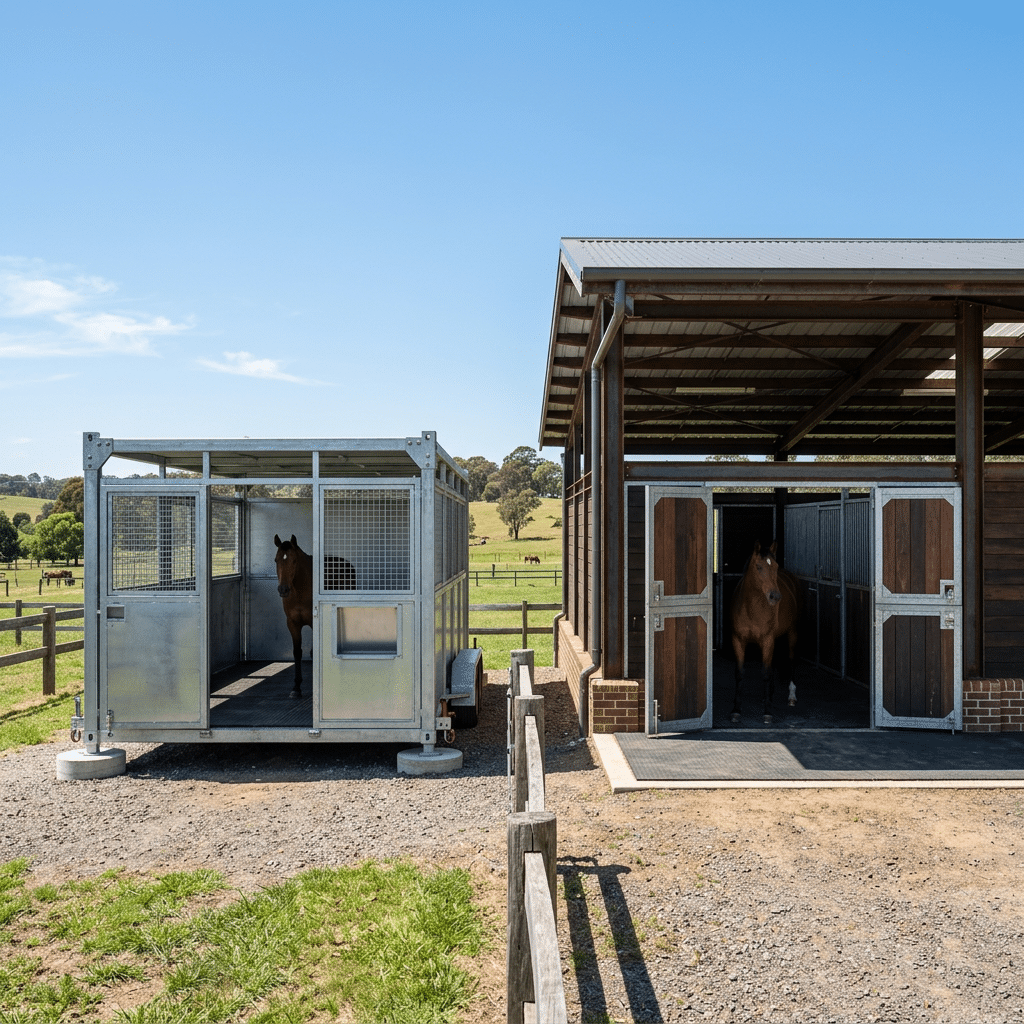
Order Timing, Minimums and the Show Calendar
Event stabling runs on a calendar that manufacturing has to respect. The commercial frame is fixed: a minimum order of 10 stall sets, volume discounts of 5%-15% on larger orders, and a global lead time of 4-6 weeks. The Sydney and Warsaw regional warehouses cut that to 1-2 weeks for expedited orders — the difference between arriving for the trial and arriving for the show.
Back-schedule from your first event, not your last comfortable order date, and add inland transport plus the trial day before quoting a deadline. Present the figure to the supplier as a date, not an expectation. For a second bank, committing before the season pays: orders above 20 stall sets come with a dedicated regional account manager covering customization and logistics — the person who answers during your show window.
Frequently Asked Questions
How long do portable horse stalls take to set up?
No honest figure exists without assumptions. Have the manufacturer time an assembly of your delivered batch with your crew size, hand tools and actual surface, stating whether linings, gates and hardware fall inside that timing.
How are portable horse stalls anchored on grass at a showground?
Three families exist: a base bearing on the surface, ground anchors driven into it, or ballast where the ground cannot be penetrated. Have the method, the wind exposure assumption and the reinstatement liability named per venue.
Can one set of portable stalls serve several events in a season?
Yes, when the frame is hot-dip galvanized and the field connections are bolted for reuse. Adjustable dimensions and interchangeable bamboo, HDPE or pine linings let one bank be reconfigured between venues.
What is the minimum order and lead time for event stabling?
Ten stall sets, with volume discounts of 5%-15% on larger orders. Global lead time runs 4-6 weeks; the Sydney and Warsaw regional warehouses reduce that to 1-2 weeks for expedited orders.
What should the manufacturer hand over after an event?
A pack-down list per stall set, a spare-hardware allowance, the anchoring method used on each surface, and a coating and weld inspection. That record decides whether the next show starts complete.
Conclusion
Portable horse stalls are judged in the working hours around an event, not in a brochure. A timed trial on your own batch turns setup into a fact you can schedule against. A named anchoring method per venue, with its exposure assumption and reinstatement owner written down, keeps a wet weekend from becoming your liability. A pack list and spare hardware keep the second show from starting short.
Take your venue list and first event date to the manufacturer while the calendar still has slack: review the stabling system specifications and ask for those seven inquiry rows in writing before you commit to a season.

 English
  Spanish
  French
  Arabic
  German
0 Comments