



Wind resistant pvc fencing is sold on a material story — no rust, no scraping, no repainting — and bought on a structural one that most quotations never write down. The rails rarely fail; the line fails at the posts, the connectors and the ground they stand in.
Three numbers decide whether an exposed PVC perimeter stands square after a bad week: wall thickness of the rail and post profiles, what reinforcement sits inside those posts, and the span each connector carries. This site publishes none of the three. They belong on your purchase order before production starts — not on a punch list after a container arrives.
Key Takeaways
- Open three-rail fencing lets air through, so wind arrives at the posts and connectors instead of pushing the whole line like a sail. That is where the load path must be documented.
- Profile wall thickness is a per-component figure. Ask for the rail wall and the post wall separately; one “PVC” label hides very different wall sections.
- Reinforced post design means an internal steel section plus how it is fixed at the base. Ask what the insert is, how long it runs, and whether it carries through the joints.
- Span is the third number. The longest span on your drawing sets the load every nearby connector sees on a storm night.
- Corners, end panels and gate openings carry the line’s wind load and want the same reinforcement written into the order, not a fix invented on site.
- Ordering follows the fence-line terms: 50-panel floor, 5%-15% volume discounts, 4-6 weeks production, 1-2 weeks from Sydney or Warsaw regional stock.
- Weathering and structure are separate claims: the 15-year figure on this site’s UV-resistant PVC line covers material life, not wind load.
Where Wind Actually Hits a Rigid Rail Line
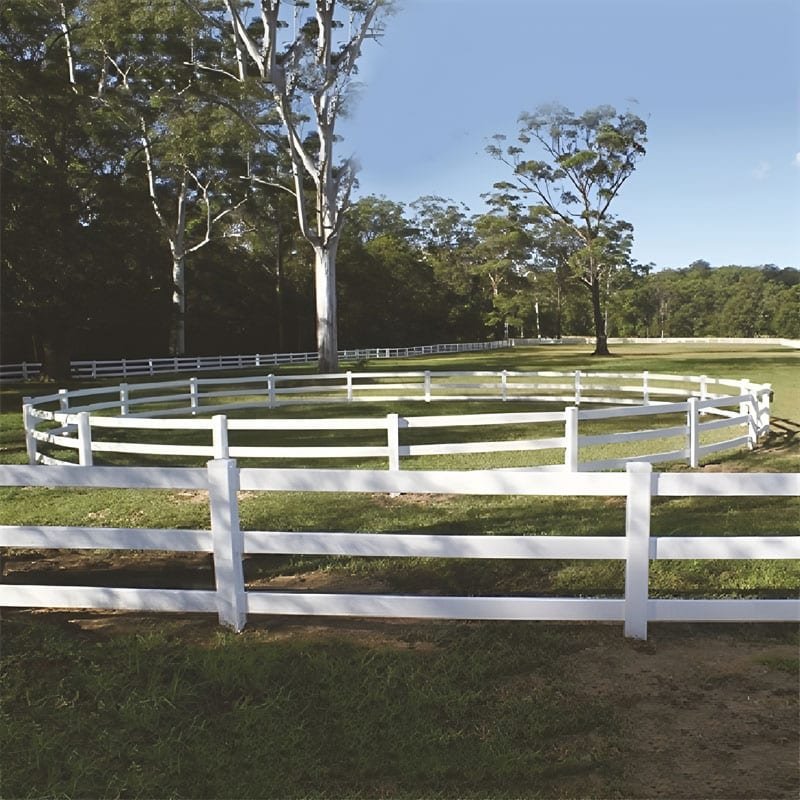
Air moves between rails, and that single fact changes the failure pattern. A solid panel catches wind across its full face and hands every post a broad, steady push. An open three-rail profile catches far less, but what it catches goes straight into two or three connection points and then down the post. Same storm, different place to break.
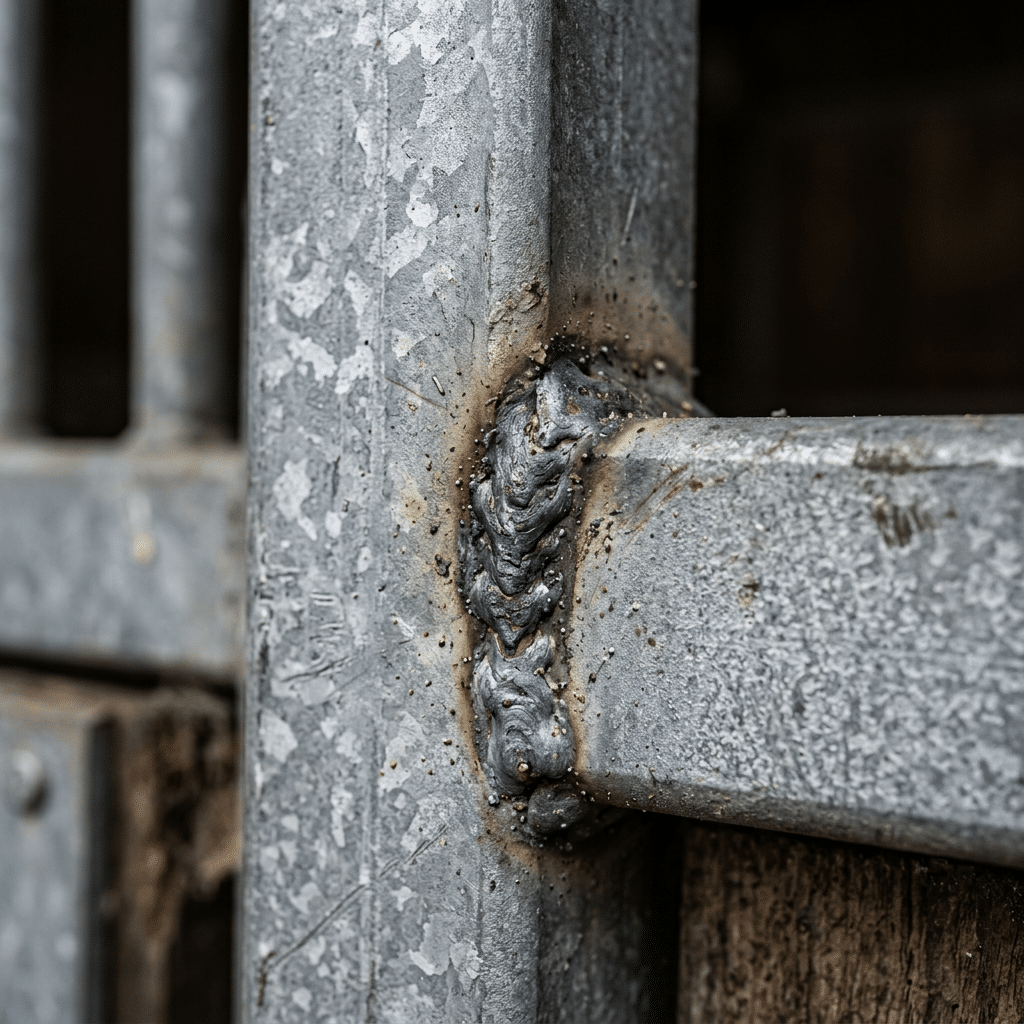
PVC earns its place here because it does not corrode the way coated steel does. The PVC shell itself does not rust, and there is no exterior weld bead exposed to weather. But the steel insert inside the post is coated steel, so ask for its coating to be documented too. The trade-off with plastic is stiffness — see our breakdown of PVC versus wooden arena fencing. Plastic sections flex, and flex shows up as a line gone out of square: panels rack, meaning the rectangle twists into a parallelogram, screws work loose at the brackets, and the top rail sags between posts. Wall thickness and internal reinforcement hold that back.
Profile Thickness: What the Number Has to Cover
Wall thickness is the plastic itself — the measured depth of the profile wall at a cut section. Two fences can both be described as heavy-duty white three-rail and still differ by a large fraction of the wall. Ask for the figure per component, in writing, with the rail and the post listed separately. A quotation that gives one number for the whole system is not a specification; it is a slogan.
No profile wall figures are published for this site’s fencing lines. That is normal. The red flag is a supplier who will not put a number on paper. Request it as a line item, then check the delivered goods against it before the first post goes in the ground.
| Spec line | What it governs | On delivery, check |
|---|---|---|
| Rail profile wall thickness | How much a rail bends and what load it passes to the post | Cut sample measured against the written figure |
| Post profile wall thickness | Shell stiffness around the internal reinforcement | Same figure on every post delivered |
| Insert material and length | Whether reinforcement is continuous or stops mid-height | Galvanized steel section, length per post |
| Rail bracket and connector type | Where wind load enters the post | Part number and fastener count per panel |
| Maximum span between posts | The bending load every line above carries | Measured against the as-built drawing |
Reinforced Post Design and the Path to the Ground
A hollow PVC post is a shell. Reinforced post design means a metal section set inside that cavity — the insert — so the plastic carries weather and the steel carries load. Three follow-up questions separate a real reinforced post from a marketing phrase. What is the insert, and what section is it? Does it run the full post height or stop below the top rail bracket? How is it fixed at the base: grouted into the post, bolted to a ground spike, or set in concrete below frost line?
The last question is where wind claims die. A post whose insert stops at the socket transfers little of that load into the ground. The overturning force at the top of a post has to reach a foundation; in freeze-thaw ground, the post can lever out after a wet winter and a hard gale. Ground work, setting depth and drainage belong to installation, covered in our guide to PVC arena fencing installation.

Openings repeat the problem at a larger scale. A gate leaf is a lever with no rail continuity behind it, and its two posts carry what a run of panels would share between many supports. Ask for the same reinforcement at corners, ends and openings on the order. Our position: reinforce an exposed line at its ends and openings before making it taller, because height adds sail area and overturning force at the posts you already worry about.
Putting a Wind Spec on the Order
Write the exposure on the request for quotation: open ridge, coastal frontage, sheltered yard. Then ask for the five spec lines above as answers, not reassurance. A supplier who returns wall thickness, insert section and maximum span has engaged with your site. A supplier who returns a price has quoted a product. How the site itself behaves under wind load — exposure, soil, drainage — is a separate decision, covered in our guide to New Zealand paddock fencing, wind and drainage.
Keep the evidence trail on one document, because structure and weathering are separate requests. The material-life claim — UV package, test documentation — sits in our piece on UV-stabilized PVC rail weathering certificates, and its 15-year figure does not double as a wind statement. Certification is separate again: manufacturing runs under ISO 9001 with CE marking, and the fencing lines are described as meeting BHS, ASPCA and EU Directive 98/58/EC requirements. None of that says how thick your rail wall is.
Buy the spares with the fence. The fence line starts at 50 panels, volume discounts run 5%-15%, production is 4-6 weeks globally, and regional stock in Sydney or Warsaw can shorten that to 1-2 weeks where the item is held. A damaged corner post should not wait on a container. Orders of 20 sets or above get a dedicated regional account manager for customization and logistics consultation — the right channel for a spec this detailed. The horse fence product page is where that conversation starts.
Frequently Asked Questions
Does a thicker PVC rail always mean a better fence in wind?
No. Wall thickness only matters together with the post insert and the span between posts. A thick rail carried on unreinforced posts at long spans can still rack; the load simply moves down to the foundation.
Is rigid PVC fencing suitable for a coastal or exposed site?
It is commonly specified where corrosion drives maintenance, and this site positions UV-resistant PVC for hot, high-sun markets such as Australia and Spain. For wind exposure specifically, ask the supplier to state in writing which site condition the profile and post are intended for.
How do I verify a delivered profile matches the written spec?
Cut a sample rail and post on arrival, measure the wall at the cut, photograph the measurement, and file it against the quotation line before installation starts. Ask for the cut sample with the pre-production sample so you have a reference value.
Where does wind damage usually show up first on a rail line?
At corners, end panels and gate openings, where one post carries what a run of panels would share. Loose brackets and a line out of square are the usual first signs — a fixable early warning if you catch them.
Conclusion
An exposed perimeter stands or falls on documented structure: rail wall, post wall, insert, connector and span. Put those five lines on the order, check them against the goods, and reinforce where the load concentrates.
Send your site description with the drawing, not after it. The horse fence product page is the fastest way to start that spec conversation.

 English
 Spanish
 French
 Arabic
 German
0 Comments