
Fence line feeding starts as a convenience — hay or grain set along a panel line where a group can reach it without being caught in a paddock corner — and ends as a procurement question. The moment feed lives on the fence, the fence becomes the most loaded, most chewed, most shouldered structure on the property, and the people distributing feed suddenly work inside the horses’ flight line.
Two patterns repeat in feeding-line enquiries: panel systems loaded sideways by a competitive herd at the feeding line, and handler access planned as an afterthought. Both are settled on the layout drawing, long before the container ships.
Key Takeaways
- Feeding along a fence line turns light-duty perimeter into load-bearing infrastructure. Panels, joints and bases take shoulders and pull-backs all day, not just wind and weather.
- Long, continuous runs beat short stitched ones: fewer corner posts in the bite zone, fewer joints where a foot or a halter can catch.
- Two lines of approach protect the handler — a horse side and a human side that never cross at feeding time. Gates and panel gaps decide whether that separation exists or is wished for.
- Galvanization and coating claims matter most exactly where mouths and hooves work the metal; first-rust patterns along the feeding line tell you which spec you actually bought.
- Panel height, rail spacing, feeder fixings and trough dimensions are not published for this site’s fence line — they belong on the written quotation, with the MOQ of 50 panels as the ordering floor.
What Feeding at the Fence Changes
A perimeter panel spends most of its life carrying weather. A feeding-line panel carries a herd. Horses queue along a resource line shoulder to shoulder, lean in to pull hay, and back out into the rails when the neighboring horse has opinions. Over a season, that is thousands of lateral cycles on joints and bases that were ordered as boundary fencing.
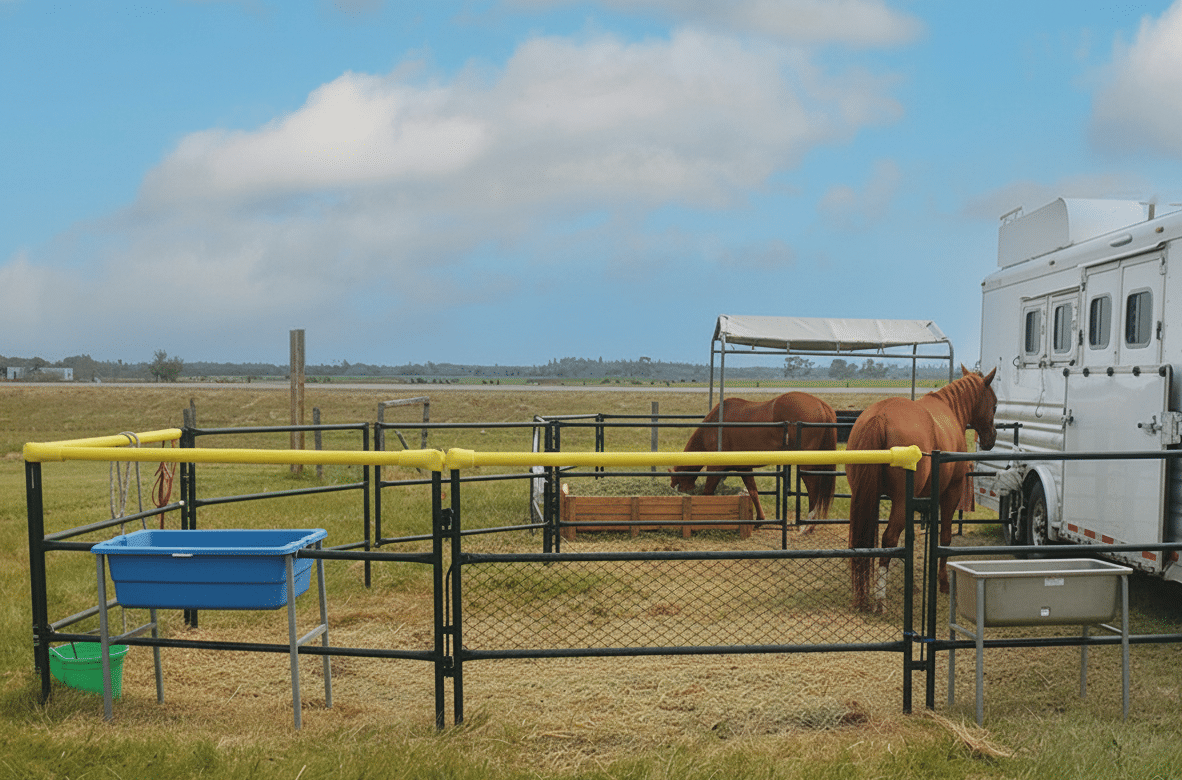
The feeding method sets the load profile. A hay line dropped along the fence spreads the group and keeps heads up; a single trough concentrates them and adds a fixed object the fence now has to accommodate. Grain tends to arrive by buckets on the human side, which is exactly when horses move toward the fence with intent. None of this argues against fence line feeding — it argues for ordering the fence for the feeding, not beside it.
Panel Layouts: Runs, Corners and Escape Lanes
Layout is where most of the safety is won, at zero hardware cost. Three principles carry over from paddock practice into feeding lines.
- Long runs, few joints: every joint in a feeding line is a pinch point and a rattle point. Where panel widths force a choice, put the joints in the quiet stretches and keep the feeding stretch continuous.
- No blind corners: a horse that cannot see around a corner into a feeding group is the one most likely to end up trapped. Sightline and corner geometry deserve their own study — this site covers arena fencing sightlines and corner design; near the feed line, give corners visibility or width rather than a hinge alone.
- Plan at least two exits per group: a feeding crowd tends to block the route it came in on. Confirm the number for your herd with your supplier and yard manager. The second escape does not have to be a gate — a removable panel section serves, if it is the same hardware as the rest of the line.
Give the line a graded or well-drained strip on the horse side. Feed line, hoof traffic and spilled forage concentrate moisture at exactly the band where the coating is already being worked. The drainage logic of a stable aisle applies to a feeding fence with less concrete and more mud.
Hardware Under Mouths and Shoulders
The connection hardware takes the feeding load, so it is the part worth interrogating before it ships. This site’s guide to panel connection systems — pins, clamps and load transfer covers the mechanics; the feeding-line version of that question is simpler: what holds the joint closed when two horses lean from opposite sides, and what happens to that same joint when a tooth finds it?

Coating is a mouth-and-hoof question here, not just a weather question. This site states twenty-year rust resistance for its hot-dip galvanized steel line; along a feeding fence, that claim gets tested at rails-to-post overlaps and at every repaired cut. Where corrosion patterns first appear on paddocks, and what they say about the coating actually supplied, is the subject of the corrosion-zone guide to galvanized panels — the feeding line is simply the zone that wears fastest.
Our position: keep feeders as independent structures. A trough or rack that bolts to the fence transfers its crowd load into panels and joints sized for containment; a freestanding feeder lets the fence do only the job it was rated for. Where a fixings-to-panel system is offered, get the load path explained in writing.

The Order That Arrives Feed-Ready
Panel height, rail spacing, base treatment and feeder dimensions are not published for this fence line, and a supplier who quotes them casually on a call is quoting a draft. Put these lines on the request and make the answers come back in writing. The fence product page is the starting point; the order is where the feeding scenario gets specified.
| Order line | Why it matters at the feed line |
|---|---|
| Panel gauge, profile and height per run | Feeding stretches want a heavier story than quiet perimeter |
| Joint type and connector spec per joint | Joints placed in the bite zone need named hardware, not improvisation |
| Base and anchoring method by ground type | Shoulder loads walk shallow bases sideways through a season |
| Coating process stated per component | Rails, posts and connectors can arrive with different finishes |
| Gate and removable-section positions | The escape lane and the human approach are drawn, not discovered |
| Spare connectors and one spare section | With a 4-6 week global lead time, the broken joint waits for the next container |
Ordering mechanics sit behind all of it: the fence line starts at 50 panels, and volume discounts run 5%-15%, which usually makes one mixed order — feeding line plus perimeter plus spares — cheaper than three emergencies spread across a season.
Frequently Asked Questions
Is feeding along a fence line safer than ground feeding in a corner?
As a general layout rule, rather than a safety certification: along an open line, horses can see each other and back away; in a corner, the group compresses and escape routes shrink. The fence still has to be ordered for the leaning and shouldering either way.
Can I bolt a hay trough directly to horse panels?
Physically yes; on a specification, only if the supplier confirms the panel and joint are rated for that added load. Otherwise the trough crowds become lateral loads on containment hardware.
How far apart should feeding stations be?
Spacing depends on herd size, temperament and feeder type, and this site publishes no station-spacing figures. Put the group composition in the supplier’s hands and ask for a layout, then adjust on site with the removable sections.
What keeps horses from working a panel joint open?
Joint design mostly: captive pins or clamped connections stay closed under leaning better than loose pins that rattle. The connection-systems guide breaks down how load moves through each type.
Do portable panels work as a permanent feeding line?
Many yards run portable panels as seasonal feeding lines and accept the base work that implies. Confirm the anchoring method for your ground type in writing; a flat base that moves with a lean will not stay a feeding line.
Conclusion
A feeding line is a load-bearing decision made with ordinary fence parts. Long runs with placed joints, corners that can be seen around, two ways out for the herd, a human approach that never crosses the horses’ line, and an order that names gauge, joints, bases and coatings — that is most of what keeps both species walking away from the fence.
Draw the feeding scenario before requesting the quote, and send the drawing with it; the customization page is where layout questions like this one get answered.


 English
 Spanish
 French
 Arabic
 German
0 Comments