


Nobody at a showground asks how fast the stalls went up. They ask how many horses the field can take, who supplied them, and whether the row is still standing on day three. A one-off weekend and a season of hire look identical in a photograph and behave nothing alike in a purchase order. Temporary horse stabling was either rented from a dealer with regional stock or bought by someone planning to strike it twenty more times, and that fact sets the budget, the calendar and the spec.
Treat temporary stabling as a reuse question first and a product question second. DB HorseStable is a manufacturer, not a rental counter: its modular hot-dip galvanized stalls carry a 20-year rust-protection specification and ship from a 10-stable-set minimum — terms that suit a fleet owner and make little sense for a single date.
Key Takeaways
- A single show and a season of hire are different procurement problems. Count reuse cycles before you request a price.
- Three routes fill a field: a dealer’s rental fleet, a purchase at manufacturer minimums, or an owned base topped up with rentals.
- Manufacturer minimums start at 10 stable sets or 50 fence panels, with a 5-15% volume discount on larger runs — below that threshold, renting is the rational move.
- Global delivery runs 4-6 weeks and expedited supply from the Sydney and Warsaw hubs 1-2 weeks; event-dense regions sit inside those catchments, which is what makes a mid-season top-up possible.
- Pin the venue in writing before the supply route: surface, anchoring permission, wash-down area and the delivery window.
- Wash-down between venues decides whether a fleet survives a season. The 20-year hot-dip specification pays only if panels get cleaned, drained and stored dry.
A Weekend Show and a Season Are Different Products
The same row of modular units gets judged on different clocks. A rental company amortizes a set across dozens of venues a year, so it buys for teardown speed. A yard buying one set for one club day amortizes it twice, so it optimizes for price and for whatever the showground allows. Those two briefs are not the same document, and the specification that follows from them is not the same specification.
Reuse also changes what the materials are worth. A hot-dip galvanized frame with a 20-year rust-protection specification is an asset for someone running the units every other weekend and close to overkill for a single club day. For that buyer, the honest comparison is against a rental quote for the same weekend.
That is why this guide starts on the commercial side of the modular stable range. The setup, anchoring and RFQ detail for a single event sits in its own piece; what follows is the season-level decision.
Three Ways to Fill a Field
Route one: rent from a dealer who keeps stock in your region. You pay for the date, the transport and the crew, and wash-down and storage belong to somebody else. Route two: buy. Manufacturer minimums apply — 10 stable sets for stabling, 50 panels for the fencing that closes the paddocks — so a purchase is a fleet decision even when the show is small. Route three: buy a base and rent the peak.
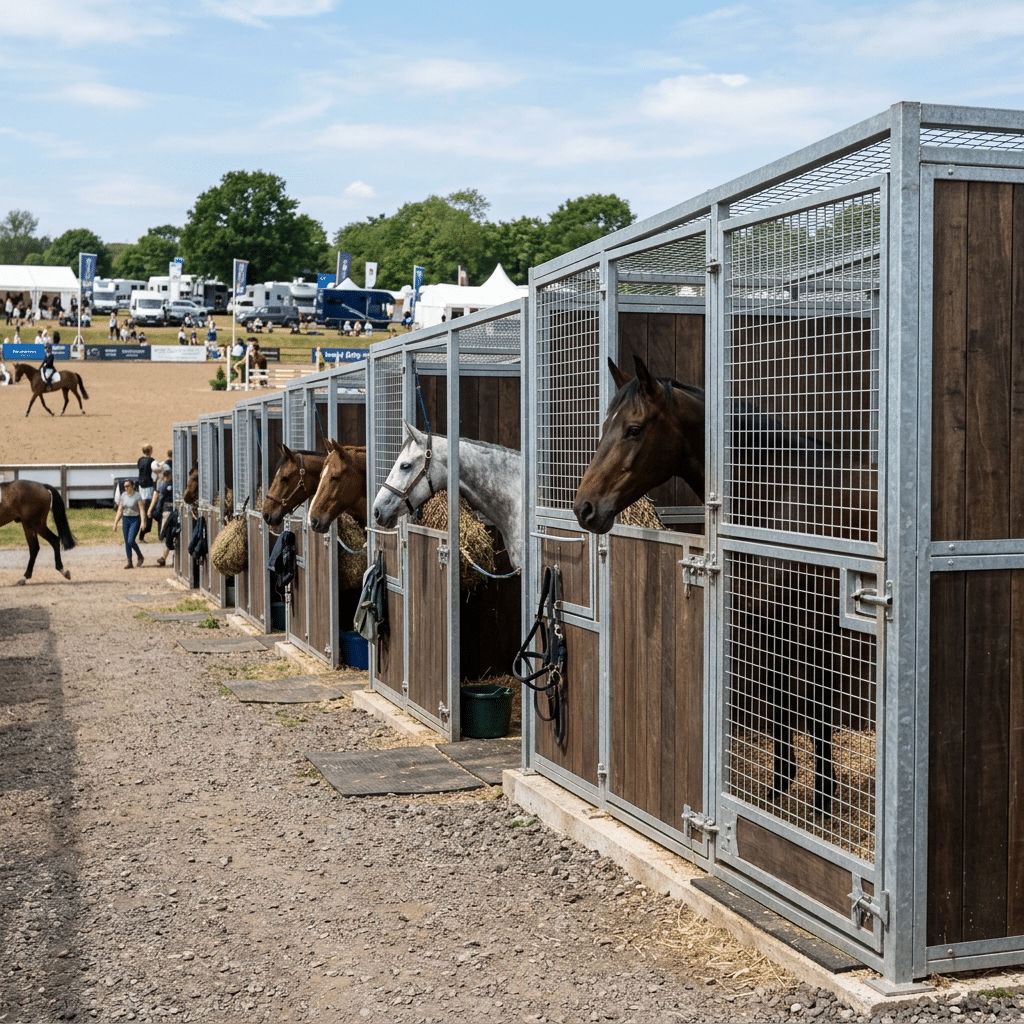
Regional stock shapes which route is realistic. Expedited supply out of the Sydney and Warsaw warehouses runs 1-2 weeks against 4-6 weeks globally, which is why event-dense regions inside those catchments can support both rental fleets and fast top-ups.
Utilization Decides Rent or Buy
Count two things: dates the units will work in a year, and whether you have anywhere to keep them between those dates. Those answers decide the route more reliably than any price list, because a purchased fleet that sleeps eleven months a year is a rental you bought at full cost.
| Program shape | Route that holds up | What belongs in the order |
|---|---|---|
| One or two club days a year | Rent from a regional dealer | Nothing from the factory; a rental line on the budget |
| A circuit with dates most months | Buy at the 10-set minimum | Spare parts, lining boards, wash-down and storage plan |
| A season with one oversized weekend | Owned base plus rented peak | One connector and panel spec across both |
| Twenty sets or more | Buy, with an account manager assigned | Volume terms and multi-venue logistics mapped once |
Our position: rent until the calendar and the storage both say buy. Below the 10-set minimum a purchase is not on the table anyway, and the rental route keeps the risk with the supplier. Above it, a fleet starts to earn at the point where panels are working rather than sitting in a shed, and 5-15% volume discounts plus the 500-plus-set monthly capacity make restocking a used fleet a scheduling problem rather than a negotiation.
Agree the Venue Before You Agree the Order
The venue contract, not the supplier, kills most season plans. Get four things in writing from the showground before you commit to a route: what surface you get and what anchoring it permits; where wash-down is allowed and where that water goes; the delivery and collection window, including yard access; and who supplies labor on the day.
Then buy or rent to that answer, not to the catalog. Hardstanding takes a different base detail from grass, and a fleet that moves between both in one season needs a configuration each site signs off. Specific figures — stall dimensions, unit weights, how many sets fit a container — are not published for this range; ask the supplier in writing and let the venue’s constraints decide the rest.
Wash-Down, Rotation and the Hygiene Cycle
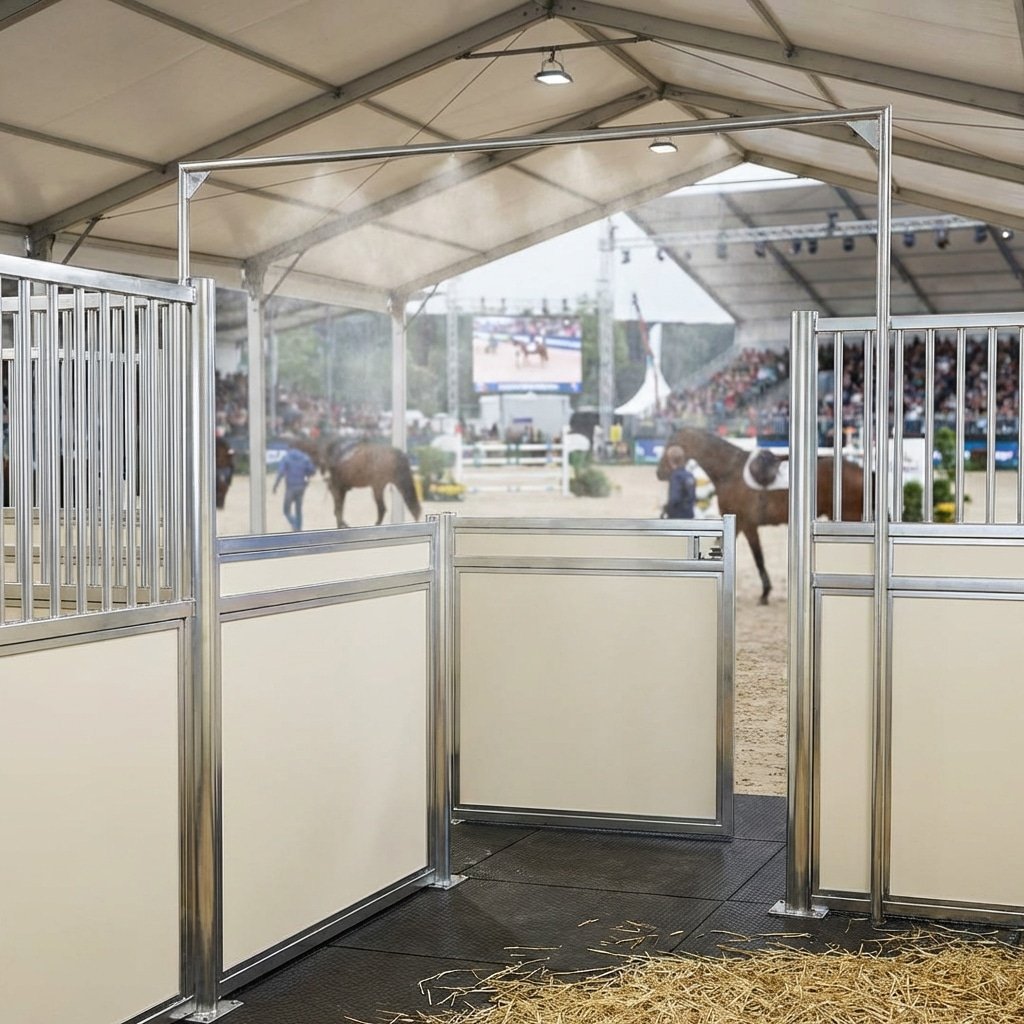
A fleet that visits several venues in a season is a hygiene object as much as a furniture object. Between lots it gets swept, washed, drained and dried; disease movement at large gatherings is a live concern for any organizer, and the practical control is the gap between one yard’s horses and the next. Requirements vary by country and event type, so confirm what the authorities in your market expect rather than importing someone else’s checklist.
What you can control is what is cleanable. Solid lower panels and HDPE or bamboo lining boards — specified by this manufacturer as chew-resistant and hard-wearing — give you something a pressure washer does not ruin. Confirm the recommended cleaning method and any pressure limits in writing with the supplier.
Storage is the half nobody photographs. Panels stacked wet undo the point of buying galvanized: the 20-year rust-protection specification holds only where the coating is washed, drained and kept dry between events. That logic feeds straight into the five-year rent-versus-buy comparison for yards weighing a fleet against a barn.
Ordering Against a Show Calendar
Global production and shipping typically runs 4-6 weeks once an order is placed, with expedited supply at 1-2 weeks from the Sydney and Warsaw warehouses. Work backwards from the first date on the calendar and add the venue’s access window; a season that starts in spring gets ordered in the quiet months.
On the commercial side, a 5-15% volume discount applies to larger orders, and orders of 20 sets or more come with a dedicated regional account manager. Minimum order quantities, tiered pricing and lead times in full are covered in our wholesale pricing guide.
Frequently Asked Questions
How many horses can one temporary stabling layout take?
Count sets, not goodwill. Manufacturer minimums start at 10 stable sets or 50 fence panels, and stall dimensions for this range are not published — get the layout confirmed in writing before you sell pitches.
Can I buy fewer than ten sets?
Not from the factory, where 10 stable sets is the stated minimum. Below that, a regional rental fleet is the practical route; a 20-set order is where an account manager enters the picture.
How much does renting cost per show?
Rental rates are dealer-level numbers and are not published here. Compare three regional quotes for the same date, and read transport, crew and wash-down in the line items rather than the nightly rate alone.
Can I top up a fleet mid-season?
If the calendar allows. Global orders typically run 4-6 weeks and expedited supply from the Sydney or Warsaw hub 1-2 weeks; both are stated windows rather than guarantees, so confirm against the production slot.
What hygiene proof do venues ask for?
It varies by country and event type. Keep a wash-down log between venues, get the organizer’s requirements in writing, and confirm the cleaning method your panels tolerate with the supplier.
Conclusion
The route you choose decides whether the season is a cost line or an asset. Reuse cycles, storage and the venue contract do that work; the stall spec only follows. Rent through the first two seasons, then buy when the calendar can absorb a 10-set minimum and the wash-down cycle can keep the panels honest.
Put your dates on one sheet before you talk to anyone, and take it to the modular stable range — or, if you are running dates in the Sydney catchment, the Australia solutions page — so the order is sized against the calendar rather than a catalog.

 English
 Spanish
 French
 Arabic
 German
0 Comments