


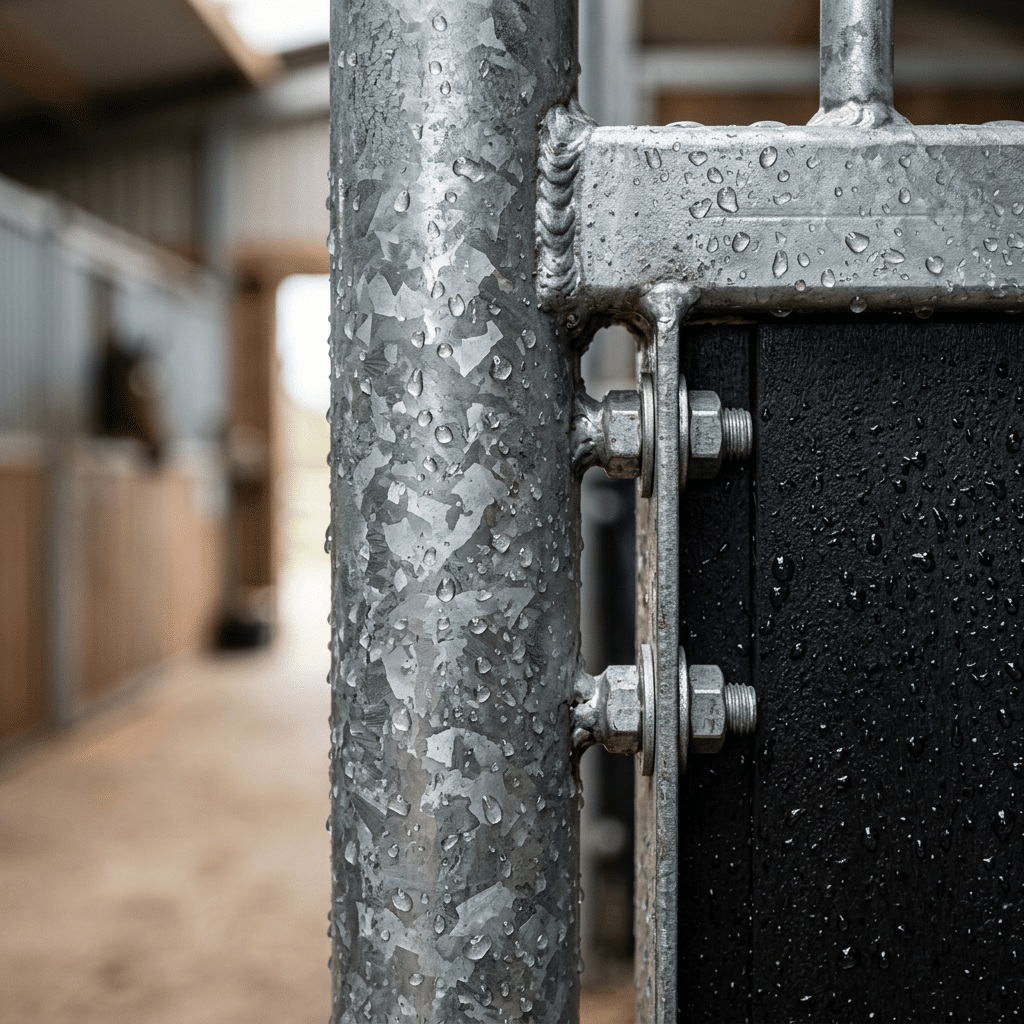
Confinement stress leads to destructive behaviors like pawing and weaving that cause cumulative damage to standard horse stalls. These repetitive impacts create material fatigue, resulting in bent bars and broken welds that become a recurring maintenance cost and a serious safety liability for any equestrian facility.
This analysis specifies hardware engineered to mitigate these risks, focusing on the impact toughness of Q345B steel. We evaluate how open-grill designs and hot-dip galvanization after fabrication provide a structural solution that lowers operational costs and directly addresses the welfare issues of isolation.
Understanding Stall Confinement Stress in Horses
Stall confinement prevents natural grazing and socializing, causing measurable stress. This can lead to severe health issues like colic, ulcers, and behavioral problems.
Physical and Behavioral Effects of Isolation
When horses are confined to stalls for long periods, they can’t move, graze, or interact with a herd. This restriction isn’t just an inconvenience; it triggers a cascade of documented physiological and behavioral problems. The stress is not theoretical—it can be measured in their blood and observed in their actions.
- Elevated Stress Markers: Research shows confined horses have higher levels of stress hormones, including fecal corticosterone and cortisol. These horses also become more difficult to handle.
- Gastrointestinal Damage: Stall confinement is directly linked to a 54% increase in impaction colic cases. The stress also increases stomach acid production, which raises the risk for painful gastric ulcers.
- Respiratory Disease: Poorly ventilated stalls trap dust, mold, and ammonia. Prolonged exposure can cause equine asthma, known as heaves, leading to chronic coughing and breathing difficulty.
- Stereotypic Behaviors: Boredom and stress manifest as “stable vices.” Stall walking and weaving are common, causing uneven hoof wear and weight loss as the horse paces instead of eating.

The Role of Ventilation and Social Contact in Stall Design
You can’t eliminate the need for stalling, but you can engineer the environment to reduce its negative effects. Smart stall design directly addresses the root causes of confinement stress: poor air quality and social isolation. The physical structure of the stable front and partitions plays a critical role in a horse’s daily well-being.
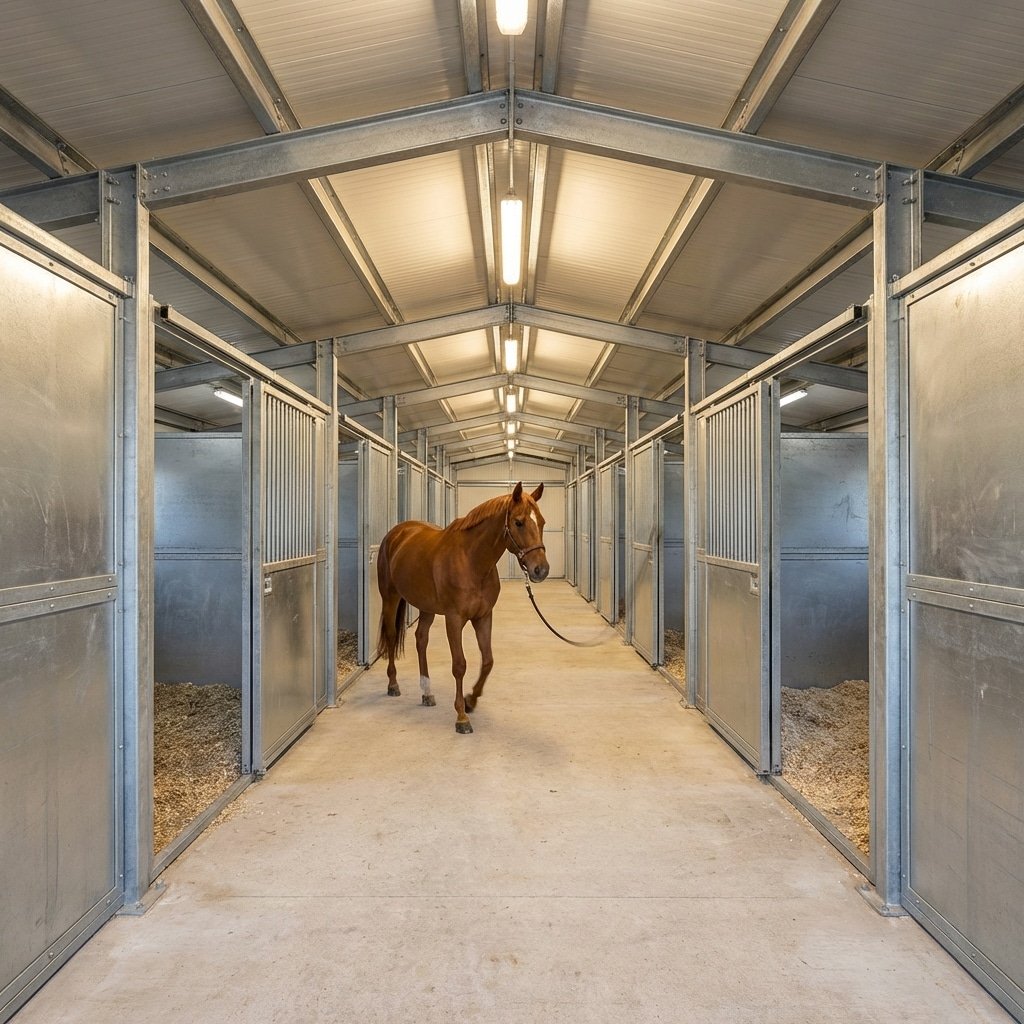
Open grill or mesh designs on stall fronts and partitions are essential for airflow. They promote what is known as “Stack Effect Ventilation,” where warm, ammonia-laden air rises and exits the barn while fresh, cool air is drawn in. This constant circulation helps prevent the buildup of harmful particulates that cause respiratory illness.
These open designs also provide the visual contact horses need to feel part of a herd. Seeing other horses reduces the anxiety of isolation and discourages the development of stereotypic behaviors. A well-designed stable provides a safe, secure space where a horse can still engage in natural herd behaviors, even when confined.
The Danger of Visual Isolation in Solid Boxes
Solid stall boxes cause significant neurological stress in horses. Open-grill designs provide essential social contact and ventilation, directly improving animal welfare and operational safety.
The Neurological Impact of Confinement Stress
Horses are herd animals, and complete visual isolation triggers a measurable and damaging stress response. Depriving them of sensory input from their surroundings and neigh
bors isn’t just unpleasant; it causes physical changes in the brain that lead to behavioral problems. This isn’t speculation. Research shows that confinement stress directly alters brain structure and chemistry.
- Hormonal Imbalance: Isolation leads to chronically elevated levels of stress hormones like cortisol and noradrenaline, keeping the horse in a constant state of fight-or-flight.
- Brain Atrophy: Sensory deprivation can cause neurons in the hippocampus to shrink. This area of the brain is critical for memory and emotional regulation, so its deterioration impairs a horse’s ability to learn and cope.
- Heightened Fear Response: That same stress causes the amygdala—the brain’s fear center—to grow. This makes horses more reactive, fearful, and potentially aggressive, posing a risk to handlers and other animals.
Open Top Grills: A Design for Social Well-being
The most direct engineering solution to visual isolation is a stall partition with an open top grill. This design directly addresses the core welfare issues of solid boxes by restoring two critical environmental factors: social connection and air quality. It’s a simple feature that prevents complex problems.
- Reduces Social Stress: Open grills allow horses to see, hear, and safely interact with their neighbors. This visual connection satisfies their natural herd instinct, reducing the loneliness and anxiety that fuel stable vices.
- Improves Air Quality: The design promotes what we call “Stack Effect Ventilation.” Warm, stale air containing ammonia and dust rises and escapes through the upper open sections, while cooler, fresh air is drawn in from below.
- Balances Safety and Socialization: A well-engineered grill provides the structural security needed for containment while giving horses the mental and physical benefits of an open, airy environment.
Globally Compliant Stables Built to Last
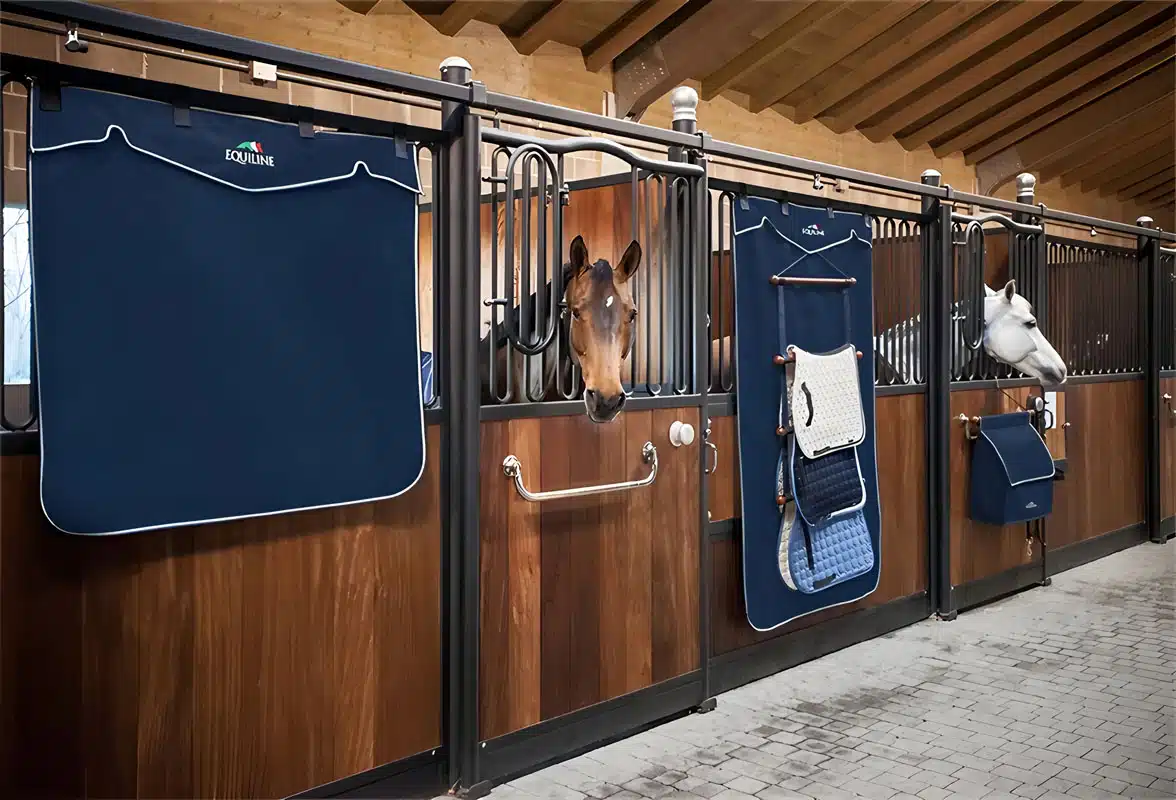
The Social Door: Yoke Fronts vs. V-Drop Systems
Social openings like yokes or V-drops let horses interact, cutting confinement stress. Yokes are fixed openings, while V-drops offer flexibility to open or close the gap.
When specifying stall fronts, the choice between a fixed yoke or a more flexible V-drop system comes down to operational needs. Both designs aim to solve the same problem: reducing the well-documented stress horses experience from isolation. A horse that can safely extend its head is less likely to develop behavioral issues. The key is ensuring the design is backed by robust engineering so the opening doesn’t become a weak point.
| Feature | Yoke Fronts | V-Drop Systems |
|---|---|---|
| Design | A fixed, permanent V-shaped or U-shaped cutout in the stall door grill. | A hinged or removable panel that swings down or out, creating a temporary V-opening. |
| Flexibility | Low. The opening is always present and cannot be closed off. | High. Allows managers to close the opening for specific horses, bad weather, or during feeding. |
| Best For | Facilities with well-behaved horses where constant social access is the priority. Simpler, with no moving parts. | Training centers, boarding barns, or quarantine units where management needs control over individual horse access. |
How Social Openings Reduce Confinement Stress
Horses are herd animals. Complete isolation in a solid box stall goes against their nature and leads to measurable stress, which often results in behavioral problems. Providing a safe way for them to see their environment and interact with neighbors directly addresses this fundamental welfare need. The goal isn’t just to look out, but to feel connected to the barn’s activity.
- They satisfy a horse’s herd instinct by allowing them to extend their heads to see, smell, and socialize with other horses and people.
- This environmental enrichment provides visual stimulation, which helps reduce stress-related habits like weaving or stall walking.
- Handlers can perform daily health checks, greet, or treat a horse without needing to fully open the stall door, improving daily efficiency.
Material Strength for Social Doors: The Q345B Advantage
Any opening in a stall front is a potential point of failure if not engineered correctly. A horse leaning, pushing, or kicking can easily compromise thin-walled tubing or poorly executed welds. This is where material specification becomes non-negotiable for safety.
- We use **Q345B high-strength steel** as an option for facilities in cold climates. Its superior impact toughness prevents brittle fractures from kicks, a common issue with standard steel in freezing temperatures.
- The design maintains safety with minimal bottom gaps, creating a **cast-proof design** that prevents a rolling horse from getting a leg stuck.
- The entire panel is **hot-dip galvanized after fabrication**, meaning after all cutting and welding is complete. This process fully coats every edge of the yoke or V-drop opening, preventing rust from attacking the most vulnerable points.
Half-Mesh Partitions: Balancing Safety with Socialization
Half-mesh partitions use a solid lower section for safety and a grilled upper section. This design lets horses socialize, reducing confinement stress while ensuring secure separation and better airflow.
Combining Physical Separation with Visual Connection
The core function of a partition is physical separation. A solid lower section is non-negotiable for preventing kicks, bites, and other negative interactions between unfamiliar or temperamental horses. This solid barrier ensures that animals can rest without the threat of physical conflict from a neighbor.
The open, grilled upper section directly addresses the psychological stress caused by isolation. Horses are herd animals, and complete visual separation can lead to anxiety and stable vices. The grilled design allows for visual and auditory interaction, which significantly reduces the stress of confinement. It also promotes what we call “Stack Effect Ventilation,” allowing warm, stale air to rise and escape while fresh air circulates, improving the barn’s overall respiratory environment.
Material Specifi
cations for Durability and Animal Welfare
The lower section must absorb impact and withstand constant abuse. We use either impact-absorbing HDPE for a zero-maintenance, kick-proof barrier or high-density bamboo, which is three times harder than oak. Both options are designed to handle repeated strikes without cracking or failing, ensuring long-term safety for the animal.
For the upper grille, structural integrity and rust prevention are critical. We use Q235B structural steel, but the manufacturing process is what sets it apart. The entire panel is welded first and then submerged in molten zinc. This process, known as Hot-Dip Galvanization after fabrication, ensures every weld, corner, and edge is fully coated, providing lifetime protection against rust and corrosion common in barn environments.
Protecting the Stall: Q345B Steel Against Chronic Pawing
Chronic pawing causes cumulative damage and fatigue in standard stalls. Q345B steel, with its superior impact toughness, resists this repetitive stress and prevents brittle fractures.
The Cumulative Damage from Repetitive Strikes
A horse pawing is not a single, powerful event. It’s thousands of repetitive, focused impacts concentrated on the same small area. This constant striking creates stress points that lead to material fatigue in standard steel, much like bending a paperclip back and forth until it breaks. Over time, you see the results: dents, bent bars, and weakened weld joints. This isn’t just a cosmetic problem; it’s a structural failure waiting to happen, compromising the safety of the enclosure.
Q345B Steel: Engineered for Impact Resistance
This is where material specification becomes critical. Q345B is a low-alloy, high-strength structural steel, equivalent to ASTM Grade 50, used specifically for high-stress applications. Its key advantage is superior low-temperature impact toughness. While ordinary steel can become brittle and fracture from a kick in colder climates, Q345B is engineered to absorb that repetitive energy without failing. This property directly counters the material fatigue caused by chronic pawing and ensures the stall maintains its structural integrity year after year.
Frequently Asked Questions
Why does my horse weave in the stall?
Weaving is a stress-related behavior often caused by boredom and confinement. Horses are social animals that require stimulation; limited turnout, social isolation, and anxiety around feeding time can trigger it. Increasing pasture time, providing constant access to forage, and ensuring the horse can see other horses are effective management strategies.
How can I keep a horse calm during stall rest?
Keeping a horse calm on stall rest involves a combination of social interaction, environmental enrichment, and proper diet. Frequent human visits, a nearby companion horse, calming music, and simple training exercises can reduce boredom. A high-fiber, low-energy diet provided through slow feeders helps manage excess energy and supports gut health.
Are open stall fronts better for horse welfare?
Yes, open stall fronts significantly benefit a horse’s well-being. They provide superior ventilation to prevent respiratory issues, allow more natural light, and facilitate crucial social interaction between horses. This visual contact reduces confinement stress and helps prevent behavioral problems like stall kicking or pacing.
What is a V-drop stall door?
A V-drop stall door has a V-shaped opening that allows a horse to safely put its head into the aisle, promoting social interaction and reducing boredom. These doors are typically made from durable, hot-dip galvanized steel and offer flexibility by allowing operators to switch between open and closed configurations.
Do horses really need to see each other in their stalls?
Yes, visual contact is a fundamental requirement for these herd animals. Isolation causes significant stress. Stalls should be designed so horses can see, hear, and smell their neighbors. This social access is critical for their psychological well-being and helps prevent the development of stress-induced behaviors.
Final Thoughts
While generic stalls offer a lower initial price, specifying Q345B steel and hot-dip galvanization after fabrication is the only way to protect your business from safety claims. This isn’t just about animal welfare; it’s about underwriting the long-term value of your inventory.
Don’t guess on material integrity—verify it firsthand. A trial order is the most effective way to test our engineering and confirm the durability of our anti-rust coating. Contact our team to configure your initial sets and discuss OEM specifications for your market.

 English
  Spanish
  French
  Arabic
  German
0 Comments