


A foaling box is the one stall in the barn where the door gets used at 3 a.m., with a head torch and a vet on the phone. The split front — a Dutch door — is the usual choice in many foaling barns, and foaling box dutch doors earn that place on three jobs at once: you can watch the mare without walking in, reach her without opening a whole leaf into her face, and keep the bottom half closed when she is on the ground with a newborn. Not on looks.
They also concentrate wear. A mare in foal leans, nips and paws at the same small area of the lower panel for weeks, and the hardware takes it in an ammonia-and-wash-down atmosphere. What follows is what to specify, what to check on delivery, and which numbers you should make the supplier put in writing.
Key Takeaways
- The split leaves the lower half as a barrier while the upper half opens for watching, feeding and treatment — that asymmetry is the whole case for a Dutch door in a foaling box.
- The two upper-half styles in this range behave differently: tempered glass shows more of the mare and moves less air, the V-yoke bar front trades sightline for airflow.
- Head and leg capture at the opening is the risk specific to split doors. Bar pitch and clear openings are specification items to get in writing rather than judge by eye.
- Hardware takes the abuse, not the frame: check hinges, latch type and coating at every antenatal inspection rather than after the foal arrives.
- Order terms for a barn fit-out: stable sets from a 10-set minimum, 5-15% volume discount on larger runs, 4-6 weeks globally, 1-2 weeks expedited from the Sydney and Warsaw hubs.
Watching Without Entering
The door is the observation instrument in the final weeks before foaling. A Dutch door with the top half open gives you a line of sight to the mare’s chest, flank and breathing rate while she stays in a stall she has not had to re-enter, and it does that without changing the barrier she is standing behind.
Two upper-half styles in this range do the job differently. The tempered glass option shows more and moves less air; the V-yoke bar front — the second style the range is built in — shows less and moves more air. Barns in warm climates usually want the airflow; barns where a mare needs to be watched through the night from the aisle often want the glass. That is a climate and staffing decision, not a fashion one. Our comparison of the two styles covers the selection arguments; here the point is narrower — pick the upper half by how you intend to watch.
Ventilation is not a bonus in a foaling box either — it helps keep ammonia and moisture down while a mare stands on the same bed for days. Our grill-panel guide covers the split-ventilation mechanics.
Quick Access When You Need It
The lower half stays shut. That is the safety logic of the split door: you can put a bucket, a halter or an arm over the top rail without releasing a mare into a passage, and a foal that has just got up stays inside the box while you work.
For the vet visit, the top leaf should open without tools. Spring-loaded sliding bolts and lift latches are typical fittings on this kind of door, and a latch that stiffens over a wet, ammoniated season is not quick access at 3 a.m. Which fitting suits your climate is a hardware question in its own right, and the last section brings it into the order.
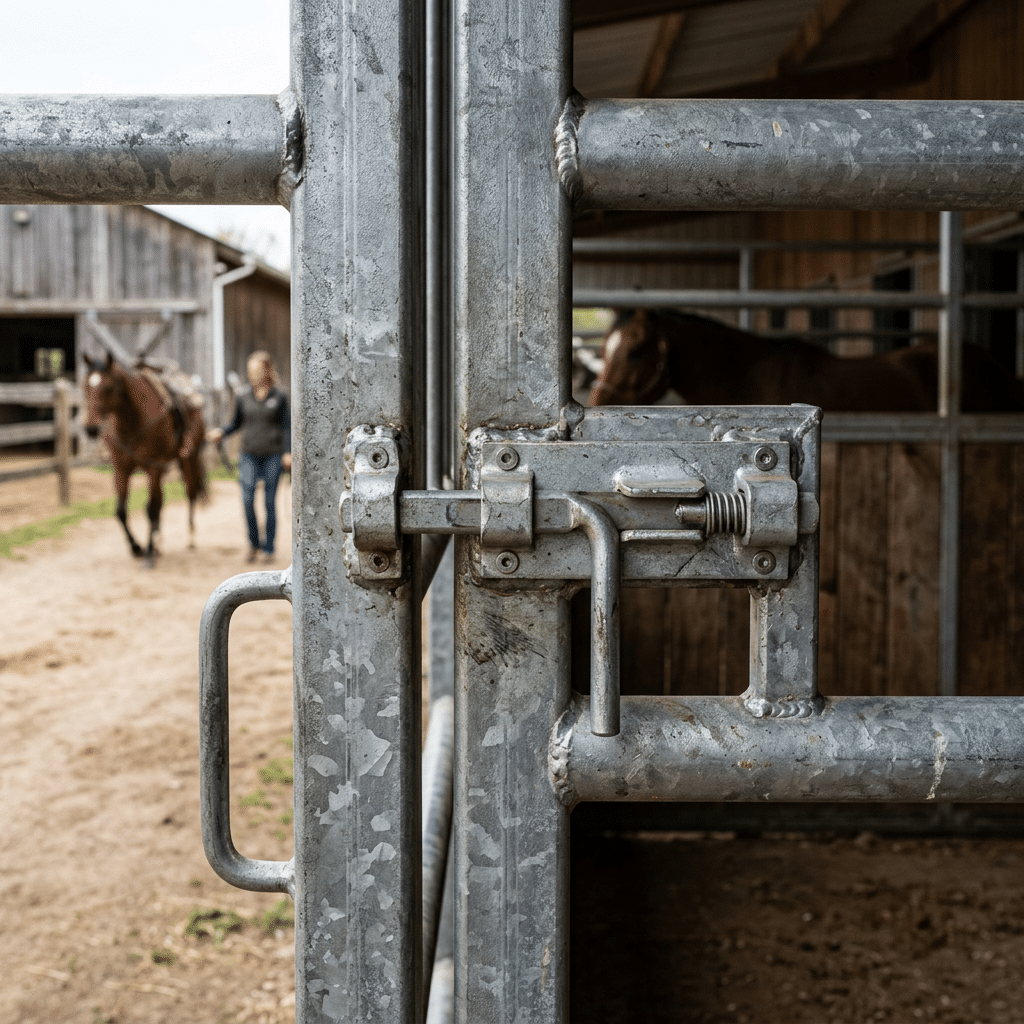
Head and Leg Capture at the Opening
Split doors create an interception risk a solid door does not: a hoof or a muzzle pushed through the gap between the bottom panel and the first bar. This is where specifications matter rather than opinions. Bar pitch, the clear opening above the lower panel and the gap at the hinge stile are dimensions you should make the supplier state in writing for a foaling box; they are not published in this range’s catalog, and eyeballing them on a foaling barn is a recognized way capture injuries start. The same logic applies to a foal’s legs reaching through stall fronts in neighboring boxes — social contact is desirable, an unmeasured gap is not.
Chewing is the other failure mode. A mare in foal works the edge of a door for hours, and a chewed lower panel can splinter and roughen, especially on timber-lined boards, which then leaves a surface that is harder to clean and harder to trust. Lining boards in HDPE or bamboo are specified for exactly that chewing pressure, and they are replaceable parts — cheaper to order as spares than to rebuild a door.
Weeks of Leaning, Nipping and Washing
A foaling box is usually washed out more often than a normal stall, and washed while the mare is standing in it. That combination — water, ammonia, disinfectant and a leaning animal — is where door hardware tends to fail first. Hot-dip galvanized steel carries a 20-year rust-protection specification, which is the reason to insist on it at the fittings rather than only on the frame. Selection of the fittings themselves is the subject of our humid-climate hardware guide; what matters here is the check you run while the mare is still in the barn.
Walk the door before you move the mare in, and again mid-term: hinges for play, the latch for smooth action, the coating for chipping at bolt holes and weld nodes, the lining boards for chew lines. A stiff hinge found before foaling is a short job; found at the moment you need the door, it is not.
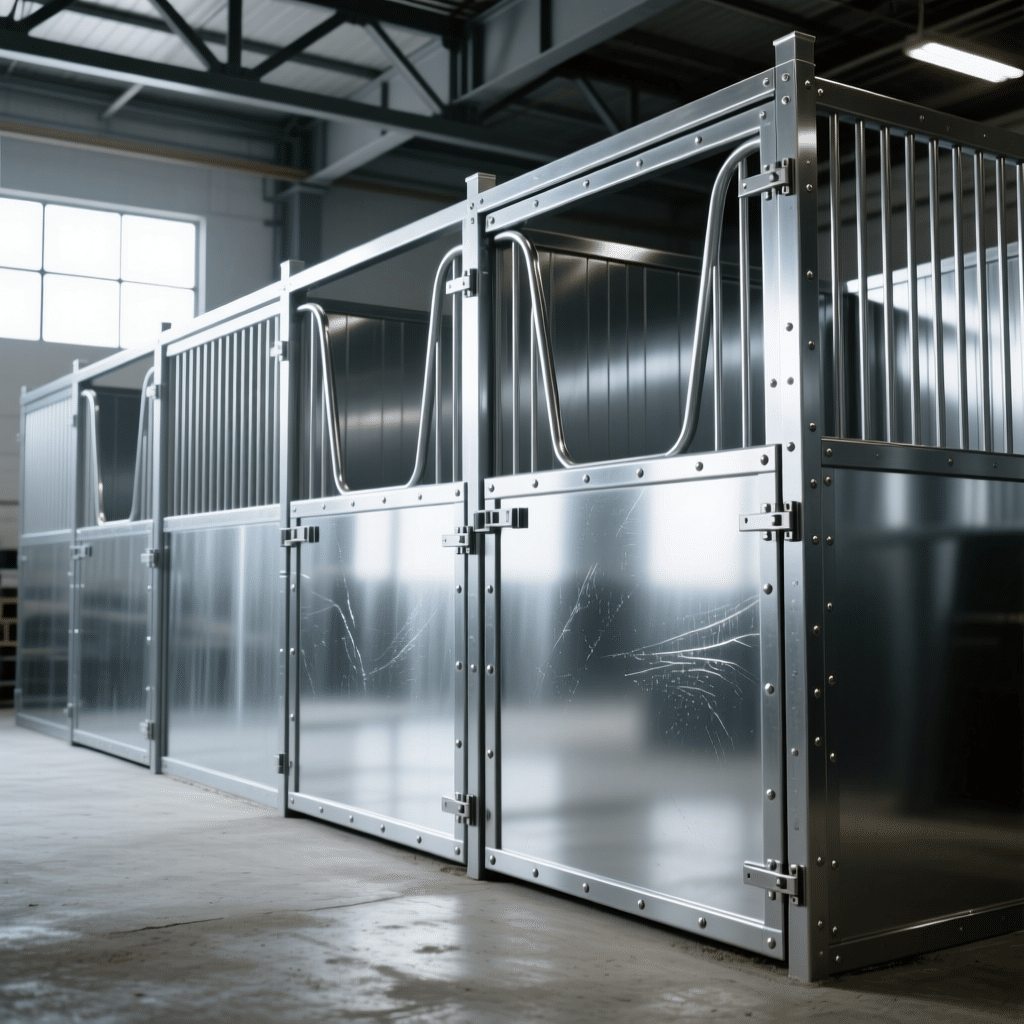
Specifying the Door Before It Ships
Write the brief down before you request a quote. Which upper half — tempered glass or the V-yoke bar front; which latch, and whether it is operable with one hand while holding a foal’s lead; lining material for the lower panel; bar pitch and clear openings in numbers; and the spare-parts list for the season. Dimensional figures for doors and windows in this range are not published in the catalog, so the supplier’s written specification is the document you sign against.

| Item | What to have in writing |
|---|---|
| Upper half | Tempered glass or the V-yoke bar front, matched to your climate and night-watch routine |
| Openings | Bar pitch, clear gap above the lower panel, hinge-stile gap |
| Hardware | Hinge and latch type, one-hand operation, coating at fixings |
| Lining | HDPE or bamboo boards, and spare boards for the season |
| Order terms | 10-set minimum, 5-15% volume discount, 4-6 weeks or 1-2 weeks from a hub |
For a whole-barn fit-out, doors are normally quoted inside a stable set rather than as a separate purchase, and minimums apply at set level: 10 stable sets, with a 5-15% volume discount on larger runs and expedited 1-2 week supply from the Sydney or Warsaw hub. If you are fitting one or two boxes only, ask in writing what the smallest workable order is. Orders of 20 sets or more come with a regional account manager for customization and logistics advice, which can take the door brief into the same conversation. The barn door and window range is where that specification starts.
Frequently Asked Questions
Is a Dutch door safe for a foaling box?
It is safe when the openings are specified rather than assumed. Ask for bar pitch, the clear gap above the lower panel and the hinge-stile gap in writing, and check them on delivery.
Glass or the V-yoke bar front in the upper half?
Glass shows you more of the mare at night; the V-yoke bar front moves more air. Warm, still barns generally want the airflow, and yards running a night watch from the aisle generally want the sightline.
What stops a mare chewing the door?
Chew-resistant lining boards — HDPE or bamboo are what this range specifies — and ordering spares up front. A chewed panel is a maintenance item, not a rebuild.
How often should the hardware be checked?
At least once before the mare moves in and again mid-term. Hinges for play, latches for smooth action, coating at bolt holes and welds for chipping.
Can I order single doors for a few foaling boxes?
Doors normally ship inside stable sets, and factory minimums start at 10 sets. For one or two boxes, ask the supplier what the smallest workable order is before assuming a door-only line exists.
Conclusion
A foaling box door is judged on three things: what you can see without entering, how fast it opens with one hand, and whether any gap in it can catch a foal’s leg. Specify those, and the rest is maintenance.
Write the openings, the latch and the lining into one brief and get it answered in writing — start from the barn door and window range, and read the V-yoke versus tempered glass comparison before you fix the upper half.


 English
 Spanish
 French
 Arabic
 German
0 Comments