


Most horse stable lighting is designed for the person holding the pitchfork, not the horse in the stall. The result shows up as behavior: horses that hesitate at a bright doorway, spook at the aisle’s shift from shadow to glare, or pace under a fixture buzzing at a frequency no human notices. A well-planned horse stable lighting layout works for both species — even, glare-free illumination along the aisle, controlled light in the stalls, and wiring protected from dust, ammonia, and wash-down water.
One boundary up front: precise illumination values for every zone are a job for a lighting designer working from your building’s layout, and this guide deliberately avoids inventing a lux table no authority published. What it gives you instead is the design logic — what horse vision demands, what each zone needs, and which questions to bring to your designer or electrician.
Key Takeaways
- Design for horse eyes, not human eyes: horses adapt slowly between light and dark, notice motion and flicker humans miss, and read the world in a very wide field of view — sudden glare and abrupt light changes are genuine stressors.
- Zone the barn: uniform aisle lighting, low-level even stall light, brighter task zones for grooming and farrier work, and graduated transition lighting at doorways.
- Protect fixtures from barn air: dust and ammonia corrode equipment, so sealed fixtures with an appropriate IP (Ingress Protection) rating belong throughout, with higher water protection in wash bays.
- Flicker and switching matter: flicker-free drivers and staged or dimmed circuits prevent the abrupt changes horses notice most.
- Treat lighting as electrical safety work: dust-laden fixtures, damaged cords, and DIY wiring are leading barn-fire contributors — use a certified electrician.
How Horse Vision Shapes Lighting Design
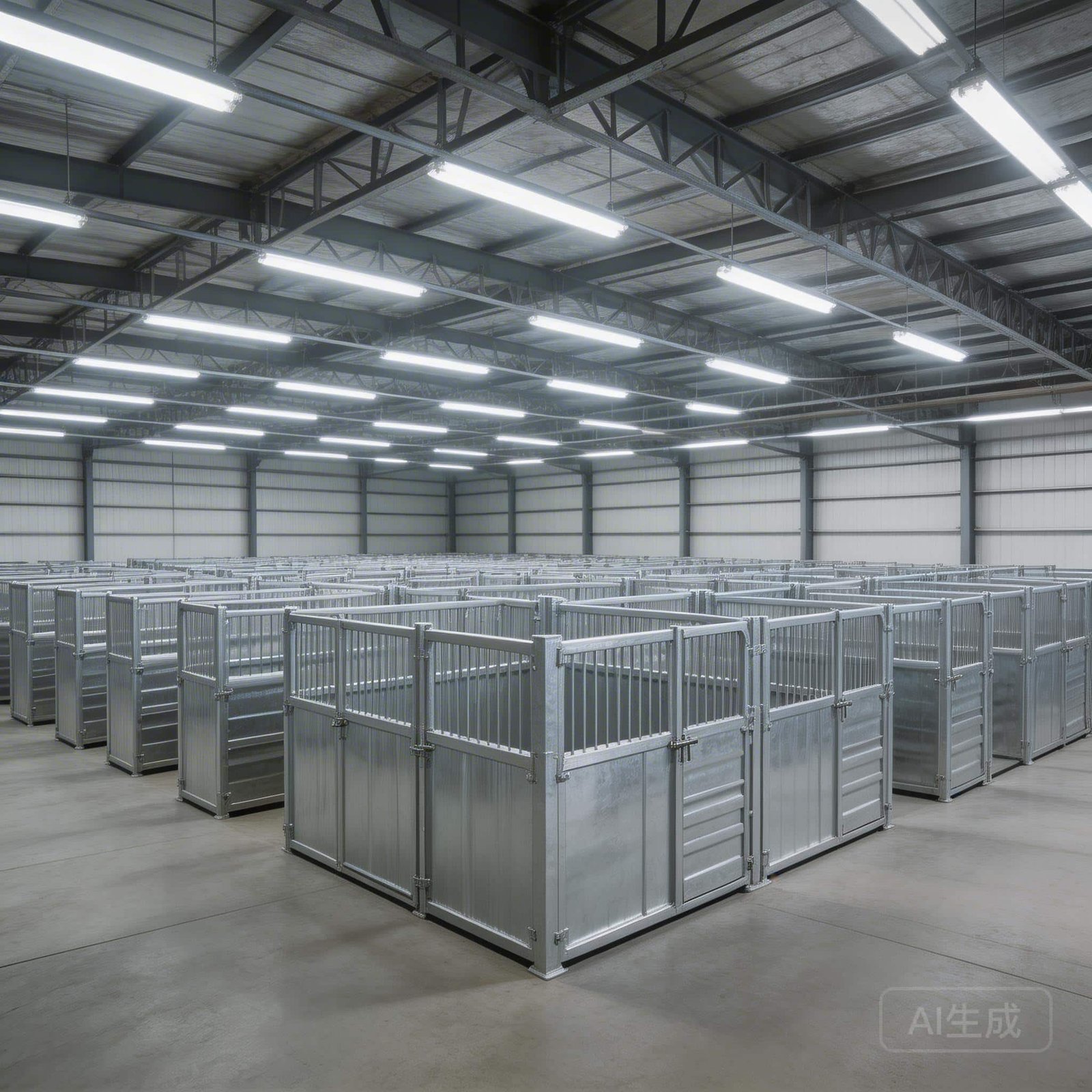
A horse’s eye is built for spotting movement across open grassland, and three of its features directly shape how a barn should be lit. First, the field of view is extremely wide — roughly 350 degrees with head raised — so a horse standing in the aisle sees the fixtures above and behind it. A glaring luminaire that a human ignores because it sits “out of the way” sits directly in the horse’s line of sight. Second, equine eyes are highly sensitive to motion and rapid light changes, so a flickering tube or a light that snaps on at full output reads as movement worth spooking at. Third, horses move between light and dark far more slowly than we do; a horse walking from bright daylight into a dim barn is effectively blind for a stretch riders read as balking at the doorway.
The design consequences are concrete. Keep brightness even along the paths horses travel, avoid fixtures that shine into a horse’s eyes from ahead or above, prefer gradual transitions over hard on/off switching, and treat every flicker source as a defect — the horse perceives it whether or not you do.
Zoning the Barn: Aisles, Stalls and Transition Zones
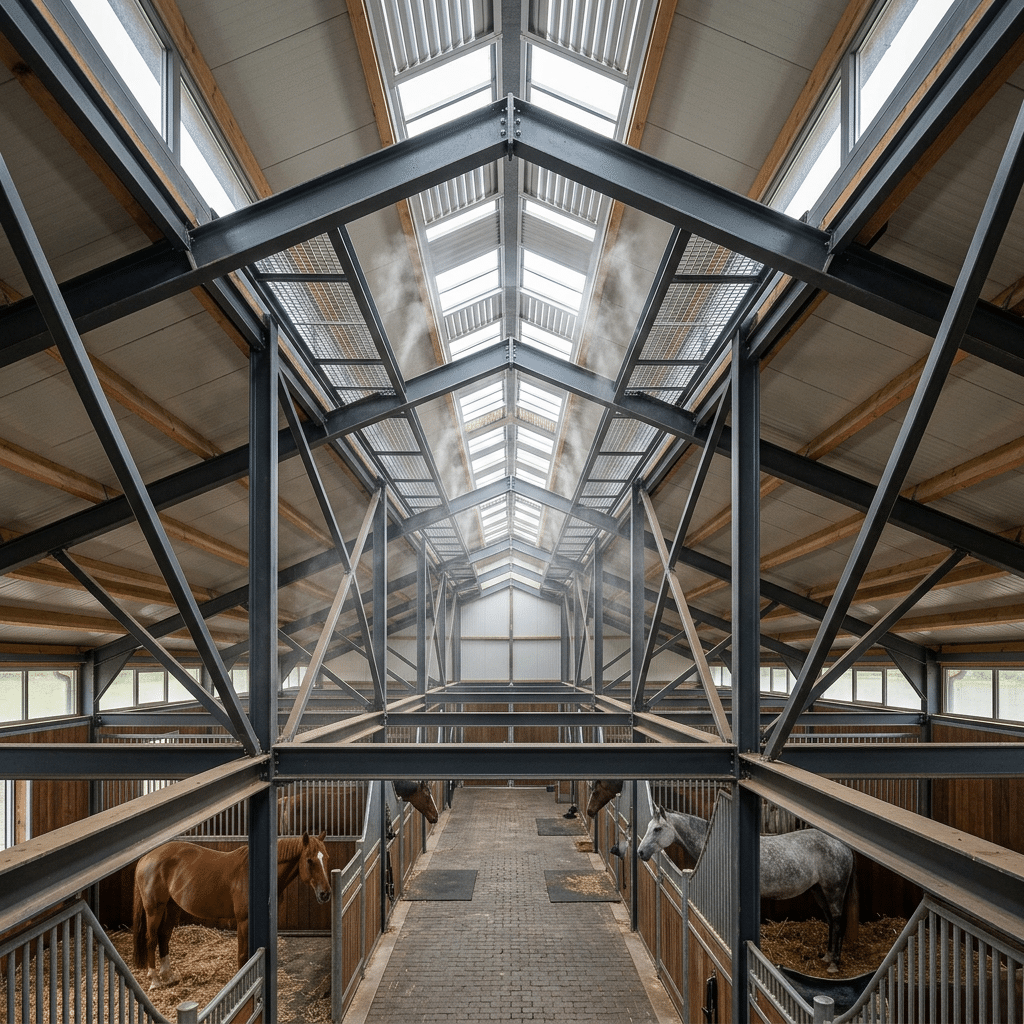
Professional barn lighting is planned by zone, because a single bright blanket of light serves none of them well. The aisle is the main traffic route for horses and machinery: it needs uniform illumination end to end, with fixtures mounted high and oriented so light falls on the floor rather than into the eyes of a horse walking the aisle. Uneven aisles — pools of light separated by dark gaps — are the classic cause of the “jumpy in the aisle” horse.
Stalls need quiet, even, low-intensity light: enough for a person to check a horse at night without a flashlight, never a bare fixture beaming directly down onto the animal’s face. Task zones — grooming bays, wash stalls, tack and feed rooms, veterinary and farrier areas — justify brighter, more focused illumination, ideally on their own switching so brightness appears where work happens without flooding the rest of the barn. And transition zones deserve their own plan: doorways, ramps, and the first meters inside every entrance, where a horse steps between full daylight and barn interior. Graduated lighting in those few square meters does more for calm handling than any upgrade elsewhere in the building.
Daylight belongs in the plan, not in opposition to it. Skylights and high windows cut daytime electrical load and give horses a natural light cycle — but every opening introduces glare patches that move with the sun, so design the electric lighting to fill the shadows at dusk and dawn, when contrasts are sharpest.
How Bright Is Bright Enough (Without Inventing Numbers)
Buyers ask for a lux table — aisle this many lux, stalls that many — and the honest answer is that a responsible article will not print one. Equine industry guidance commonly recommends uniform, moderate illumination for general barn areas with higher levels for detailed work such as veterinary treatment and farriery, and local agricultural codes or insurer requirements may set minimums in your market. The exact figures depend on your building’s geometry, fixture selection, mounting heights, and surface reflectances — precisely what a lighting designer’s photometric calculation is for.
What you can fix without a calculation is uniformity and switching structure. Plan circuits so the aisle, stalls, task zones, and exterior approaches switch separately, with dusk-to-dawn control on approach lighting and the stall row on a reduced circuit for late-night checks. Then hand the layout to your designer or electrical contractor and let them size the fixtures — the zoning survives every redesign, because it follows how the barn is used.
Zone first, calculate second: no lux figure compensates for a layout that glares into horses’ eyes or drops a hard shadow line across the aisle.
Flicker, Dimming and Color Temperature
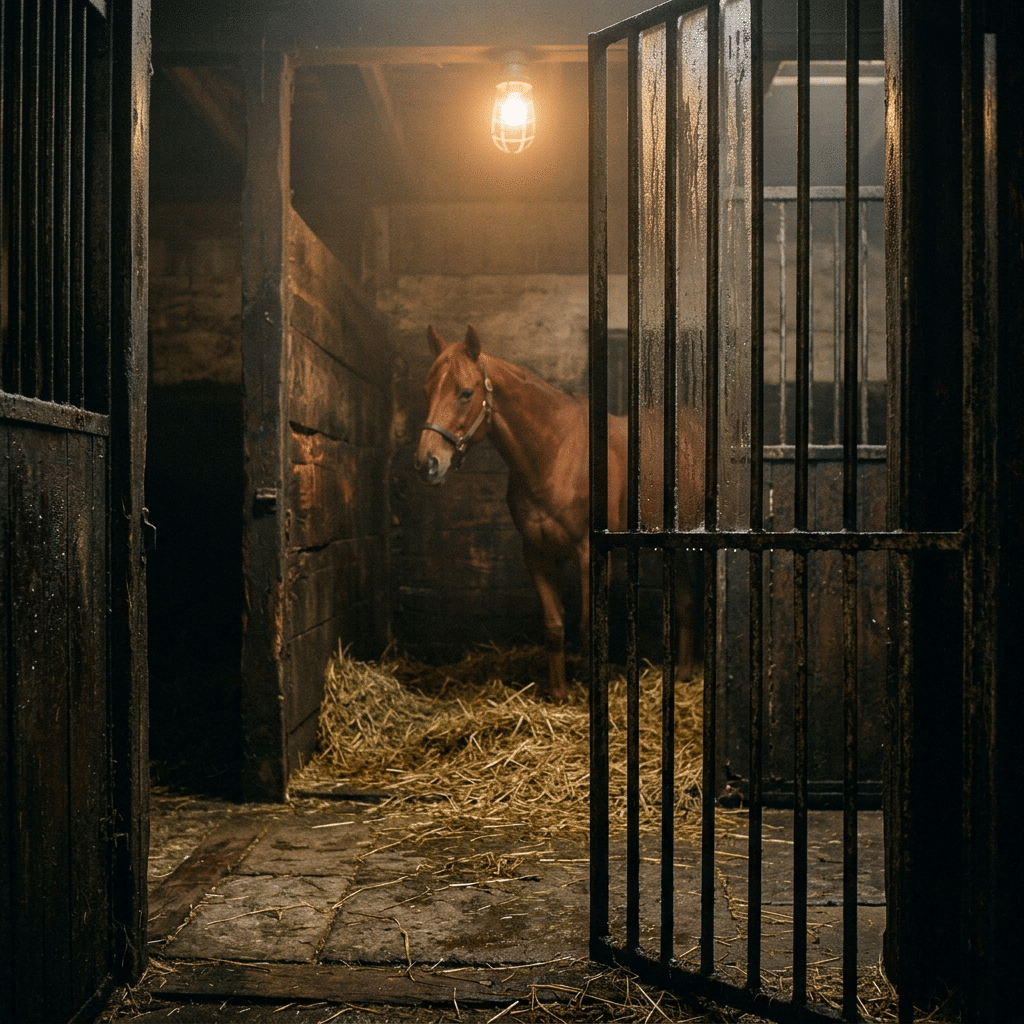
Modern LED fixtures solve most of the barn’s old lighting problems — they start instantly in cold buildings, tolerate temperature swings, and sip electricity compared to the gear they replace. But LED quality varies more than any previous technology, and the two failure modes that matter for horses are flicker and harsh switching.
Flicker comes from cheap drivers, and horses perceive it in conditions where humans do not. Specify flicker-free drivers from the outset and ask the supplier to confirm it in writing. Switching is the other trigger: a full barn going from dark to full brightness in one step is the exact abrupt transition equine vision handles worst. Stage the circuits — half the aisle fixtures on one switch, half on another — or specify dimmable fixtures so night checks run at partial output and come up gradually.
Color temperature is a softer question. Warmer white light feels calmer and suits stall rows and evening work; cooler white renders detail better for veterinary inspection. Consistency matters more than the specific choice — mixing color temperatures along a single aisle gives the visual patchiness that uneven brightness does.
IP Ratings: Dust, Ammonia and Wash-Down Areas
A barn is a hostile environment for electrical equipment, and the industry’s shorthand for surviving it is the IP rating — Ingress Protection, a two-digit code where the first digit measures protection against solids like dust and the second against water. In stable terms: airborne hay dust and bedding particles attack the first digit, while wash-down hoses, condensation, and leaky roofs attack the second.
Two barn-specific threats go beyond the rating itself. Ammonia from urine is corrosive to contacts, housings, and anything with exposed metal, which is why sealed, gasketed fixtures outlast open strip lights in a stall row by years — and why lighting design belongs in the same conversation as stable drainage planning, since dry bedding and controlled urine mean less corrosive gas in the air. Wash bays are a different world from the aisle: hosed water hits fixtures from below and sideways, so every fixture in splash range needs higher water protection. The practical instruction for your electrician: no open-bottomed or bare-tube fixtures anywhere horses are housed, sealed dust-protected enclosures throughout, elevated water protection where hosing happens, and corrosion-resistant fittings.
Electrical Discipline and Fire Safety

Barn lighting is electrical work in a building full of combustibles, and it deserves the respect that combination demands. Electrical faults rank among the recognized contributors to barn fires, alongside hot lighting kept too close to hay and bedding. The failure pattern is consistent: dust accumulates on fixtures, cords get chewed or crushed by machinery, DIY repairs accumulate, and eventually heat meets fuel. The full prevention checklist is covered in the horse barn fire safety checklist.
For the lighting scope specifically, the rules are short. Use a licensed electrician for the installation, full stop — the barn’s damp, dusty, corrosive air is exactly the environment where improvised wiring fails. Keep fixtures well clear of stored hay, bedding, and cobweb buildup, and put fixture cleaning on the same seasonal schedule as gutter clearing. Protect all cabling in conduit where rodents or machinery can reach it. All of it is cheaper than a fire.
Conclusion
Good horse stable lighting comes from four decisions: design around equine vision with even, glare-free, flicker-free light; zone the barn so brightness follows the task; specify sealed, appropriately rated fixtures; and treat the installation as fire-safety-critical electrical work. Get those four right and the exact lumens almost arrange themselves.
If a new stable or a retrofit is on your project list, walk the barn at dusk with your layout in hand and mark where your own eyes flinch — every glare line and hard shadow you notice, your horses noticed months ago. That marked-up plan is the brief your electrician and lighting designer need.
Frequently Asked Questions
Why do horses react badly to sudden changes in barn lighting?
Horse eyes adapt between light and dark far more slowly than human eyes, and equine vision is tuned to detect motion and flicker. A light that snaps on at full output leaves a horse briefly unable to see clearly — which reads as a reason to spook.
What IP rating do barn light fixtures need?
The IP code rates dust protection (first digit) and water protection (second digit). In horse housing, use sealed, dust-protected fixtures everywhere and specify elevated water protection in wash bays. Confirm the code minimums for agricultural buildings with your electrician.
Where should light fixtures be placed in a stable?
Mount aisle fixtures high and aimed at the floor so light never shines directly into a horse’s eyes, keep stall fixtures low-intensity and offset from the animal’s face, brighten task zones like grooming and wash bays separately, and add graduated lighting at doorways where horses pass between daylight and interior.

 English
  Spanish
  French
  Arabic
  German
0 Comments