


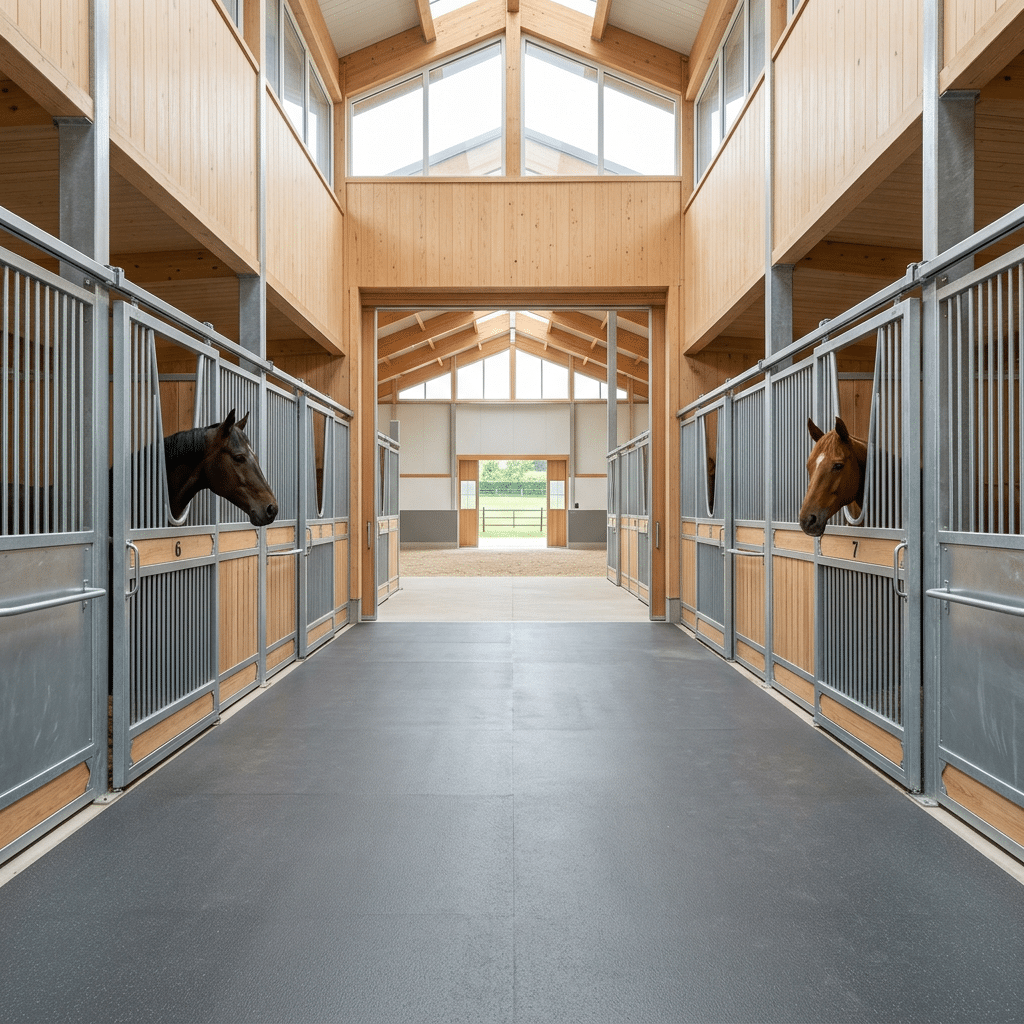
Designing for Senior/Rehab Horses requires materials that prevent both health risks and high maintenance costs. Common choices like unprotected steel and porous wood in high-moisture zones inevitably lead to rot and corrosion, creating expensive structural failures and compromising animal health.
This analysis benchmarks materials by their ability to create a hygienic, low-maintenance environment. We compare non-porous HDPE against traditional infills and evaluate steel corrosion resistance based on the ISO 1461 hot-dip galvanizing standard, providing a clear blueprint for facility design.
El microclima de una zona de lavado: calor, agua y estiércol
A wash bay’s micro-climate is the managed balance of water temperature, ambient heat, and drainage. It’s critical for sensitive horses and demands materials that fight constant corrosion.
Managing Temperature and Water for Senior Horses
Older or recovering horses are highly sensitive to thermal shock. Using lukewarm water is standard practice to avoid causing physiological stress or discomfort during washing. Sudden exposure to cold water can tense muscles and cause a negative experience, while overly hot water can be just as problematic.
In cooler climates, the air temperature is as important as the water temperature. A wet horse will chill rapidly, so many professional facilities install radiant or infrared heating systems. These heaters warm the horse’s body directly, not just the air, which helps prevent chill-off after a wash. To guarantee a reliable water supply year-round, frost-free hydrants and insulated plumbing are essential for any serious build in a cold region.
Structural Defense Against Constant Humidity and Corrosion
A wash bay is one of the most corrosive environments in any equestrian facility. The steel framework is constantly exposed to a mix of water, cleaning agents, and ammonia from manure. This combination aggressively attacks unprotected steel and even undermines cheap coatings.
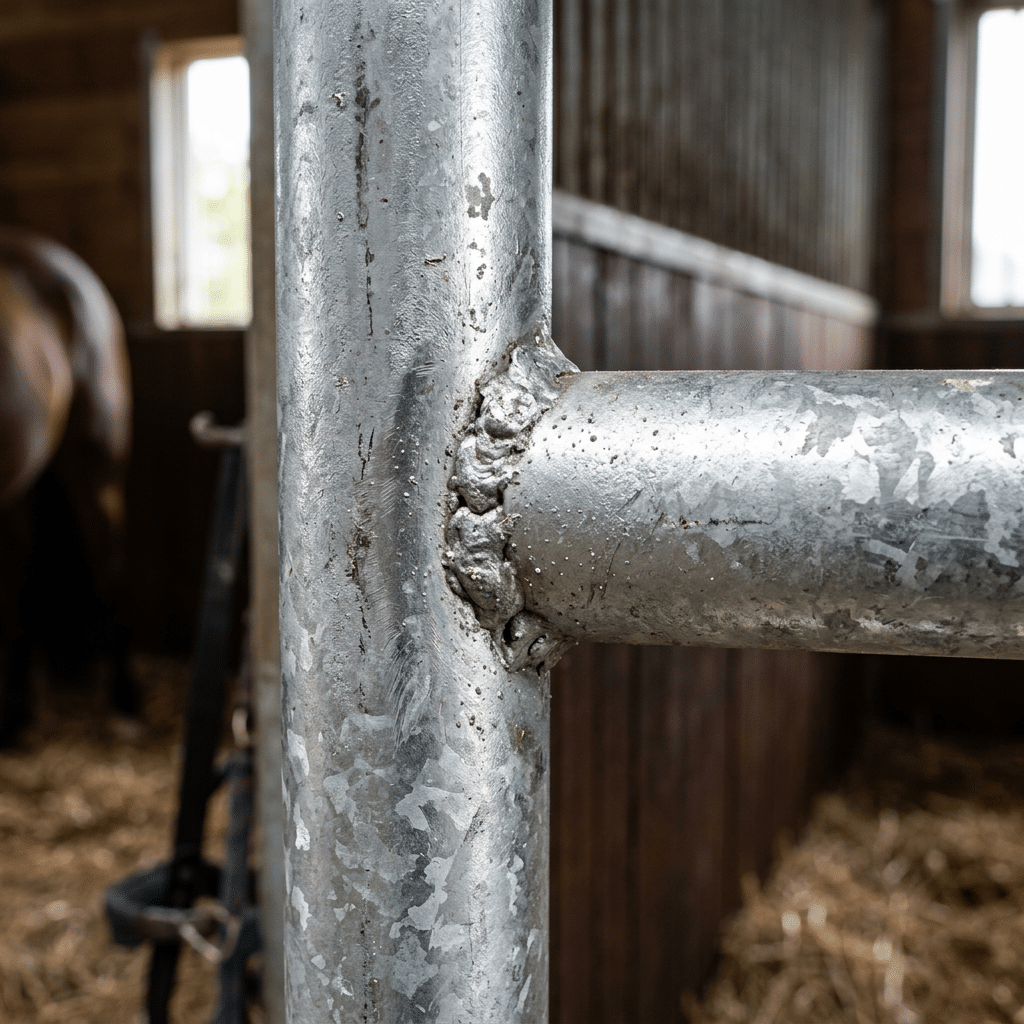
The only reliable defense for steel is hot-dip galvanization *after* fabrication. This process coats every surface, cut, and weld in a protective zinc layer. We engineer our systems to meet ISO 1461, achieving a coating thickness that exceeds 70 microns. This isn’t just a paint job; it’s a metallurgical bond that provides decades of protection.
The framework is only part of the equation. Infill materials must also resist moisture. Traditional wood absorbs water, leading to rot, mold, and warping. Using a non-porous infill like High-Density Polyethylene (HDPE) completely eliminates this risk. HDPE doesn’t absorb water, so it can’t rot or harbor mold, ensuring a hygienic and structurally sound partition for the life of the stable.
Paredes de hormigón: porosidad, agrietamiento y dificultad para limpiarlas
Concrete’s porous structure absorbs moisture, causing mineral deposits and cracking. This makes walls hard to clean, creating an unhygienic environment that harsh chemicals only make worse.
How Porosity Leads to Cleaning Challenges
Concrete isn’t as solid as it looks. At a microscopic level, it’s full of pores that act like a s
ponge. When walls get wet, concrete pulls in water and any dissolved salts or minerals. As the water evaporates, it leaves behind ugly white salt deposits called efflorescence, which are almost impossible to scrub off permanently.
The go-to solution is often a harsh acid wash, but this just attacks the problem with a bigger one. Acids erode the concrete’s surface, opening up even more pores and making the material more absorbent. It’s a cycle of cleaning that ultimately damages the wall. The trapped moisture also creates a perpetually damp environment, which can lead to structural cracking over time from expansion and contraction.
The Zero-Maintenance Solution of HDPE Infill
HDPE (High-Density Polyethylene) panels offer a direct fix to concrete’s inherent flaws. Because HDPE is completely non-porous, it cannot absorb moisture, urine, or cleaning agents. Nothing seeps in, so contaminants and stains stay on the surface where they can be easily managed.
Cleaning becomes simple. The material’s smooth, impact-absorbing surface can be wiped down or pressure washed without any risk of damage or degradation. Unlike concrete, HDPE provides a true ‘Zero Maintenance’ solution for stable walls. It doesn’t need sealing, special chemical treatments, or worries about long-term moisture damage.
Engineered Horse Stables for Any Climate
Alfombrillas de goma en las paredes: un foco de moho y hongos
Rubber wall mats trap moisture in seams and behind panels, creating a prime environment for mold. A better solution is non-porous infill like high-density bamboo or HDPE.
How Trapped Moisture Creates a Health Hazard
Padding stall walls with rubber mats seems like a good idea for safety, but it often creates a hidden problem. Water from washing and urine can easily seep into the seams between mats or get trapped in the gap between the mat and the stable wall. In stables with limited airflow, this trapped moisture creates the perfect breeding ground for mold and mildew. This poses a serious respiratory risk for horses, especially for senior animals or those with already compromised immune systems.
The Advantage of Mold-Resistant Infill Materials
Instead of creating moisture traps, it’s better to use infill materials that inherently resist mold. High-density strand woven bamboo is naturally resistant to mold and rot, stopping fungal growth before it can even start. It’s also incredibly durable, with a Janka hardness over 3000 lbf, making it a tough and hygienic choice.
Another excellent option is non-porous HDPE (High-Density Polyethylene). Since it doesn’t absorb any moisture, mold has nowhere to take hold. This material provides a true zero-maintenance surface that can be easily cleaned without worrying about what’s growing behind it. It gives you the impact absorption you want without the hidden health risks.
Plástico HDPE: 100%, hidrofóbico y apto para lavado a presión
HDPE is a non-porous plastic that naturally repels water, preventing rot, mold, or warping. This makes it durable enough to withstand power-washing for easy sanitation.
| Característica | Relleno de HDPE | Traditional Wood | |||
|---|---|---|---|---|---|
| Absorción de agua | Minimal (<0.05%) | High (Porous) | |||
| Rot & Mold Resistance | Inherent | Mantenimiento | Zero (No sealing needed) | Requires painting/sealing | |
| Cleaning Method | Power-washable | Scrubbing, risk of damage |
Why HDPE Naturally Repels Water and Resists Rot
Wood rots because it’s organic and porous; it soaks up moisture, swells, and provides a breeding ground for fungus. HDPE is the complete opposite. It’s a synthetic polymer with a tightly packed molecular structure, making its surface non-porous and fundamentally water-repellent.
- Its water absorption rate is incredibly low, at less than 0.05%. This physical property stops the material from swelling, warping, or cracking when exposed to constant moisture or humidity.
- The smooth, non-porous surface leaves no microscopic footholds for mold, mildew, or bacteria to grow. Contaminants stay on the surface where they can be easily washed away.
- The material is chemically inert. It doesn’t react to the acids or bases found in animal waste and common barn cleaning solutions, so it won’t degrade over time.
The ‘Zero Maintenance’ Advantage of UV-Stabilized HDPE Infill
These material properties directly translate into a practical, long-term advantage for stable owners. Our systems use thick 28mm to 32mm impact-absorbing HDPE planks. We ensure they are UV-stabilized, so they won’t become brittle or fade from sun exposure in open-air barns or outdoor shelters.
This material choice delivers a genuine ‘Zero Maintenance’ solution. There is no need for future painting, sealing, or staining. The color is solid throughout the plank, so scratches don’t reveal a different color underneath. The robust surface allows for repeated, aggressive power-washing, ensuring you can maintain a hygienic environment for your horses without causing material degradation. This eliminates the labor costs and material expenses associated with replacing warped or rotten wooden boards every few years.
Estructuras de acero HDG: Resistiendo en la zona de salpicaduras
Splash zones accelerate steel corrosion with a wet-dry cycle that strips coatings. Hot-dip galvanizing provides a base defense, while a duplex system adds a synergistic powder coat barrier.
Why the Splash Zone Accelerates Corrosion
The area constantly hit by water spray—the splash zone—is far more corrosive to steel than full immersion or simple air exposure. This environment creates a repeated wet-dry cycle. The cycle continuously forms and then strips away the zinc’s protective patina, consuming the galvanized layer at a staggering rate of 50 to 100 micrometers per year.
The Duplex System: Powder Coating Over a Galvanized Base
All our frames are hot-dip galvanized after fabrication, a critical process that ensures complete protection. This method meets the BS EN ISO 1461 standard, guaranteeing a zinc coating over 70 microns thick. For coastal or high-humidity facilities, our Royal Series uses a duplex system. We add a durable powder coat on top of the galvanized base. This dual-layer approach creates a barrier that extends the frame’s protective life by 1.5 to 2.3 times compared to galvanizing alone.
Preguntas frecuentes
What are the best materials for horse wash bay walls?
PVC panels are a top choice for wash bay walls because they are 100% waterproof, durable, and low-maintenance. They resist mold and rot, and their impact-resistant surface helps reduce injury risk. Fiberglass is another option, but it can support mold growth over time. While some use coated wood or concrete, PVC provides a more reliable and hygienic solution.
Can you put rubber mats on stall walls?
Yes, installing rubber mats on stall walls is a common practice. These mats protect the horse’s hips, knees, and ankles from impact with hard surfaces like concrete. They also safeguard the wall structure from damage and can help dampen noise in the barn. Mats are typically secured with appropriate fasteners like pancake screws.
How do you properly waterproof a horse wash bay?
Effective waterproofing involves three steps. First, protect the walls with waterproof panels like fiberglass-reinforced plastic (FRP) and seal all joints with silicone. Second, ensure proper drainage by locating the bay on high ground or installing a subsurface drain with perforated pipe and gravel. Third, use non-slip flooring like thick rubber mats or scored concrete to prevent falls.
Does HDPE infill material warp or require special molding?
HDPE is a thermoplastic that molds very easily, making it suitable for creating durable stall panels. While it’s cost-effective and strong, it does have a high rate of shrinkage and thermal expansion. Professional manufacturing processes account for this by using specific molding temperatures and pressure to produce stable, warp-resistant boards that hold their shape.
Is concrete or plastic better for wash stall floors?
Concrete is a standard in many professional facilities because it is durable and easy to disinfect. Its main drawback is becoming very slippery when wet. Plastic or rubber mats are often a better alternative for safety, providing excellent traction and more comfort for the horse’s legs. Many facilities install rubber mats over a concrete base to get the benefits of both materials.
Reflexiones finales
Choosing a stable based on price alone invites long-term problems like rust, rot, and mold. Our systems use hot-dip galvanization after fabrication and zero-maintenance HDPE infill as a non-negotiable standard. This engineering choice is the only way to eliminate costly repairs and protect your facility’s reputation.
Don’t guess on quality—verify it. We recommend starting with a trial order to test our fitment and ISO 1461-compliant finish firsthand. Contact our team to get the technical specifications for your next project or distributor inventory.

 Spanish
  English
  French
  Arabic
  German
0 comentarios