
Most new yards have one concrete element that no drawing assigns to anyone: the walker concrete foundation pad. The stalls are dimensioned by the stable supplier, the arena surface by the riding-court contractor, the fence line by whoever drives the posts. The pad in the middle sits in a gap between three trades, and it carries a machine that walks the full live weight of a horse around it at a constant circle, all day, in whatever weather your market gets.
Here is the awkward fact about ordering a horse walker from China: the machine ships, the civil work does not. This manufacturer publishes an Italian-motor drive unit and open or covered roof options on its lunging pen and horse walker range, with a stated MOQ of 10 stall systems or 50 fence panels, 4-6 week global delivery and 1-2 weeks from the Sydney and Warsaw regional warehouses. What it does not publish is an anchor bolt specification, a concrete thickness, a pad diameter or a load table. That is not a criticism of one supplier over another; it is the normal shape of the deal, and it is precisely why the handover between your civil builder and your equipment supplier needs a written checklist rather than a phone call.
Key Takeaways
- Two suppliers, one hole in the ground. Anchor hardware may travel with the machine; the concrete under it is more often than not poured by a crew that has not seen the machine drawing. Make those two documents meet before excavation.
- No foundation data is published here. This range documents the drive unit and the roof choice — not pad thickness, reinforcement, anchor diameter, embedment depth or a load rating. Treat all of it as a written question.
- Ask the supplier who the pad is designed for. A central column, a perimeter track or a cantilever arm each loads the ground differently, and the fixings follow the load path.
- A rotating load is not a fence post. Post-hole footings resist a shove from one direction; a walker arm applies a sustained, circling pull. Your engineer may design both differently, and typically will.
- Cold-ground sites need a local decision. Frost heave is a real failure mode for anchored steel in a stated -10°C Polish winter; anchoring depth is a question for your own engineer and soil data, not for a catalog.
- Record the pad before the frame lands. Level readings, cure age, anchor positions and photographs belong in the handover file, because after assembly you cannot see any of them.
The gap between the machine order and the concrete order
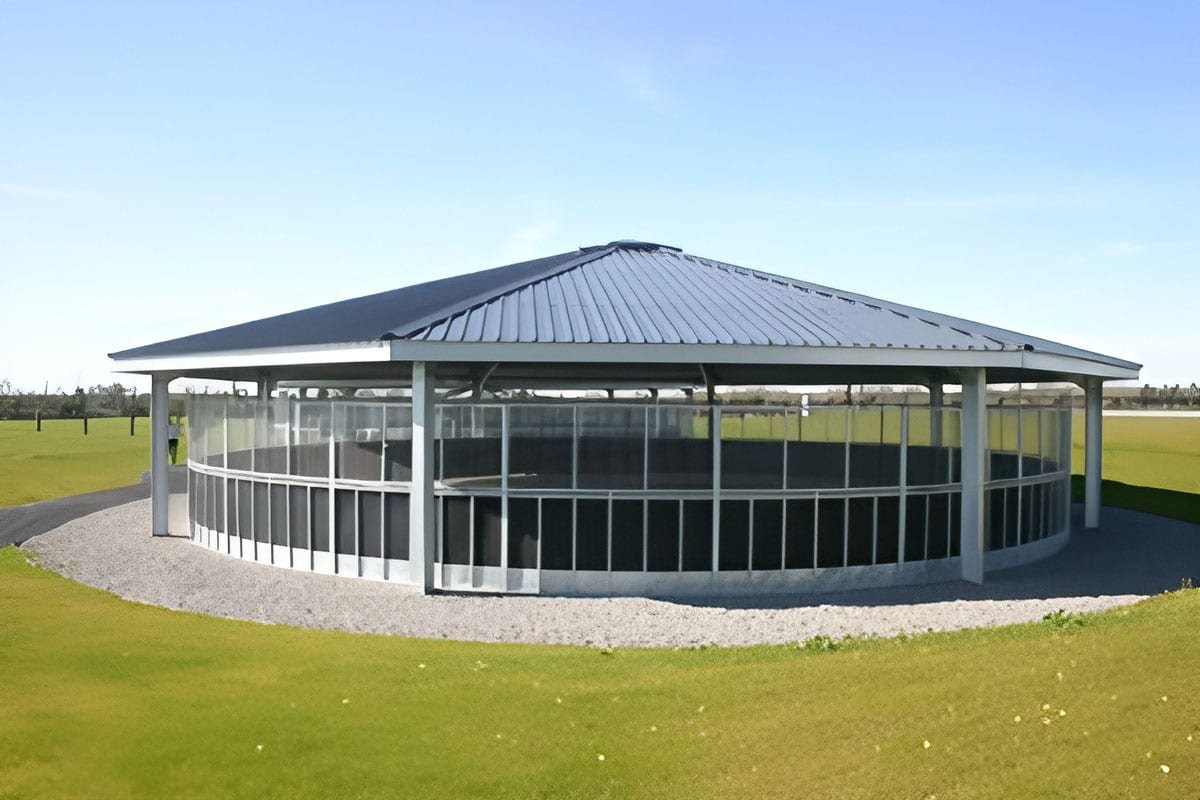
Importers usually discover the gap only after the earthworks quote has been priced and accepted. The crew has booked a slab as a line item, the equipment order is confirmed, and neither party holds a document tying them together. Then the machine arrives on a pallet, the site has no dimension drawing to check it against, and the anchor pattern becomes a question answered with a tape measure in the mud.
There is a structural reason this happens. A stable order comes with panel heights, stall widths and an aisle. A walker order comes with a drive unit, arms and a roof choice — in this range an Italian motor and an open or covered configuration. Concrete sits outside both scopes. Treat the pad as your own work package: brief the builder, obtain the supplier’s dimensional and fixing information, and make one drawing carry both.
The interface drawing: five questions to settle in writing
Send five questions to the supplier and five to your concrete contractor, and do not start the slab until both sets are answered on paper. Ask the equipment supplier: what does the machine bear on — a central column, a perimeter track, or arms cantilevered from a ring; what fixing pattern does the frame expect; what bolt diameter and embedment do the base plates assume; what level tolerance is acceptable across the circle; and what surface is required under the horse, since a pad that suits the drive unit may be wrong underfoot. Ask the builder: what the slab is designed for, what reinforcement sits under the anchor zones, the pour date and design strength, who owns the drainage falls away from the pad, and what happens at the joint with the riding surface.
The last pair matters more than buyers expect. A hard pad next to a loose riding surface is a drainage and containment problem, and the interaction between surface depth, drainage and the fence line around it is worked through for lunging and training areas in lunging arena surfaces and drainage. This article stays on the anchor side of that boundary.
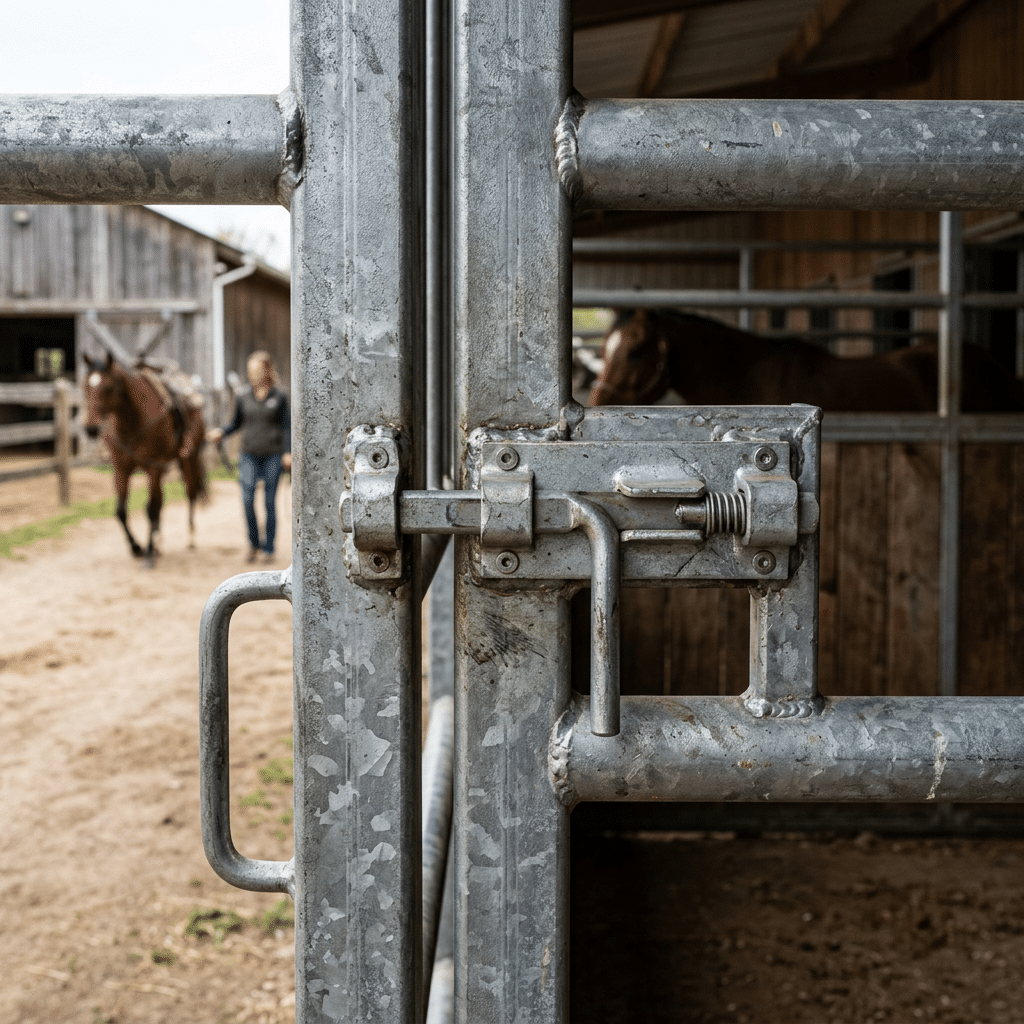
Civil works handover checklist
The table below is the document to hand to your site manager. Every row is a recorded fact, not a design value; nothing here is a substitute for a structural engineer’s specification for your soil, your climate and the exact unit you ordered.
| Checklist item | What to record on the handover sheet | Why it gets skipped |
|---|---|---|
| Load path of the unit | Written answer from the supplier: central column, perimeter track or cantilever arms | Assumed to be the same as last year’s model |
| Anchor pattern and bolt size | Dimensions drawing with positions, diameter and embedment depth, marked against one fixed corner | Bolts cast in by a crew working from a marketing brochure |
| Pad geometry and level | Diameter or footprint, falls away from the ring, level readings taken after cure | Levelled by eye because the machine will sit on it |
| Cure age at installation | Pour date, design strength stated by the contractor, date the frame is set down | A shipping date that arrives earlier than the concrete schedule |
| Ground condition at the site | Soil type, water table notes, and whether the site freezes — with your engineer’s answer on anchoring | Copied from the neighboring yard |
Freeze the last row against your own market. A pad performing in a 40°C Australian summer and one performing through a stated -10°C Polish winter are not the same engineering case, and the frost question is a site decision rather than a product one. How frost lifts anchored steel out of cold ground is covered separately for northern European yards in frost anchoring in Nordic conditions; read that as a soil and depth problem, not as a walker specification.

The acceptance walk, before the frame arrives
This walk covers what becomes invisible after the pour — pad level, anchor positions, cure age. Machine-level checks such as drive-wheel alignment or track truing belong to the acceptance stage after the frame is up, and are a different list.
Walk the pad once with the checklist in hand and photograph it. Run a string line across the circle, take level readings at four points and at each anchor, and write the pour date on the sheet you photograph. If the supplier’s fixing pattern reaches you after the concrete is placed, stop rather than force the base plate down with a washer stack; a shimmed anchor can turn into a warranty dispute.
Two positions worth holding. First, the pad should be designed by your engineer against the supplier’s dimension drawing, with both names on the revision you build from — an unsourced slab detail is the one thing nobody will own in five years. Second, do not let a 4-6 week delivery window or a 1-2 week pull from the Sydney or Warsaw warehouse set your concrete schedule. Expedited logistics help you sequence a build; they do not shorten a cure. The equipment and training range, including walkers and lunging pens, is on the lunging pen and horse walker page.
Frequently Asked Questions
Does a horse walker need a concrete foundation?
Usually the drive and support structure are anchored to a hardened base, but the answer for your unit is a written question to the supplier. Nothing in this published range states a pad specification, so ask what the frame bears on and how it is fixed.
Who supplies the anchor bolts?
Get it stated on your order. Anchor hardware may travel with the frame or may be bought locally to your engineer’s specification, and the handover fails when both parties assume the other has it.
How thick should the pad be?
That is your engineer’s number, not a catalog one. It depends on the load path, your soil and whether the ground freezes, and no thickness is published for this range.
Can the pad be poured after the machine arrives?
It can be poured after the fixing drawing arrives, which is the sequence that matters. Set the machine down on green or uncured concrete and you own whatever happens next.
Conclusion
A walker is often the only item in a new yard whose performance depends on concrete that no supplier’s scope covered and a drawing nobody compared until the crane was on site. Recording the load path, the anchor pattern, the level readings and the cure dates costs an afternoon and turns a hidden connection into an auditable one.
Before you release the excavation, ask the equipment supplier what the frame bears on and what fixings the base plates expect, then have your own engineer size the pad against that answer. If you are ordering alongside stall systems, put the dimension drawing for both on the same sheet so the pad, the aisle and the drainage falls are set out once instead of twice.



 English
 Spanish
 French
 Arabic
 German
0 Comments