


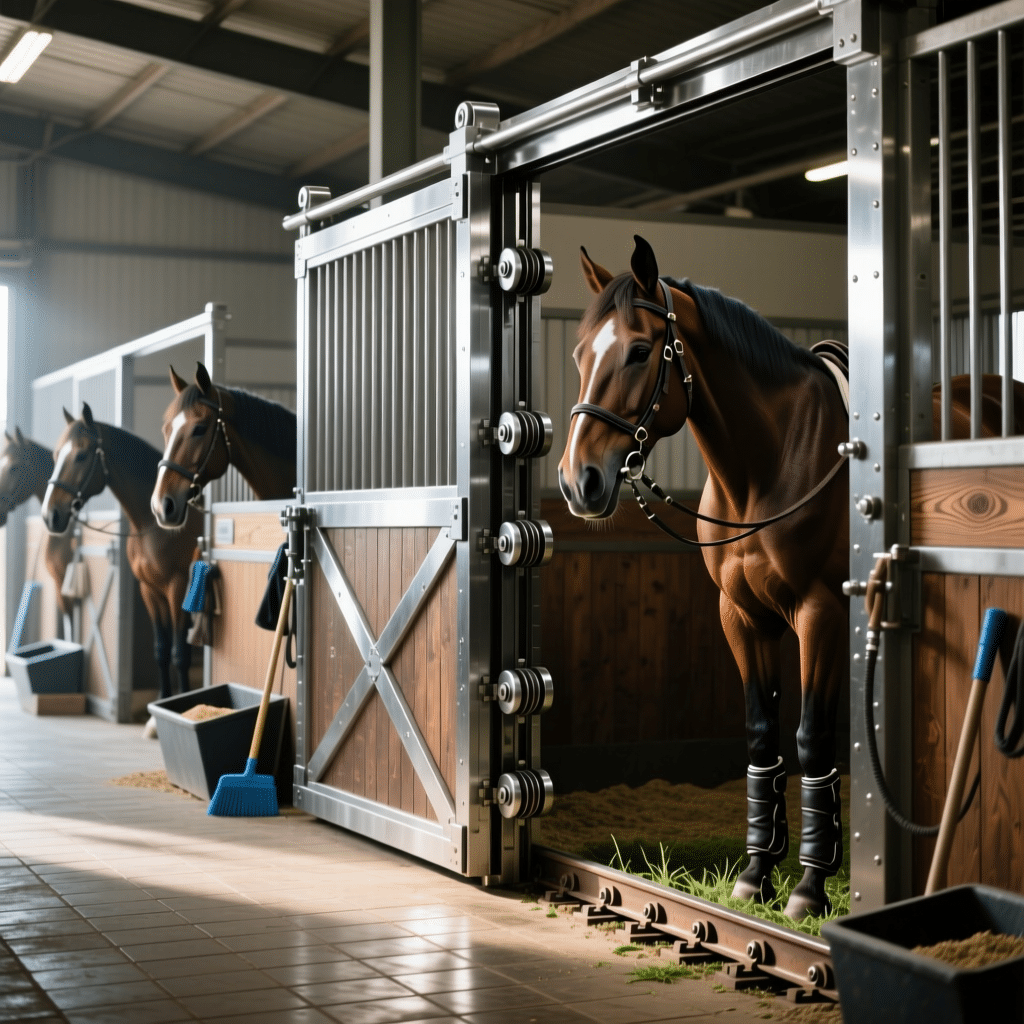
sliding stall door derailment fix is the first checkpoint buyers should lock before they approve a supplier, budget, or production slot. Every facility manager knows the sinking feeling when a 300kg stall door grinds to a halt mid-track, blocking a feeding or turnout. The instinct is to reach for a wrench and start adjusting hangers, or worse, thinking the track needs replacement. That instinct is wrong about 80% of the time. The real sliding stall door derailment fix is likely sitting in front of you as a worn U-channel cap — a five-dollar plastic part that gets overlooked until the door has already jumped the rail.
After a decade of manufacturing stabling systems for commercial facilities across nine countries, a consistent pattern is observed: maintenance teams replace tracks, order new doors, or bring in welders when a cap swap would have solved it. That is 30x the cost and days of unnecessary downtime. A single lost stall can disrupt feeding schedules, shift labor hours, and create safety risks. The simple fact is that the cap, not the metal, absorbs the daily wear from dust, thermal swings, and lateral door forces.
This guide covers the cap-first approach — why it works, why most competitors skip it, and how to source caps that do not crack after one season. You will get the clearance spec that keeps a door running smoothly for years, not months. Treat this as a diagnostic shortcut. If you are chasing a repeating jam or trying to prevent horse stall door derailment, start here before you touch a single track bolt.

Why Most Derailments Are Track-Related (But Not the Track)
80% of derailments come from worn plastic caps, not bent tracks.
The U-channel cap is the sacrificial wear component on your sliding door track. Friction, UV exposure, and bedding debris cause these plastic liners to crack, warp, or fall out over time. Once the cap degrades, the door gains slack and jumps the rail. Replacing a $5 cap every 2–3 years prevents a $150+ track replacement and the safety risk of a door falling off its hangers.
- Visual check: Look at the top edge of the door where it meets the track. Missing or deformed plastic is the first sign. Run your finger along the inside of the channel — if you feel bare metal or rough edges, the cap is gone.
- Common trap: Generic ‘universal’ caps from big-box stores lack UV stabilizers. They crack within one season, causing the same jam a year later. OEM-matched caps, like DB Stable’s UV-stabilized polypropylene versions, are molded to your track flange width (1″ or 1.25″) and tested for 500,000 cycles.
- Track bending: True track deformation is rare. It usually requires a direct horse kick or impact from heavy equipment. If the track looks straight but the door binds, check the caps first. Bending the track to fix a cap problem compounds the issue and leads to door hanger misalignment.

Real Cost Breakdown of Sliding Door Repairs in 2026
A $5 cap replacement prevents a $300 track job and weeks of downtime.
Replacing a single U-channel cap runs $5–$10 in parts and 20 minutes of labor. Ignore that cap and the track bends from repeated binding – replacement track costs $150–$300 plus the labor to remove and rehang the door. That’s a 30x cost multiplier for the same root cause.
- Cap replacement cost: $5–$10 per cap, 20 minutes labor, no door removal needed.
- Track replacement cost: $150–$300 per track, 2–3 hours labor, door must be lifted and fully dismounted.
- ROI of proactive cap replacement: Reduce door-related service calls by 60% with quarterly cap inspections and replacement every 2–3 years.
- Worst-case scenario: A single door derailment can injure a horse or handler – vet bills or liability costs dwarf any component price.
Now scale that across a 20-stall facility. If you replace caps every 2–3 years ($200–$400 total every 3 years), you avoid the $3,000+ track replacement bill that hits every 5 years when caps are ignored. Over a decade, proactive cap maintenance saves $4,000–$6,000 per barn. Plus you eliminate the safety hazard of a derailed door and the callouts for emergency repairs.
| Repair Item | Parts Cost | Labor Time | Total Estimated Cost | Notes |
|---|---|---|---|---|
| U-Channel Cap Replacement (Single) | $5 – $10 | 20 minutes | $15 – $30 | Solves 80% of derailments; replace every 2–3 years |
| Full Track Replacement (Per Stall) | $150 – $300+ | 1–2 hours (door removal) | $200 – $400+ | Required if caps ignored; 30x more expensive than cap fix |
| Track Realignment / Adjustment | $0 – $20 (tools) | 30–60 minutes | $20 – $50 | Only for bent tracks (rare); cap-first diagnosis avoids this |
| Quarterly Cap Inspection (Per 20 Stalls) | $0 | 2 hours | $40 – $80 (labor) | Cuts door-related service calls by 60% |
| Annual Cap Replacement (20 Stalls, Bulk) | $100 – $200 | 4 hours | $200 – $400 | Prevents $3,000+ in track repairs over 5 years |
Cap Replacement vs. Track Realignment: Which Fix Works?
A $5 cap replacement fixes 4 out of 5 sliding door derailments.
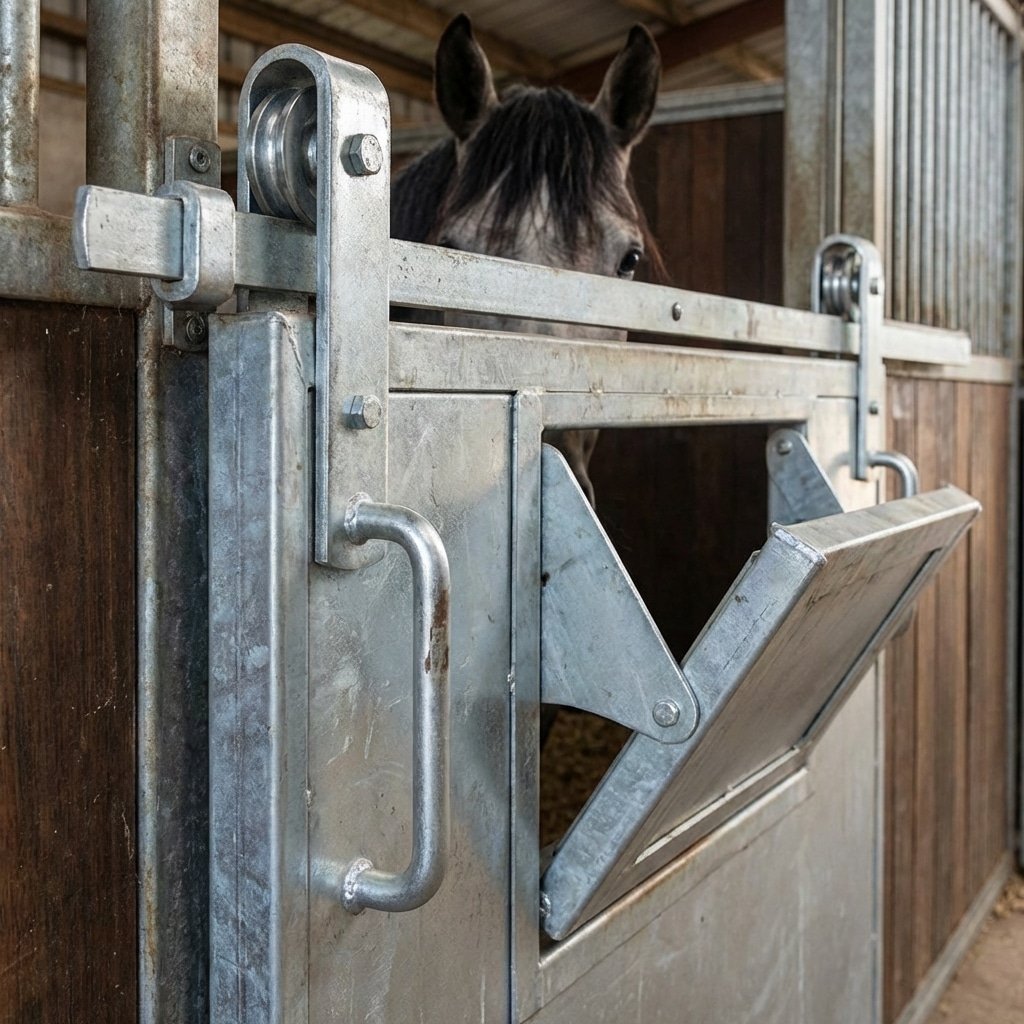
Start diagnosis by checking clearance between the door edge and the track. Worn U-channel caps reduce clearance below the required 3/8″ (9.5 mm), causing binding and eventual derailment. Inspect caps for cracks, flattening, or complete absence – that reveals the root cause in 80% of cases. Only then should you decide between cap replacement and track realignment.
- Cap replacement cost: $5 per cap, 20 minutes labor. No welding or special tools.
- Track realignment cost: $150-$300 per track plus door removal, often requiring welding or new fasteners.
- Success rate: Cap-only fix resolves the issue in 4 out of 5 derailment cases. Track realignment is needed only if the track itself is bent (e.g., from a horse kick).
- Cap failure risk: Generic ‘universal’ caps from big-box stores lack UV stabilizers and crack within one season. UV-stabilized polypropylene caps (e.g., from DB Stable) last 5+ years outdoors.
Skip the hanger adjustments and track bending advice found in most DIY guides. Replace the caps first. If the door still drags after a proper cap swap, then consider track realignment. In 80% of commercial stable cases, you will never get to that step.
How to Source Quality U-Channel Caps Without Getting Scammed
A $5 cap without UV stabilizers cracks in one season — that’s a $300 track replacement waiting to happen.
Every time you source U-channel caps, you’re betting the track on it. The single most common mistake is buying caps made from recycled ABS instead of UV-stabilized polypropylene. Recycled ABS looks identical out of the box, but under sunlight it embrittles in 12–18 months. UV-stabilized polypropylene holds its flexibility for 5+ years. If you’re managing a barn with south-facing doors, that difference is the line between a cap that works and one that shatters.
- Track flange width: Measure your existing track flange — it’s almost always 1″ or 1.25″. A cap that’s even 0.1″ too wide will slide off; one too narrow won’t grip. DB Stable’s caps are precision-molded for both sizes with zero trimming required.
- Material certification: Request written confirmation that the caps are virgin UV-stabilized polypropylene, not ‘heavy-duty plastic’ or ‘reinforced ABS’. Some suppliers hide recycled content. Ask for the UV additive percentage — 2% minimum is the industry baseline for outdoor equestrian gear.
Avoid any cap labeled ‘universal fit’ or ‘adjustable’. Those use flexible wings that are supposed to conform to any flange, but they never seat tight. The resulting gap collects bedding dust, manure particles, and moisture — which accelerates track rust and cap failure. You end up replacing caps every 8 months instead of every 2–3 years. A matched cap like DB Stable’s costs the same per unit but eliminates that gap entirely.
The hard truth about ‘cheap’ caps: a manufacturer willing to skip UV stabilizers is also likely skipping cycle testing. DB Stable puts every cap through 500,000 operational cycles — that’s about 10 years of daily opening and closing. They also back each cap with a 5-year warranty against manufacturing defects and test the material to hold up from -20°C to 60°C without cracking. When you source caps for a 20-stall facility, that consistency saves 60% of door-related service calls. Don’t let a $5 cap gamble turn into a $3,000 track replacement project.

Preventative Maintenance Schedule for Stall Doors
Quarterly cap inspection cuts door service calls by 60%.
The #1 cause of sliding stall door derailment is U-channel cap wear — responsible for 80% of track issues according to DB Stable’s field data from 2026. A single replacement cap costs $5 and takes 20 minutes to install. Ignoring it leads to a $150–$300 track replacement plus hours of downtime. A quarterly inspection program is the highest-ROI preventive action you can take.
- Inspection check: Every 90 days, remove each U-channel cap. Look for hairline cracks, flattening at the contact surface, or warping. Warping is common in non-stabilized ABS caps — UV-stabilized polypropylene caps (like DB Stable’s) resist this for 5+ years outdoors.
- Lubrication rule: Apply silicone spray to the track only — never use grease. Grease attracts dust and bedding debris, forming a grinding paste that accelerates cap wear. Silicone dries clean and reduces friction by 40%.
- Replacement trigger: Replace every cap on a door immediately if any one shows visible wear. Otherwise, replace all caps on that door every 2 years. DB Stable’s caps are precision-molded to 1″ or 1.25″ track flanges and tested for 500,000 cycles — fit matters more than price.
- Documentation impact: Log each replacement with date, stall number, and cap type. Facilities that maintain this log reduce door-related service calls by 60% — because they never let a cap fail completely. The log also helps justify preventive part orders to ownership.
Critical detail: always maintain 3/8″ (9.5 mm) clearance between the cap edge and the door to allow for thermal expansion. Caps installed flush will bind in summer heat and crack by winter. Track inspection rarely catches this — cap clearance is the hidden variable that keeps doors running for years.
Conclusion
A worn U-channel cap is the root cause of eight out of ten sliding door derailments. Replacing it costs $5 and twenty minutes — far less than the $300 track replacement and downtime that follow if you ignore it. That math alone makes cap-first diagnostics the only sensible workflow for any commercial stable.
Build a quarterly inspection into your maintenance schedule. When caps show cracks or flattening, swap them immediately with UV-stabilized polypropylene caps that match your track flange. For consistent fit and durability, manufacturers like DB Stable offer precision-molded caps tested for 500,000 cycles and backed by a five-year warranty. Review your current cap inventory and compare specs on their UK Solutions page.
Frequently Asked Questions
How to unjam sliding doors?
First check the U-channel caps on top of the door—worn or missing caps cause most jams. Replace them with a screwdriver and new caps in about 20 minutes. If caps are intact then inspect the track for bends.
Why is my sliding door jammed?
80% of sliding door jams are caused by worn or missing U-channel caps, not a bent track. The caps degrade from UV and friction over 2–3 years. Inspect caps before assuming track damage.
How to fix a derailed door?
Lift the door back onto the track and inspect the U-channel caps; replace them if cracked or missing. This fixes 4 out of 5 derailments without touching the track. If the track itself is bent, weld or replace it.
How to fix a sliding door rail?
For a bent rail, straightening or replacing it costs $150–$300 and requires door removal. But first check if worn U-channel caps are the real issue—a $5 cap replacement often solves the problem. Cap replacement takes 20 minutes; rail work takes hours.
How do I unjam my door?
Start by removing the door and examining the U-channel caps for wear or deformation. Replace them if needed; this fixes most jams quickly and cheaply. Ensure 3/8″ clearance between cap and door to avoid re-jamming.

 English
  Spanish
  French
  Arabic
  German
0 Comments