


Specifying Foal Safe Sliding mechanisms is the only way to mitigate the liability of high-value injury claims in professional breeding facilities. While standard single-bolt guides save initial capital, they often create a pendulum effect that traps hooves, risking the structural integrity of the stall and the life of the animal.
We examine the engineering behind Cast-Proof designs, focusing on heavy-duty 4-bolt stay rollers and 304 stainless steel anchors. By strictly limiting ground clearance to 50mm and utilizing zero-threshold tracks, facility managers can eliminate the squeeze hazard while maintaining operational efficiency in high-traffic foaling units.
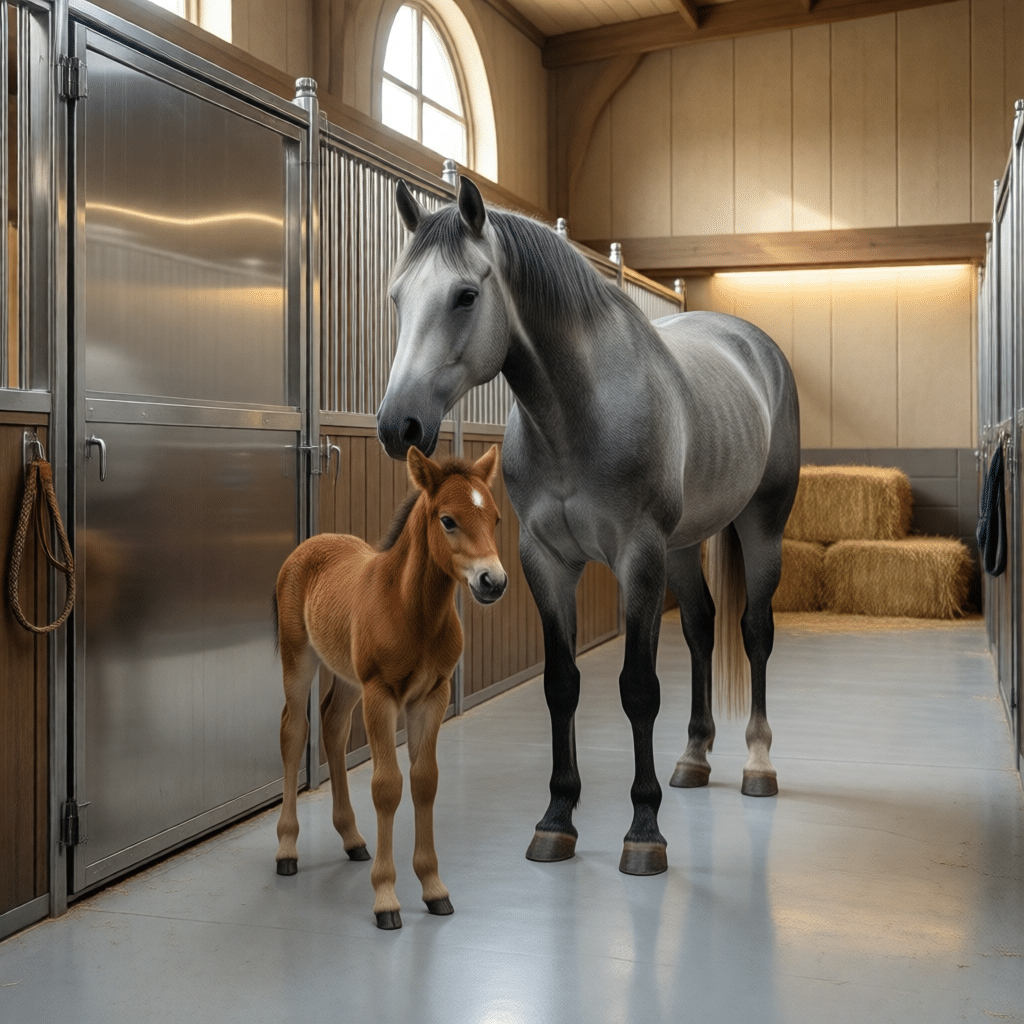
The Frantic Movement of a Newborn Foal
Newborn foals exhibit a “dysmetric gait” and hyperreflexive thrashing as they gain alertness. Impact-absorbing 32mm HDPE infill is essential to cushion these inevitable collisions.
The “Dysmetric Gait”: Understanding Neurological Coordination
Newborns don’t just stand up; they undergo a massive neurological shift. Within minutes of birth, a foal transitions from a semi-tranquilized state in utero to full alertness. This rapid adjustment triggers “hyperreflexive tendon reflexes,” resulting in sudden, jerky limb extensions that the animal cannot yet control. This isn’t clumsiness; it is a biological lack of spatial precision known as a “dysmetric gait.”
- Neurological Shift: The transition from sedation to alertness creates a burst of uncoordinated energy.
- Hyperreflexive Responses: Tendons fire involuntarily, causing limbs to thrash rather than move purposefully.
- Choppy Gait: Early movement is characterized by a “choppy” rhythm where the foal lacks the ability to measure distance or force.
- Collision Risk: The “wobbling head and neck” phase creates a high probability of high-impact collisions with stable walls during the first 60 minutes.
Impact Absorption: How HDPE Infill Protects Fragile Limbs
When a foal with a dysmetric gait thrashes against a wall, the material dictates the injury outcome. Rigid surfaces like concrete, stone, or blockwork are unforgiving; they reflect the energy of the impact back into the foal’s fragile skeletal structure, causing trauma. Traditional wood can splinter or break under this specific type of erratic force.
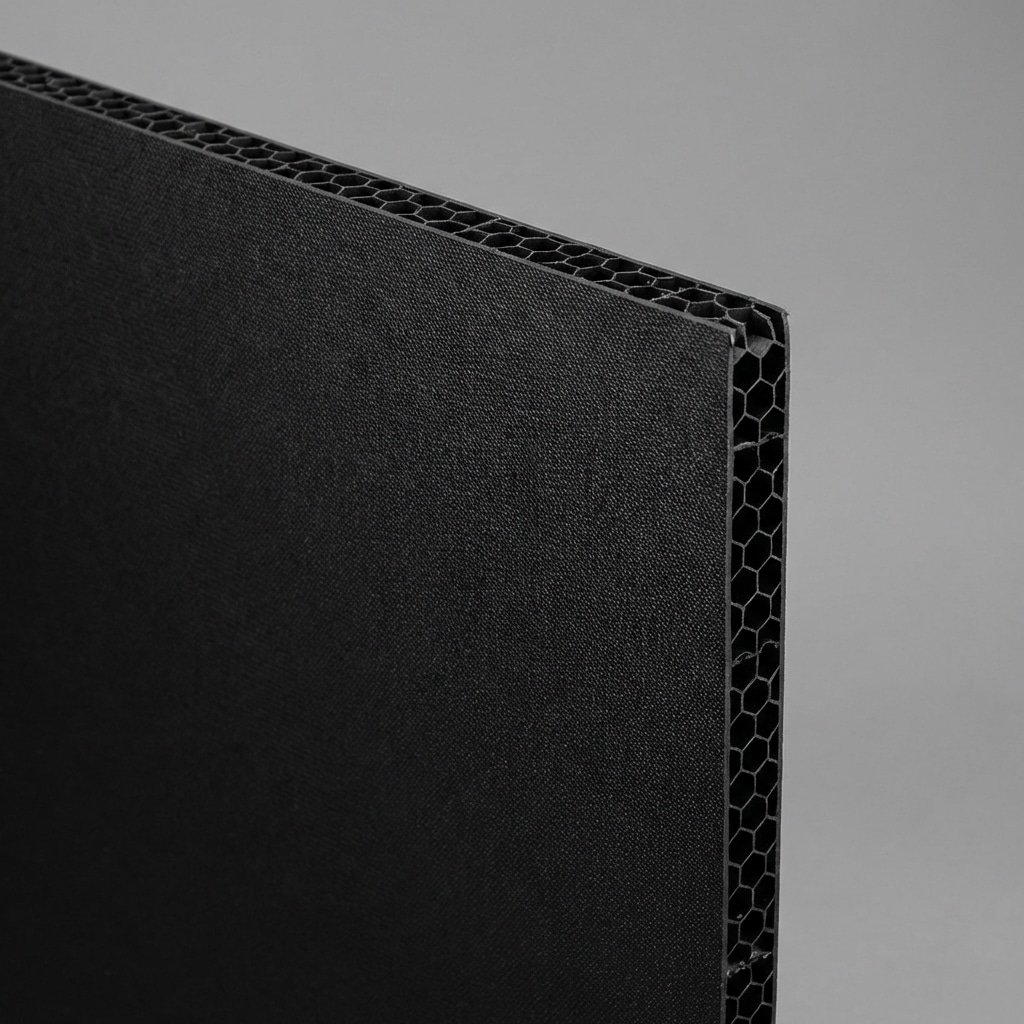
- Material Specification: DB Stable utilizes 28mm-32mm HDPE infill specifically for its shock-absorbing properties.
- Energy Dissipation: Unlike concrete, HDPE flexes slightly upon collision, dissipating the kinetic energy rather than transferring it back to the animal.
- Kick-Proof Guarantee: The Q345 steel frame combined with flexible HDPE ensures the wall survives the impact while the animal remains safe.
- Zero Maintenance: The material withstands the fluids and abrasion associated with foaling without requiring repainting or treatment.
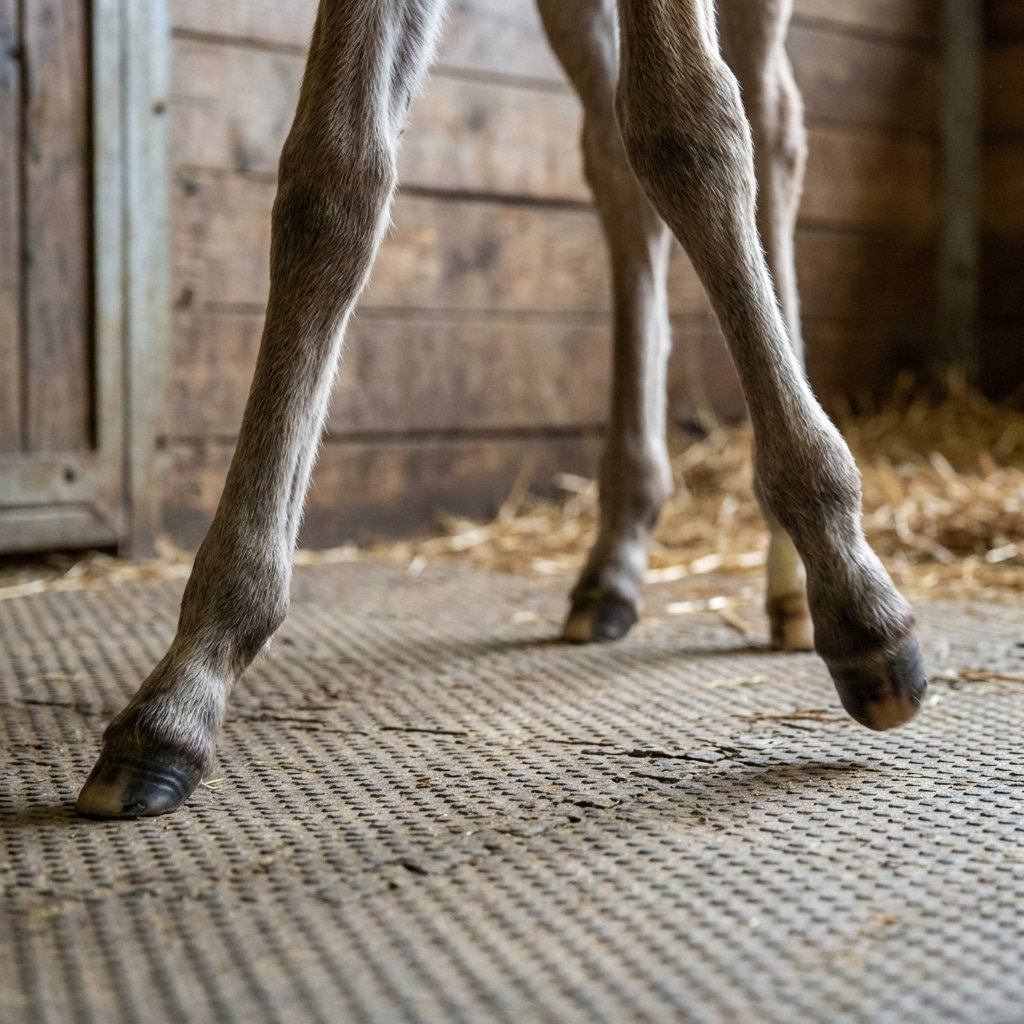
The Squeeze Hazard: When the Bottom Door Guide Fails
A broken bottom guide turns a sliding door into a dangerous pendulum. DB Stable prevents this “squeeze trap” using 304 stainless steel hardware and strict cast-proof alignment.
The “Pendulum Effect”: How Loose Doors Trap Hooves
The most overlooked mechanical failure in a stable isn’t the latch or the hinge; it is the bottom guide. When this small component fails, the sliding door loses its anchor to the floor. It effectively hangs solely from the top track, turning a heavy steel barrier into a free-swinging pendulum.
This creates a specific trap known as the “Squeeze Hazard.” If a horse leans or kicks against the bottom of an unguided door, the panel swings outward, creating a wedge-shaped gap between the door and the wall. The danger arises when gravity takes over.
- The Trap Mechanism: As the horse retracts its leg or neck, the heavy door swings back inward, pinning the animal against the masonry.
- Foal Vulnerability: Due to their smaller size and high-energy movement, foals are statistically more likely to push through these lower gaps.
- Panic Response: Once pinned, the animal’s natural instinct is to pull back, which only tightens the wedge, leading to severe soft tissue damage or fractures.
The Solution: 304 Stainless Steel Anchors & Cast-Proof Gaps
Most bottom guide failures happen because the anchoring hardware corrodes. Stables are ammonia-rich environments. Standard mild steel anchors located at floor level—right where urine and moisture accumulate—will rust and eventually snap under lateral pressure.
DB Stable eliminates this failure point by upgrading the metallurgy and the geometry of the installation.
- 304 Stainless Steel Hardware: We strictly use 304-grade stainless steel for all anchor bolts and connectors in our installation kits. Unlike galvanized or zinc-plated steel, this material resists the shearing forces and ammonia corrosion that destroy standard guides.
- Cast-Proof Design: Our engineering standard mandates a strict bottom gap of approximately 50mm. This tolerance is tight enough to prevent a hoof from slipping under the door, even if a horse is cast (lying down unable to rise) against it.
- Permanent Fixation: The included heavy-duty anchors ensure the guide remains part of the concrete structure, effectively neutralizing the pendulum risk for the lifespan of the stable.
Wholesale Horse Stables With 20-Year Durability
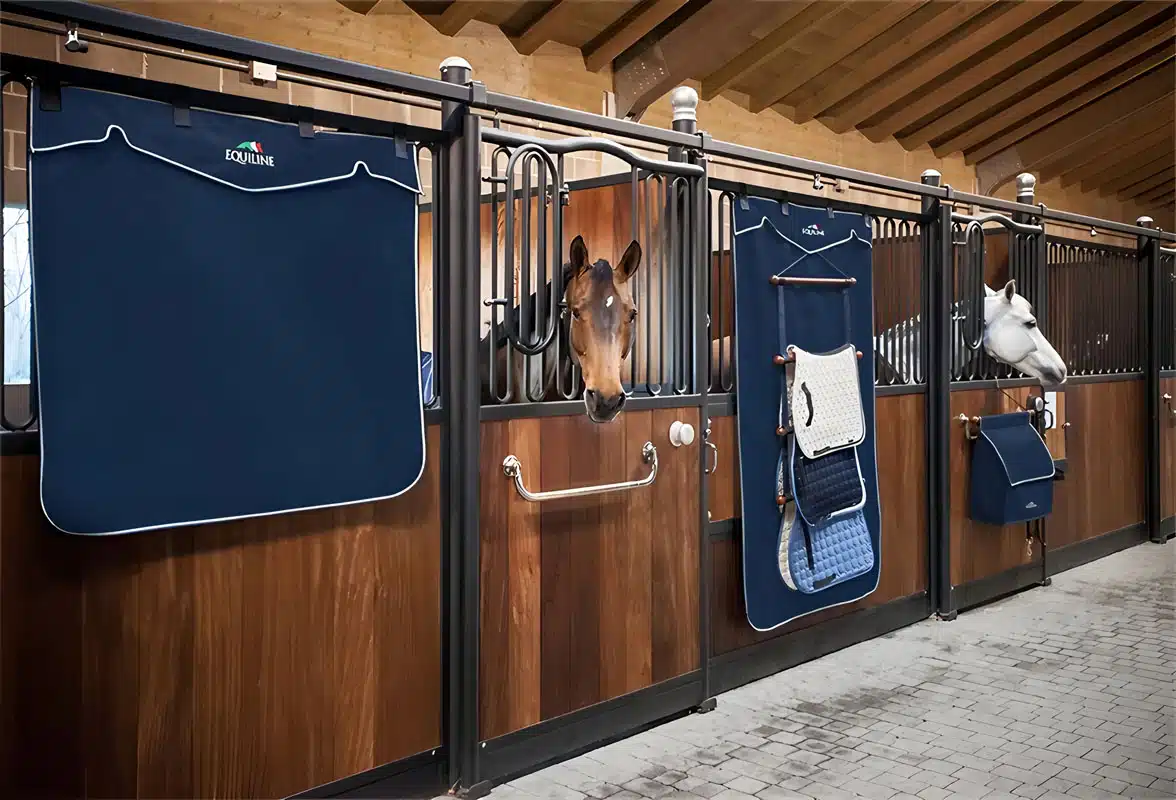
Why 4-Bolt Stay Rollers are Mandatory for Foaling Boxes
Standard single-bolt guides pivot under pressure, allowing doors to swing out. A 4-bolt system anchors the door vertically, maintaining the critical 50mm anti-entrapment gap.
| Feature | Standard Single-Bolt Guide | DB 4-Bolt Stay Roller |
|---|---|---|
| Anchor Points | 1 (Central Pivot Risk) | 4 (Structural Box) |
| Lateral Resistance | Low (Prone to shearing) | High (Kick-Proof Rated) |
| Failure Mode | Rotates, allowing door swing | Remains static |
| Hardware Material | Often Mild Steel (Rustom) | 304 Stainless Steel |
The Danger of Lateral Displacement
Foaling boxes present a unique mechanical challenge compared to standard stables. Newborn foals do not just stand; they are uncoordinated, they flop, and they often sleep pressed directly against the perimeter walls. When a foal lies against a sliding door, they apply significant outward lateral pressure at the weakest point of the system: the floor level.
In standard stable designs, builders often use a single-bolt floor guide (usually a mushroom stop or a small L-bracket). While sufficient for an adult horse that stands centrally, this hardware creates a pivot point. When a foal pushes against the door, that single bolt acts as an axis. If the bolt loosens or bends even slightly, the guide rotates.
- The “V” Trap: As the guide fails, the bottom of the door swings outward, creating a V-shaped opening between the door frame and the floor.
- Leg Entrapment: A foal’s leg can slide through this gap. When they attempt to stand or retract the leg, the heavy door swings back via gravity, trapping the limb against the concrete.
- Structural Shearing: The lateral force of a mare rolling can shear a single bolt cleanly off the concrete, leaving the door completely unanchored at the bottom.
The 4-Point Anchor Specification
To eliminate the risk of rotation and displacement, we mandate a heavy-duty 4-bolt stay roller system for all Professional and Royal Series foaling boxes. This design uses a wide steel chassis that anchors into the concrete at four distinct corners. Geometrically, this makes rotation impossible. Even if one anchor bolt loosens over years of vibration, the remaining three points maintain the guide’s alignment parallel to the door track.
This hardware specification supports our “Cast-Proof Design” standard, which requires the gap between the door bottom and the floor to remain strictly under 50mm. Without a rigid 4-point guide, maintaining this tolerance under the impact of a kicking horse is impossible. We utilize specific materials to ensure these anchors do not corrode in the high-ammonia environment of a foaling stall.
- 304 Stainless Steel Hardware: We supply Grade 304 anchor bolts to prevent rust that typically weakens carbon steel anchors at the concrete line.
- Adjustable Barrel Width: The roller accommodates variable door thicknesses (including 40mm Bamboo/Royal profiles) while keeping the fit tight to prevent rattling.
- Kick-Proof Resilience: The housing is fabricated from heavy-gauge steel, hot-dip galvanized after welding to ISO 1461 standards, ensuring the guide itself does not deform under impact.
Zero-Threshold Tracks: Eliminating Floor Tripping Hazards
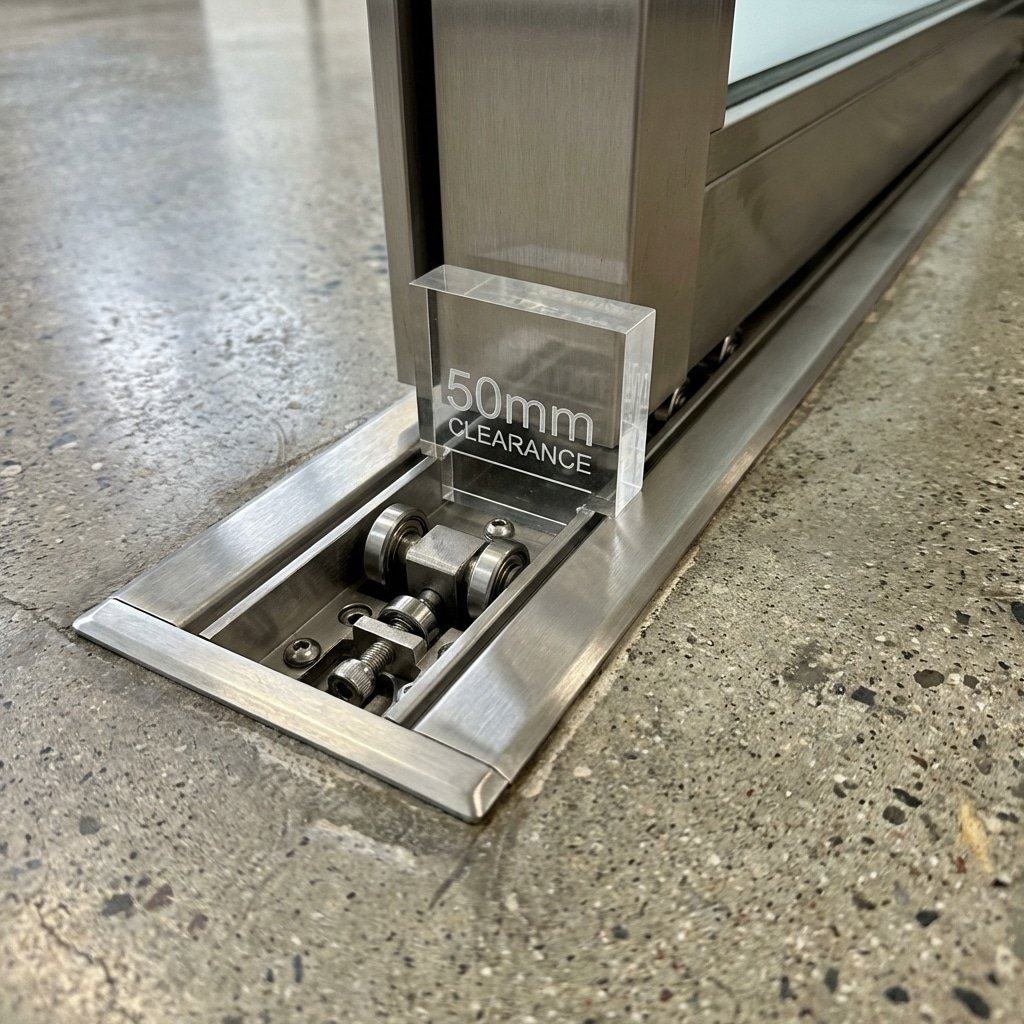
Zero-threshold tracks replace raised floor guides with flush-mounted systems, reducing transition height from 50mm to under 5mm. This eliminates tripping hazards for staff, horses, and heavy machinery.
The Engineering Behind Flush-Floor Transitions
Traditional stable doors often rely on a raised threshold or U-channel, typically standing 50mm to 70mm above the ground, to guide the sliding mechanism. In a commercial equestrian environment, this creates a permanent obstruction in the most critical traffic zone. Zero-threshold engineering removes this barrier, maintaining a floor level difference of less than 5mm to ensure a continuous surface between the aisle and the stall.
- Injury Prevention: Removes the stumble risk for foals learning to walk and horses with leg injuries who may drag their hooves.
- Equipment Mobility: Allows unrestricted movement for feed carts, wheelbarrows, and mobile veterinary units without lifting or jarring the equipment.
- Staff Safety: Eliminates trip hazards for handlers carrying heavy tack, feed buckets, or leading restive horses.
The Hidden Track System in Professional Series Stables
We implement this zero-threshold concept specifically in our Professional Series through a proprietary “Hidden Track System.” Rather than relying on an exposed bottom rail that collects dirt and requires maintenance, we integrate heavy-duty rollers directly into the bottom profile of the door frame. This keeps the floor clear and transfers the mechanical load upward, ensuring longevity even in high-use riding schools and training centers.
- Heavy Load Capacity: Engineered to support the significant weight of High-Density Bamboo infills without friction or sticking.
- Corrosion Defense: All floor-level components undergo Hot-Dip Galvanization to BS EN ISO 1461, providing maximum resistance against urine and moisture at the ground level.
- Debris Management: The absence of a floor channel prevents bedding and hay from compacting in the track, a common failure point in cheaper systems.
Frequently Asked Questions
Are sliding doors safe for foaling boxes?
Yes, sliding doors are generally safer than hinged variants because they don’t swing into the aisle or the stall, eliminating impact risks. However, you must operate them strictly fully open or fully closed. A half-open door creates a dangerous “squeeze hazard” where a foal may try to push through and get trapped. For added safety during the first few weeks, we recommend installing a removable lower kickboard to cover the bottom grill.
What is the recommended bar spacing for a foal stall?
Vertical bar spacing must not exceed 50mm (approx. 2 inches). Standard adult stalls often use 70mm-80mm spacing, which is a trap hazard for small foal hooves. At DB Stable, we use 14-gauge (2.0mm) minimum wall thickness for these bars to ensure they do not bend under impact. Alternatively, heavy-gauge woven mesh on the upper grill offers excellent ventilation without the risk of limb entrapment.
How do I prevent a foal from rolling under the door?
Standard stable doors usually have a 50mm ground clearance. While adults are safe, newborns have much smaller limbs. We utilize a “Cast-Proof Design” that minimizes this bottom gap significantly. For existing stalls, we recommend using a specialized bottom guide system or attaching a temporary rubber seal to the door frame to eliminate the gap completely while the foal is young.
Do I need special latches for a foaling box?
Absolutely. Foals are naturally curious and will mouth any accessible hardware. We insist on “kick-proof” latches that are flush-mounted or pin-lock systems. Avoid any protruding handles or gravity latches; protruding parts can injure a foal’s eye, and simple gravity latches can vibrate open if the mare kicks the door.
Final Thoughts
Standard stabling hardware fails under the erratic impact of a newborn foal, turning a facility into a significant liability risk. Specifying the Professional Series with Q345 structural steel and shock-absorbing HDPE ensures your inventory meets strict animal welfare standards. Dealers who prioritize these safety-critical engineering details build lasting trust with high-value breeding clients.
Do not compromise on safety specifications for breeding facilities; verify our ISO 1461 hot-dip galvanization and 304 stainless hardware yourself. We recommend securing a Professional Series trial unit to validate the Cast-Proof design before outfitting a full barn. Contact our engineering team today to configure a flat-pack shipment optimized for your distribution margins.

 English
  Spanish
  French
  Arabic
  German
0 Comments