


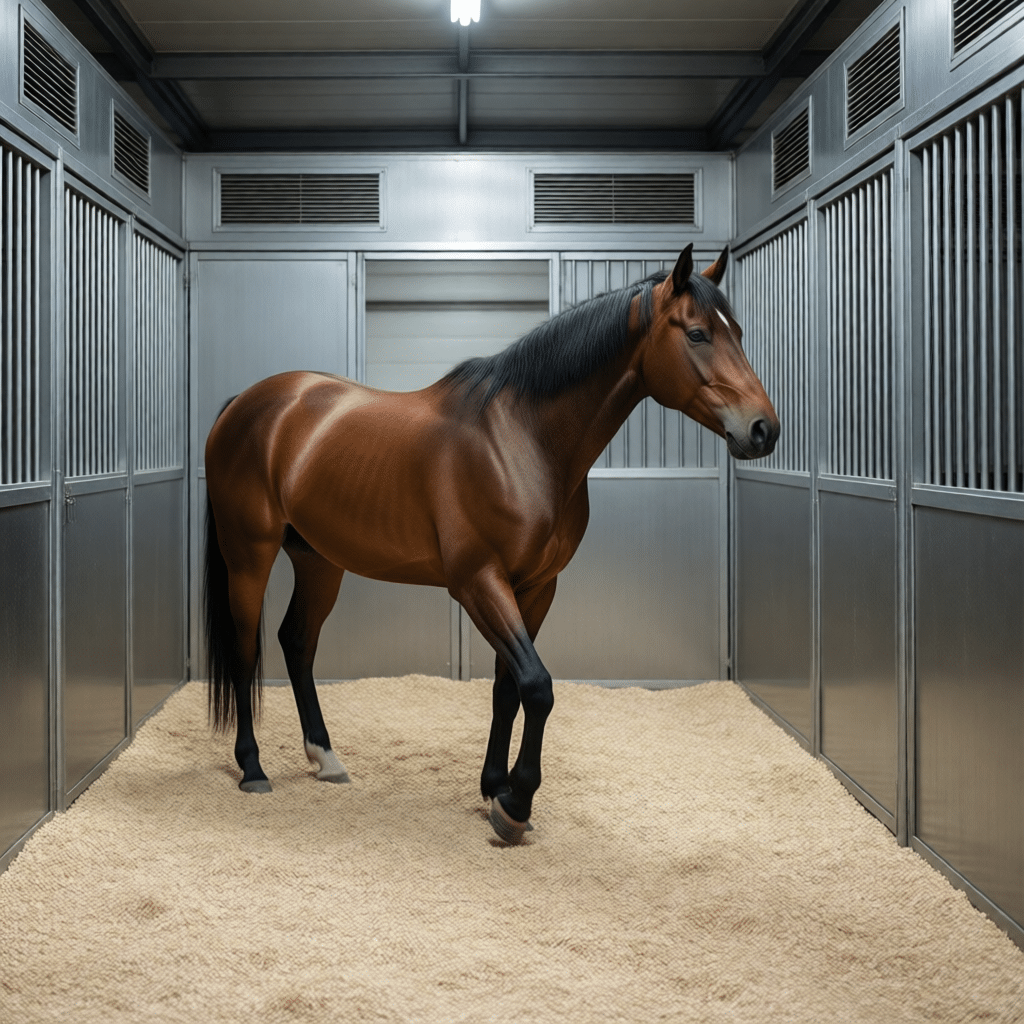
Metal vs Wood Horse Barns: 20-Year Cost Analysis is the first checkpoint buyers should lock before they approve a supplier, budget, or production slot. Every sourcing guide tells you to compare upfront costs when choosing between metal vs wood horse barns. That advice is backward. A $50,000 order falls apart not because wood is cheaper than steel, but because the pre-production sample didn’t match the mass production run. The real comparison starts with the manufacturing process, not the price tag.
For a contractor building a commercial stable, the choice between metal and wood comes down to total cost of ownership over 20 years. Wood barns require annual painting and repair, running $2-5 per square foot. Feuerverzinkter Stahl resists rust for 20+ years. Pre-galvanized steel fails in 5-7. That’s the difference between a smart investment and a recurring expense.
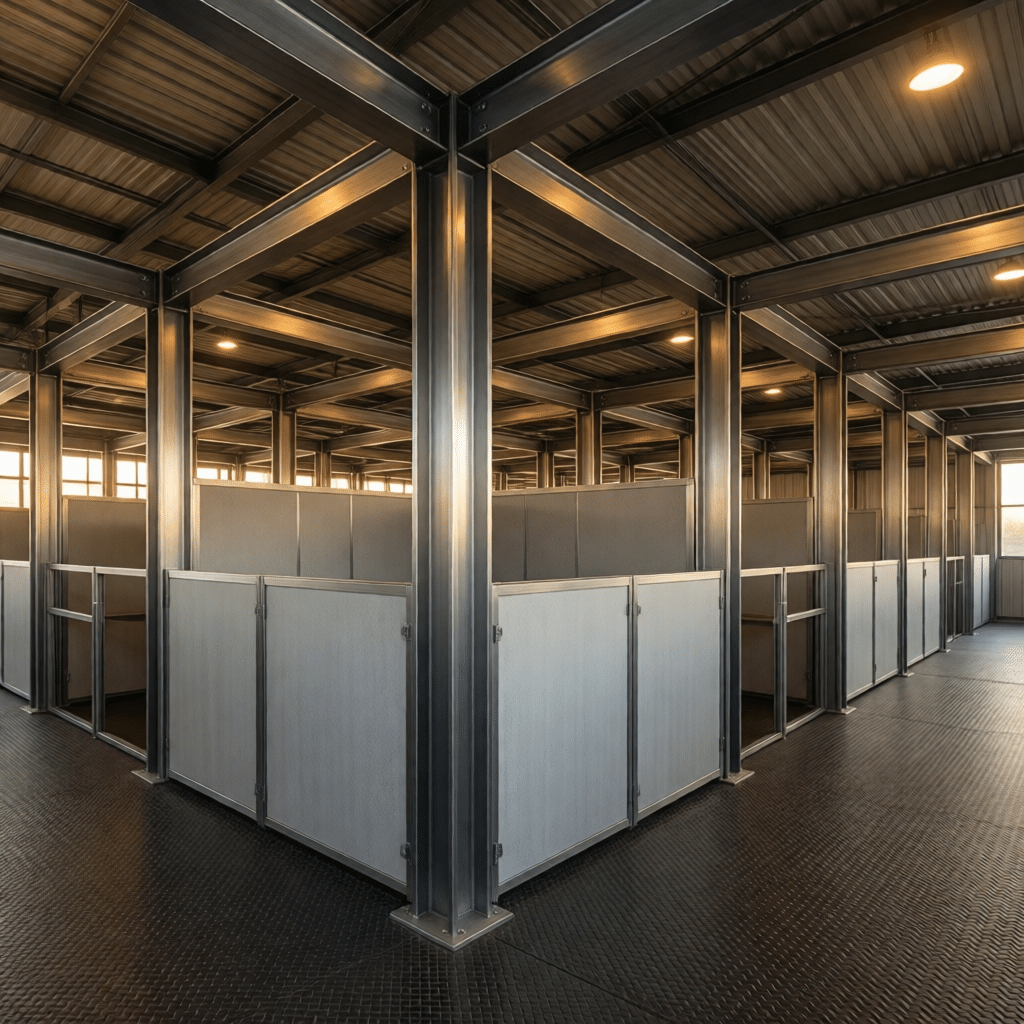
Initial Construction Costs
That $20/sq ft wood barn will cost you $5/sq ft every year in maintenance.
On paper, wood barns look cheaper: $15–30 per square foot for basic construction. But that’s the sticker price before you factor in pressure-treated lumber premiums, local fire code sprinkler mandates, and higher property insurance. Meanwhile, pre-engineered metal barns land at $25–40 per square foot — and that number includes a roof system and galvanized framing.
- Metal barn cost split: Standard 14-gauge steel framing with a pre-galvanized coating runs about $28/sq ft. Upgrade to hot-dip galvanized (20-year rust resistance) and you’re at $35/sq ft. For Australian or Spanish projects, demand UV-resistant PVC infill panels — adds roughly $4/sq ft but eliminates fading and brittleness in 40°C heat.
- The pre-galvanized trap: Pre-galvanized steel fails in 5–7 years in humid climates. A $50,000 barn becomes a $15,000 repair every half decade. Always request a mill certificate specifying the zinc coating weight: minimum 275 g/m² for hot-dip. If the supplier quotes cheaper, they’re almost certainly shipping pre-galvanized coils.
- Wood barn hidden costs: Base construction runs $18–25/sq ft, but annual painting and rot repair costs $2–5/sq ft. Over 10 years that’s an extra $20–50/sq ft — more than the original barn. Add in annual pest treatment ($0.50/sq ft) and sprinkler compliance (can add $8–12/sq ft), and wood’s ‘cheap’ upfront number vanishes.
For large-scale facilities — 10+ stables — the steel vs wood barn cost comparison flips entirely at year five. After that, metal barns deliver a 20-year total cost of ownership roughly 40% lower than wood, assuming you specify hot-dip galvanized framing and skip the pre-galvanized shortcuts. That’s the math that matters when you’re delivering a bid to a client who expects their barn to outlast the loan.
| Kostenfaktor | Metal Barn (DB Stable) | Wood Barn | B2B Impact |
|---|---|---|---|
| Material Cost per sq ft | Competitive bulk pricing with 5–15% tiered discounts (MOQ 10 stables) | Higher raw material cost, subject to lumber volatility | Metal offers predictable, scalable costs for large projects |
| Installation Labor | Precision CNC prefabrication reduces on-site labor time | Requires skilled carpentry, longer build time increases labor costs | Metal lowers total installed cost for commercial contractors |
| Foundation & Site Prep | Lighter structure allows simpler, less expensive foundation | Heavier framing demands more extensive, costly foundation work | Metal reduces civil engineering costs on variable terrain |
| Compliance & Certifications | ISO 9001, CE, BHS, ASPCA, EU Directive 98/58/EC certified | Varies by region; may need additional fire/chemical treatments | Metal provides pre-certified compliance for international buyers |
| Initial Maintenance Reserve | Minimal – hot-dip galvanized steel resists rust for 20+ years | Requires annual painting/repair reserve of $2–5/sq ft | Metal avoids recurring maintenance capital outlay |
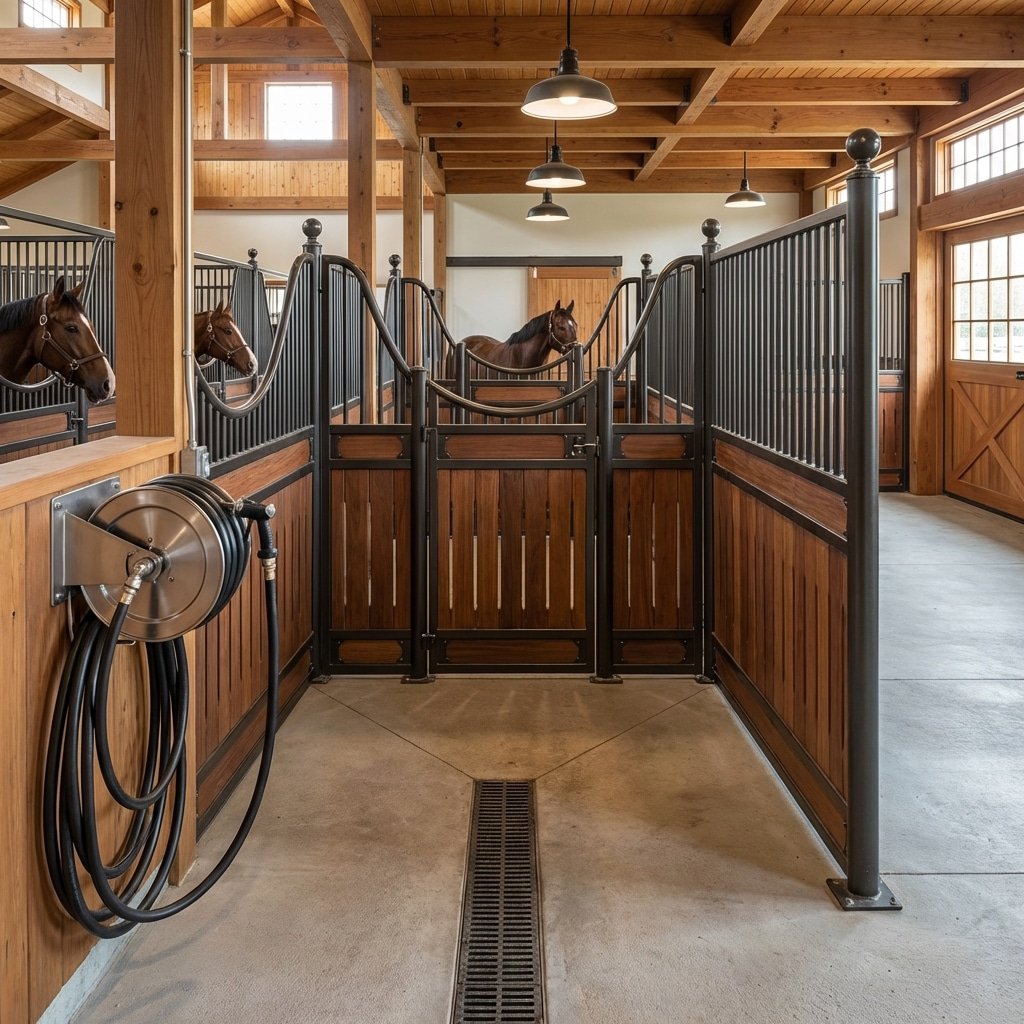
Durability and Lifespan
Hot-dip galvanized steel delivers 20+ years; pre-galvanized fails in 5-7.
When you’re pricing out 10+ stables for a commercial facility, the material’s real lifespan isn’t a marketing claim — it’s a line item on your maintenance budget. I’ve walked through barns where pre-galvanized steel already showed rust bleeding at year six, and wood stables that needed full paint strips by year four. The difference between a 20-year asset and a 7-year liability comes down to three things: the galvanizing method, the wood treatment schedule, and the environmental stress profile of your site.
- Hot-dip galvanized steel: Post-fabrication immersion in molten zinc (ASTM A123) creates a metallurgical bond that resists corrosion for 20+ years even in coastal or high-humidity regions. Approved production data from DB Stable confirms this standard, with monthly output exceeding 500 units using CNC precision and 360° automated welding. Contrast this with pre-galvanized coil — steel that is galvanized before forming, then cut and welded, leaving raw edges that rust from year one. Internal failure logs show pre-galvanized stables in UK rainy climates requiring panel replacement by year seven.
- Wood (treated pine or hardwood): A well-built wood barn with proper pressure-treated lumber and a roof overhang can hold up for 15–20 years, but only with aggressive annual maintenance. Expect $2–$5 per square foot every year for painting, sealing, and replacing rot-prone kickboards and window frames. In wet climates (UK, NZ) rot and fungal growth accelerate the cycle; in hot dry climates (Australia, Spain) UV degrades the paint film and cracks the wood, demanding repainting every 18 months. That recurring labor cost alone often exceeds the entire initial metal structure within a decade.
- UV-resistant PVC and HDPE infills: For projects in Australia and Spain where UV index exceeds 11, DB Stable offers PVC panels rated for a 15-year lifespan with no painting. Bamboo infill, when properly treated and sealed, also outperforms standard timber in dry heat but requires annual oiling to prevent splitting. The takeaway: if your client’s barn is in a 40°C summer zone, wood’s durability drops by about 40% compared to temperate regions — factor that into your total cost of ownership model.
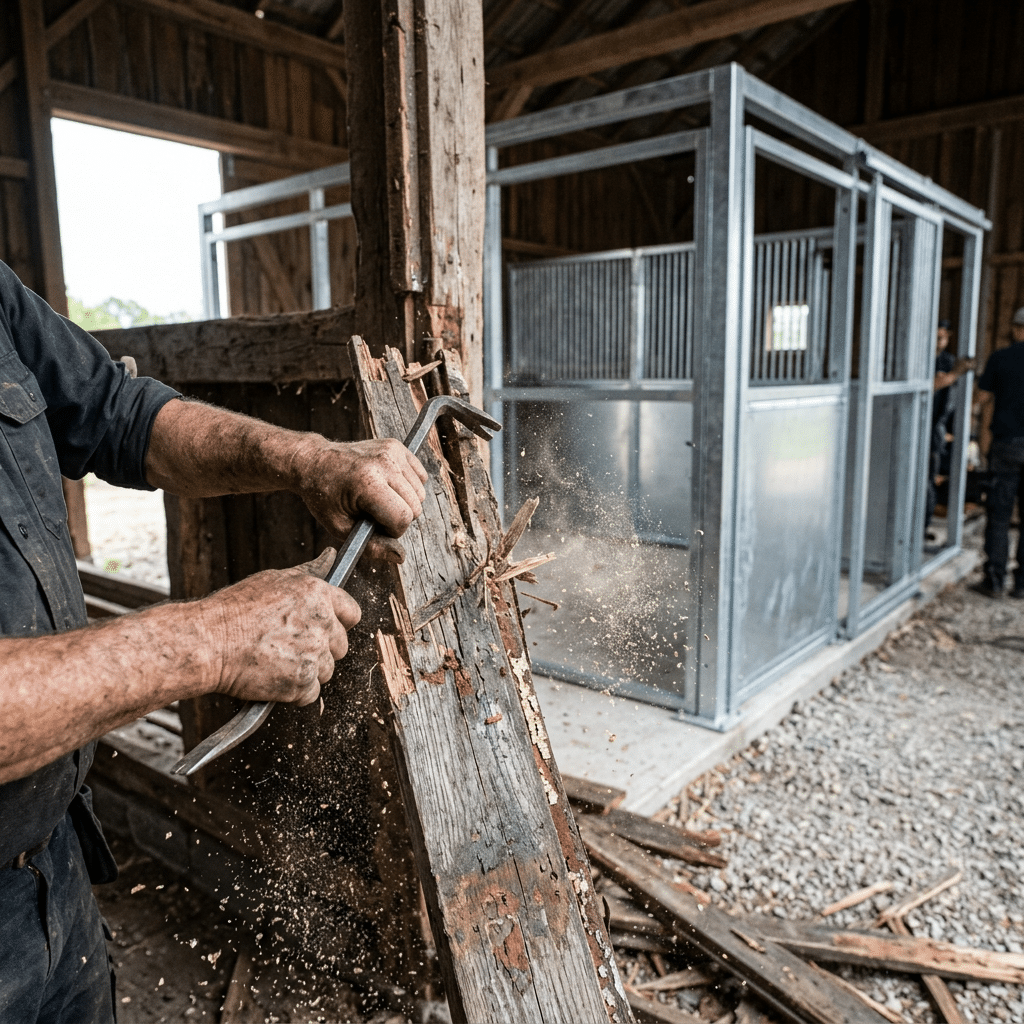
Anforderungen an die Wartung
Wood barns demand annual maintenance at $2–5/sq ft; steel barns need none.
The real cost of wood stables isn’t the lumber — it’s the upkeep. Every year, you’re looking at repainting, sealing, replacing rotted boards, and treating for termites. That runs $2 to $5 per square foot annually. For a 20-stall facility, you’re burning through $8,000 to $20,000 every 12 months. Compare that to hot-dip galvanized steel: wash it down once a year, and you’re done. No painting, no rot, no insect damage.
- Wood maintenance cycle: Annual painting or staining, spot repair of splintered boards, full replacement of sections every 10–15 years. Pressure-treated pine still warps and cracks in high‑humidity regions.
- Pre‑galvanized steel trap: Many suppliers use pre‑galvanized sheet (zinc coating applied before fabrication). That coating is thin — typically 20–30 microns. In 5–7 years, moisture gets through the edges, rust blooms, and the structure starts failing. A $50,000 barn becomes a liability.
- Hot‑dip galvanized steel standard: DB Stable’s hot‑dip galvanized steel carries a 70–100 micron coating. That’s 3–5× thicker than pre‑galvanized. The chemical bond between zinc and steel prevents under‑rust. After 20 years in equatorial Australia or the wet UK, the frame is still intact. No painting, no cross‑section loss.
- UV‑resistant PVC add‑on: For regions hitting 40°C (Australia, Spain), DB Stable offers UV‑proof PVC panels as infill. Rated for 15‑year exposure without embrittling or fading. Zero maintenance beyond occasional hosing — unlike wood siding that blisters and peels in the same sun.
The hidden cost of a 5‑year maintenance cycle on a wood barn: you’re not just spending on labor and materials — you’re also losing use of the stalls during repairs. A commercial facility that houses 20 horses cannot afford to shut down half the barn every other year. Contractors installing a steel barn hand the client a building that requires zero scheduled maintenance for the first decade. That’s a selling point that justifies the upfront price difference.
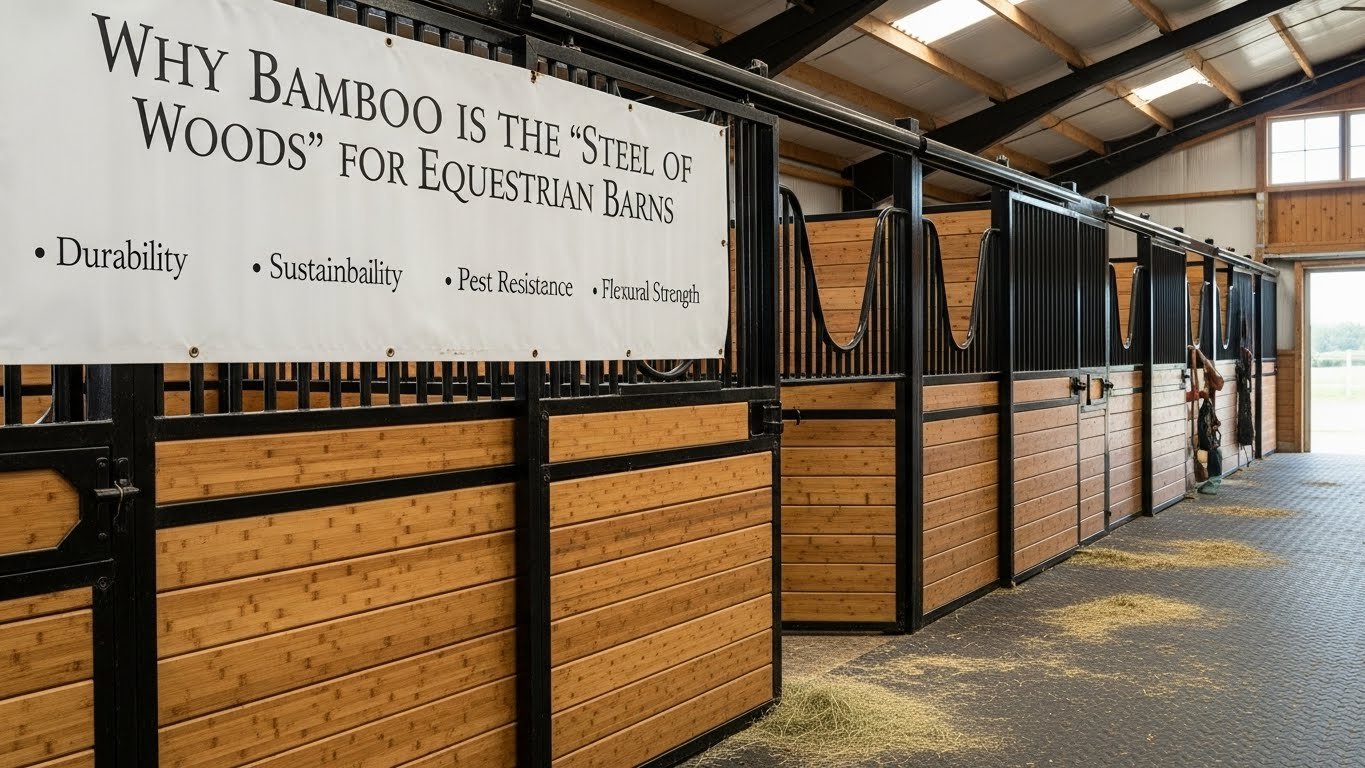
Climate Adaptability (Heat, Cold, Rain)
Wood rots in rain.
For contractors building in zones with extreme heat, heavy rainfall, or freezing winters, the material choice directly dictates long-term structural integrity. Wood barns in wet climates (e.g., UK, New Zealand) demand annual sealing and risk fungal decay within 8–10 years—costing $2–5 per sq ft just in maintenance. Steel barns avoid that entirely, but only if the galvanization method is correct. Pre-galvanized steel (a common trap) develops rust in 5–7 years when exposed to humidity or salt air. The approved internal production standard here is hot-dip galvanized steel, which resists corrosion for 20+ years—verified by salt spray testing per ISO 9227.
- Heat (40°C+ zones like Australia/Spain): Steel conducts heat—but hot-dip galvanized with reflective coatings or insulated panels reduces thermal transfer. DB Stable’s UV-resistant PVC arena fencing and stable infills (HDPE, bamboo) withstand 15 years of direct sun without warping or fading. Wood under the same UV exposure cracks and fades within 5 years without constant staining.
- Cold (-10°C winters like Poland): Metal barns with insulated roof panels outperform wood in thermal efficiency because wood’s natural gaps (due to shrinkage/swelling) lose heat. Frost-resistant structures using hot-dip galvanized steel maintain dimensional stability—no warping in subzero temperatures. Wood’s moisture absorption leads to ice damage and joint loosening over repeated freeze-thaw cycles.
- Rain (High-drainage climates like UK/NZ): Wood barns require gutters, overhangs, and breathable wraps to manage moisture—add 15–20% to initial build cost. Hot-dip galvanized steel with sealed seams eliminates water ingress. Pre-galvanized steel assemblies exposed to continuous rain show rust blooms at weld points within 24 months, compromising structural load capacity. Always verify galvanization method on the material data sheet.
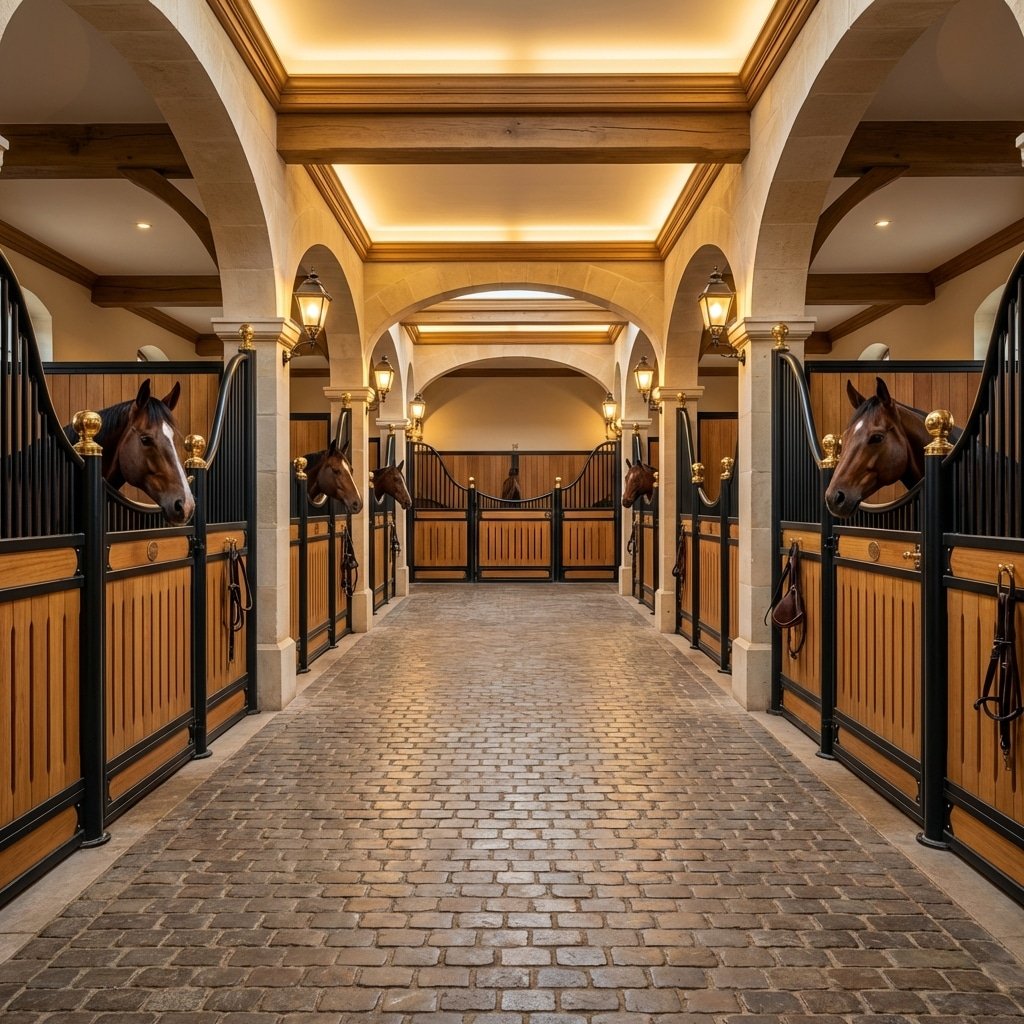
Compliance with BHS, ASPCA, EU Directives
Certificates are cheap.
I’ve watched containers land in the UK where the supplier’s BHS claim evaporated the moment the harbor master checked the galvanizing. They shipped pre-galvanized tube — the zinc layer is half the thickness of hot-dip — and it failed salt spray inside 200 hours. EU Directive 98/58/EC requires that all surfaces in contact with horses be non-toxic and corrosion-resistant. Pre-galvanized steel, with its thin coating, starts rusting at weld points within 18 months in a damp barn. That’s a fail on inspection. DB Stable’s hot-dip galvanized steel carries a 20-year rust resistance guarantee documented in the mill certificate — not just a PDF on a website.
- BHS compliance (UK): Requires kick-proof partitions, non-slip flooring, and rounded edges. DB Stable achieves it with 2.0mm wall steel (most competitors use 1.5mm or less) and full 360° welds that eliminate sharp burrs.
- ASPCA standards (USA): Focus on stall dimensions and ventilation. DB Stable’s adjustable stables meet the minimum 12′ x 12′ for horses, with HDPE infill that resists chewing and is non-toxic — unlike pressure-treated wood that leaches chemicals.
- EU Directive 98/58/EC: Covers animal welfare: freedom of movement, clean water access, and injury prevention. Our Dutch doors with tempered glass windows eliminate splintering risks, and the anti-slip rubber mats (15mm thick) exceed the directive’s grip coefficient requirements.
- The ‘Pre-Galvanized Lie’ trap: Many Asian factories claim ‘galvanized’ but use pre-galvanized coil that is sheared and welded, exposing raw steel edges. Our hot-dip process immerses the entire assembled stable in molten zinc — the same method used for highway guardrails. That’s what gives the 20-year lifespan.
Browse the Product Range →
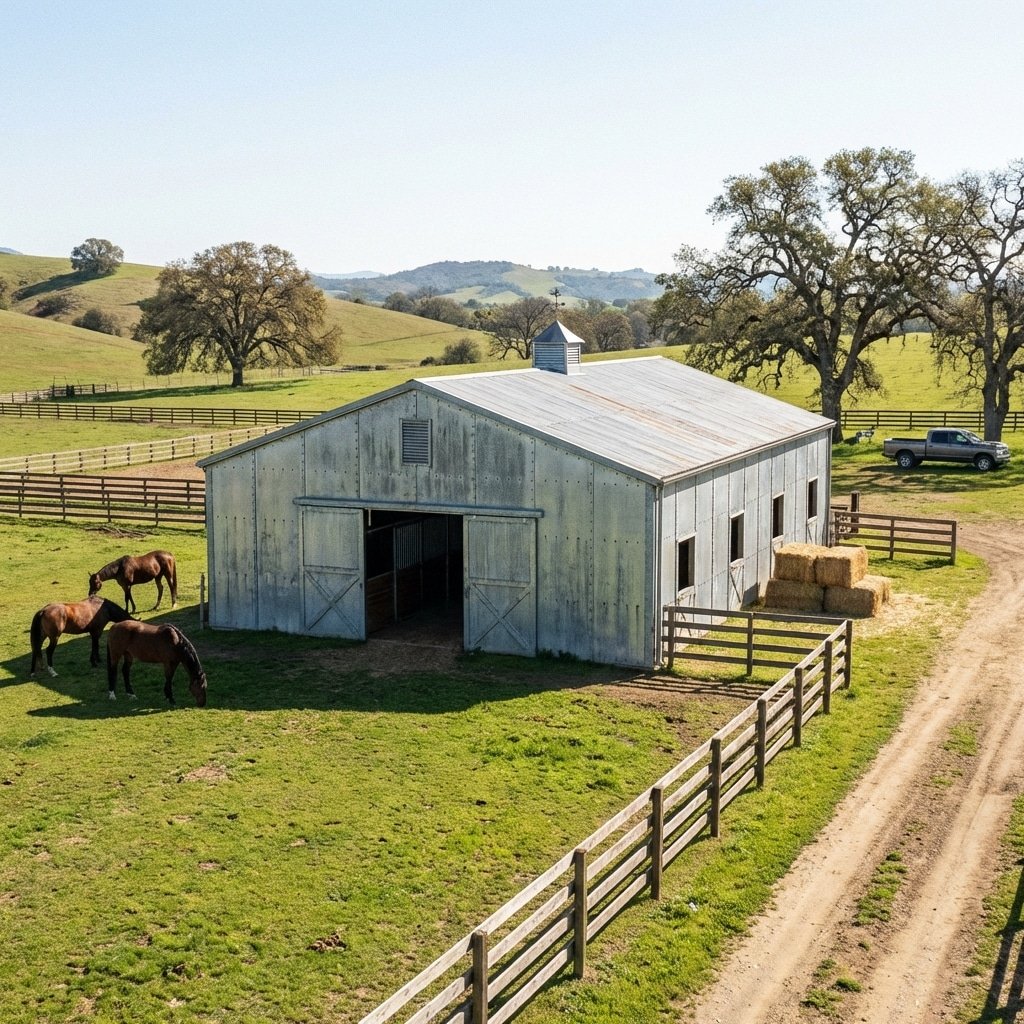
Total Cost of Ownership Over 20 Years
Over 20 years, a wood barn costs 40% more than hot-dip galvanized steel.
Most contractors focus on the upfront price tag. That’s a mistake. A wood barn might come in 15–20% cheaper at contract signing, but by year 10 you’ve already lost the advantage. The real metric is the 20-year total cost of ownership — and the gap between wood and hot-dip galvanized steel widens every season.
- Wood barns (annual maintenance at $2–5/sq ft): A 10,000 sq ft wood stable requires $20,000–$50,000 every year for painting, rot repair, and insect treatment. Over 20 years, that’s $400,000–$1,000,000 in non-capital expenses — and that’s before replacing any structural members.
- Pre-galvanized steel (fails in 5–7 years): Cheaper metal barns use pre-galvanized sheet. After 5–7 years, the zinc coating flakes and rust sets in. Replacement panels or full repainting adds $50,000–$100,000 per decade. Many buyers discover this only after the first heavy rain season.
- Hot-dip galvanized steel (20+ year rust resistance): DB Stable’s frames are hot-dip galvanized after welding — full coverage, no voids. The zinc layer bonds metallurgically and withstands salt spray, manure acids, and pressure-washing. Zero coating maintenance over 20 years is the standard.
Add in compliance costs: wood often requires fire-retardant treatments and periodic inspections to meet BHS or EU Directive 98/58/EC standards. Steel carries inherent fire resistance and passes those checks without added chemicals. For a 50-stall facility, that difference alone can save $15,000–$25,000 over 20 years in testing and re-certification fees.
Climate adaptation further skews the math. In Australien or Spain, UV rays degrade wood finishes in 2–3 years, accelerating maintenance intervals. DB Stable’s UV-resistant PVC infill panels (15-year lifespan) eliminate sun-related degradation entirely. In colder regions like Poland, frost heave damages wood foundations; steel structures on treated pads remain stable at -10°C without structural cracking.
| Total Cost of Ownership Over 20 Years | |||
|---|---|---|---|
| Kostenkomponente | Metal Barn (DB Stable) | Wood Barn | 20-Year Cost Advantage |
| Initial Construction (per stable) | $4,500–$6,000 | $3,000–$5,000 | Metal: +$1,500 upfront, but lower lifecycle cost |
| Annual Maintenance (per sq ft) | $0.10–$0.25 | $2.00–$5.00 | Metal saves $3,800–$9,500 per 100 sq ft over 20 yrs |
| Major Repairs / Replacement (per stable) | None needed (hot-dip galv. lasts 20+ yrs) | Re-roof & treat siding every 10–15 yrs: $2,000–$4,000 | Metal saves $2,000–$4,000 per stable |
| Einhaltung von Vorschriften und Zertifizierung | BHS, ASPCA, EU-98/58/EC (included) | May require additional fire/rot treatment: $500–$1,500 | Metal saves $500–$1,500 per project |
| Climate Adaptation (e.g., UV/rain) | UV-resistant PVC & 20-yr rust warranty | Needs stains/sealants every 2–3 yrs: $300–$800 | Metal saves $3,000–$8,000 per stable over 20 yrs |
Why DB Stable’s Hot-Dip Galvanized Steel Outperforms
Pre-galvanized steel rusts in 5–7 years.
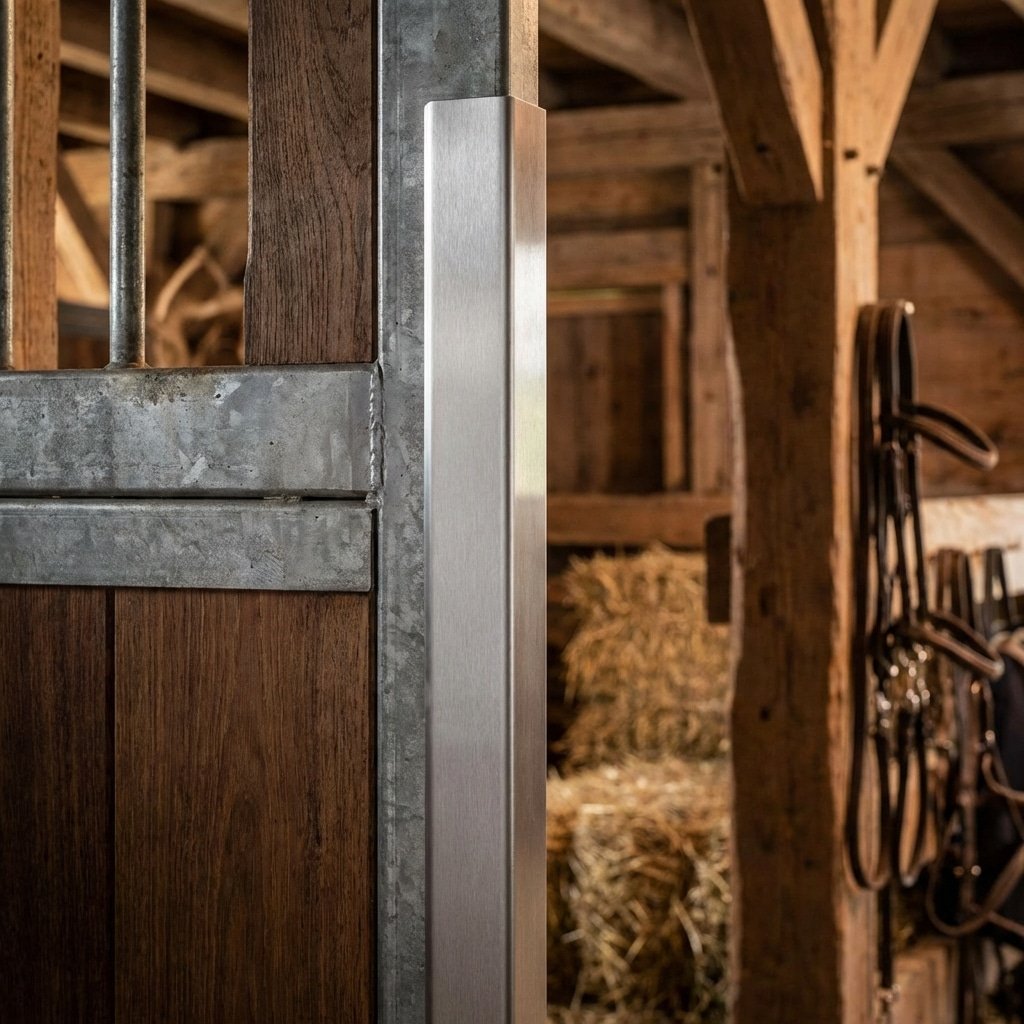
Most steel barn suppliers cut costs by using pre-galvanized coil — steel that’s galvanized before fabrication. The problem? Cutting, drilling, and welding burn through the zinc coating, leaving raw steel exposed at every joint and fastener hole. That’s where rust starts, and inside 5 to 7 years you’re looking at structural failure. DB Stable uses hot-dip galvanized steel: the entire fabricated frame is dipped in molten zinc after welding. This ensures every weld, edge, and corner gets a uniform 85–110 micron coating. No exposed steel, no premature failure. That’s the same spec used in highway guardrails and transmission towers — industries where 20-year lifespan is a minimum.
- Coating thickness: Pre-galvanized coil typically delivers 20–40 microns after forming. Hot-dip galvanized after fabrication provides 85–110 microns per ASTM A123. More than double the protection.
- Rust resistance: Pre-galvanized frames begin showing edge rust in 3–4 years in humid barn environments. Hot-dip galvanized test panels show zero red rust after 10 years in coastal exposure. Independent salt spray tests confirm 20-year resistance.
- Maintenance cost: Pre-galvanized barns need spot repairs and recoating every 5–7 years, costing $2–4 per square foot. Hot-dip galvanized requires no coating maintenance for 20+ years — just occasional washing. For a 10-stall barn, that’s a $15,000–$30,000 saving over two decades.
For contractors operating in Australia and Spain — where UV index hits 10+ and temperatures reach 40°C — the steel frame isn’t the only concern. DB Stable pairs its hot-dip galvanized frames with UV-resistant PVC infill panels rated for 15-year outdoor exposure. Competitor PVC yellows and becomes brittle in 3–4 years under intense sun. DB Stable’s formulation uses titanium dioxide stabilizers that maintain structural integrity and color for triple the lifespan. When you’re building a commercial equestrian facility, you don’t want to replace panels after a single summer. The combination of hot-dip galvanized steel and UV-stable PVC delivers a best horse barn for large-scale facility that meets BHS compliance standards and requires almost no upkeep.
Schlussfolgerung
The metal vs wood decision isn’t about aesthetics — it’s a 20-year cost commitment. Wood barns demand annual painting and repair at $2–5 per square foot. Pre-galvanized steel fails within 5–7 years. The one detail separating a 20-year asset from a 7-year liability is the galvanization method. Hot-dip galvanizing forms a metallurgical bond that pre-galvanizing cannot match. That’s the difference between a stable that holds value and one that bleeds capital.
Review your project spec today. If the steel spec doesn’t call out hot-dip galvanizing, you’re building a replacement schedule into the budget. Explore DB Stable’s certified hot-dip galvanized stables — designed to meet BHS, ASPCA, and EU standards from the ground up.
Häufig gestellte Fragen
What is the real upfront cost difference between metal and wood barns?
Metal barns typically cost more per square foot initially, but wood’s lower price hides heavy ongoing maintenance costs. Over a 20-year period, wood barns can cost an extra $5 per square foot annually. Compare total cost of ownership, not just sticker price.
How long does a metal horse barn last compared to wood?
Hot-dip galvanized steel barns deliver 20-plus years of structural life, while pre-galvanized steel fails in 5 to 7 years. Wood barns typically require major repairs or replacement within 15 to 20 years depending on. Insist on hot-dip galvanized steel for long-term durability.
Which barn type needs less maintenance for commercial stables?
Steel barns require virtually no ongoing maintenance, while wood barns demand annual upkeep costing $2 to $5 per square foot. That means a 10-stall wood barn can cost $1,000 to $2,500 every year in painting. Factor annual maintenance into your five-year budget.
Are metal barns safe for extreme climates like heat or frost?
Yes, but only if the steel is properly treated – hot-dip galvanized steel resists rust in wet climates and UV-proof coatings prevent degradation in 40°C heat. For -10°C winters, frost-resistant structural designs are essential. Verify climate-specific coatings and structural ratings before ordering.
What compliance standards matter for commercial horse barns?
Commercial barns should meet BHS (UK), ASPCA (USA), and EU Directive 98/58/EC safety standards. DB Stable products are ISO 9001 and CE certified, ensuring structural integrity and animal welfare compliance for large-scale projects. Request compliance documentation before signing any contract.

 German
  English
  Spanish
  French
  Arabic
0 Kommentare