


Horse fence panel connections are where a paddock either holds together or quietly comes apart. The rails and mesh get the product photos, but the pins, clamps and posts carry the loads: a horse leaning on a panel puts force into the joint, the joint transfers it to the post, and the post either passes it into the ground or lets the whole line walk. Buy the connection system with the same attention as the panel itself, and the fence lasts; treat it as an afterthought, and you re-order panels that failed at a low-cost connector.
This guide explains how connection hardware works in a modular horse fence, what to specify when you order, and how load moves through a panel line. It is written from the manufacturing side: DB HorseStable builds galvanized steel horse fence panels and UV-resistant PVC arena fencing in Anping, China, exporting to farm, training and competition projects across nine countries. Where a number appears below, it comes from the factory’s published specifications.
Key Takeaways
- A fence line is a load path: pressure on the panel travels through the connector into the post and down into the ground — the weakest link sets the strength of the whole run.
- Order connections with the panels, not after: fence panels start at an MOQ of 50 panels, and pins or clamps are line items a complete quotation should itemize.
- Hot-dip galvanized steel carries a 20-year rust-resistance specification, and automated 360° welding with CNC machining keeps joint geometry consistent — ask for both in writing.
- Post-to-ground anchoring is part of the connection system: anchor type must match your soil, exactly as panel type must match your horse and climate.
- Bulk orders earn tiered discounts of 5-15% and global delivery in 4-6 weeks, with 1-2 week express dispatch from the Sydney and Warsaw regional warehouses.
How Load Moves Through a Panel Line
Picture a horse pressing its chest against a panel. The panel wants to rotate. What stops it is not the panel’s tube wall alone — it is the connector at each end locking the panel to its neighbors, and the end posts of the run resisting the rotation the whole line tries to share. Engineers call this a load path: force enters at the panel, crosses the joint, travels along the line and down the posts. Every connection in that path either passes the load along or becomes the point of failure.
The practical consequence for a buyer: a run is as strong as its worst joint. A line of heavy panels joined by undersized clamps behaves like a line of undersized panels. That is why connection hardware deserves its own lines on the quotation, and why manufacturers who automate their welding — DB HorseStable runs CNC machining with automated 360° welding at a capacity above 500 sets per month — can keep joint geometry consistent across a bulk order, so panel number 200 mates with panel number 1 exactly as panel number 2 did.

Pins, Clamps and What Each One Is For
Modular fence systems generally join in two ways. Pin connections drop a pin through aligned holes in adjacent panel frames — fast to assemble, fast to strike, and forgiving of ground that is not perfectly level. Clamp connections wrap a bracket around the meeting point of two frames and tighten, which grips the joint over a larger area and suits lines that stay in place longer. Neither is universally better; the choice follows how often the line moves and how much lateral force it must resist.
What matters at order time is that the hardware matches the rest of the system in material and coating. A galvanized panel joined with untreated brackets rusts at the joint first, and joint rust is the quiet kind — hidden under the clamp, spreading where you cannot see it until the connection loosens. The factory specification for the steel line is hot-dip galvanizing with 20-year rust resistance; hold the connection hardware to the same standard and ask the supplier to state it in the quote.
| Connection element | What it does | What to confirm at order |
|---|---|---|
| Joining pins | Lock adjacent panel frames; allow quick assembly and strike-down | Quantity per panel listed on the quote; same galvanized finish as panels |
| Clamps / brackets | Grip the joint over a larger contact area for longer-running lines | Sized for the panel tube; coated to the same rust-resistance specification |
| Posts and anchors | Receive load from the line and transfer it into the ground | Anchor type matched to your soil; end posts specified for the run |
| Spare hardware | Replaces lost pins and worn clamps without waiting on a new container | Ordered with the bulk run; tiered discounts of 5-15% apply to volume |
Posts and Ground Anchoring
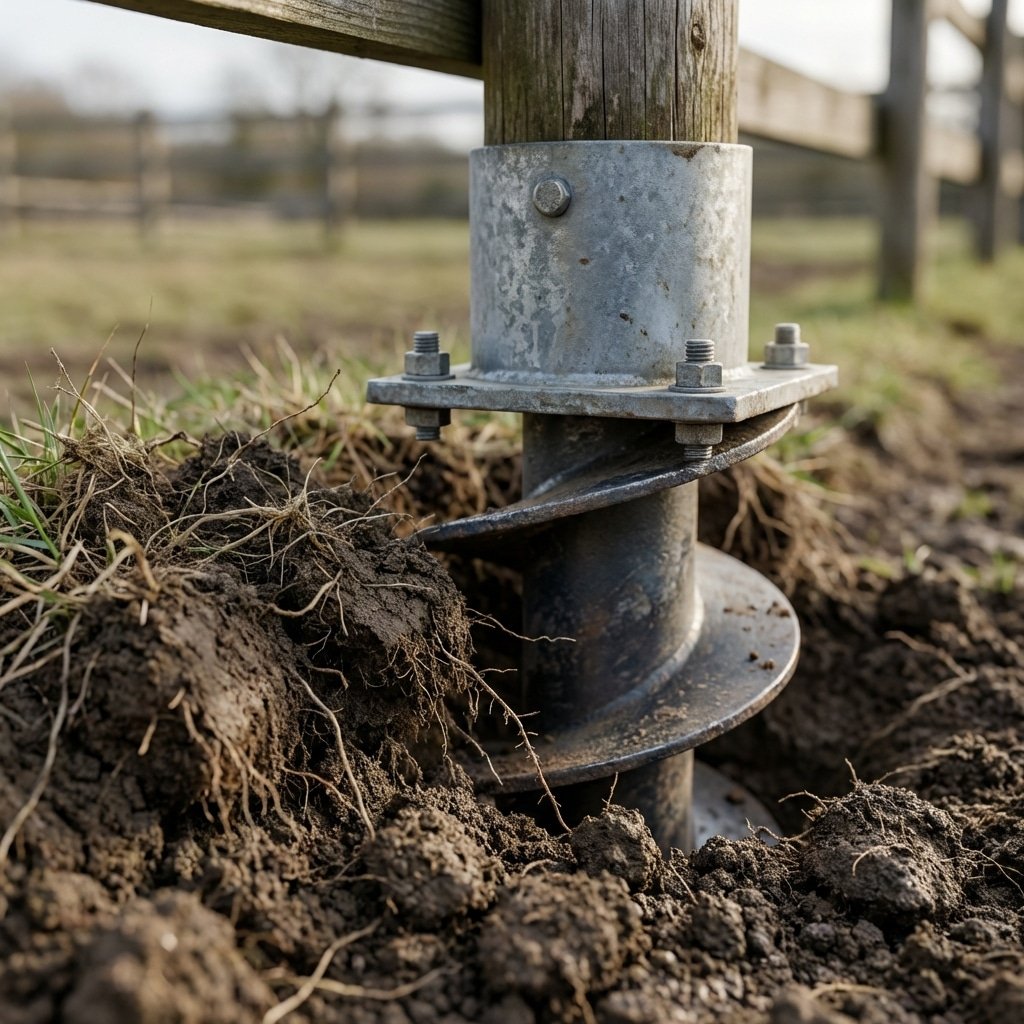
The last link in the load path is underground. A post anchors the line by transferring force into the soil, and soil is not one material — firm clay, sandy loam and wet organic ground each hold a post differently. The anchor selection follows the ground: screw-type anchors bite into firm soil, flanged and driven anchors suit conditions where a helix cannot find purchase, and surface-mounted feet work where the fence must stay portable or the ground cannot be penetrated at all.
This is also where fence projects interact with climate. In regions with freeze-thaw cycles or heavy rain, ground conditions change through the year, and a post set in dry summer soil may stand in a different material by spring. Our wind-exposure guide for arena fencing covers how exposure shapes the above-ground specification; the same logic applies below ground, and it is the reason anchor type belongs in the order specification rather than in a note added after delivery.
Specifying Connections When You Order
Turn the engineering into a checklist. Fence panels from this factory start at a minimum order of 50 panels, with tiered discounts of 5-15% on bulk volumes, global delivery in 4-6 weeks, and 1-2 week express dispatch from the Sydney and Warsaw regional warehouses — so a complete order can carry its connection hardware in the same container at the same discount tier. Orders above 20 stable sets are assigned a dedicated regional account manager, and fencing buyers planning multi-line projects can raise the same request when quoting.
Four lines to insist on in the quotation: pin or clamp count per panel, stated explicitly; coating specification for the hardware matching the 20-year hot-dip galvanized standard of the steel line; anchor type matched to your ground; and a spare-hardware allowance. A supplier manufacturing with CNC machining and automated 360° welding machines joints and pins across the whole run to the same geometry — that repeatability is what makes spares worth stocking. Buyers comparing material lines can start from the horse fence pillar page, and the material trade-offs between galvanized steel and PVC are worked through in our PVC versus wooden fencing comparison.
Häufig gestellte Fragen
What is the minimum order for horse fence panels?
Fence panels start at an MOQ of 50 panels, with tiered discounts of 5-15% on bulk orders. Connection hardware should be ordered in the same batch so it ships in the same container at the same discount tier.
Are pins or clamps better for horse fence panels?
It depends on how the line is used. Pins assemble and strike down quickly, which suits paddocks that move; clamps grip the joint over a larger area for lines that stay in place and face sustained lateral pressure. Match the hardware to the job, not to habit.
How long does galvanized fence connection hardware last?
The factory specification for the hot-dip galvanized steel line is 20-year rust resistance. Specify the same finish for pins, clamps and brackets — mismatched hardware becomes the first point of corrosion in the run.
How fast can a bulk fence order be delivered?
Global delivery runs 4-6 weeks from order, and the Sydney and Warsaw regional warehouses cut that to 1-2 weeks for express dispatch.
Schlussfolgerung
A fence line is a chain of connections: panel to panel through pins or clamps, line to ground through posts and anchors, and the whole system held to a 20-year rust-resistance standard only when every link shares the same galvanized specification. The joint, not the rail, decides whether the line holds.
Before your next order, list the hardware with the panels — counts, coatings, anchors, spares — and have the supplier confirm each line. A quotation that itemizes the connection system is a quotation from a factory that understands where fences actually fail.

 German
  English
  Spanish
  French
  Arabic
0 Kommentare