


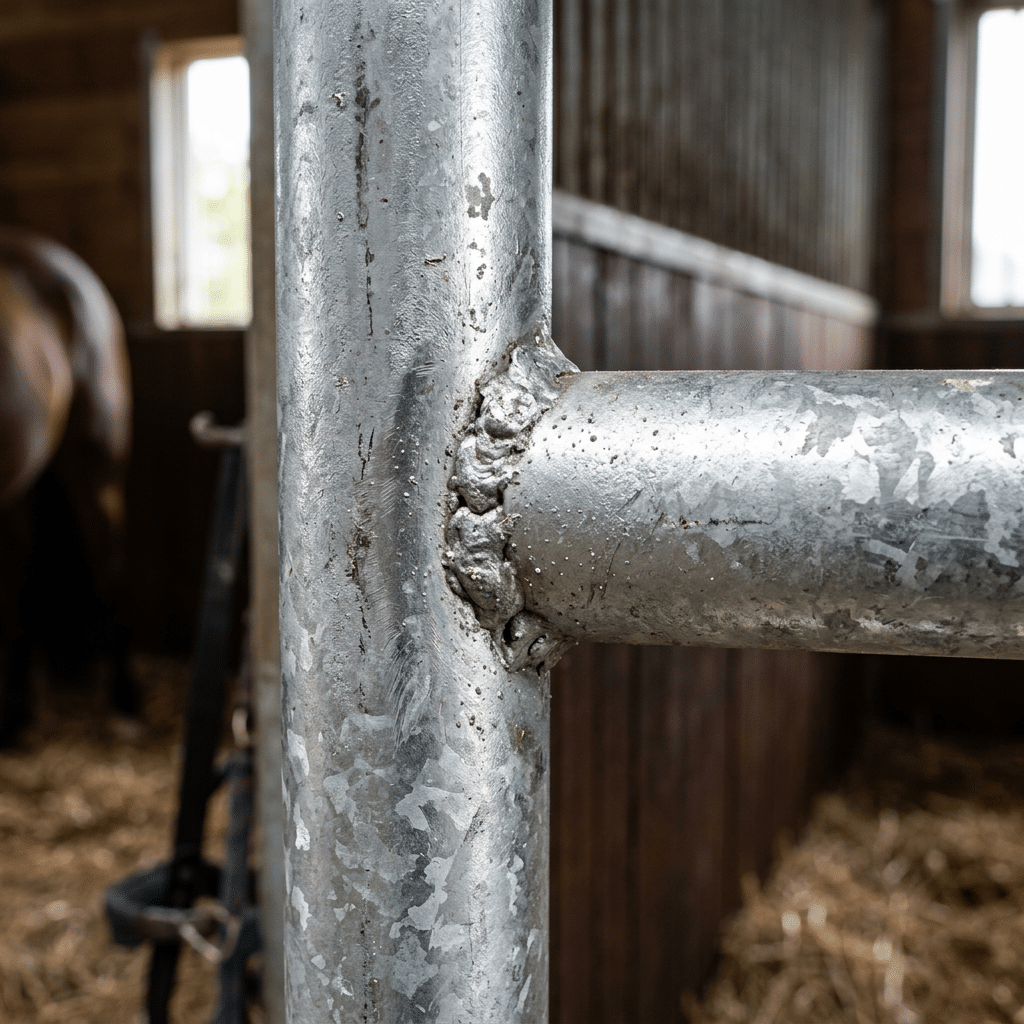
bhs compliant stables is the first checkpoint buyers should lock before they approve a supplier, budget, or production slot. The first sign of trouble isn’t the pre-production sample approval. It’s the 18th month of UK rain when the steel starts showing rust spots on the stall dividers. That $50K order for BHS compliant stables suddenly looks like a long-term liability, not an investment. The sample unit looked perfect — tight welds, smooth coating, correct dimensions. But the mass production run used pre-galvanized steel instead of hot-dip galvanized, and the difference only shows after the warranty clock starts ticking.
Pre-galvanized steel fails in wet climates within five years. Hot-dip galvanized steel holds for twenty. That gap is the difference between a stable that passes BHS inspection on day one and one that stays compliant through a decade of drainage cycles. The real test for a BHS compliant stable isn’t the sample approval — it’s how the materials hold up when the ground stays saturated and the barn air never fully dries. Most buyers learn this the hard way, after the installation crew has left and the supplier’s invoice is already paid.
Understanding BHS Requirements for Stabling
BHS requires drainage that prevents standing water within 15 minutes.
Drainage and Footing Specifications
The 15-minute drainage rule is the single most overlooked BHS requirement in wet climates. Standing water in a stall leads to hoof rot, ammonia buildup, and footing degradation. BHS compliant stables must have a floor system that channels water away fast — either a sloped concrete base with a fall of at least 1:80 or heavy-duty rubber matting with integrated drainage channels. DB Stable uses anti-slip rubber mats that meet this standard, providing a non-slip surface even in heavy rain while allowing water to flow beneath the horse.
Minimum Stall Dimensions and Ventilation
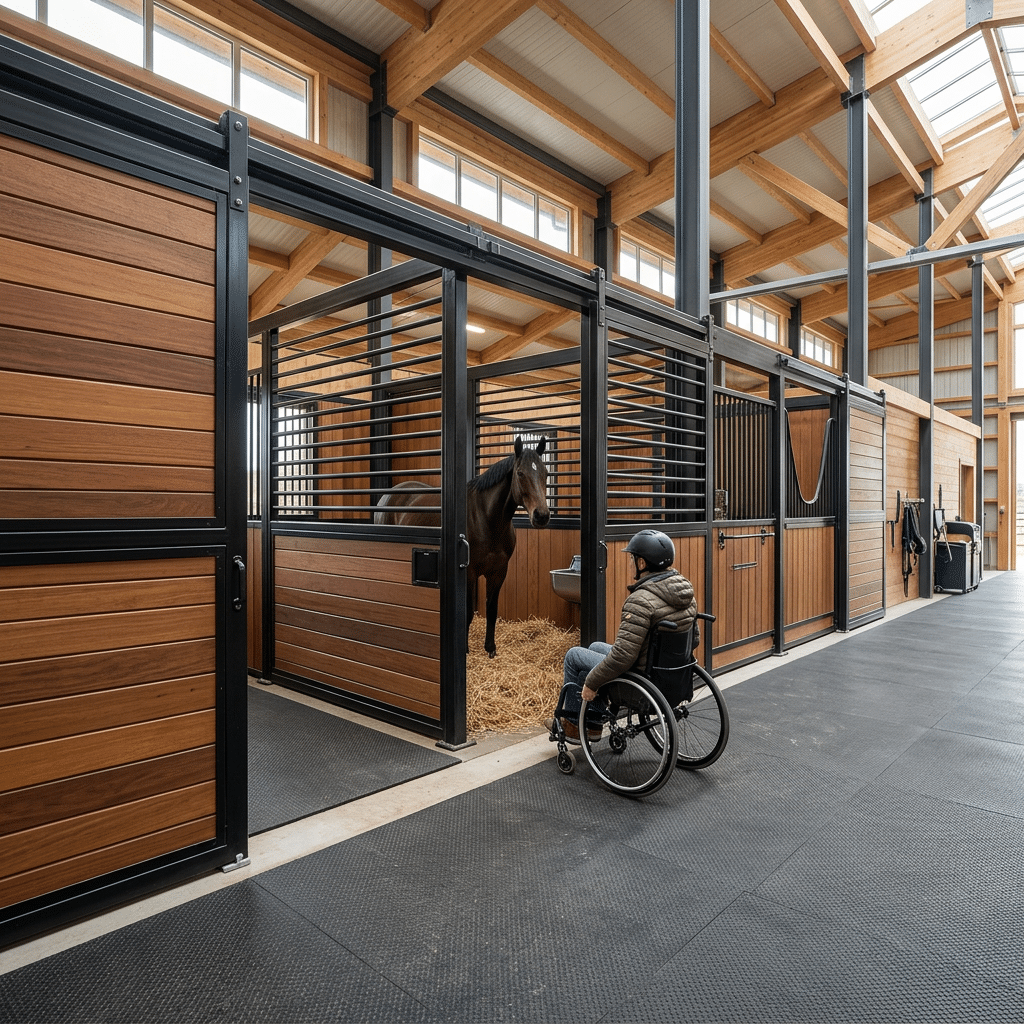
BHS standards require stall dimensions that allow the horse to lie down, roll, and stand without restriction. For a single horse, the minimum is typically 3.6m x 3.6m, though taller horses may need 3.6m x 4.2m. Just as critical is BHS approved stable ventilation — at least four air changes per hour to prevent condensation and respiratory issues. DB Stable’s barns incorporate V-yoke Dutch doors and tempered glass windows that can be adjusted for cross-ventilation, keeping air moving even in low-wind conditions. This combination of space and airflow is the baseline for any facility serving UK or New Zealand climates.
Drainage Solutions for Mud-Free Barns
BHS requires standing water to drain within 15 minutes.
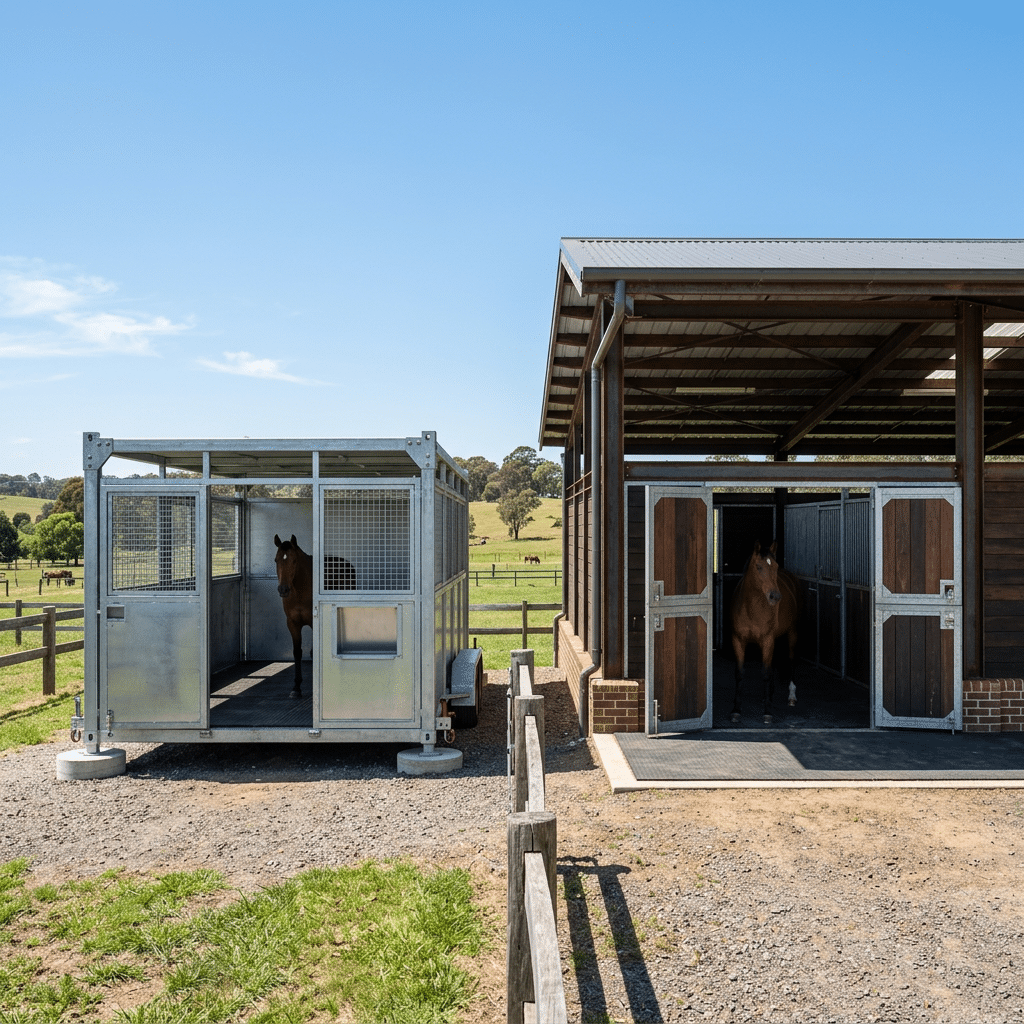
In a wet climate, the floor is the first thing that fails. BHS stable footing requirements are clear: no pooling water after 15 minutes. That sounds simple, but the material choice between sloped concrete and rubber matting determines whether you’re scraping mud every morning or hosing down a clean surface.
Sloped Concrete: The BHS Baseline
A properly poured concrete floor with a 1:60 fall toward a central drainage channel meets wet climate stable drainage BHS specs without question. It’s permanent, scrubbable, and doesn’t shift under hoof traffic. The downside? Concrete is unforgiving on joints. Horses standing for long hours need thick bedding or integrated rubber mats over the concrete to avoid hock injuries. And if the slope is off by even half a degree, water sits in corners — exactly what BHS prohibits.
Rubber Matting: Not All Mats Drain
Interlocking rubber mats are popular for comfort, but standard solid mats trap moisture underneath. Within six months in a UK winter stable, you’ll lift a mat to find black sludge and ammonia burn on the concrete. The fix is dimpled or studded mats designed for drainage — they create an air gap so urine and wash water flow to a sub-floor drain. Even then, the sub-base must be sloped. Lay flat mats on a flat slab and you’ve built a swimming pool under your horse.
Rainwater Harvesting Integration
If you’re already cutting concrete for drainage channels, adding rainwater harvesting costs very little at the build stage. Route gutter downspouts from barn roofs into a storage tank instead of dumping water onto the yard. A 100-square-metre roof in southern England collects roughly 55,000 litres per year — enough to wash down stalls and irrigate paddocks through dry spells. Some UK stable suppliers now offer pre-plumbed stabling systems with integrated gutter connections that tie directly into harvesting tanks.
Material Selection for Damp Environments
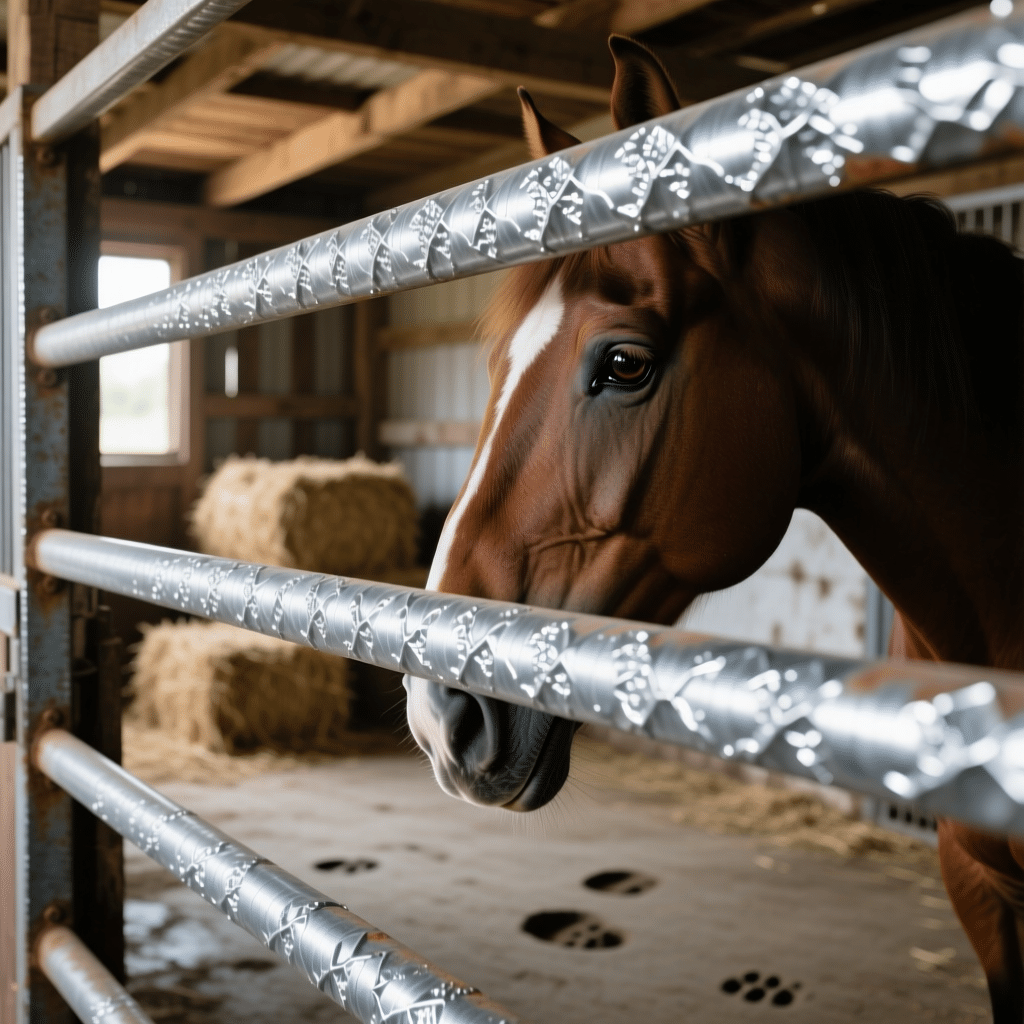
Hot-dip galvanized steel lasts 20 years; pre-galvanized fails in 5.
Galvanized Steel: The 20-Year vs 5-Year Bet
Every supplier says their steel is galvanized. The distinction matters most in wet climates like the UK or New Zealand. Pre-galvanized steel — sheet metal dipped in a thin zinc bath before fabrication — looks clean on delivery but rusts through within 5 years under constant moisture. The edges where the steel is cut or welded have no protection at all.
Hot-dip galvanizing happens after fabrication. The entire structure, including welds and cut edges, gets submerged in molten zinc. That creates a 75–85 micron coating that bonds metallurgically, not just on the surface. DB Stable uses this process exclusively. Their internal data shows the steel withstands 20 years of UK rain, and they back it with the certifications that matter: ISO 9001 and CE.
- Dicke der Beschichtung: Pre-galvanized: 15–25 microns, easily scratched. Hot-dip: 75–85 microns, bonded to the base metal.
- Failure Mode: Pre-galvanized: edge rust starts in year 2, structural failure by year 5. Hot-dip: no exposed edges, uniform protection.
- Climate Suitability: Pre-galvanized: okay for dry inland barns. Hot-dip: required for coastal, high-rainfall, or heavy-condensation regions.
- Cost Reality: Hot-dip adds 15–20% upfront. But one replacement cycle of pre-galvanized panels will cost more than the initial savings.
- Widerstandsfähigkeit gegen Nässe: Zero water absorption. No swelling, no warping, no fungal growth.
- Cleaning Protocol: Pressure wash with disinfectant. No sanding, no sealing, no repainting.
- Strukturelle Integrität: HDPE does not crack or splinter. Horse kicks leave dents, not sharp edges.
- What to Ask the Supplier: Request the exact density (g/cm³) and UV stabilizer package. Minimum spec: 0.95 g/cm³ and 3% carbon black for UV protection.
HDPE Panels: The Mold-Proof Alternative
Wood absorbs moisture. Even pressure-treated pine starts to rot after 3–4 years in a wet stable environment, especially around the kickboards and feed corners. Bamboo is denser but still organic — given enough humidity and ammonia from urine, it will support mold growth.
HDPE (high-density polyethylene) is a closed-cell polymer. Water cannot penetrate the surface. Mold spores have nothing to feed on. For a commercial stable manager washing down stalls daily, HDPE panels mean zero rot, zero delamination, and a simple pressure-wash cleaning routine. DB Stable offers HDPE as a standard infill option for their indoor and portable stables. The material carries a 15-year lifespan under UV exposure, verified by the same UV-proof PVC formulation used in their arena fencing.
| Material Typ | Key Property | Performance in Wet Climates | Lifespan / Certification |
|---|---|---|---|
| Feuerverzinkter Stahl | 20-year rust resistance | Withstands heavy rainfall; no corrosion for decades | 20+ years; BHS, CE, ISO 9001 compliant |
| vorverzinkter Stahl | Thin zinc coating | Rusts within 5 years in damp conditions – common industry pitfall | 5 years; not recommended for BHS compliance |
| HDPE Panels | Mold and rot resistant | Non-porous, easy to clean; no moisture absorption | 15+ years; meets BHS hygiene standards |
| UV-Proof PVC | 15-year UV and moisture resistance | Ideal for arena fencing and outdoor stalls; no degradation | 15 years; certified for EU Directive 98/58/EC |
Barn Components That Reduce Moisture
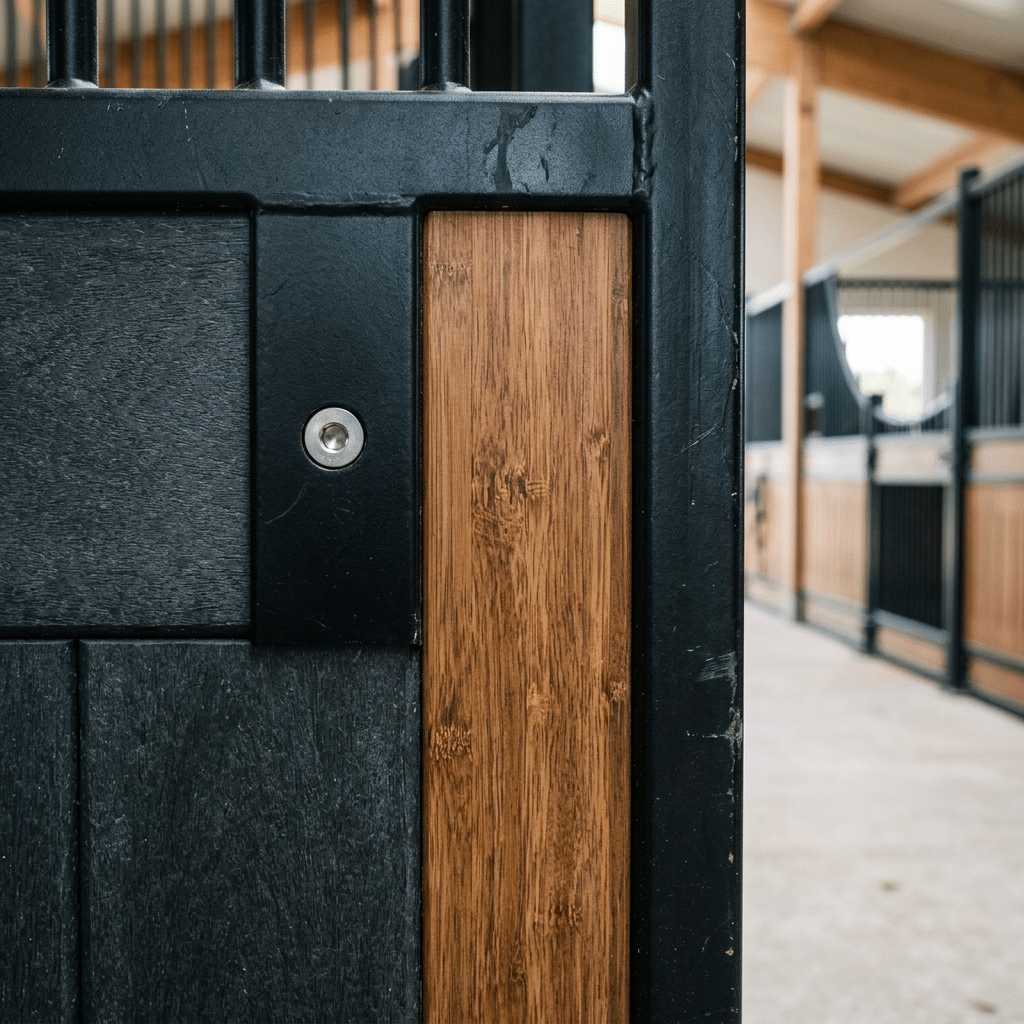
These two components cut stable humidity measurably, without mechanical ventilation.
Managing moisture inside a stable is a constant battle, especially in UK and NZ climates where rain is a fact of life. Still air and high humidity create the perfect conditions for respiratory issues, mold on wood panels, and corroded metal fittings. The British Horse Society (BHS) expects cross-ventilation as a minimum requirement. The question is how to achieve it without turning the barn into a wind tunnel.
V-yoke Dutch doors for cross-ventilation
A standard Dutch door splits in half, allowing the top to open while the bottom stays closed. The V-yoke design adds a locking mechanism that holds the top door at a fixed angle, creating a directed airflow channel across the stall. This pulls stale, moisture-laden air out and draws fresh air in without drafts at horse level. It is a simple, mechanical solution that requires no electricity.
The material choice matters. Feuerverzinkter Stahl frames — the same spec used in DB Stable’s full stabling systems — resist rust for 20 years even in constant damp. Pre-galvanized steel, which many budget suppliers rely on, often starts flaking and rusting within five years in wet climates. For a commercial stable manager, that difference translates into fewer replacements and lower long-term maintenance costs.
Tempered glass windows with anti-condensation coatings
Windows are another major moisture source. When warm, humid stable air meets a cold glass pane, condensation forms. That water runs down onto sills, drips into bedding, and feeds mold in the frame. Standard single-pane windows are the worst offenders.
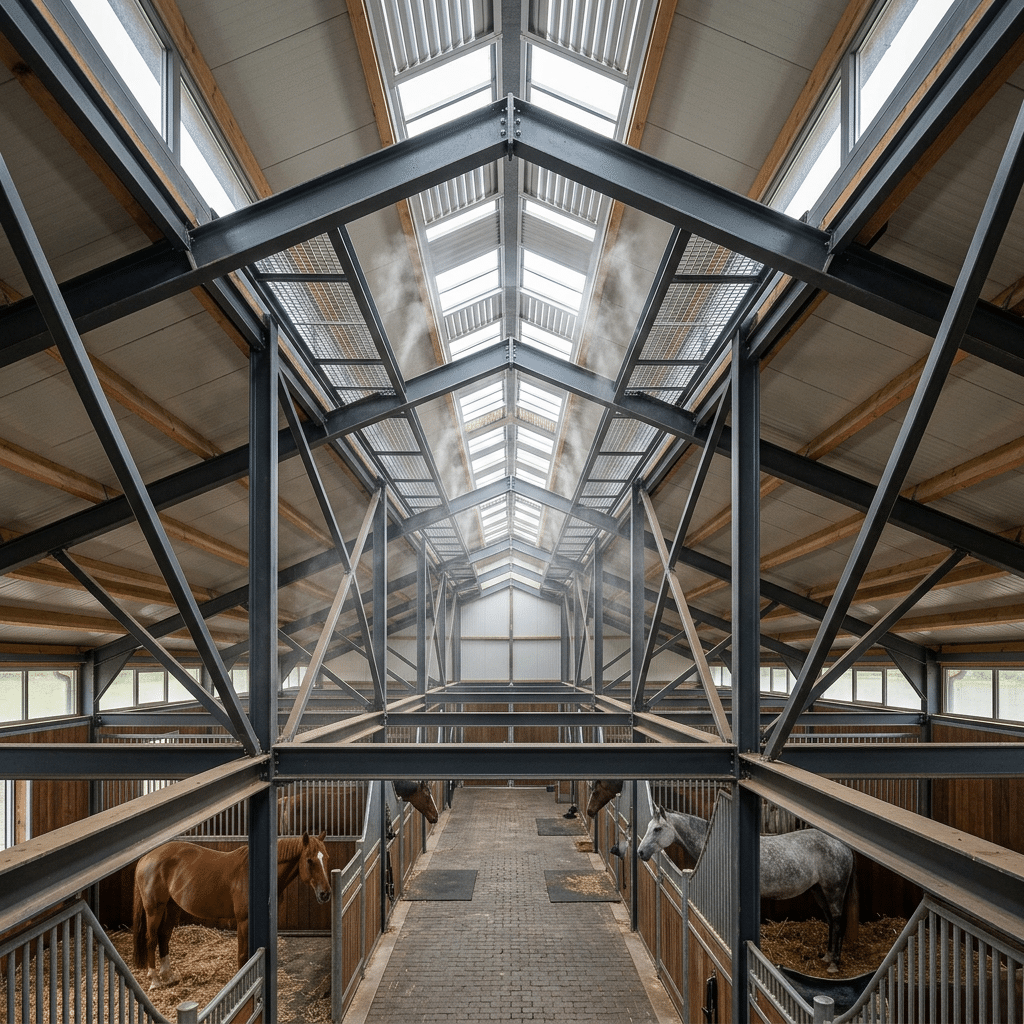
Tempered glass windows with a factory-applied anti-condensation coating change the surface temperature gradient so that moisture stays suspended in the air rather than beading on the glass. They also provide natural light, which helps keep bedding drier and reduces the overall humidity load. When paired with a sealed, powder-coated aluminum or galvanized steel frame, the assembly meets BHS approved stable ventilation guidelines without compromising security.
DB Stable supplies these windows as part of a BHS-compliant package, with ISO 9001 and CE certification covering the manufacturing process. For a UK stable supplier BHS certified, having documented proof of component specs is non-negotiable. The anti-condensation coating is not a field-applied spray — it is baked onto the glass during production, so it lasts the life of the window.
Supplier Checklist: Verifying BHS Compliance
A supplier who hesitates to share certification documentation is a supplier you should not trust with a 50-stable order.
You have the spec sheet, the drainage plan, and the material list. But without verified compliance paperwork, those documents are just ink on paper. BHS compliance requires proof — not promises.
Requesting CE and ISO 9001 Documentation
CE marking confirms the product meets EU Directive 98/58/EC for animal welfare. ISO 9001 certifies the factory’s quality management system is audited and consistent. These are not optional extras for a UK stable manager — they are baseline requirements.
Ask for both certificates by name. A legitimate manufacturer will provide them immediately. If the supplier sends a generic PDF or says “we are working on it,” that is a red flag. The certification must cover the specific product you are ordering, not just the company address.
One more check: verify the certificate number against the issuing body’s database. Counterfeit ISO certificates exist in this industry. A quick lookup saves you from installing non-compliant stables that fail your first BHS inspection.
Asking About Regional Hub Delivery (Sydney/Warsaw)
Delivery timeline matters when you are managing a working barn with horses arriving on a set date. Global shipping from Asia typically runs 4–6 weeks. But some manufacturers maintain regional inventory hubs that cut that to 1–2 weeks.
DB Stable operates hubs in Sydney and Warsaw. For UK buyers, Warsaw stock reduces lead time significantly compared to factory-direct ocean freight. Ask your supplier directly: “Do you hold stock in a regional hub near me?” If they do not, factor the extra weeks into your project schedule.
$50K orders get burned when pre-production samples match but mass production does not — because nobody checked whether the delivery route introduced moisture damage or handling defects during extended transit.
Schlussfolgerung
The gap between a stable that passes BHS inspection after five rainy seasons and one that doesn’t comes down to two things: drainage that clears standing water within 15 minutes, and steel that won’t rust through in five years. Pre-galvanized steel looks fine on paper but fails fast in wet climates. The material choice you make at ordering dictates the maintenance schedule for the next decade.
- BHS requires drainage that prevents standing water in 15 minutes.
- Hot-dip galvanized steel lasts 20 years; pre-galvanized rusts in 5.
- HDPE panels resist mold and rot in humid environments.
- V-yoke Dutch doors improve cross-ventilation and reduce condensation.
Before you approve a sample for your next barn project, compare the manufacturer’s steel specification against the BHS drainage requirements for your region. A supplier that offers hot-dip galvanized steel and HDPE panels—and can provide CE and ISO 9001 certification—is one you can trust for the long haul. Review the product specifications for BHS-compliant stables that handle wet climates without compromise.
Häufig gestellte Fragen
What makes a stable BHS-compliant for wet climates?
BHS compliance requires drainage that eliminates standing water within 15 minutes and stall dimensions of at least 12×12 feet with proper ventilation. For wet climates, you also need hot-dip galvanized steel with 20-year rust. Verify drainage specs and material certificates before ordering.
How do you verify BHS compliance from a supplier?
Request ISO 9001 and CE certification documentation, plus written confirmation that materials meet BHS drainage and safety standards. For orders over 20 units, a dedicated regional account manager. Ask for regional hub delivery options in Sydney or Warsaw to speed up inspection.
What materials work best for stables in rainy climates?
Hot-dip galvanized steel resists rust for 20 years, while HDPE panels resist mold and rot better than wood in damp conditions. Avoid pre-galvanized steel—it’s a common industry shortcut that leads to rust. Specify hot-dip galvanized and HDPE infills in your order contract.
Can I get BHS-compliant stables delivered to the UK or New Zealand?
Yes, DB Stable provides high-drainage, BHS-compliant designs specifically for UK and New Zealand rainy climates. Global delivery takes 4-6 weeks standard, or expedited 1-2 weeks through regional hubs like Sydney. Confirm your hub eligibility when requesting a quote.

 German
  English
  Spanish
  French
  Arabic
0 Kommentare