
Planning horse stables Australia projects around a 40°C design temperature is not a materials problem—it is a sequencing problem. Buyers who specify UV-stable materials, plan shade and orientation, and organize the airflow path as one connected brief get a yard that works through February. Buyers who treat them as three separate line items get a stable that looks right on the quote and cooks by two in the afternoon. Australia and Spain are the two markets where shipped products are engineered for UV resistance and 40°C heat tolerance.
DB HorseStable has manufactured and exported indoor, portable and temporary stabling from Anping, China since 2013. The four planning layers below follow the order in which decisions should actually be made on an Australian project.
Key Takeaways
- Plan in four layers, in order: UV material specification, shade and orientation, airflow path, delivery rhythm—each layer constrains the next.
- Hot-dip galvanized steel carries a 20-year rust-protection baseline; UV-resistant PVC carries a 15-year service life in the UV-resistant PVC paddock fencing line.
- Shade and orientation are decided at layout stage—roof coverage, eave overhangs and sun exposure are set before steel is cut.
- Airflow works as a path from low inlet to high outlet; exact air-change rates are project-specific, so confirm ventilation targets with the factory during design.
- Standard global delivery runs 4–6 weeks; the Sydney regional warehouse cuts expedited orders to 1–2 weeks. Minimum order is 10 stable sets, with tiered volume discounts of 5–15%.
The Four-Layer Planning Framework for 40°C Conditions
Heat damages a stable along two tracks. Sustained UV exposure and high ambient temperatures break down polymer surfaces, fade coatings and accelerate corrosion at every unprotected edge; a closed barn under full sun also traps radiant heat from the roof with nowhere to go. A frame that survives twenty years can still stand in a building that is unsafe for horses by mid-afternoon—so material durability and heat management are planned together, not purchased separately.
The framework below sequences the four decisions in the order they lock each other in: materials set what the structure tolerates, orientation decides how much sun hits it, the airflow path removes what shade cannot block, and delivery determines whether the build lands before or during summer.
| Planning layer | Core decision | Traceable benchmark |
|---|---|---|
| Materialien | Frame, liner and fencing materials that hold up under sustained UV at 40°C | Hot-dip galvanized steel: 20-year rust protection; UV-resistant PVC: 15-year service life |
| Shade and orientation | Building axis, roof coverage and eave overhang relative to the sun path | Qualitative design principle—set at layout stage, confirmed project by project |
| Airflow path | Continuous low-inlet to high-outlet ventilation through windows, doors and roofline | Qualitative design principle—exact air-change rates are project-specific; confirm with the factory |
| Delivery rhythm | Order timing against the southern-hemisphere summer calendar | Global lead time 4–6 weeks; Sydney regional warehouse expedited 1–2 weeks; MOQ 10 stable sets; tiered discounts 5–15% |
UV Material Specification: The 15- and 20-Year Baselines
Two manufacturer-stated baselines anchor the material specification for hot climates: hot-dip galvanized steel at 20 years of rust protection, and UV-resistant PVC at a 15-year service life. The zinc story matters most on the frame. Hot-dip galvanizing bonds the coating metallurgically to the steel, so parts are dipped after fabrication and cut edges and welds stay protected. Pre-galvanized steel, coated before cutting and welding, leaves every cut edge and weld point exposed—and heat plus humidity accelerates corrosion at exactly those points. For a 40°C market, verify that structural frames are hot-dip galvanized, not pre-galvanized sold as the same thing.

UV-resistant PVC is the second baseline, used across the UV-resistant PVC paddock fencing line. The 15-year figure is a service-life claim for the UV-stabilized compound—the practical question is documentation: which stabilizer package is in the product being quoted, and can the supplier state it in writing. Unstabilized polymers chalk, embrittle and crack under sustained Australian sun—slowly enough to pass handover, fast enough to become a replacement cost in the middle years.
Most projects face a liner choice rather than a single answer: bamboo, HDPE and pine are offered across the indoor, portable and temporary stable systems, and each carries UV exposure differently—stabilized polymer compounds resist chalking, while timber species and surface treatment decide how the boards gray and check under sustained sun. Review the full stable system options with your operating conditions in front of you, and ask the factory for the UV behavior of the exact liner compound or timber treatment on offer.
Shade and Orientation for Horse Stables Australia Projects
Shade planning is geometry, and geometry is fixed at layout. Roof coverage over stalls and the aisle, eave overhangs deep enough to block low-angle morning and afternoon sun, and the long axis relative to the sun path together decide how much radiant load the structure absorbs. An overhang that is too shallow costs nothing on the drawing and bakes the front third of every stall all summer—by the time panels are bolted in, the fix is shade cloth and regret.
Orientation has a second job that buyers often miss: the same axis decision that manages sun exposure also sets up the airflow path. Orienting the building so the prevailing summer breeze travels through the open sides pairs the shade plan with the ventilation plan for free. Open-front and partially covered layouts can reduce trapped heat at the source, and shade structures over yards extend the principle beyond the stable itself. The right combination depends on site orientation, prevailing wind and how the yard operates through the hot months—treat the layout review with the factory as a climate-design meeting, not a dimensions check.
Airflow Planning: Organizing the Ventilation Path
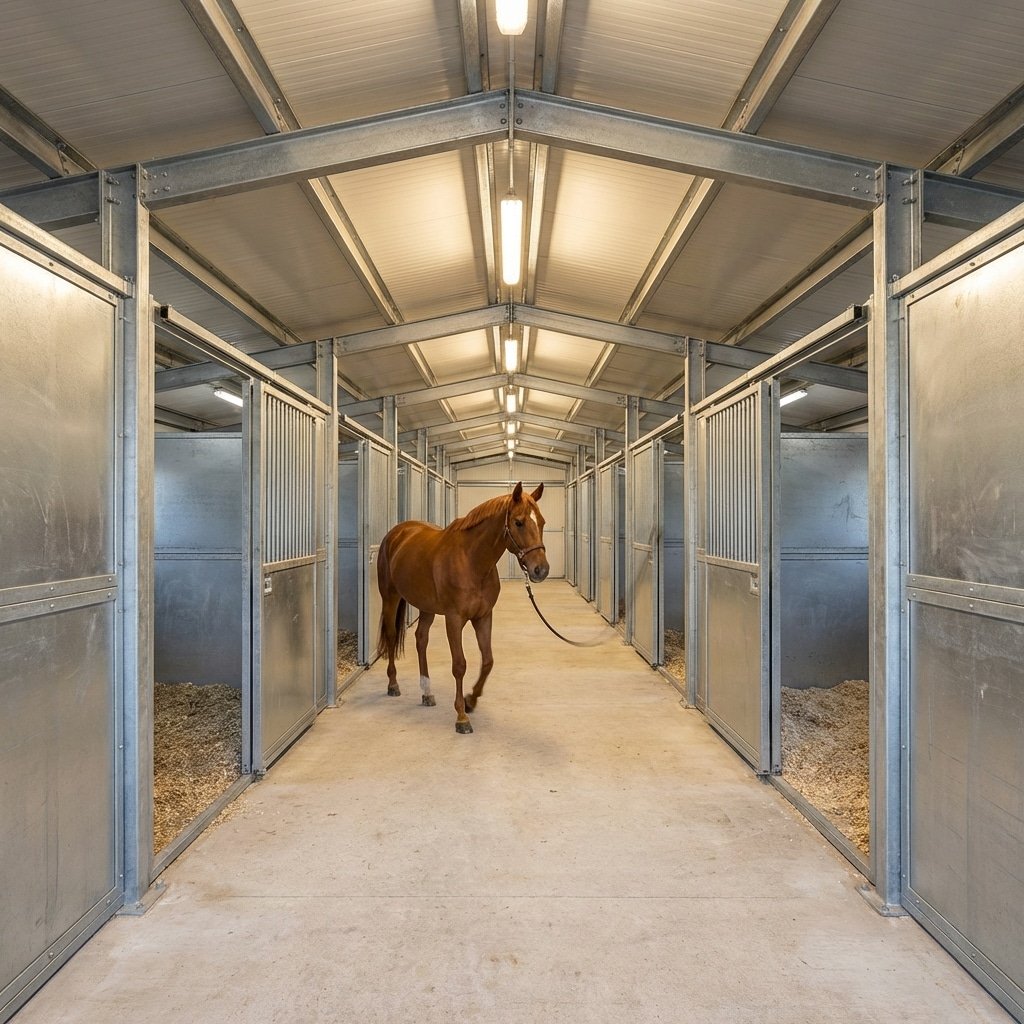
Airflow works as a path, not a feature list. The organizing principle is a continuous route from low inlets to high outlets: cooler air enters at stall level, picks up heat inside the stable, and escapes through high openings, with the roofline as the collection point. Every component either serves that path or blocks it. Ventilated stable windows placed for cross-flow, Dutch doors with openable upper sections, and an aisle that works as an air channel rather than a dead-end corridor are the standard building blocks in the barn components line.
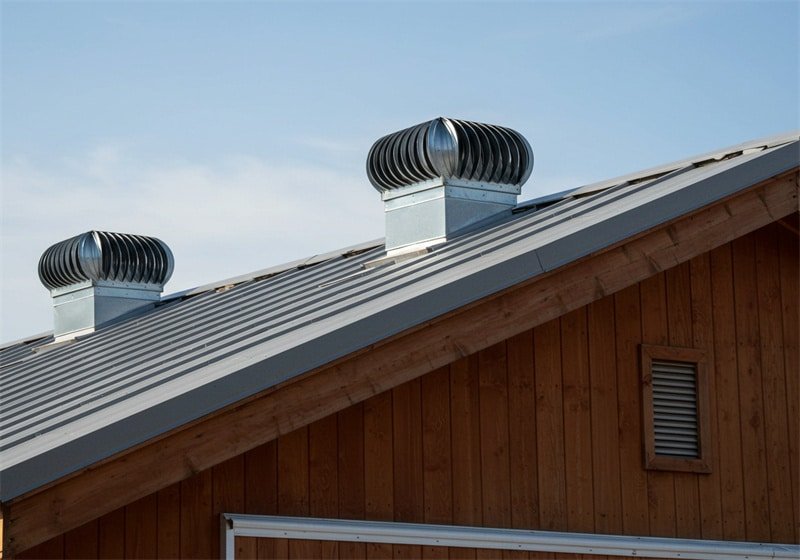
The failures are predictable. A single high opening with no low inlet moves almost nothing. Windows on one wall only create still-air corners where heat pools. Interior partitions that stop short of the roof can either channel flow or chop it into dead zones, depending on placement. Draw the air path stall by stall—where air enters, where it exits, what it passes through—before approving any component list.
One caution on numbers: exact air-change rates, opening sizes and airflow velocities are project-specific—they depend on stable dimensions, roof pitch, orientation and local wind data, so confirm ventilation targets with the factory during design rather than accepting generic brochure figures. If you only budget for one upgrade in a 40°C climate, spend it on the airflow path, not on cosmetic finishes—no liner or coating on its own compensates for a stable that cannot shed heat. For the stall floor, heavy-duty anti-slip rubber stable mats complete the environment and can be reviewed as part of the same project brief.
Delivery Rhythm: Sydney Warehouse and the Summer Calendar
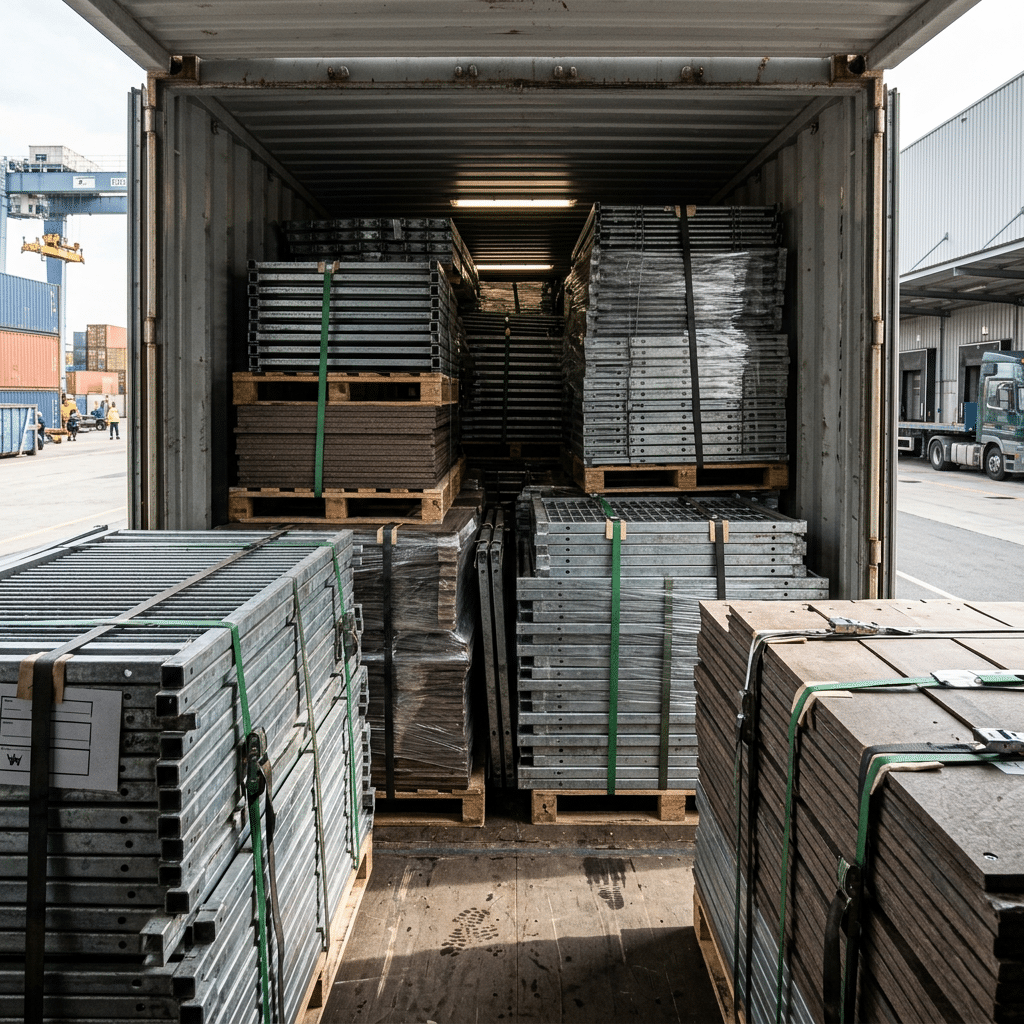
Standard global delivery for this line runs 4–6 weeks from order confirmation. For Australian projects, the Sydney regional warehouse shortens expedited orders to 1–2 weeks—a meaningful difference when a build is racing the season. Ask which configurations the warehouse stocks before assuming the shorter timeline applies.
The commercial parameters shape the planning too. The minimum order is 10 stable sets or 50 fence panels; volume orders earn tiered discounts of 5–15%; and orders of 20 sets or more come with a dedicated regional account manager handling customization and logistics advisory. Manufacturing runs under ISO 9001 and CE certification, with CNC machining and automated 360° welding supporting 500+ sets per month.
Work the calendar backwards. Stables ordered in autumn or winter arrive, clear customs and get installed before the first serious heat; the same order placed in November becomes an installation job in January, when crews, concrete and horses are all dealing with the temperatures you were designing against. Dealers planning multi-stage yards can review the Australia program page for the regional delivery and support arrangement as a whole.
Häufig gestellte Fragen
What materials hold up best in 40°C Australian conditions?
Hot-dip galvanized steel frames carry a 20-year rust-protection baseline, and UV-resistant PVC products carry a 15-year service life in the UV-resistant PVC paddock fencing line. Verify that frames are hot-dip rather than pre-galvanized, and ask for the UV-stabilizer documentation on any polymer component.
How fast can stables be delivered to Australia?
Standard global delivery runs 4–6 weeks, and the Sydney regional warehouse ships expedited orders in 1–2 weeks. Confirm which configurations the warehouse stocks before planning around the faster timeline.
What is the minimum order for horse stables?
The minimum order is 10 stable sets or 50 fence panels. Volume orders earn tiered discounts of 5–15%, and orders of 20 sets or more include a dedicated regional account manager.
Which liner options suit hot climates—bamboo, HDPE or pine?
All three are offered across the indoor, portable and temporary stable systems, and each handles UV exposure differently. Ask the factory for the UV behavior of the specific liner compound or timber treatment quoted for your project.
How should ventilation be specified for a hot climate?
Organize a continuous path from low inlets to high outlets using ventilated stable windows, Dutch doors with open upper sections, and roofline openings. Exact air-change rates are project-specific—confirm targets with the factory during design.
Schlussfolgerung
A stable built for 40°C gets that way through sequencing: UV-stable materials with traceable baselines—20 years on hot-dip galvanized steel, 15 years on UV-resistant PVC—then shade and orientation set at layout, then an airflow path organized from low inlet to high outlet, and finally a delivery plan that lands the build before summer rather than during it.
If you are planning an Australian project, write the climate brief into your RFQ—design temperature, sun path, prevailing wind and the stall hours that matter most—and ask the factory to respond to it explicitly.

 German
 English
 Spanish
 French
 Arabic
0 Kommentare