
The fire question that reaches a stable owner rarely arrives as advice. It arrives as a schedule: an insurer’s surveyor or a venue auditor listing what the building must be able to show on paper. Whether your barn sprinkler layout is wet-piped, dry, or absent is one line on that schedule. The harder lines are about documents most yards never think to collect — who signed the wiring, what the storage room is separated from, and what each material was actually tested against.
What this manufacturer publishes is company-level: ISO 9001 and CE, with alignment to BHS guidance in the UK, ASPCA in the US and EU Directive 98/58/EC, a stated 20-year rust-resistance figure on hot-dip galvanized steel and a 15-year life on UV-resistant PVC. No certificate numbers are published, and no fire performance rating, sprinkler design or electrical certification for supplied fittings is published at all. That gap is where most audit friction comes from, and it is not closed by a supplier brochure. It is closed by a record pack you assemble before a renewal date.
Key Takeaways
- Three parties ask three different questions. An insurer prices risk, an auditor checks the event, an authority enforces code. Each wants a different document.
- A company certificate does not answer a fire question. ISO 9001 and CE describe the manufacturing operation, not the reaction to fire of a stall front.
- Layout belongs to the site, equipment belongs to the order. Sprinkler coverage and obstruction are your contractor’s answer; only the item specification is the supplier’s.
- Collect the pack before it is requested. A renewal or an event licence is the worst week to discover who did not sign your wiring.
- Ask for the negative answer. “Not tested to a fire classification” is usable information; silence is not.
Who asks what, and what satisfies them

Buyers meet the same subject three times from three directions, and each visitor is satisfied by a different artifact. Getting the three confused is why a yard can pass a venue inspection and still get a renewal condition.
| Who | What they want | Satisfied by |
|---|---|---|
| Insurer or surveyor | How much risk is priced, and what reduces it | Detection and suppression records, storage separation, past claims |
| Venue or event auditor | Whether the site is safe for the scheduled event | Egress plan, capacity, drill log, temporary stabling layout |
| Fire or building authority | Whether the construction meets the rule it was approved under | Approved drawings, installation certificates, product classifications |
| Your own supplier | What was made, to what specification | Order documents and named test status per item |
What a sprinkler question is really asking
A sprinkler line in a schedule is really four questions wearing one coat. Is there a system at all, and was it designed and installed under the approval your authority requires? What covers the risk areas — the hay and bedding store, the aisle, the electrical service point, the tack room? What obstructs the discharge, given that a stall front, a rack of windows and a stored bale all change what reaches the horse? And who maintains it, on what interval, with what record?
None of those is a manufacturer’s answer. A fencing and stabling supplier can tell you what an item is made of and how it was finished. It cannot tell you whether your layout is compliant, and an honest reply to a sprinkler question is a referral to your designer and the local requirements. This distinction matters for another reason: the more a supplier volunteers fire performance language it has not tested, the less useful your file looks to a surveyor. Requirements vary by country, by occupancy and by the operator’s own obligations, so confirm current rules with the fire authority or your broker rather than treating any article, including this one, as a code.
The record pack, document by document
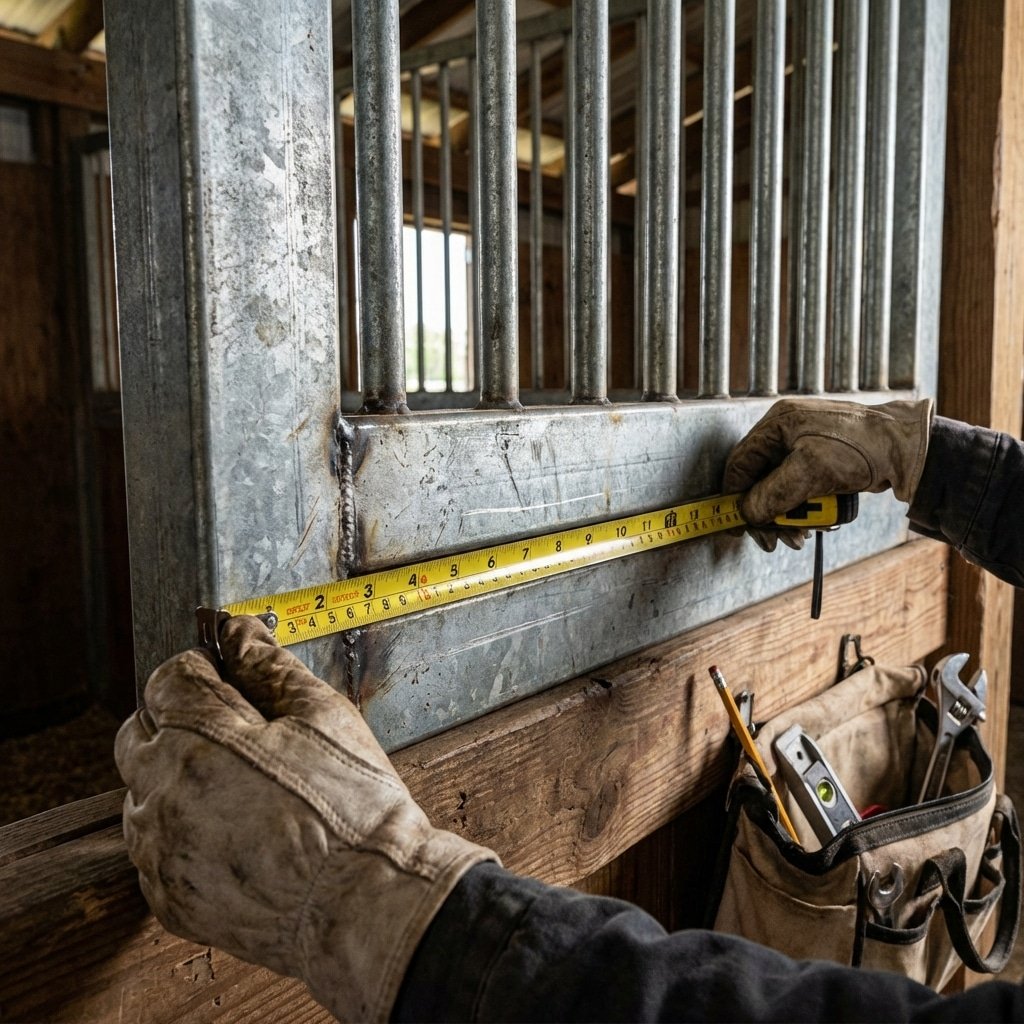
Six documents answer most of what an insurer or auditor asks, and five of the six are yours to create. The prevention side of the same subject — wiring condition, hay storage and escape routes — is set out in the barn fire safety checklist; this article keeps to the paper that proves those habits exist.
- Approved drawings or as-built sketch. Include stall rows, aisle widths, door openings and where stored hay sits relative to them.
- Electrical installation certificate from the contractor who did the work, dated, with the scope they signed for.
- Equipment schedule with named specifications, per item: what it is, what process it was made to, and what fire classification it has or does not have.
- Suppression and detection service log, even if the only entries say “not installed here” and give the reason.
- Egress plan and drill record, including who handles loose horses during an evacuation — a point auditors ask about more often than owners expect.
- Correspondence file, with supplier answers kept as written text rather than a sales phone call.
What a supplier can put in writing
Ask four questions of any supplier before a renewal or a licence application, and keep the answers as sentences. Which quality or conformity certificates exist for the company, with reference numbers you can check? Which specific standard or test is each item claimed against, and does that cover reaction to fire or only durability? What process made the finish on the steel you are buying, since a hot-dip and a pre-galvanized run are not the same statement? And what is expressly not tested? A written “not tested to a fire classification” keeps your file honest; a vague assurance is what surveyors pick apart.
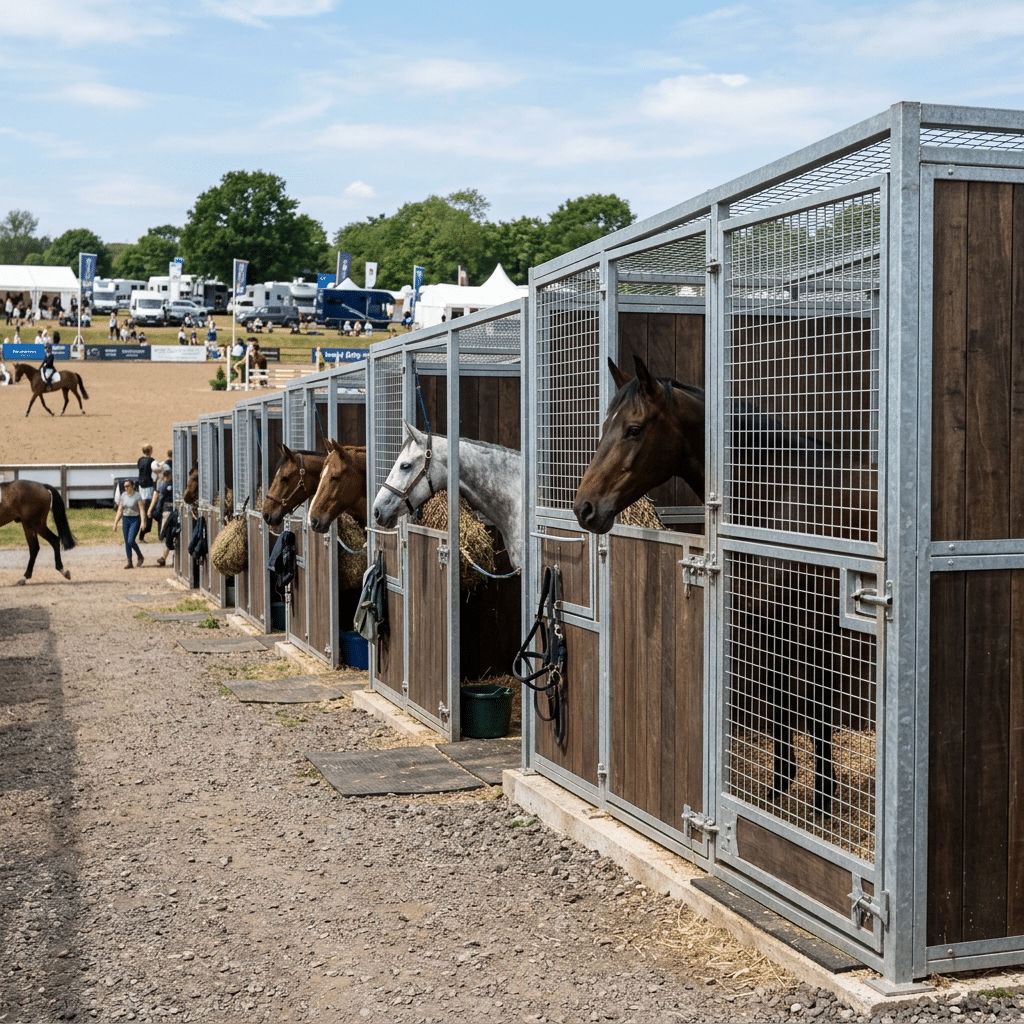
Two other items belong in the same file because they change what an auditor sees. Openings are a documented topic of their own: grilles, locks and what an insurer will actually recognize are covered in barn window security and insurance requirements. And the configuration of the building itself — indoor, portable or temporary stabling, with adjustable stall sizes — is set out on the horse stable systems page. Commercial terms are simple by comparison: 10 stall sets or 50 fence panels as the published minimums, 4-6 weeks globally with 1-2 weeks expedited from the Sydney and Warsaw warehouses, and a 5%-15% volume band whose thresholds are not published. Order timing is a scheduling record, not a safety one — keep the two files apart so neither looks like the other.
Häufig gestellte Fragen
Does ISO 9001 help with an insurer’s fire question?
Only indirectly. It describes how the manufacturer manages quality, not how a product behaves in fire. Ask separately which test or classification each item is claimed against, and which items carry none.
Can a stable supplier design the sprinkler layout?
No. Sprinkler design needs the building, the water supply and the approval route your authority sets, which sit with a fire design contractor. A stabling supplier’s useful role is documenting what the equipment in front of the heads actually is.
What if the barn has no sprinklers at all?
Then the record shifts to what you do have: separation of stored hay, detection, an egress plan that works with horses, and a dated wiring certificate. An absence is not always the problem; an undocumented absence often is.
Are temporary or portable stables audited the same way?
They are often treated as site contents rather than building fabric, so an event auditor looks at layout, spacing and escape routes. Ask your insurer and the venue how the same units are classified when they move between sites.
Schlussfolgerung
Fire records survive a renewal because they name a person, a date and a scope. Build the six-document pack while the yard is quiet, and keep every supplier answer as written text: which certificate exists, which test each item is claimed against, and what is not tested at all.
Then take the pack to your broker or the authority that governs your site and ask which parts they will accept. That single conversation tells you what is missing months before a surveyor or an event licence does.


 German
 English
 Spanish
 French
 Arabic
0 Kommentare