Your liability insurance premiums directly reflect your facility’s documented risk profile. A single horse injury resulting from a weak stall partition can trigger a negligence lawsuit with six-figure penalties, making proof of reasonable care your only effective financial defense. Implementing liability lawsuit prevention stable design ensures you possess the necessary horse stable insurance premium reduction materials to support your case effectively.
This analysis focuses on the engineering specifications that serve as tangible evidence. We demonstrate how material choices like Q345B steel and design standards such as the Cast-Proof 50mm gap create a verifiable record of proactive risk mitigation for your insurance actuary. Submitting boarding facility risk mitigation documentation alongside stable partition safety certification ISO strengthens your position when seeking a horse stall steel grade Q345B insurance discount.
The Boarding Facility Nightmare: Client Lawsuits for Injured Horses
Boarding facilities face costly lawsuits when horses get injured from shoddy stalls. The defense is simple: prove you provided ‘reasonable care’ with properly engineered equipment.
The Legal Standard of ‘Reasonable Care’
When a stable accepts a horse, it assumes a legal duty to provide reasonable care. Courts do not expect perfection but evaluate what a prudent, careful stable owner would do under similar circumstances. Failure to meet this standard forms the foundation for a negligence lawsuit, which is why adhering to specific horse injury legal defense stall specifications is critical for your operational security.
Lawsuits often arise from obvious facility failures rather than unforeseen accidents. Poor stall construction, thin walls between horses, and inadequate barriers are frequent culprits. If a horse kicks through a partition and injures itself or another animal, the facility owner is directly liable for failing to maintain a safe environment.
If the facility is found liable, the financial penalties are severe. The owner can be forced to pay the horse’s full market value before the injury, plus all related veterinary and transportation bills. For a high-performance horse, this liability can easily run into six figures.
Mitigating Liability with Kick-Proof Steel Construction
Proving reasonable care is not merely about paperwork but about the physical equipment you install. Investing in properly engineered stalls serves as a direct, documented defense against negligence claims. The material specifications show you took prudent steps to prevent foreseeable injuries, especially when supported by a comprehensive stable supplier engineering report template.
Key engineering choices directly address common failure points and demonstrate a commitment to safety.
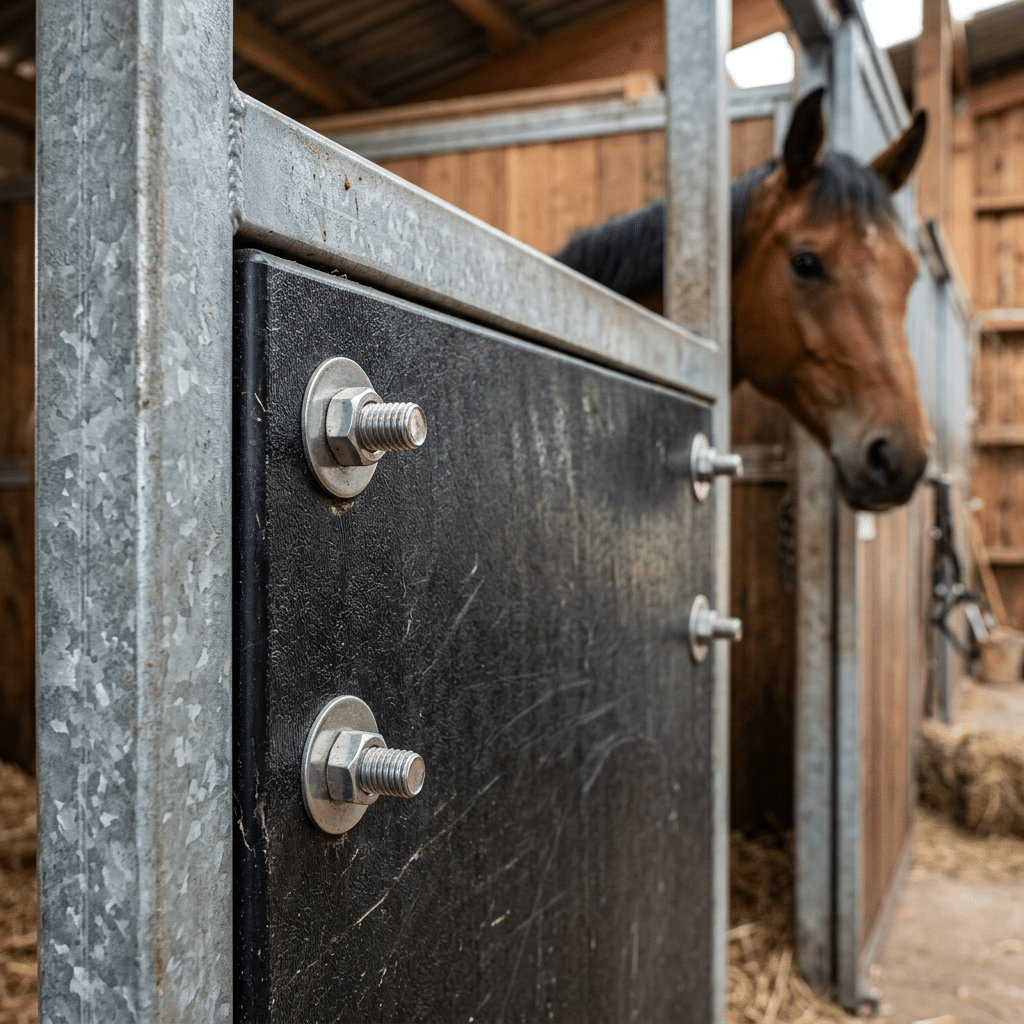
High-Strength Steel: Using Q345B steel is critical, especially in colder climates. It prevents brittle fractures from powerful kicks in winter, a known failure point for lesser-grade steel. This durability directly influences long-term maintenance cost horse stall materials projections by reducing replacement frequency and structural failures.
We enforce a strict minimum wall thickness of 14-Gauge (2.0mm) on all steel tubing. Anything thinner lacks the structural integrity to withstand repeated impacts over time. Utilizing specifications that support a horse stall steel grade Q345B insurance discount ensures durability. This approach significantly reduces long-term maintenance cost horse stall materials over the facility’s lifecycle.
A robust frame requires the right partner. Impact-absorbing HDPE infill dissipates the force from kicks, protecting both the horse’s joints and the stall’s structure. These horse stable insurance premium reduction materials help lower risk profiles while maintaining safety.
This combination creates a complete system designed to prevent common stall-related injuries. When you can show an insurance adjuster or a court that your facility uses equipment built to these standards, you build a strong case that you met your duty of care. These horse injury legal defense stall specifications validate your commitment to safety.
The “Attractive Nuisance” of Poor Hardware (Exposed Latches)
Exposed Latches as a Legal Liability
The legal doctrine of”attractive nuisance”holds property owners responsible for injuries to trespassing children, even if the child was not supposed to be there. An easily accessible, poorly designed gate latch is a textbook example. Courts see it as a failure to exercise reasonable care. If a child manipulates an exposed latch and gets injured, the facility owner is likely negligent. This negligence is not just a legal headache; it is an insurance problem. Many policies have strict requirements for securing hazards. Using cheap, non-secure hardware can give your insurer grounds to deny a claim after an incident, leaving you with the full financial burden. Implementing liability lawsuit prevention stable design eliminates these hazards at the source.
Mitigating Risk with Engineered Hardware
You address this liability at the source with better engineering. The Professional Series’Hidden Track System, for example, recesses all moving parts of the door mechanism. By hiding the hardware, you remove the temptation and the physical access for a child to tamper with it. The risk is designed out of the system from the start. Durability is just as important as design. Using 304 Stainless Steel for all connectors and fasteners ensures the latching mechanism will not fail from rust or corrosion. A latch that works reliably for decades is a far better defense against liability than one that weakens over a few seasons. We provide a stable supplier engineering report template to verify these specs.
Invest in Horse Stables with 20-Year Durability.
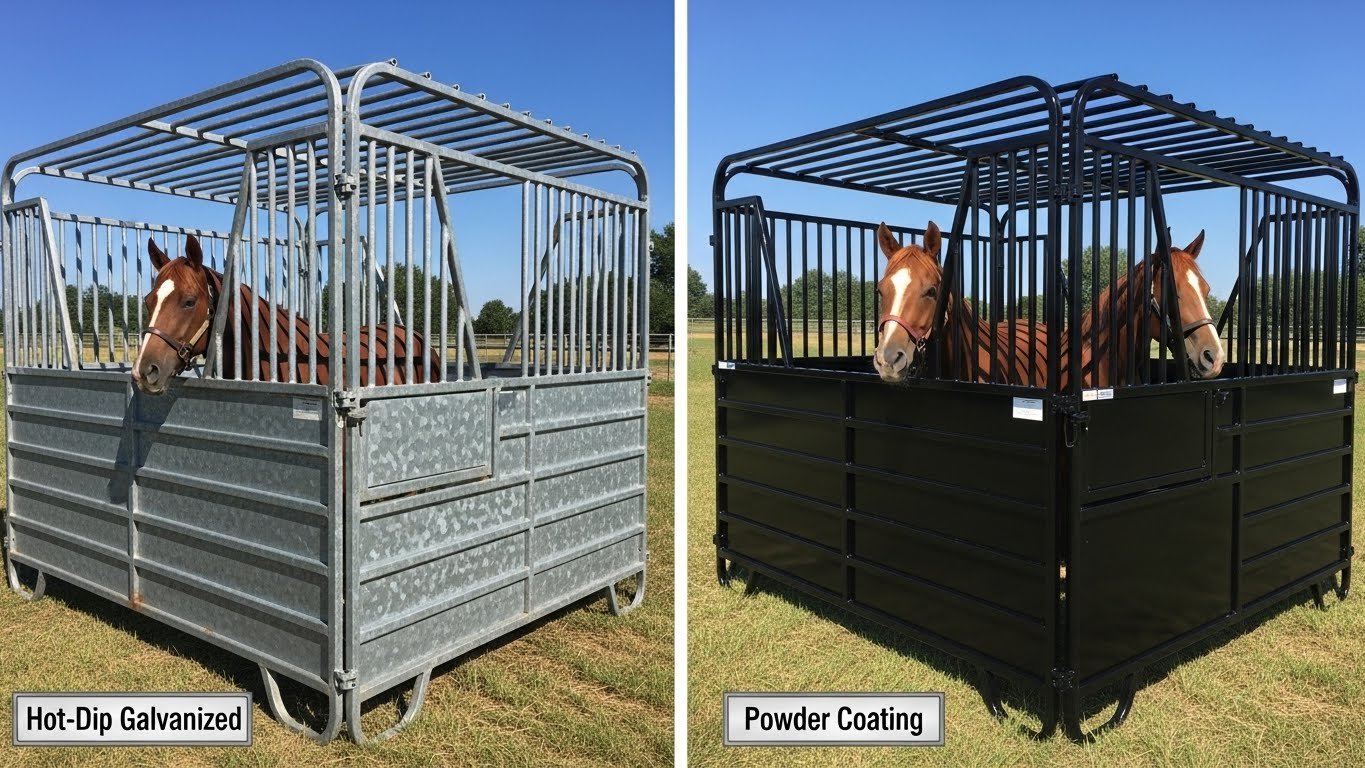
Our hot-dipped galvanized steel stables are engineered for a 20-year lifespan, reducing long-term maintenance costs and maximizing your investment. We manufacture over 500 units monthly to deliver fully customized, regulation-compliant solutions directly to your facility.
Cast-Proof 50mm Gaps: Defending Against Negligence Claims
A ‘cast-proof’ 50mm gap is a critical safety feature that prevents a horse from getting its legs trapped. Documenting this measurement proves adherence to a high standard of care.
The Legal Risk of a Horse Getting ‘Cast’
In equine terms, ‘casting’is when a horse lies down and rolls too close to a partition, trapping its legs underneath or against the wall. The animal is stuck and unable to stand up without help, often leading to panic, exhaustion, and severe injury.
For a facility owner, this scenario is a serious liability. An oversized gap under a stall partition is a well-known hazard. Failing to mitigate it can be considered a breach of the legal duty of”reasonable care.”If a horse gets injured this way, the inadequate stall construction forms the basis for a negligence lawsuit. Proper design avoids this breach of care and supports your boarding facility risk mitigation documentation.
Engineering the 50mm ‘Cast-Proof Design’ Standard
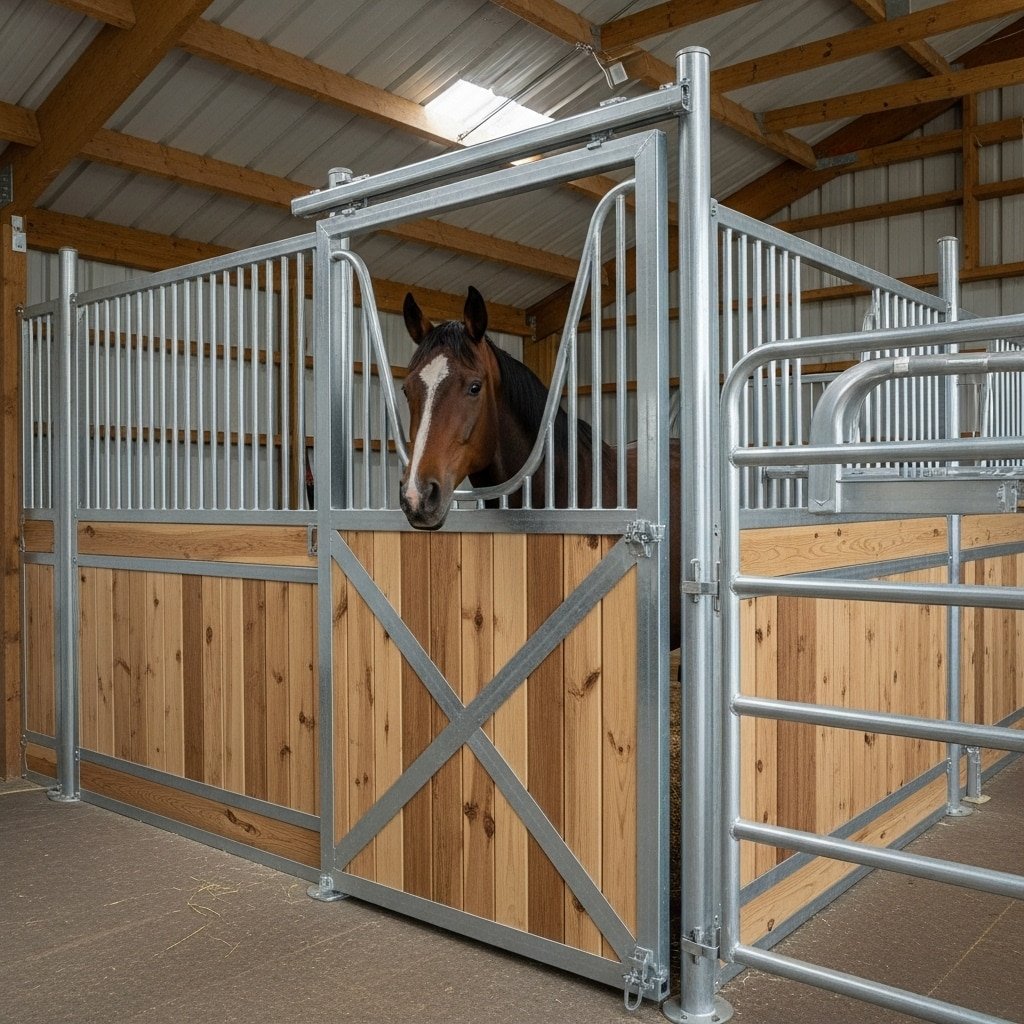
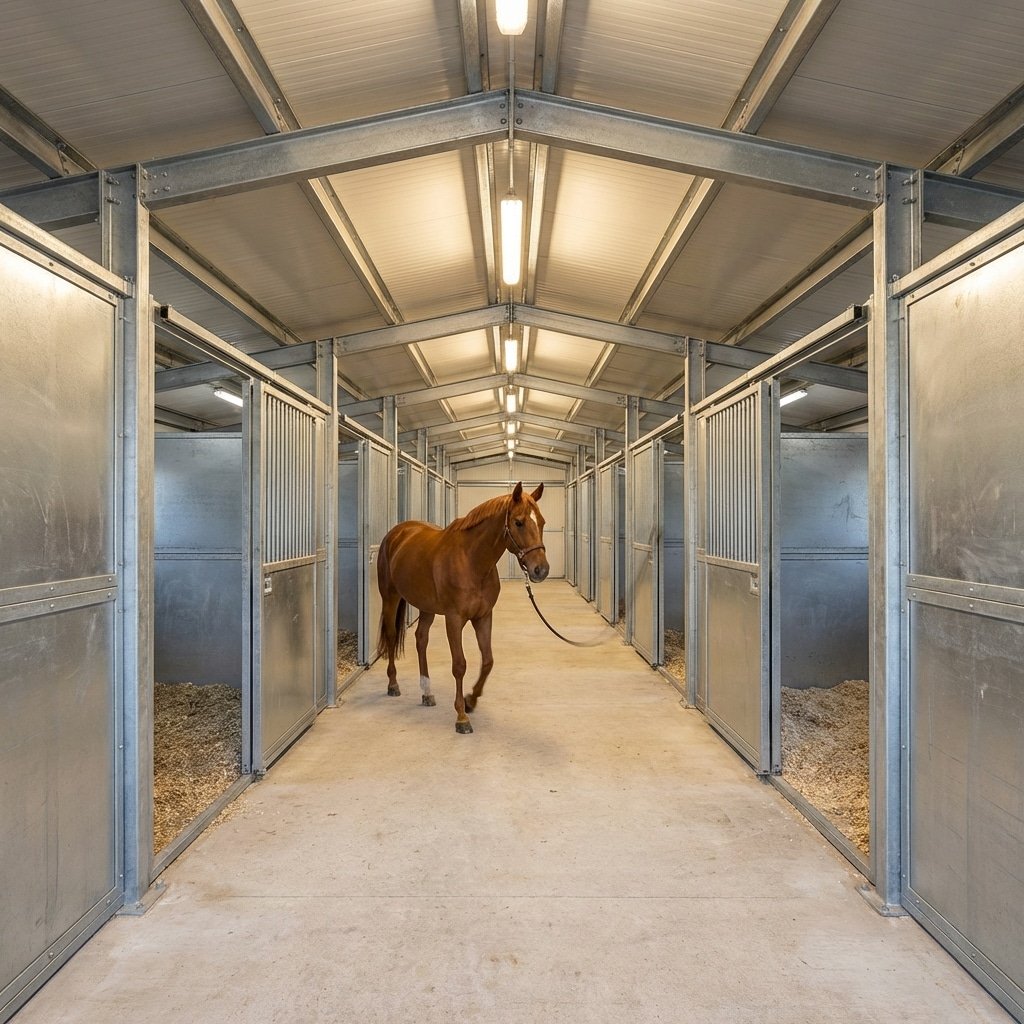
DB Stable systems directly address this risk with a feature we call the’Cast-Proof Design’. Our partitions are engineered with a minimal bottom gap of approximately 50mm, making it extremely difficult for a horse’s hoof or leg to become trapped during a roll. This design supports your stable partition safety certification ISO compliance efforts.
This figure represents a precise, documented safety standard embedded directly into the product structure. For commercial operators, this specification acts as concrete evidence of proactive risk management. It establishes a fact-based defense against claims regarding faulty equipment, demonstrating a commitment to liability lawsuit prevention stable design. By investing in a system engineered to meet rigorous welfare standards, you secure robust horse injury legal defense stall specifications that protect both assets and animals.
Window Safety: Tempered Glass vs. Plate Glass Liability
Plate glass shatters into dangerous shards, creating a huge liability risk. Tempered glass is 4-5 times stronger and breaks into harmless fragments, making it the required safety standard.
The High-Risk Liability of
Standard Plate Glass
Standard plate glass presents a significant liability exposure within any equestrian facility. When impacted by a horse, it does not merely crack but shatters into large, dangerous shards capable of causing catastrophic lacerations to horses and handlers. This failure mode drastically increases premises liability, often exceeding the scope of standard property policies. To avoid forcing your operation into separate, expensive coverage, integrating horse stable insurance premium reduction materials like safety glazing is essential for maintaining comprehensive protection without inflated costs.
Tempered Glass as a Non-Negotiable Safety Standard
Tempered glass stands as the only responsible choice for high-impact zones. Engineered to be four to five times stronger than standard glass, it is designed specifically to withstand significant force. Upon breakage, it crumbles into small, blunt pieces that virtually eliminate severe injury risks. Building codes classify this as safety glazing, often mandating its use in areas accessible to horses. Selecting products with stable partition safety certification ISO compliance ensures your facility meets these regulatory requirements while prioritizing safety.
Documenting Your Safety Upgrades for the Actuary
Provide detailed records of your stable upgrades, with verifiable specs like steel grade and galvanization standards, to prove reduced risk for your next insurance review.
Upgrading facility infrastructure does more than improve daily operations; it creates a verifiable data trail that lowers your risk profile. An actuary cannot adjust ratings based on unverified improvements. Your objective is to provide a clear file proving you have systematically engineered away common points of failure. Utilizing a stable supplier engineering report template helps organize this data, turning physical upgrades into recognized assets that insurers can validate.
Key Evidence Your Actuary Needs
Adjusting risk assessment requires specific, documented facts rather than general claims of improved safety. An actuary needs a clear paper trail to justify any changes to your policy terms. Focus on compiling evidence across three critical areas that directly influence underwriting decisions. This structured approach ensures your boarding facility risk mitigation documentation is robust enough to support requests for better terms based on tangible risk reduction.
Implementation Details: Record the exact date each safety measure became operational. For instance, note New stable fronts for Barn B installed and operational as of June 10, 2025. This precise timeline validates the currency of your upgrades and provides insurers with a clear reference point for when risk exposure was reduced.
Rationale and Impact: Clearly explain why each upgrade was executed and identify the specific risk it addresses. Connect features directly to known liabilities and operational efficiencies, such as stall-related injuries or long-term maintenance cost horse stall materials. Demonstrating how specific design choices reduce wear and tear or prevent accidents strengthens your case for operational excellence and financial prudence.
Supporting Proof: Validate all claims with hard data, including material certifications and engineering drawings. Documentation showing compliance with recognized standards like ISO 1461 is crucial. Providing proof of horse stall steel grade Q345B insurance discount eligibility or similar material specifications confirms durability. This level of detail transforms general assertions into verified assets that support your overall risk management strategy.
Translating Product Specs into Preventive Controls
Actuaries prioritize preventive controls that stop incidents before they occur. To secure favorable terms, you must translate technical equipment specifications into clear language regarding risk prevention. This process involves demonstrating how specific product features eliminate known causes of claims. Providing robust boarding facility risk mitigation documentation and a stable supplier engineering report template helps insurers recognize your setup as horse stable insurance premium reduction materials rather than standard infrastructure.
Component Specification
Preventive Control (Actuarial Relevance)
Required Documentation
Material Strength: Q345B Steel
Prevents brittle fractures from kicks, especially in cold climates, reducing risk of catastrophic equipment failure and subsequent animal injury.
Material mill certificate or supplier purchase order specifying Q345B grade.
مقاومة التآكل: Hot-Dip Galvanization to ISO 1461
Ensures long-term structural integrity by preventing rust-through, which can create sharp edges or weaken stall walls and doors.
Galvanizer’s certificate of compliance with ISO 1461.
Engineered Design: ‘Cast-Proof Design’ with 50mm Gap
Specifically mitigates the common and costly risk of a horse getting a leg trapped underneath a stall wall while rolling (casting).
Product specification sheet or engineering drawing detailing the gap dimension.
الأفكار النهائية
Lower initial invoices from cheaper stalls often create unacceptable financial risk over time. Documented engineering, such as horse stall steel grade Q345B and a 50mm cast-proof gap, serves as a verifiable defense against negligence claims. This approach supports liability lawsuit prevention stable design and aligns with stable partition safety certification ISO standards. Choosing these horse injury legal defense stall specifications is not merely a product decision but a comprehensive liability strategy that also influences long-term maintenance cost horse stall materials and potential insurance discounts.
Do not guess on liability protection when you can verify the engineering firsthand. We recommend starting with a trial order to document build quality for your insurance provider. This step ensures you have the necessary evidence for validation. Contact our team to receive the technical specification file for your next project and secure your facility against future risks.
مرحباً، أنا فرانك تشانغ، مؤسس شركة DB Stable، شركة تديرها عائلة، خبير متخصص في إسطبلات الخيول. في السنوات الـ 15 الماضية، ساعدنا 55 دولة وأكثر من 120 عميلاً مثل المزرعة والمزرعة لحماية خيولهم. الغرض من هذه المقالة هو مشاركة المعرفة المتعلقة بإسطبلات الخيول للحفاظ على سلامة حصانك.
يتم تحديد مواصفات معدات الفروسية المخصصة للسوق الألمانية وفق محورين في آن واحد: البنية التحتية للتدريب المتوافقة مع معايير الاتحاد الدولي للفروسية (FEI) من جهة،...




 Arabic
  English
  Spanish
  French
  German
0 تعليق