


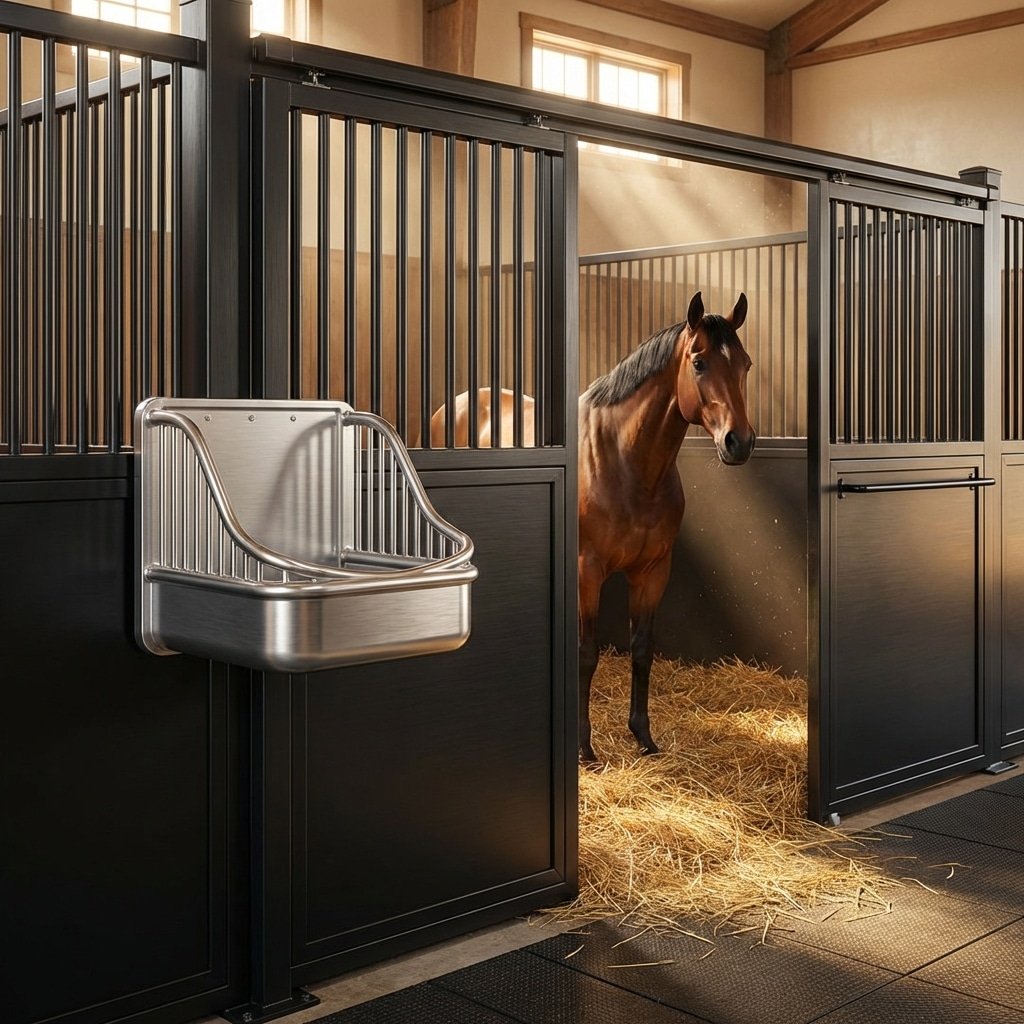
Retrofit Swivels eliminate the most dangerous interaction in your daily stable operations. Manually carrying grain buckets through stall doors increases workers’ compensation risks and adds hours of non-productive labor to your weekly payroll. Modernizing your facility prevents these recurring costs without the capital expense of a full renovation.
This guide details the installation of DB Stable cast aluminum units into standard Q235B steel or lumber partitions. We examine السلامة الهيكلية requirements, precise cutting templates, and the necessity of using 304 Grade Stainless Steel fasteners to prevent galvanic corrosion in your upgraded facility.
The Exhaustion of Carrying Grain Buckets into the Stall
Manual feeding creates unnecessary labor costs and safety liabilities. Retrofitting DB Aluminum Swivel Feeders eliminates stall entry, pro
tecting staff and cutting feeding time in half.
The Safety Risks and Labor of Entering Stalls
Traditional feeding methods force staff to act as gatekeepers rather than caretakers. Opening a stall door to deliver grain puts the handler directly in the horse’s space during a high-arousal moment. Hungry horses often crowd the door, bolt, or kick out in anticipation. This repeated exposure to volatile animals increases your liability and drives up worker compensation claims.
Beyond the immediate safety risk, the physical toll on your workforce is substantial. Carrying 5-gallon grain buckets—weighing 20 to 30 pounds each—down long aisles creates repetitive strain on backs and shoulders. The operational inefficiency poses a financial problem as well. Staff waste valuable minutes unlatching, entering, exiting, and re-latching doors for every single horse. In a 40-stall barn, this “door dance” adds hours to the weekly payroll without adding value to the horse’s care.

The Solution: DB Aluminum Swivel Feeder Specifications
We engineered the DB Aluminum Swivel Feeder to solve these specific operational bottlenecks. By integrating this system into our Professional Series fronts or retrofitting it into existing grill work, you remove the need for stall entry during feeding times. The system allows staff to pour grain from the safety of the aisle, rotating the feeder into the stall with a simple push.
- 360-Degree Rotation: Fully reversible design allows filling from the aisle and locking in place, preventing horses from accessing the aisle side.
- Cast Aluminum Construction: We use high-grade aluminum for the feeder bowl to ensure it remains lightweight for daily operation while resisting rust from wet feed or saliva.
- Retrofit Compatibility: Designed to bolt into existing lumber or steel grill frameworks, allowing you to modernize older stable blocks without replacing the entire واجهة المماطلة.
Measuring the Cut: Preparing Your Existing Grill
Measure vertical bar spacing to ensure the swivel feeder fits between structural supports. Use the actual feeder frame as a template to mark cut lines directly on the steel.
Verifying Structural Integrity and Bar Spacing
Before you cut any steel, you must distinguish between the structural skeleton and the infill bars. Never cut the main outer frame or the primary load-bearing posts of the stable front. These components, often made from 50mm x 50mm RHS or heavy-duty 114mm round posts in DB Stable systems, support the roof load and door mechanism. You should only modify the intermediate vertical tubes that form the grill.
- Identify Load-Bearing Zones: Locate the primary structural columns. The cut for the feeder must occur strictly within the infill area (the vertical bars) and must not compromise the welded frame perimeter.
- Center the Mechanism: Measure the total distance between the vertical bars where you intend to install the unit. The swivel mechanism must sit perfectly centered to distribute weight evenly across the remaining welded connection points.
- Check Vertical Clearance: Verify that the swivel bowl has enough room to rotate 360 degrees without striking the bottom channel or the top rail. Standard commercial feeders require specific clearance radii; failing to measure this results in a feeder that jams against the frame during rotation.
Templating the DB Aluminium Swivel Profile
Paper templates are unreliable for retrofitting steel. The most accurate method involves using the actual product as your guide. Place the DB Aluminium Swivel Feeder frame directly against the existing grill at your determined height. This physical tracing method accounts for minor manufacturing tolerances and ensures the cut matches the specific unit you are installing.
- Trace the Physical Frame: Hold the aluminum frame against the bars and mark your cut lines.
- Define the Aperture: The opening must be slightly larger than the internal feeder box to allow smooth insertion, but strictly smaller than the outer mounting flange. The flange needs solid steel to bolt onto; if you cut too wide, you lose your mounting surface.
- Verify Squareness: Use a speed square to check your markings. The marked area must be perfectly rectangular. If the opening is out of square, the lightweight aluminum frame will twist when you tighten the bolts, leading to binding hinges and difficult operation.
Premium Custom Stables With 20-Year Durability

Bolting the DB Aluminum Swivel Feeder to the Frame
Secure the aluminum feeder to the 50mm RHS frame using 304 stainless steel bolts. This prevents galvanic corrosion and ensures the swivel mechanism operates without sagging.
| Installation Component | المواصفات | Engineering Purpose |
|---|---|---|
| Frame Post | 50mm x 50mm RHS (Q235B) | Provides rigid structural support for the feeder load. |
| Fasteners | 304 Grade Stainless Steel | Prevents galvanic corrosion between aluminum and steel. |
| Feeder Housing | Lightweight rotation and rust immunity. |
Positioning the Aluminum Housing
Slide the pre-assembled aluminum feeder frame into the cut opening of the Q235B steel partition. Precision here prevents mechanical binding later. You must align the unit perfectly before reaching for any tools.
- Flush Fitment: The flange must press flat against the 50mm x 50mm RHS posts. Any gaps here will compromise the structural integrity of the partition.
- Clearance Verification: Rotate the swivel mechanism 360 degrees. It must move freely without hitting the surrounding hot-dip galvanized grill bars.

Fastening with 304 Grade Stainless Steel Hardware
We strictly supply 304 Stainless Steel anchor bolts for this connection. Do not substitute these with standard zinc-plated hardware found at local hardware stores. You are connecting aluminum to galvanized steel; without stainless steel, galvanic corrosion will seize the bolts and degrade the frame.
- Secure Anchoring: Bolt the feeder directly to the hot-dip galvanized frame using the provided kit.
- Torque Requirements: Tighten all connectors firmly. A loose feeder will eventually sag under the daily abuse of feeding time, leading to misalignment.
Ensuring No Sharp Edges Remain on the Cut Steel
Immediate deburring prevents injury. You must reseal cut ends with cold galvanizing spray to maintain the >70 micron zinc barrier and ASTM B117 rust resistance.
Mechanical Deburring: Eliminating Laceration Risks
When you cut through our Q235B or Q345B structural steel tubing, the process inevitably leaves jagged edges. These are not just cosmetic issues; they are active hazards. A horse exploring a new feeder with its muzzle or tongue can suffer serious lacerations from even small metal shards. You need to physically remove these hazards before any assembly continues.
- Grind it Flush: Use a metal file or an angle grinder to smooth the cut ends of the tubing until they are completely flat.
- Check for Micro-Burrs: Run a gloved finger or a heavy cloth over the edge to catch “micro-burrs” that are invisible to the eye but sharp enough to cut skin or snag horse hair.
- Verify Fitment: Ensure the cut zone is flush. If the edge is uneven, the swivel feeder frame will not sit square against the post, compromising the structural stability.
Restoring Protection with Cold Galvanizing Spray
Cutting the tube breaks the continuous مغلفن بالغمس الساخن seal we apply at the factory (which conforms to BS EN ISO 1461). That exposed cross-section is raw steel, and without protection, it becomes the weak point where rust starts. We do not accept “good enough” here; the integrity of the galvanization must be restored to maintain the product’s lifespan.
- Locate the Spray: Use the “Touch-up Spray” (Cold Galvanizing) provided in the DB Stable Installation Kit.
- Seal the Cut: Apply a thick coat directly to the exposed steel cross-section. This restores the zinc barrier to match our >70 micron standard for tubing.
- Maintain Standards: This step prevents moisture ingress and ensures the modification does not void the ASTM B117 salt spray resistance ratings of the stall front.
الأسئلة المتداولة
Can I retrofit a swivel feeder into an existing stall front?
Yes, you can install swivel feeders into most existing wood or HDPE stall fronts. The process involves cutting a precise opening in the grill or lumber to match the feeder’s frame. We recommend ensuring your current stall wall has sufficient structural integrity to anchor the heavy-duty aluminum or steel feeder frame securely.
What tools are best for cutting the steel grill bars?
For on-site retrofitting, an angle grinder with a high-quality metal cutting blade is the most efficient tool. It allows for precise cuts through standard 14-gauge tubing or solid rods. Always wear safety glasses and gloves, as cutting steel generates significant sparks and debris.
How do I prevent rust after cutting the galvanized steel?
Cutting through the hot-dip galvanized layer exposes raw steel, which allows rust to form. You must file down any sharp burrs and immediately apply a zinc-rich cold galvanizing spray (often provided in our installation kits) to seal the cut ends. This restores the protective barrier and maintains the longevity of your stall.
الأفكار النهائية
Retrofitting demands components that survive the harsh stable environment without seizing or corroding. Integrating our Cast Aluminum Swivel Feeder ensures you provide a permanent safety upgrade rather than a temporary fix. This commitment to industrial-grade materials safeguards your reputation against callbacks and liability claims.
Stop estimating quality and start verifying fitment with a physical sample. We recommend ordering a trial unit to test the installation process and demonstrate the labor savings directly to your facility managers. Contact our engineering team today to secure your wholesale pricing and discuss volume logistics.

 Arabic
  English
  Spanish
  French
  German
0 تعليق