


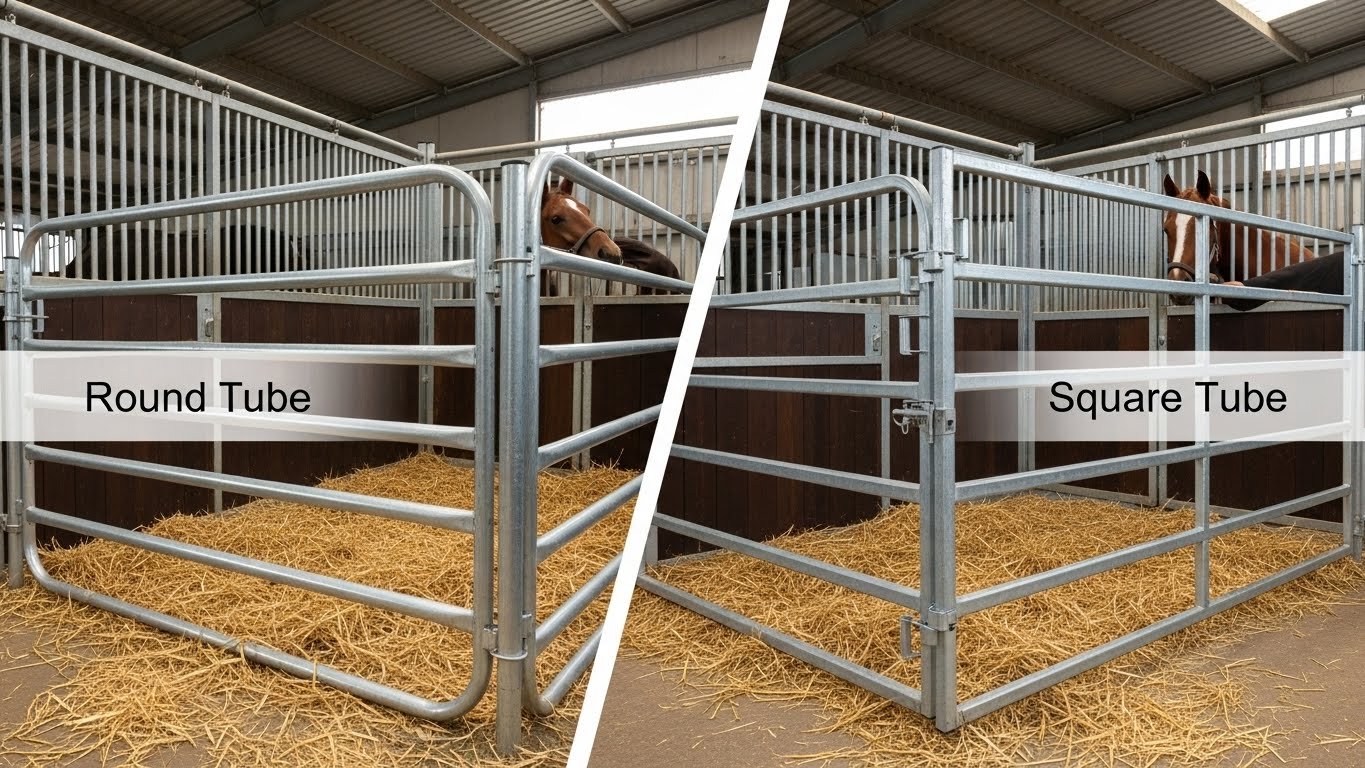
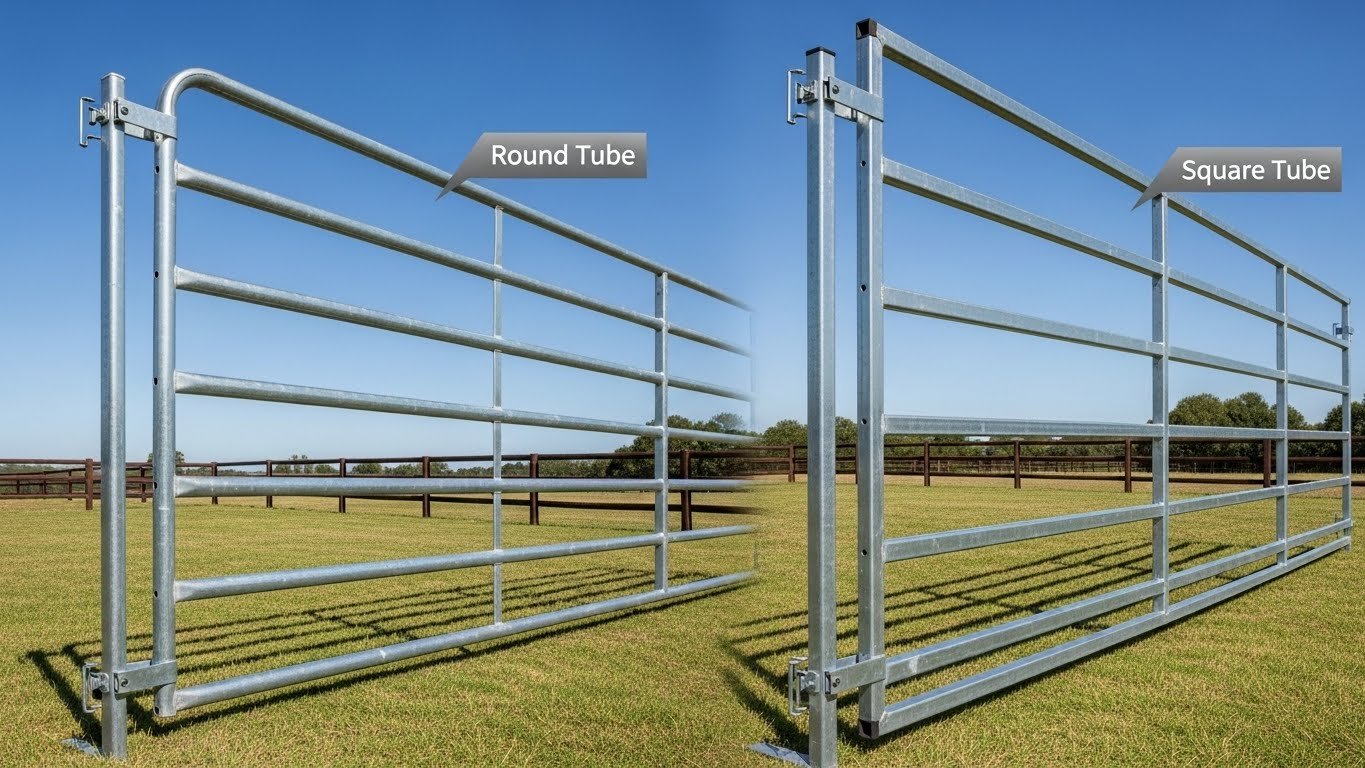
Selecting the right tubing for temporary livestock panels affects both animal safety and the long-term performance of your setup. The choice between round and square profiles goes beyond mere aesthetics, impacting how panels withstand daily use and environmental challenges.
This guide explores the key differences in how round and square tubing perform in temporary panels, from structural integrity to livestock safety. We examine specific properties, such as a round tube’s measured 10.2 mm deflection under a 400 kg load and the high yield strength of square tubing (42,000-46,000 psi for ASTM A500 Grade B), helping you make an informed choice for your operation.
The Geometry of Steel Strength
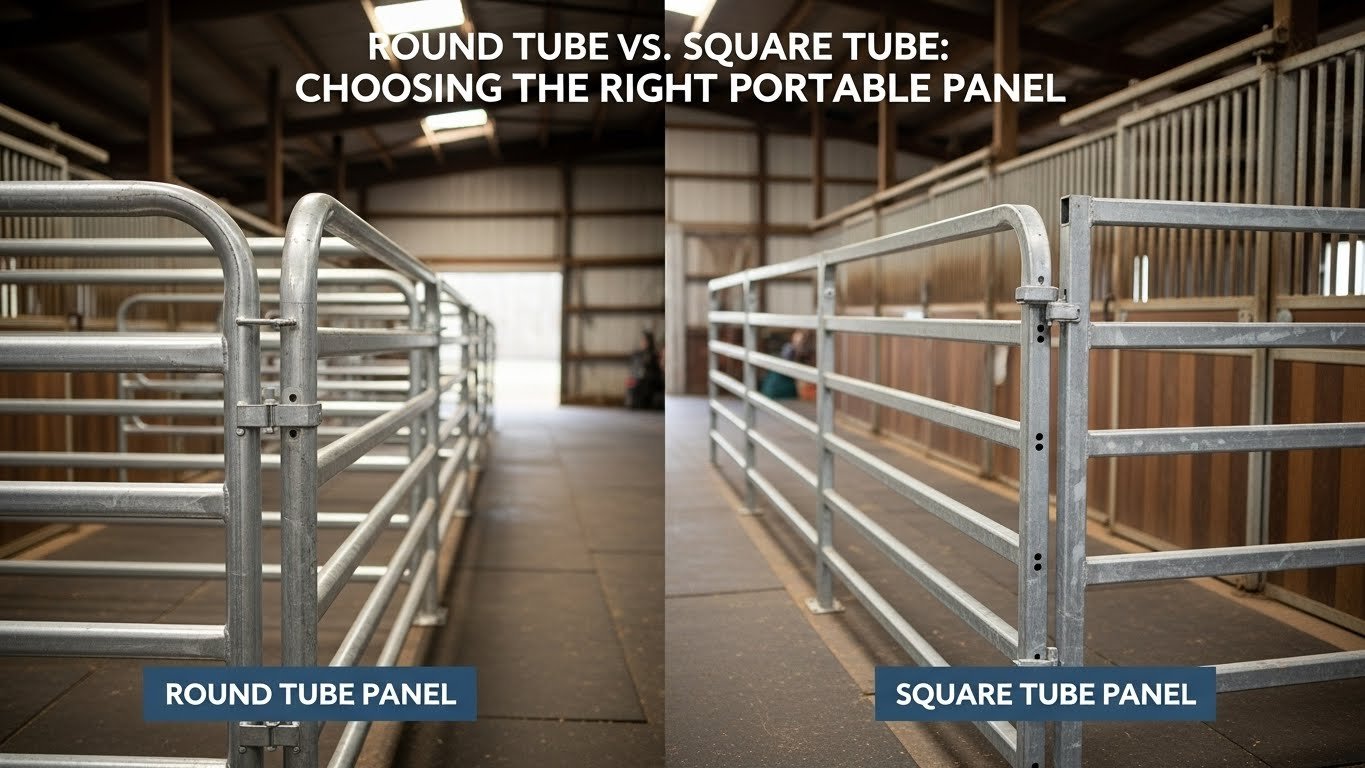
The geometry of steel strength in portable panels, effective for 2026 and beyond, relies on 1.75 to 2-inch diameter high-tensile round tubing with 16-20 gauge thickness. Integrated Z-braces and continuous welds enhance rigidity, while hot-dip galvanization at 450°C provides a 42-micron zinc coating for lasting corrosion resistance, ensuring durability against livestock impact.
Optimizing Steel Geometry for Panel Resilience
Portable corral panels achieve resilience through specific design choices. They use 1.75 to 2-inch diameter round high-tensile steel tubing, which resists deformation when livestock impact it. Different gauges like 16, 19, and 20 provide varied strength levels; 16 gauge and 2-inch tubing offer maximum pressure resistance, suitable for heavy-duty applications while maintaining portability.
Z-braces, typically 2-4 per panel, are integrated, along with continuous-welded saddle joints. These features distribute loads efficiently and boost structural rigidity across common panel widths of 10-16 feet. Panel heights, such as 50-72 inches, are also considered to effectively handle typical livestock impacts.
Material Specifications and Corrosion Protection
The base material for portable corral panels often consists of low carbon steel pipe, sometimes with a thickness like 1.6 mm for specific rail types. A crucial protection method is hot-dip galvanization. This process involves immersing the steel in molten metal at about 450°C, applying a zinc coating—for example, 42 microns—to achieve 10-year durability.
Powder coating can also be applied as an extra layer. This provides enhanced durability and weather protection, contributing to the overall finish. Structural elements like square corner pin connections and loop legs also play a role in stability, preventing the panels from sinking into soft ground.
Round Tube (Deflection/Safety)
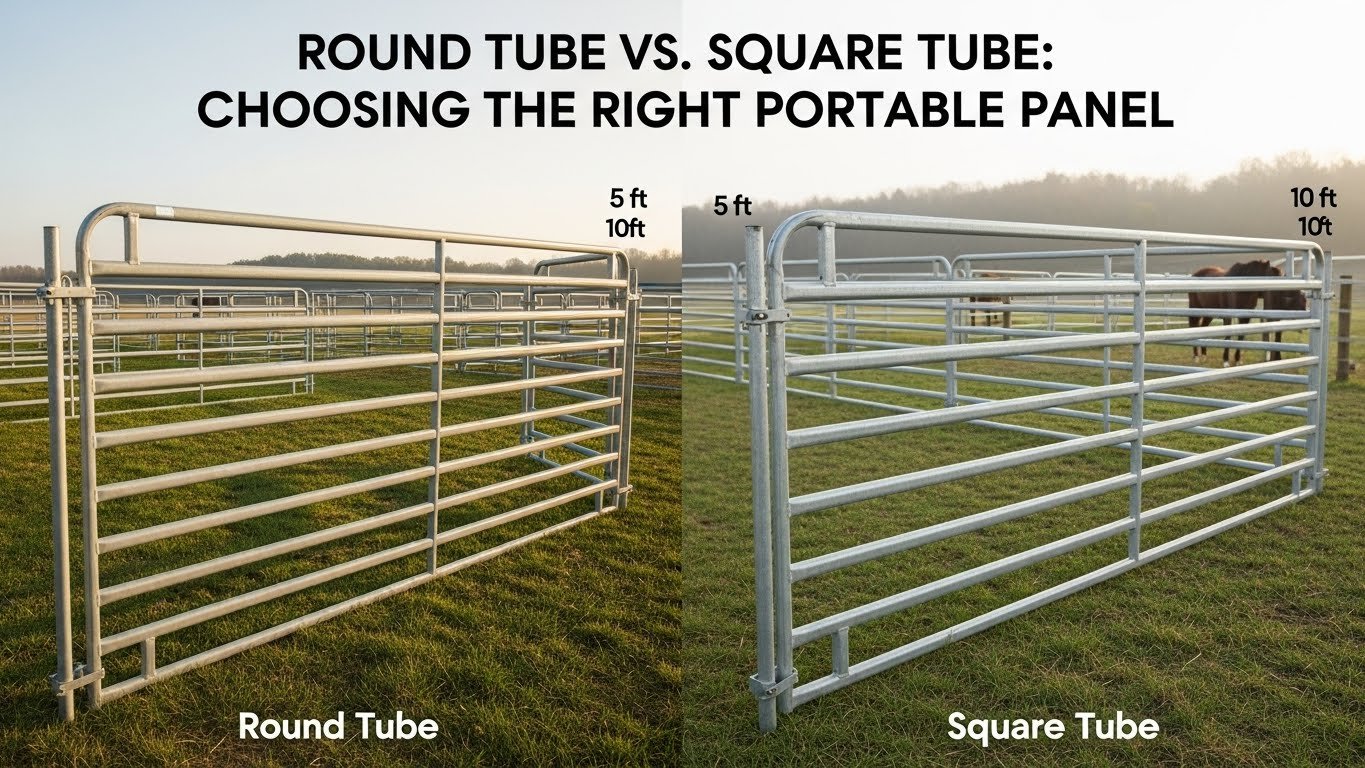
Round tubes are commonly used in structural applications, but their deflection under load is a critical safety factor. A 38.1 mm OD × 1.5 mm wall tube on a 1.0 m span deflected 10.2 mm under 400 kg. Design adheres to AISC and ASTM standards, with typical serviceability limits for live-load deflection ranging from L/240 to L/360, translating to 4.2–2.8 mm for a 1.0 m span.
| Parameter | Details | Value/Standard |
|---|---|---|
| Test Tube Specification | 316L stainless steel round tube | 38.1 mm OD × 1.5 mm wall |
| Test Span & Load | Simply supported, mid-span load | 1.0 m span, 400 kg (≈3.9 kN) |
| Measured Deflection | Under test conditions | 10.2 mm |
| Profiled Tube Performance | Similar wall thickness (vs. Round) | 20–54% lower deflection |
| Governing Design Standards | For structural steel tubing (HSS) | AISC, ASTM A500/A500M, AISC 360 |
| AISC Serviceability Limit (1.0m span) | Maximum live-load deflection | L/240–L/360 (≈4.2–2.8 mm) |
Deflection in Round Tubes: Understanding Performance
A 38.1 mm OD × 1.5 mm wall, 316L stainless steel round tube, simply supported over a 1.0 m span, deflected 10.2 mm under a 400 kg (≈3.9 kN) mid‑span load in a 2026 controlled test.
Under identical conditions, profiled stainless tubes (square, D‑shaped, flat‑sided oval) with similar wall thickness demonstrated 20–54% lower deflection than the round control tube.
This 10.2 mm measurement provides a concrete baseline for expected sag in typical round tube configurations under a specified load.
Safety Design and Serviceability Limits
Structural steel tubing design generally follows AISC and ASTM frameworks, with round structural tubing (HSS) covered by ASTM A500/A500M and designed using AISC 360 provisions.
AISC serviceability guidance commonly sets beam deflection limits such as L/240–L/360; for a 1.0 m span, this corresponds to approximately 4.2–2.8 mm maximum live‑load deflection.
Engineering calculators, like RogueFab’s Tube Calculator, compute bending stress, mid‑span deflection, and safety factor based on tube dimensions, span, material yield strength (e.g., 250–350 MPa), and applied load.
Design requires thorough checks of section modulus, moment of inertia, and material yield strength to ensure both ultimate capacity and serviceability deflection are met.
Square Tube (Structural Strength)
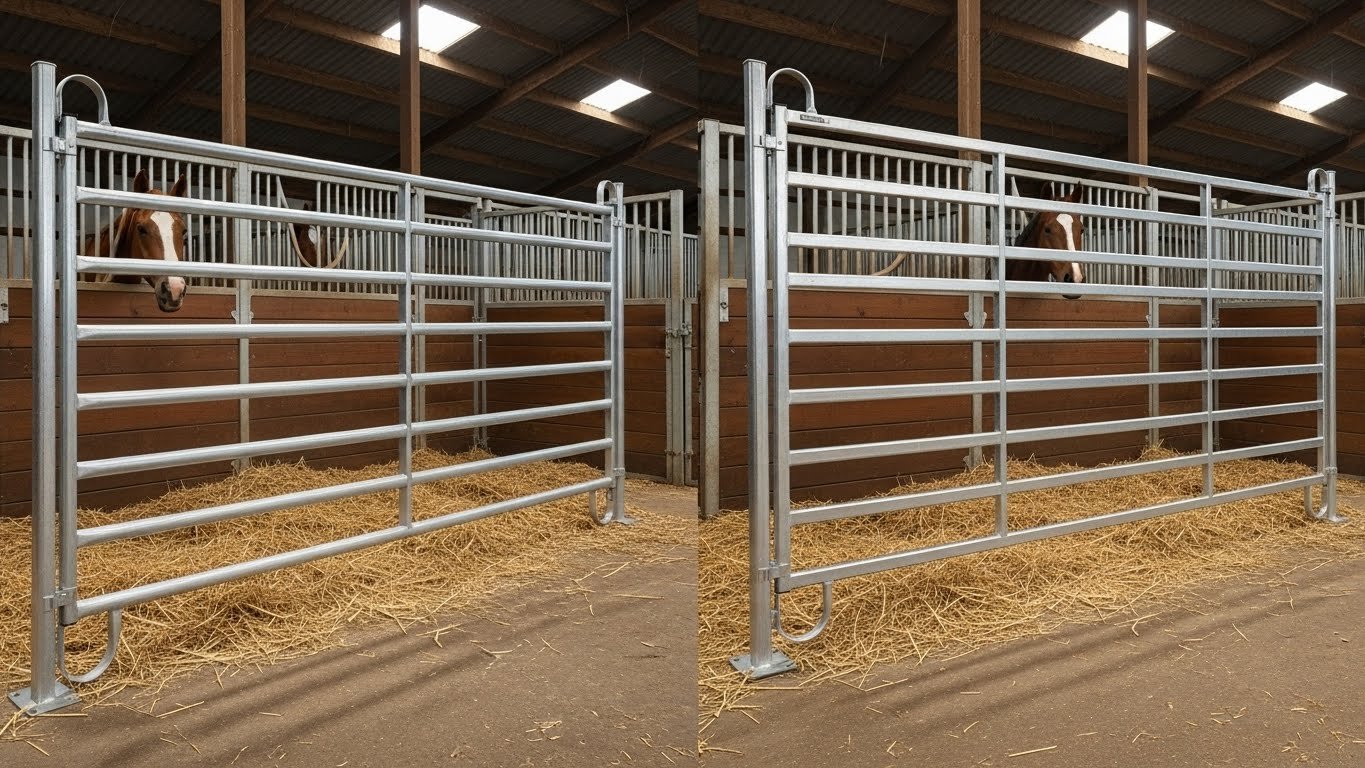
Square tubes, particularly Hollow Structural Sections (HSS) meeting ASTM A500 Grade B, offer superior structural strength due to their material composition, wall thickness, and multi-axis load distribution. This makes them ideal for robust frameworks and columns in temporary installations, balancing strength with an optimized strength-to-weight ratio.
| Characteristic | Description | Value / Detail |
|---|---|---|
| ASTM A500 Grade B | Standard for structural tubing | Min. Tensile strength 58,000 psi (400 MPa), Min. Yield strength 42,000-46,000 psi (290-317 MPa) |
| Wall Thickness Impact | Directly affects load capacity | 0.25-inch wall is significantly stronger than 0.125-inch for bearing heavy loads |
| Example Specifications | Typical HSS (50mm x 50mm, 3mm wall) | Density 7,850 kg/m³, Tensile strength 400 MPa, Strength-to-weight ratio ~90.3 x 10^6 N/kg per meter |
| Common Materials | Used for structural square tubing | Carbon steel (high strength), Stainless steel (corrosion resistance, slightly lower strength), Aluminum (lightweight, lower strength) |
| Manufacturing Tolerances | Ensures consistent quality | Squareness ±2°, Twist max 0.050-0.062 inches over 3 ft (for sides up to 2.5 inches) |
| HSS Core Properties | Inherent benefits of hollow sections | High strength-to-weight ratio, Excellent resistance to compression and torsional forces |
Core Structural Advantages and Applications
Square Hollow Structural Sections (HSS) provide a high strength-to-weight ratio, which is essential for efficient design in structures planned for 2026. This balance optimizes material use without compromising load-bearing capacity.
These sections offer robust resistance to both compression and torsional forces, ensuring stability under diverse load conditions. Their structural integrity makes them reliable for various demanding applications.
The uniform geometry of square tubes ensures even load distribution across multiple axes. This feature significantly enhances stability in both framework construction and vertical support elements.
Square tubes see common use in columns and frameworks for temporary structures, including durable corral panels. Their versatile strength adapts well to these varied installation needs.
Material Specifications and Performance Metrics
Adherence to ASTM A500 Grade B is a standard practice. This specifies a minimum tensile strength of 58,000 psi (400 MPa) and a yield strength between 42,000-46,000 psi (290-317 MPa).
Wall thickness significantly influences load capacity. For example, a 0.25-inch wall tube is considerably stronger than a 0.125-inch wall when designed to bear heavy loads.
A typical 50 mm x 50 mm cross-section with a 3 mm wall thickness can show a strength-to-weight ratio of approximately 90.3 x 10^6 N/kg per meter, highlighting its efficiency.
Carbon steel is the most common material, offering high inherent strength. Stainless steel provides corrosion resistance, suitable for specific environments, though it has slightly lower strength properties.
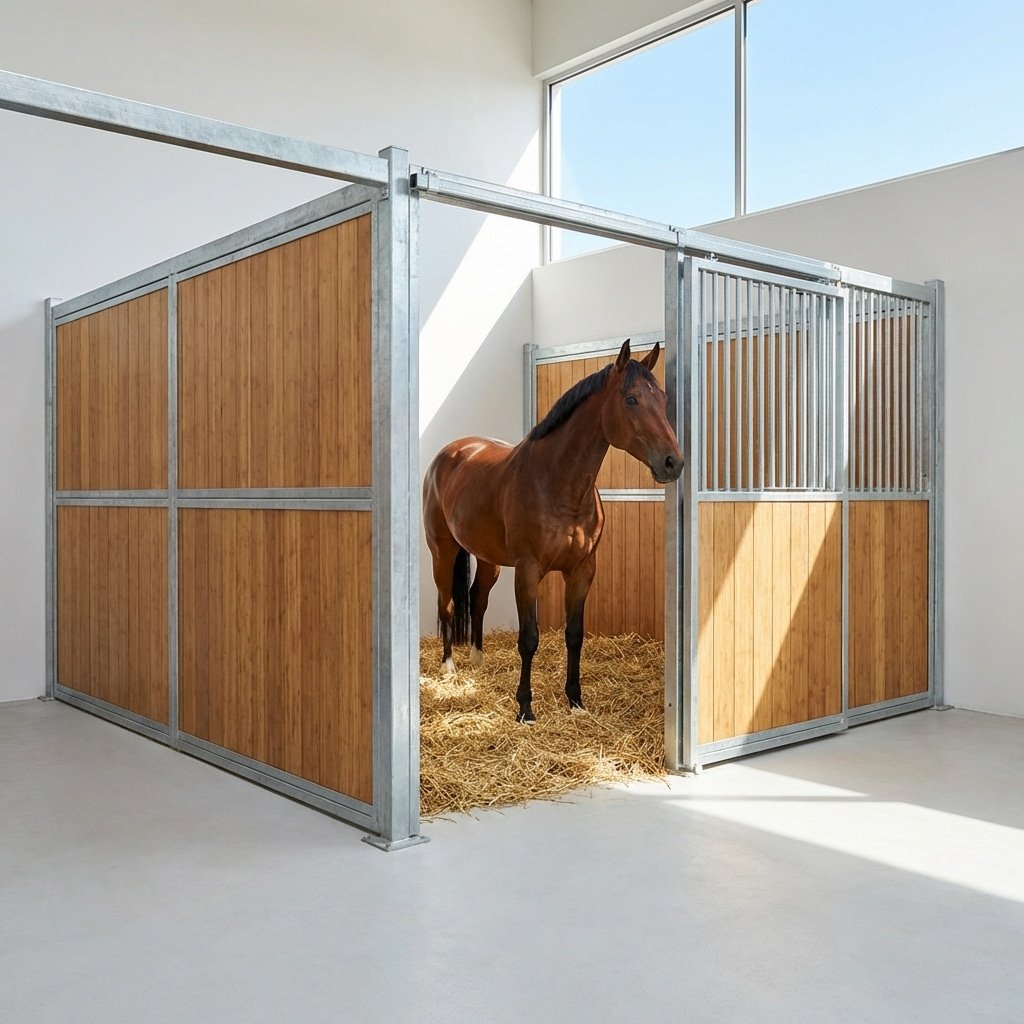
Engineered for Global Excellence: Your Horse Stables, Perfected.

The “Oval Rail” Compromise
The term ‘Oval Rail Compromise’ is often misunderstood; it typically refers to specific railway engineering solutions for transitioning between different rail sections or designs with oval bolt holes, not the oval-shaped hollow sections used in livestock fencing. These two applications involve distinct material standards, dimensions, and structural demands.
Defining ‘Oval Rail’ Across Industries
In livestock and corral panels, ‘oval rail’ commonly refers to oval/elliptical hollow sections (OHS) made from cold-formed steel.
Typical OHS dimensions range from 50×30 mm to 80×40 mm, with wall thicknesses between 1.5–2.5 mm for temporary animal fencing.
The phrase ‘compromise’ in engineering, especially for railways, signifies a geometric and structural transition between two differing rail sections.
Railway applications use ‘oval’ to describe oval bolt holes in joint bars, which prevent rotation and maintain track alignment, not the rail’s cross-section.
Technical Specifications: Fencing OHS vs. Railway Compromise Joints
Base steel grades for OHS in fencing include S235JR / S275JR / S355JR (EN 10219) or Q235 / Q345, providing yield strengths of 235–355 MPa.
Railway compromise joints and rails must conform to stringent standards like AREMA Chapter 4 ‘Rail’ and U.S. federal regulations (e.g., 49 CFR Part 213 Subpart D).
Compromise joint bars for railway use, such as for 115RE rail, feature alternating round and oval bolt holes for 1-inch oval-neck track bolts.
These compromise joint bars, for BS and UIC rails, are made from high-strength materials (e.g., Chinese 40# steel) with 550–650 MPa tensile strength and ≥18% elongation, adhering to standards like BS 47-1.

Final Thoughts
Choosing the right tube shape for portable panels involves balancing structural needs with animal safety. Round tubing excels where livestock contact is expected, offering a safer, edge-free surface that reduces injury risk. While round tubes may show more deflection under specific loads than other profiles, their design, often with integrated Z-braces and robust welding, ensures resilience for most livestock applications. Square tubing, with its superior strength-to-weight ratio and resistance to torsion, is better suited for structural components like posts or bracing, supporting the panel framework where direct animal impact is not the primary concern.
Effective panel design combines these different geometries strategically. Panels prioritize animal welfare through smooth, round rails, while leveraging the strength of square tubing for critical support points. Hot-dip galvanization and precise fabrication further ensure durability and safety, making portable panels reliable for containing various livestock. Understanding these material and design choices helps ensure panels perform as needed, safely managing animals in diverse settings.
Frequently Asked Questions
Which is better for horses: round or square tubing?
Round tubing is the industry-preferred shape for horse corral and temporary panels due to safety, as it has no sharp edges and reduces impact injury compared to square tubing. Typical specifications include round galvanized steel tube of about 1.66–1.90 inches (42–48 mm) outside diameter with a 14–16 gauge wall (≈1.6–2.0 mm). Square tubing is generally used for posts, bracing, or hardware frames where direct horse impact is unlikely.
Are portable panels safe for livestock?
Yes, portable galvanized corral panels are safe for livestock containment. This safety is achieved when panels are constructed with heavy-duty galvanized steel tubing, smooth edges, rounded corners, and full-welded joints, ensuring they meet industry safety standards for animal handling without sharp hazards. Many designs feature 1-3/4 in. to 2 in. diameter steel round tubing (16-20 gauge) with vertical ‘Z’ braces for added stability.
What are the strongest cattle panel designs?
The strongest cattle panel designs include heavy-duty bull panels utilizing 1-gauge wire (thicker than standard 4- or 5-gauge) at 60 inches height with 16 feet length, weighing 82 pounds. Another robust option is tubular Victory panels, which feature 1.5 inches x 16-gauge hi-tensile 58,000 psi steel tubing at 62 inches height and 16 feet length, weighing 117 pounds.
What are the differences between oval and round saddle rails?
Round rails for saddles are standardized at 7 mm diameter and are typically used on chromoly, steel, and titanium rails. Oval rails, standardized at 7 × 9 mm (7 mm wide, 9 mm tall), are primarily used on carbon rails. Oval rails offer measurably stiffer vertical performance and often support higher rider weight limits than equivalent 7 mm round carbon rails. Note that 7×9 oval rails require a compatible clamp, while 7 mm round rails fit almost all standard seatpost or clamp heads.
What gauge is standard for corral panels?
For galvanized corral panels made from round steel tube, the common industry build is 16‑gauge tubing for standard and heavy‑duty event and livestock panels. Some ‘extra heavy’ designs use 14‑gauge on end posts and 16‑gauge on rails. For wire-mesh style cattle or corral panels, 4–5 gauge galvanized wire is typical, with bull panels featuring 1‑gauge wire for maximum impact resistance.
What are the best panels for a round pen?
For a safe and durable round pen, industry practice recommends 12 ft galvanized steel corral panels, 5–6 ft high, made from 1⅝–2 in OD tubular steel in 14–16 gauge, with 5–6 rails. These are typically arranged to create a pen diameter of 50–60 ft for most training work. Event-safe systems often feature hot-dip galvanized or heavy powder-coated finishes for superior corrosion resistance and daily use.

 English
  Spanish
  French
  Arabic
  German
0 Comments