
Aisle doors get left open because somebody is carrying two buckets at once. In a barn full of curious horses, a door propped by habit turns into a risk one bad morning. Self closing barn doors take the human out of that equation: the door shuts because a mechanism decides it must, whether the last person through was careful or not.
Two mechanisms share this job. A spring built into the hinge stores the opening force and spends it closing the door. An arm-and-piston unit above the door meters that force through oil, letting the installer set speeds. They fail differently, cost differently and ask for different checks on a quotation. The corrosion side is covered in this site’s hardware guide, linked below; this article is about where the closing force should live.
Key Takeaways
- Self closing is not self latching. A closer returns the door to the frame; only a latch or bolt holds it there. Both parts belong on the order.
- Spring hinges put force in the pivot — nothing protrudes near a horse’s head, but the pull is strongest at the shut and hardest to slow.
- Hydraulic arms adjust sweep and latching speed separately, at the cost of an arm standing in the doorway and oil whose behavior shifts with temperature.
- For closers sold into the EU, expect a European product standard to be named — EN 1154 is the common one for door closers — plus a size class matched to the leaf. “Heavy duty” is not a rating.
- This site publishes its Dutch door styles, V-yoke and tempered glass fronts, not closer ratings. Leaf weight, force size and service temperature are written confirmations from the supplier.
- A workable division of labor: springs at stall fronts where a horse reaches, an arm on aisle-end doors where a slow, controlled shut matters more.
Self Closing Barn Doors: Where an Open Door Comes From
The typical barn door left open is not negligence. It is the top half of a Dutch door wedged open all summer for air, or a bottom leaf that never quite caught the latch after the farrier’s visit. The failure is geometry and habit: latches wear, hinges sag, a damp-swollen timber leaf rides higher at its closing edge, and the last degrees that used to click stop clicking. Once closing takes a deliberate act on every pass, some passes go careless — buckets, night checks and hoof picks competing for the same two hands.
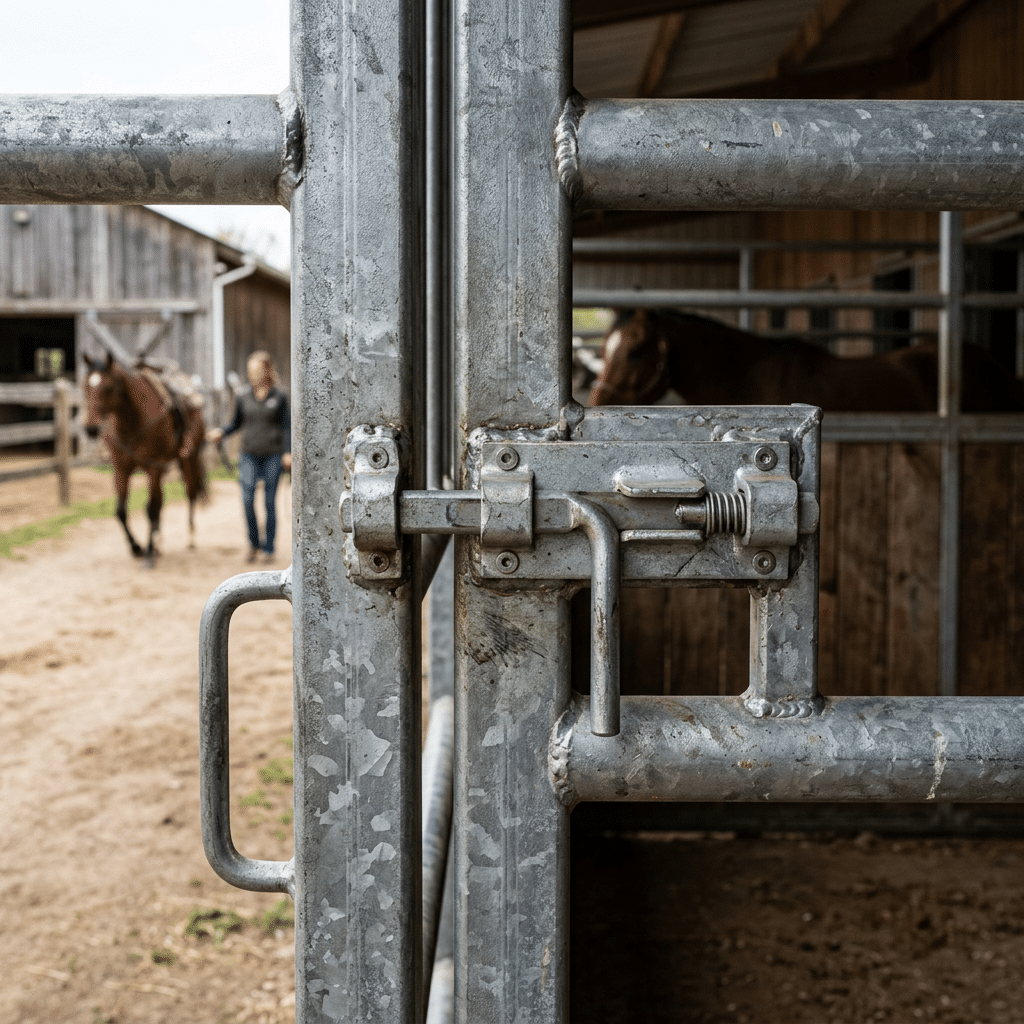
A self-closing mechanism converts the deliberate act into an automatic one — the entire argument for buying one. It also frames the two ways these doors disappoint: one that shuts too hard can teach a horse to avoid it and push staff to wedge it open; one that shuts without latching leaves the aisle open with extra steps. Both are specification errors, not bad luck.
Spring Hinges: The Force in the Pivot
A spring hinge looks like an ordinary hinge from the outside, which is its chief virtue at a stall front. The closing force lives in a coil inside the barrel: opening the door winds it, releasing spends it. Nothing stands off the door face for a mane, a collar or a curious lip to catch.
For barn work they come in two job sizes — spring-loaded butt hinges hung like any hinge, and heavier frame-mounted units for gate-scale leaves. Adjustment is a screw in the barrel that pre-compresses the spring: more tension, harder and faster shut, within the range the coil was built for. That range is narrow. Ask which leaf weight and door size each hinge is rated for, because two brands’ coils behave differently on the same door.
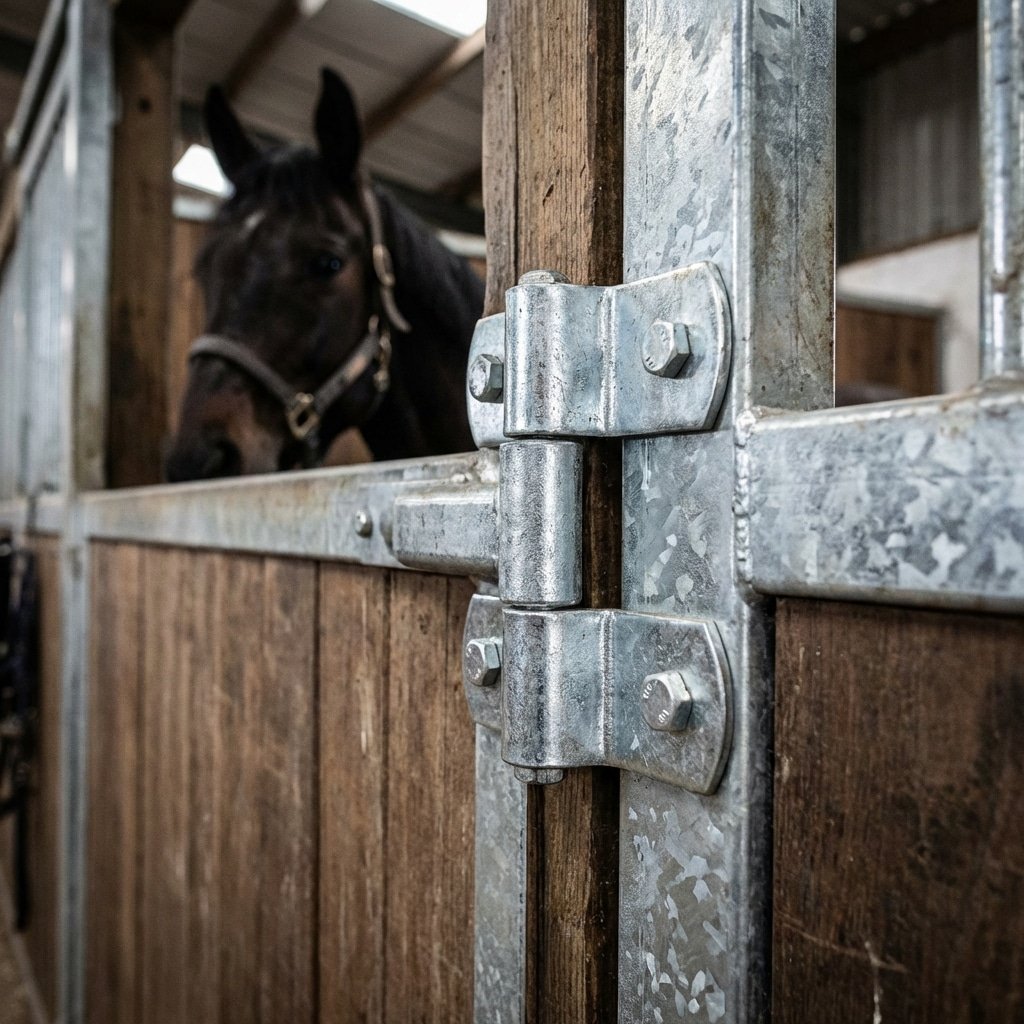
Two weaknesses come with the geometry. The force curve is strongest when the door is nearly closed, so the last degrees arrive fast unless the spring is set weak — and a weak setting will not close a swollen or sagging leaf. Springs also relax with cycles and weather, so the tension set at installation will want topping up over time. That is maintenance, not defect, but it has to be planned. Damp, ammonia-heavy barn air brings the corrosion questions covered in this site’s humid-climate hardware guide — the spring barrel is usually the first part to freeze up.
Hydraulic Arms: Adjustable, and Outward
A hydraulic closer is a small gearbox mounted at the top of the door with an arm reaching to the frame. The door winds a spring inside the box; going closed, that spring drives a piston, and oil squeezed past a valve sets the speed. Most units meter two stretches separately — the sweep, then the final degrees into the latch. That is the selling point: a slamming door slows without losing the force that catches the latch.
The bill arrives in three shapes. Protrusion first — arm, bracket and body stand in the airspace above and beside the door. Over an aisle-end opening that is nothing; at a stall front where horses drop heads, it is a hazard survey. Our leaning on that trade: nothing a horse can reach wears an arm, and springs belong at the stall fronts. Temperature second — the metered oil thickens in cold and thins in heat, so a closer set in an August barn can crawl in January; ask for the rated service temperature range instead of trusting the valves to compensate. And the split-leaf question third: a Dutch door’s two leaves hang on one hinge line, so someone must decide which leaf carries the closer and how the other half stays secured. A foaling mare’s stall front is where these decisions get unforgiving — the safety side is already on this site in the foaling box door notes; the mechanical side is a supplier question, in writing.
Ask which standard the closer is tested and sized to. In EU trade the name to expect is EN 1154, the European product standard for door closers, with a size class matched to door mass and width — and confirm the current edition with the supplier. This site publishes no closer ratings, so anything in a quotation is a claim to verify.
What the Quotation Has to State
Buyers compare brochures; orders survive on lines of specification. Whatever mechanism you land on, the written answer should state six things.
| Item | What the answer must include |
|---|---|
| Mechanism and standard | Spring hinge or arm closer; the standard it is tested to and the size class proposed. |
| Leaf data | Weight and dimensions of each leaf — not published on this site; confirm before sizing. |
| Adjustment | Which controls adjust after hanging, and the tool the stable hand needs to reach them. |
| Temperature and lubrication | The closer’s rated service range, or the lubrication schedule for spring barrels. |
| Latching pair | Which bolt or spring latch pairs with the closing force, and proof the force drives that latch. |
| Spares | Hinges, springs, arms as separately stocked parts, with prices and lead times. |
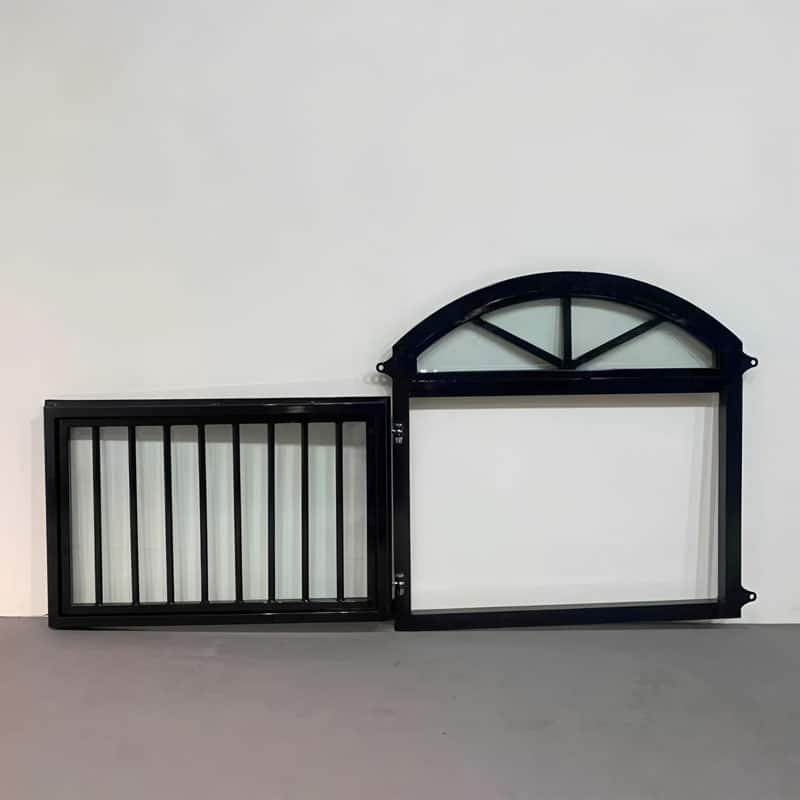
The doors themselves come, in this site’s published range, in the V-yoke and tempered glass styles; no closer appears in that published spec. The whole mechanism is therefore an add-on question — the conversation starts from the barn doors and windows range, and the answers stay attached to the order.
Questions fréquemment posées
Do self closing barn doors arrive adjusted?
They arrive set to a nominal size class. Plan one adjustment pass after hanging — a tension screw on springs, sweep and latch valves on arms — and if the quotation cannot name those controls, that is a missing spec line.
Which mechanism is safer around horses?
Neither is certified for horses; they trade risks. A spring hinge leaves nothing to catch, while a hydraulic arm controls speed better. A common resolution puts springs at stall fronts and arms on aisle-end doors.
Can a self-closing door close too hard?
Yes. A spring set for a heavy or swollen leaf can snap the last few degrees, and a horse that gets hit once can learn to keep clear of the leaf, and staff tend to wedge it. Set the weakest tension that still drives the latch, and re-check it with the seasons.
What does cold weather do to an arm closer?
The metered oil thickens, so the swing slows and the final degrees can stall before the latch. Ask for the rated temperature range at order time — after the first frost, the valve is not going to invent force.
Does a Dutch door need closers on both halves?
Not necessarily. Both leaves hang on one hinge line, so specify per leaf: which gets springs or a closer, and how the other is secured. Nothing in this site’s published door spec settles that — get the supplier’s answer.
Conclusion
The mechanism decides what the barn lives with afterward: a force hidden in the pivot that wants periodic retensioning, or an arm in the doorway that wants correct sizing and a cold-weather answer. Both beat the door left ajar on purpose. Six lines of quotation — mechanism and standard, leaf data, adjustments, temperature, latching pair and spares — cover most of what goes wrong later.
Put those questions to the supplier in writing, and let the answers pick the closer rather than the adjectives on the price list.

 French
 English
 Spanish
 Arabic
 German
0 commentaires