


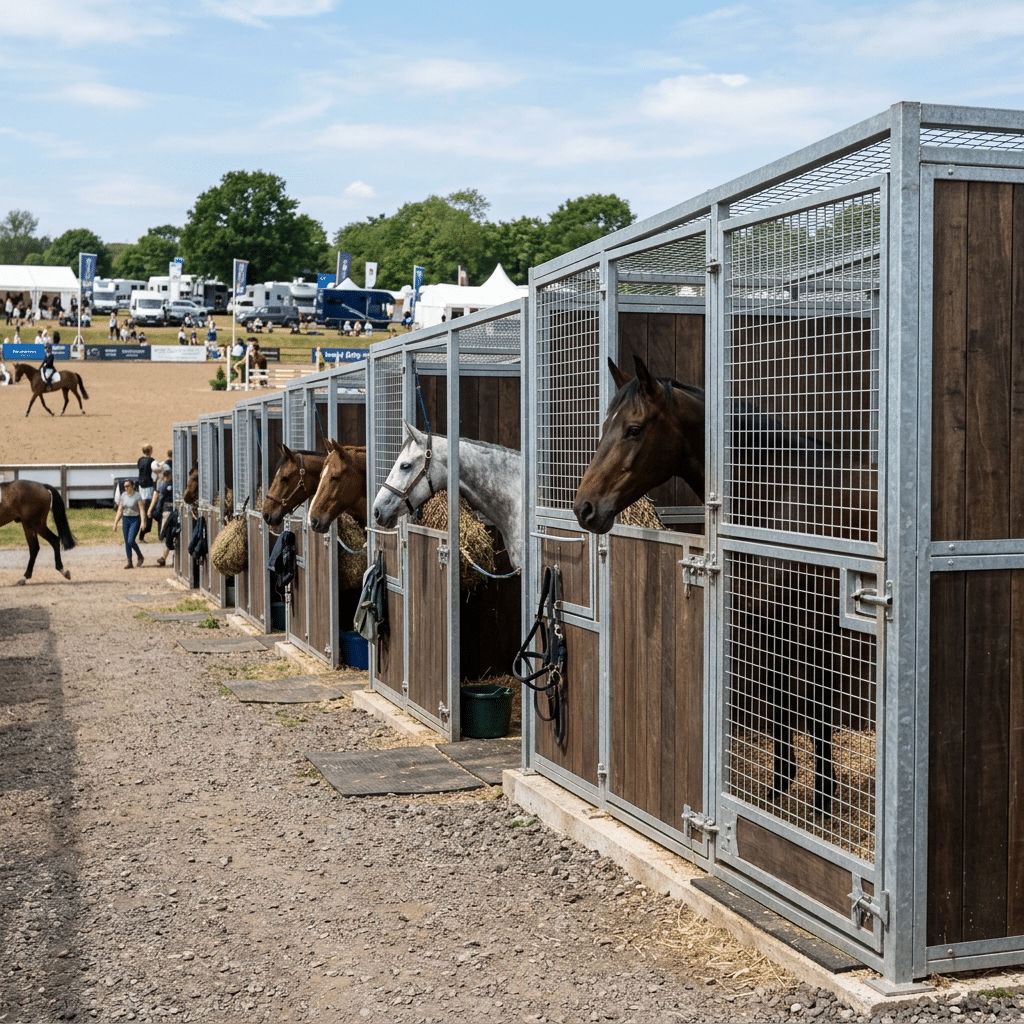
The polo horse stables brief at 20 or more animals stops looking like a home stable and starts looking like a procurement problem. One string of horses is in and out of the yard on a training calendar, the wash-down on many working yards is close to daily, tack is kept within reach, and the layout is a workflow before it is architecture. A row built for three horses copied to twenty is not the same building; it is a different buying decision.
This guide is for the buyer planning that batch. It is written against what this supplier publishes — stall sets in adjustable sizes, bamboo, HDPE and pine lining options, a stated 20-year rust-protection claim on hot-dip galvanized steel, a 10-set minimum, and a documented account-manager threshold at 20 sets. Anything else — stall dimensions, aisle widths, per-horse turnout area, polo-specific welfare requirements — is not in what the site releases, and belongs in your supplier’s written answer, not in a catalog assumption.
Key Takeaways
- Batch, not one-off. A polo string is bought in stall sets, and this range states a 10-set minimum. Orders of 20 sets or more unlock a dedicated regional account manager — the practical threshold at which a 20-set brief (a working rule of thumb of roughly one set per horse, which your supplier confirms) starts to be a project conversation rather than a purchase.
- The account-manager value is customization and logistics, not just pricing. Use it as a technical channel to review your liner choice, phasing plan and wash-down routine against what the site actually publishes, before the groundworks start.
- The steel is the durability claim; the layout is your own work. The site publishes a stated 20-year rust-protection specification on hot-dip galvanized steel. It publishes no stall dimensions, no aisle figure and no price — those are yours to set against the horse calendar and the site.
- A polo yard is a liner test before it is a steel test. Bamboo, HDPE and pine are the lining materials in this range. Selection should be against chewing, kicking and repeated hose-down wear — this range publishes no liner thickness, hardness or wear figure, so put the pattern of wear to the supplier in writing.
- Delivery cadence, not delivery day. The site’s stated lead time is 4-6 weeks worldwide, with 1-2 weeks expedited from the Sydney or Warsaw regional hubs, and a stated 5-15% volume discount on larger runs. Plan phased arrivals against the season, not a single drop that parks for six weeks before the barn is ready.
What a Polo Complex Is Actually Buying
A home stable buys a stall. A polo or training complex buys a set of repeating conditions: horses going out and coming back in tight groups, tack and gear for each, a wash rack used most mornings and evenings on working yards, and a vet or foaling bay kept free while the rest of the yard runs. Once the count reaches 20 stall sets or more, those conditions start to shape the spec before the aesthetic does, and the way the buyer orders the steel starts to matter as much as the steel itself.
The right frame is a batch of stall sets on a common aisle, ordered against the horse calendar. Not “twenty individual boxes”, but a layout the site actually supports as a wholesale program: this supplier positions itself for farms, training centers and competition venues, and lists stall sets as the order unit for a 20-set-plus customer with an account manager. Everything else in the brief — how many rows, how deep the aisle, where the wash rack sits — is your site, your local rules and your supplier’s written answer, not something a manufacturer’s page can decide for you.
Rows, Aisles and the 20-Set Threshold
Aisle width and stall dimension are the two questions buyers ask first, and neither is published here. What is published is the order threshold: a 10-set minimum, and a dedicated regional account manager on orders of 20 sets or more. Once you are at that size, the layout conversation shifts from “what does a stall look like” to “how do twenty of them get on and off a truck, through a doorway and along a shared service run”. The site’s own guide to indoor stall systems and utility runs covers the row-and-service side of the same problem; read it before you commit a footprint, and take the local building and welfare rules from your authority.

Our view on the 20-set line is that the account-manager channel is more valuable before groundworks than after. It is a technical review of your liner choice, phasing plan and wash-down routine against what the site can actually ship — the moment to use it is while the drawings can still move, not when a row has to fit a hole already poured. Start with the horse stable range and the customization brief as your inputs to that conversation, and put the questions that stay open on the paper.
Liners, Hardware and the Wash-Down Routine
In a working string the liner is what the horse actually touches, and what the frequent hose-down hits. Bamboo, HDPE and pine are the lining materials this range publishes. What the site does not publish is any liner thickness, hardness rating or wear figure, so any claim that one is “the polo choice” is a supplier answer, not a manufacturer fact. What you can put in writing from your own side is the pattern of wear: how many horses chew, how often the aisle is hosed, whether ammonia-heavy bedding sits against the base, and how often the panels are broken down for a changeover.
Behind the liner is the steel, and behind the steel is the coating. The site specifies hot-dip galvanized steel with a stated 20-year rust-protection claim; the field-cut ends, drilled holes and repeated wash-down are often where such a claim first gets tested on a working yard, rather than on the flat panel face. Ask how those ends get re-coated and how the hardware at latches and hinges is finished. Everything in that exchange — the liner you pick, the coating answer you get — belongs in the order paperwork, not in a sales call.
Phasing Delivery Against the Horse Calendar
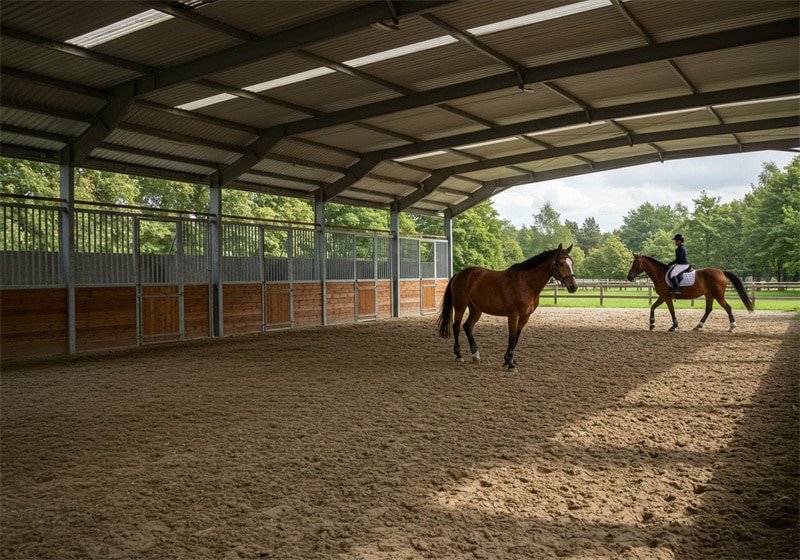
A 20-set order rarely arrives into a building that is ready to receive it all in one week. The site’s stated lead time is 4-6 weeks worldwide, with a 1-2 week expedited window from the Sydney or Warsaw regional hubs — a real option when a season starts earlier than the drawings assumed, and a real limit when the yard has no storage for a partial drop. The stated manufacturing capacity of 500-plus stall sets a month sits behind those numbers; treat it as scale, not as a promise about your dates.
Phase the arrival against the season instead. Order the fixed row and the first block’s panels together, and hold the interior expansion panels for a second drop when the arena and wash rack are poured. Volume pricing in this range is stated as 5-15% on larger runs; ask what tier applies to your specific set count rather than assume one number fits both a 20-set and a 40-set brief. Getting this exchange into the RFQ in writing — dates, tiers, spares, re-coating — is the whole point of a batch buy. Everything else on a polo complex is site work you can adjust; the order paperwork you cannot un-sign.
Preguntas frecuentes
What does a 20-horse polo string need in stall size?
This supplier publishes no stall dimensions. Set the size against your own horse count, turnout pattern and local welfare rules, and take the finished figure from your architect and the supplier’s written answer rather than a catalog default.
How many spare panels or stall parts should I order with a 20-set batch?
There is no published spare-parts ratio for this range. Ask the supplier to recommend a spares count against your horse density, chew pattern and wash-down frequency, and put that recommendation in the same order as the fixed row so a changeover is not waiting on a second container.
Do bamboo, HDPE and pine liners behave the same way?
This range publishes the three materials but no wear, hardness or thickness data. Selection is a design answer for your pattern of chewing, kicking and hosing. Put the wear pattern to the supplier in writing and ask which liner they recommend against it, rather than choosing off a photograph.
What is the smallest order for a polo complex in this range?
Stall sets start at 10. A 5-15% volume discount applies on larger runs, lead time is 4-6 weeks worldwide, and 1-2 weeks expedited from the Sydney or Warsaw hubs. Orders of 20 sets or more come with a dedicated regional account manager for customization and logistics.
Are hot-dip galvanized stall frames actually 20-year steel in a polo barn?
The site’s specification is stated as a 20-year rust-protection claim on hot-dip galvanized steel. The practical test on a working yard is what happens at field-cut ends, drilled holes and repeated wash-down — ask how those are re-coated and put the answer in the paperwork.
Conclusión
Ordering a polo complex as one batch is project control you can exercise before groundworks start, provided the paperwork carries the open items. Fix the row, the aisle and the wash-down routine against what the supplier actually publishes, and put every unanswered dimension into the order paperwork instead of a construction-day improvisation.
Start with the horse stable range and the site’s row-and-utility guide; for a 20-set brief, the customization brief is the technical channel, not the sales one.


 Spanish
 English
 French
 Arabic
 German
0 comentarios