


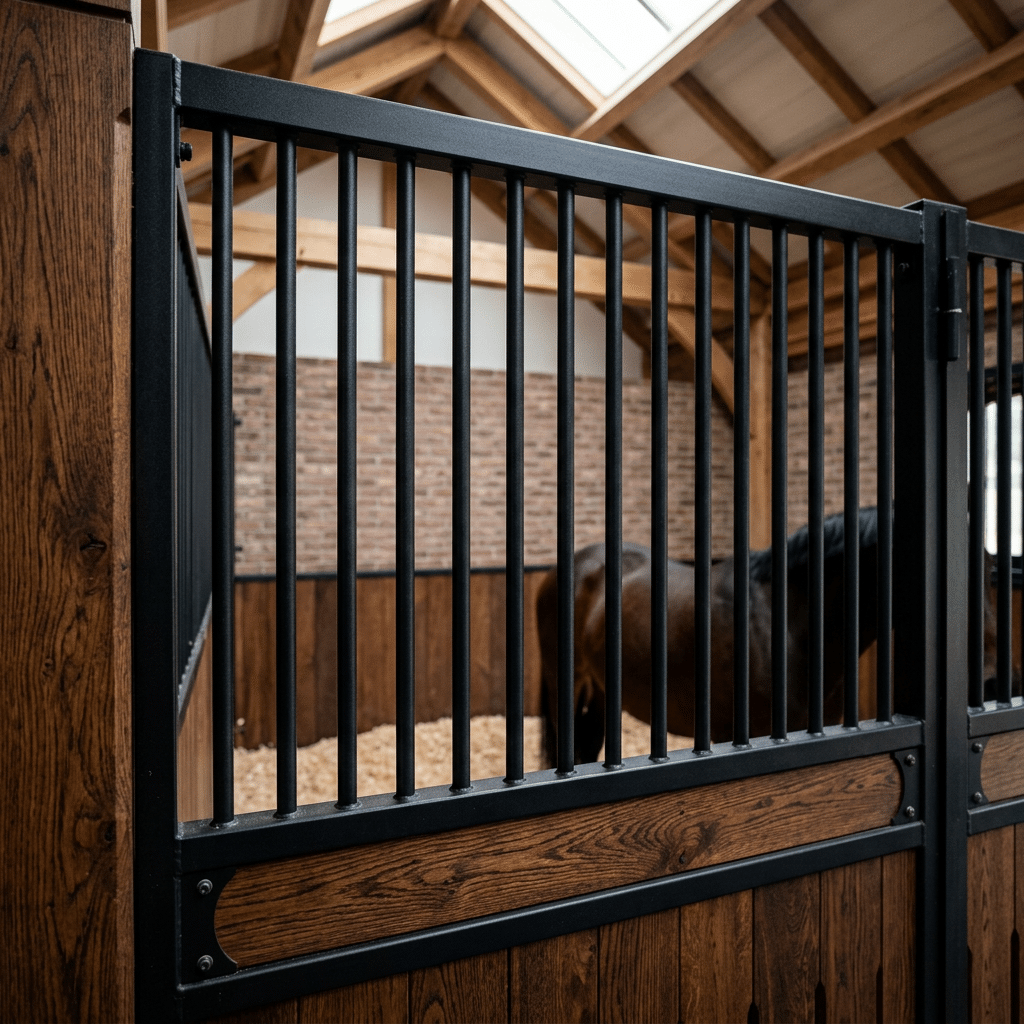
Successful installation for 4 stall horse barn plans hinges on the engineering of the components, not just the assembly process. Sourcing kits made with pre-galvanized tubes is a common mistake that leaves welds exposed, guaranteeing rust and leading to costly warranty claims or rework within the first two years.
This guide provides a technical analysis of material standards essential for a durable build. We specify the benchmarks for a true ‘Hot-Dip After Fabrication’ process compliant with ISO 1461 and explain the structural importance of Q345B steel for cold climates to prevent failures from animal impact.
¿Qué debes tener en cuenta a la hora de elegir un fabricante internacional?
Look past unit price. A real partner provides verifiable data on quality systems like ISO 9001, steel grades, production capacity, and rust protection processes.
Assessing Core Reliability and Technical Skill
Your manufacturer’s reliability is non-negotiable. It’s the foundation of your project’s success and your brand’s reputation. You need to look for concrete evidence of their capabilities, not just promises on a website. This means digging into their systems, capacity, and actual technical knowledge.
- Quality Management Systems: Ask for proof of an active ISO 9001 certification. This isn’t just a logo; it’s a commitment to a documented, repeatable process for delivering consistent quality.
- Production Capacity: Can they handle your project without derailing their entire operation? Confirm their capacity and how your order fits into their schedule. A reliable factory can meet deadlines for container-sized orders without sacrificing quality.
- Engineering Expertise: A true partner understands the “why” behind material selection. They should be able to explain the technical advantages of using Q345B steel for cold climates versus the standard Q235B for temperate zones.
- Lead-Time Stability: Get clear data on their on-time delivery performance. For example, a 35-45 day lead time for hot-dip galvanizing is realistic because the process cannot be rushed. Unusually short lead times can be a red flag for cut corners.
Verifying Material and Fabrication Standards
The spec sheet tells the real story. Vague terms like “high-quality steel” are meaningless. A professional manufacturer provides verifiable standards that prove their products are built to last and perform safely in demanding equestrian environments.
- Galvanizing Standards: Don’t just accept “galvanized.” Demand compliance with a specific standard like BS EN ISO 1461. This ensures a minimum zinc coating thickness, typically over 70 microns, for real rust protection.
- Correct Steel Grades: The steel must match the climate. While Q235B structural steel is suitable for many projects, manufacturers serving colder regions must offer a Q345B option to prevent steel from becoming brittle from horse kicks in freezing temperatures.
- Fabrication Process: This is critical. Insist on a ‘Galvanizado en caliente tras la fabricación’ process. This means the entire panel is welded first and then dipped in molten zinc, completely sealing every weld and joint. Cheaper alternatives involve welding pre-galvanized tubes, which leaves the welds exposed and guaranteed to rust.
¿Cuáles son las principales marcas de Estados Unidos y Australia?
Australian brands prioritize corrosion-resistant galvanized steel systems. Key US manufacturers focus on decades of experience and custom, domestically-produced stalls.
When sourcing horse stalls, buyers often look at established domestic brands in Australia and the United States. Each market has distinct leaders with different engineering priorities. Australian companies focus heavily on materials that withstand harsh weather, while US brands often highlight their long history and custom design capabilities.
Leading Australian Brands
Australian manufacturers build for durability, using hot-dip galvanized or alloy-coated steel as a standard to fight corrosion. The typical design combines steel frames with formply kickboards for safety and mesh panels for ventilation.
| Fabricante | Diferenciador clave | Material Focus |
|---|---|---|
| Guerilla Steel | Prefabricated modular system with a 25+ year service life. | Duragal® alloy-coated structural steel. |
| DoWell Equine | European-inspired designs with recycled material options. | Hot-dip galvanized Australian steel. |
| Equistall Premium | Supplied stalls for Sydney 2000 Olympics; exports to Japan/UK. | 100% Hot-dip galvanized steel kits. |
| Superior Sheds & Stables | Custom prefabricated designs with flexible material choices. | Steel or powder-coated frames. |
| Soluciones Stables | Commitment to 100% Australian materials. | Galvanized steel frames with certified Formply. |
Top US Manufacturers
The US market is dominated by established, family-owned companies that emphasize domestic manufacturing, customization, and safety. Most major players have been operating for over 30 years, building a reputation on craftsmanship and direct client relationships.
| Fabricante | Experiencia | Diferenciador clave |
|---|---|---|
| Lucas Equine Equipment | 40+ years | Kentucky-based specialist in custom-made stall components. |
| Equipamiento clásico para caballos | 30+ years | Focus on custom-engineered stalls for safety and durability. |
| J&E Grill Manufacturing | 35+ years | Offers both prefabricated and fully custom stall doors. |
| Puestos estadounidenses | Since 2006 | Handcrafted, powder-coated steel systems with global distribution. |
Engineered Horse Stables Built to Last

¿Por qué elegir un fabricante OEM directo, como DB Stable?
A factory-direct OEM gives you control over quality, like post-fabrication galvanizing. Our flat-pack system also saves distributors over 60% on container freight, protecting profit margins.
Direct Control Over Production and Material Standards
Working directly with the factory means your quality standards are actually enforced. There’s no middleman diluting specifications. We ensure every stable system undergoes Hot-Dip Galvanization After Fabrication, a critical step for genuine, long-term rust protection. Many competitors just weld pre-galvanized tubes, leaving the welds vulnerable.
This direct control also applies to raw materials. We use specified Q235B and Q345B structural steel without unapproved substitutions. You get the material integrity you paid for, ensuring the final product meets safety and durability requirements in your market.
Profit Protection Through Smart Logistical Engineering
Logistics costs can destroy a distributor’s profit margins. Fully-welded stable panels are bulky and inefficient to ship, fitting only 12-15 sets into a standard 40HQ container.
Our flat-pack system was designed to solve this. By engineering the components for efficient stacking on steel pallets, we can load 30-45 stable sets into a single 40HQ container. This saves our B2B partners over 60% on freight costs, giving them a significant pricing advantage and protecting their bottom line.
¿Cumple tu proveedor con las normas ISO 1461 sobre galvanizado?
ISO 1461 is the global benchmark for rust prevention. It mandates minimum zinc thickness on steel that is hot-dipped *after* fabrication, ensuring complete weld protection.
If your supplier can’t give you a straight answer on their galvanizing standard, you have a problem. BS EN ISO 1461 isn’t just a suggestion; it’s the official international standard for hot-dip galvanized coatings. It’s the difference between a stable that lasts for decades and one that shows rust spots after the first winter. The entire point is to protect the steel from corrosion, and this standard defines exactly how that’s measured.
Core Requirements of the ISO 1461 Standard
This standard is not about vague promises of “good quality.” It’s a set of hard, measurable benchmarks. The process of dipping the fully assembled steel component into molten zinc—known as hot-dip galvanizing after fabrication—is fundamental. This method ensures every cut, corner, and weld is completely sealed in a protective zinc coating. Anything less, like using pre-galvanized tubes and then welding them, leaves the most vulnerable points exposed to rust.
To claim compliance, a manufacturer must meet these key technical points:
- Espesor mínimo del recubrimiento: The thickness of the zinc coating is directly tied to the thickness of the steel it protects. The standard mandates an average coating of at least 70 microns (μm) for steel between 3mm and 6mm thick, and 85 microns for steel thicker than 6mm.
- Coating Integrity: The zinc coating has to be continuous and relatively smooth. Any lumps, blisters, or bare spots that could compromise the rust protection are grounds for rejection.
- Post-Fabrication Process: The standard explicitly applies to items galvanized *after* they are fully fabricated. It does not cover products assembled from pre-galvanized materials where welds are left unprotected.
Verifying Zinc Coating Thickness on DB Stable Panels
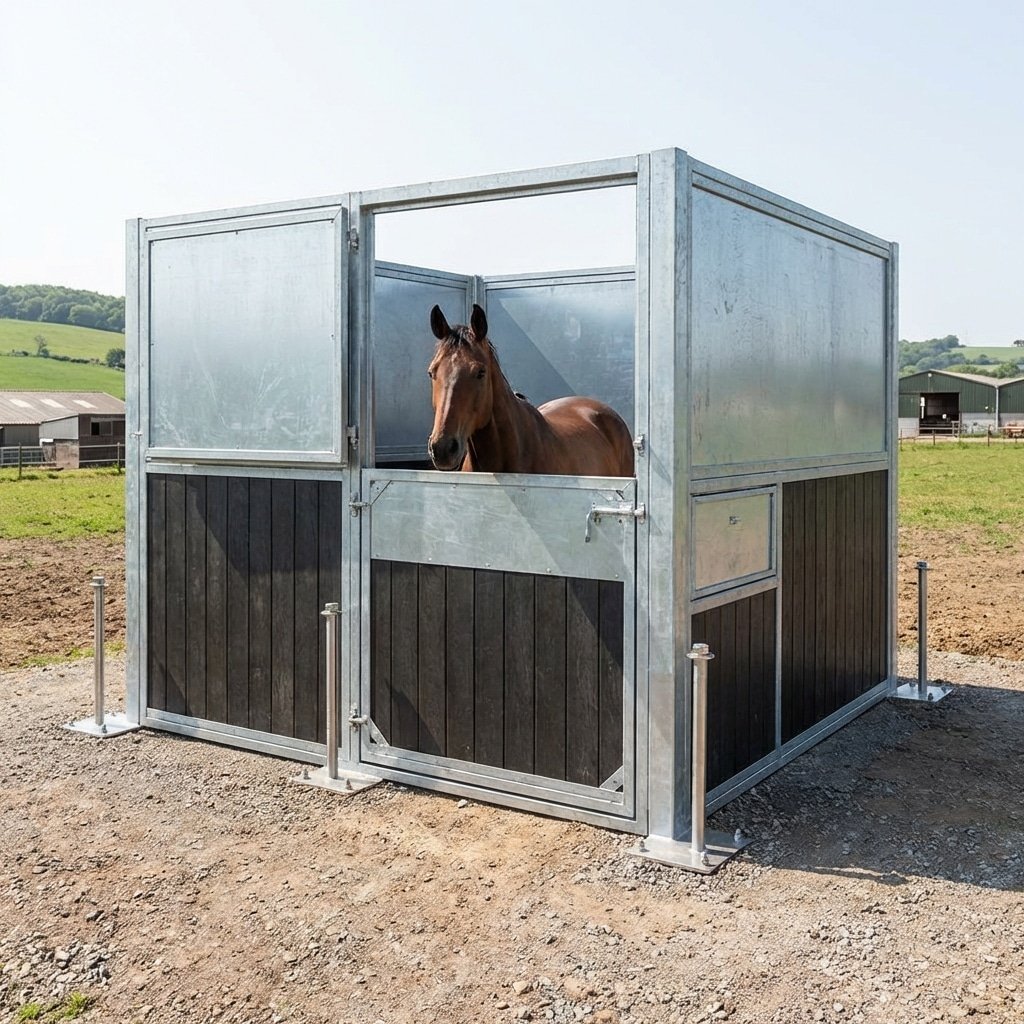
We don’t just follow the standard; we build our reputation on it. Our process is strictly **Hot-Dip Galvanization After Fabrication**. Every single panel, door, and post is fully welded from black steel first, then submerged in the galvanizing bath. This guarantees that every weld seam—the most common point of failure for our competitors—is completely protected.
Our coating thickness measurements consistently meet or exceed the highest tiers of the ISO 1461 standard. We verify these results with non-destructive magnetic coating thickness gauges as part of our quality control.
- Tubing (3–6mm steel): Achieves an average coating of over 70 microns (μm).
- Structural Parts (steel >6mm): Achieves an average coating of over 85 microns (μm).
When you source from us, you’re not just buying a stable panel. You’re buying documented proof of compliance with a global anti-corrosion standard. Always ask to see the test results.
¿Cómo se elige a la pareja adecuada?
Vet a partner’s project history and communication. For B2B, confirm they are a source factory with key certifications like ISO 9001 to ensure commercial reliability.
Verify Their Experience and Communication Standards
Don’t get sidetracked by a portfolio full of generic steel buildings or unrelated fabrication work. You need to see specific, completed horse barn and stable projects. A manufacturer who understands equestrian construction knows the unique demands for animal safety, ventilation, and durability. General fabricators often miss these critical details.
Ask them to walk you through their communication process. How do they handle timelines, suggest material alternatives, and manage delays? Any experienced partner has a clear protocol for when things go wrong. If they can only talk about ideal scenarios, it’s a red flag.
Assess Their Manufacturing Certifications and Business Model
Certifications like ISO 9001 aren’t just paperwork; they prove a factory has a documented and audited quality management system. This ensures consistency from the first unit to the last, which is vital for large projects or distributor stock. It separates professional operations from smaller workshops with variable output.
If you’re a distributor or managing a large-scale project, confirm their business model is strictly B2B. A true OEM/ODM source factory is built to support your commercial needs—think optimized container loading, consistent production schedules, and an understanding of your market. A company that also sells one-off stables to retail customers has a different focus and a different operational structure that may not serve your interests.
Preguntas frecuentes
What is your Minimum Order Quantity (MOQ)?
Our MOQ is flexible to support different business needs. We offer trial orders for as few as 3-5 stable sets. For larger projects, a 20GP container (around 10-15 sets) is a typical starting point, while distributor orders usually fill a 40HQ container (30-45 sets) to maximize freight savings.
Do you offer private label (OEM/ODM) manufacturing?
Yes, our core business is B2B OEM/ODM manufacturing. We work with distributors and large project holders to produce horse stable systems according to their specific designs, technical requirements, and branding.
How can I verify your factory’s certifications like ISO 9001?
You can verify our ISO 9001 certification by checking the unique certificate number, scope, and expiration date. We recommend confirming the status with the issuing certification body, which should be accredited by a recognized national or international authority.
Is it possible to become an exclusive distributor in my region?
We do offer exclusive distributor agreements in select markets. These partnerships are designed to protect your sales territory and build a strong, long-term business relationship. Contact our team to discuss the opportunities in your region.
How do you handle scratches or defects found during installation?
Our quality control process, including hot-dip galvanizing after fabrication, minimizes defects. For any minor scratches that may occur during transport or assembly, each installation kit includes a cold galvanizing touch-up spray to maintain rust protection. For any significant issues, we work directly with our clients to resolve them.
Reflexiones finales
While generic options offer lower upfront costs, the ISO 1461 Hot-Dip After Fabrication standard is the only way to safeguard your reputation against early rust claims. Building with verifiable quality protects your margins and secures long-term client trust.
Don’t guess on quality—verify it. We recommend starting with a small trial order to test our panel fitment and ISO-compliant finish firsthand. Contact our team to discuss your OEM distributor requirements and get a factory-direct quote.

 Spanish
  English
  French
  Arabic
  German
0 comentarios