


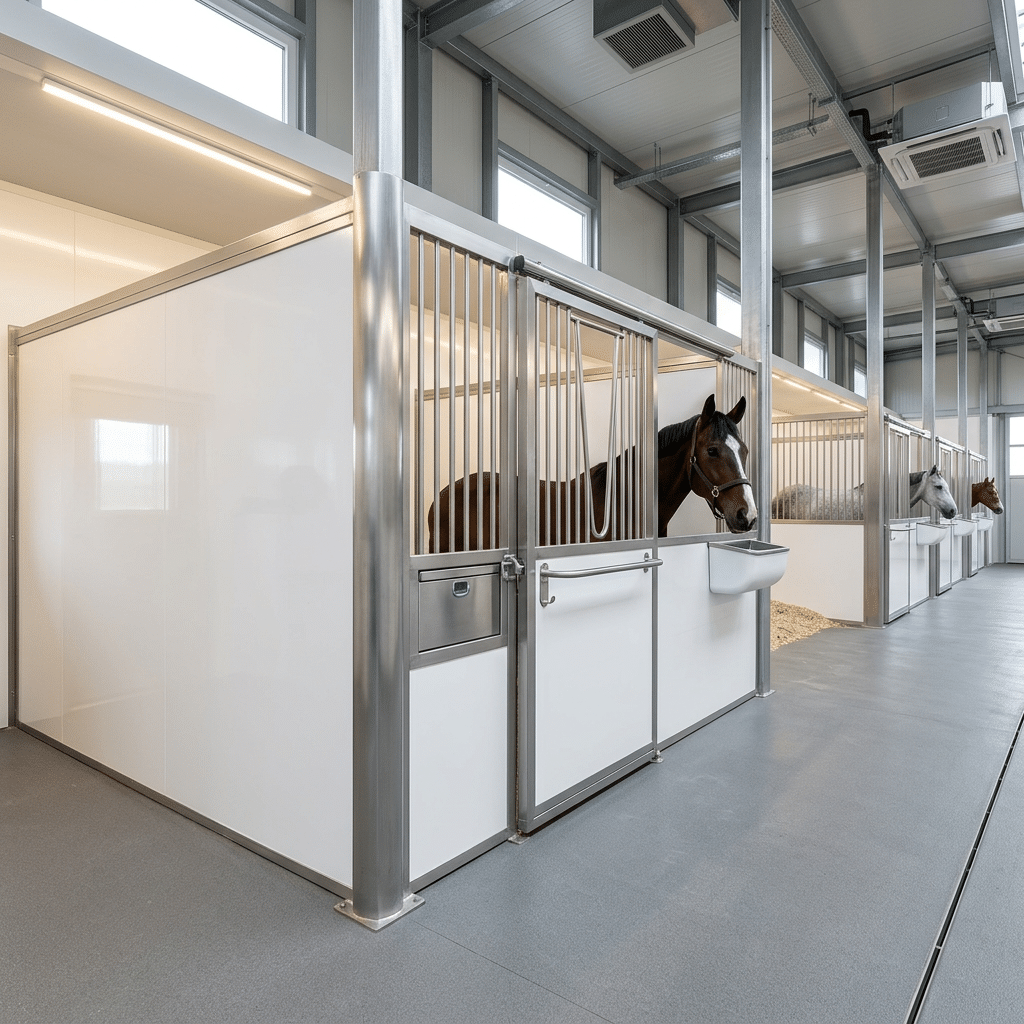
Evaluating horse stable Australia Suppliers requires a direct comparison between local fabrication and importing from a source factory. Choosing a supplier without verified corrosion protection can lead to premature rust and warranty claims, while an inefficient import strategy erodes project margins through high freight costs and reseller markups.
This analysis benchmarks suppliers against the critical durability standards for Australian conditions. We evaluate compliance with ISO 1461 for hot-dip galvanization and the use of UV-stabilized infills, assessing how smart logistics like flat-pack shipping directly protect your profitability.
Establos duraderos y conformes para cualquier clima

The Australian Stable Market Overview
Australia’s equestrian market shows stable growth, driven by a resilient economy. Buyers are selective, prioritizing long-term value and infrastructure built to withstand the country’s harsh coastal and high-UV conditions. This creates strong demand for high-quality, durable stable systems that offer proven corrosion and material protection.
Stable Economic Foundations Driving Equestrian Investment
Australia’s economy is on a resilient path, with forecasts pointing to steady growth around 2%. This stability is supported by solid household consumption and immigration, creating a reliable economic backdrop for the equestrian sector. As a result, facility owners and developers feel confident making long-term investments in upgrading or building new, high-quality stable infrastructure.
A Market of Selective and Quality-Focused Opportunities
The market rewards disciplined purchasing decisions, with a clear focus on long-term value over initial cost. Buyers are seeking infrastructure that can handle Australia’s demanding climate, from coastal salt spray to intense inland sun. This drives demand for stables built to rigorous standards.
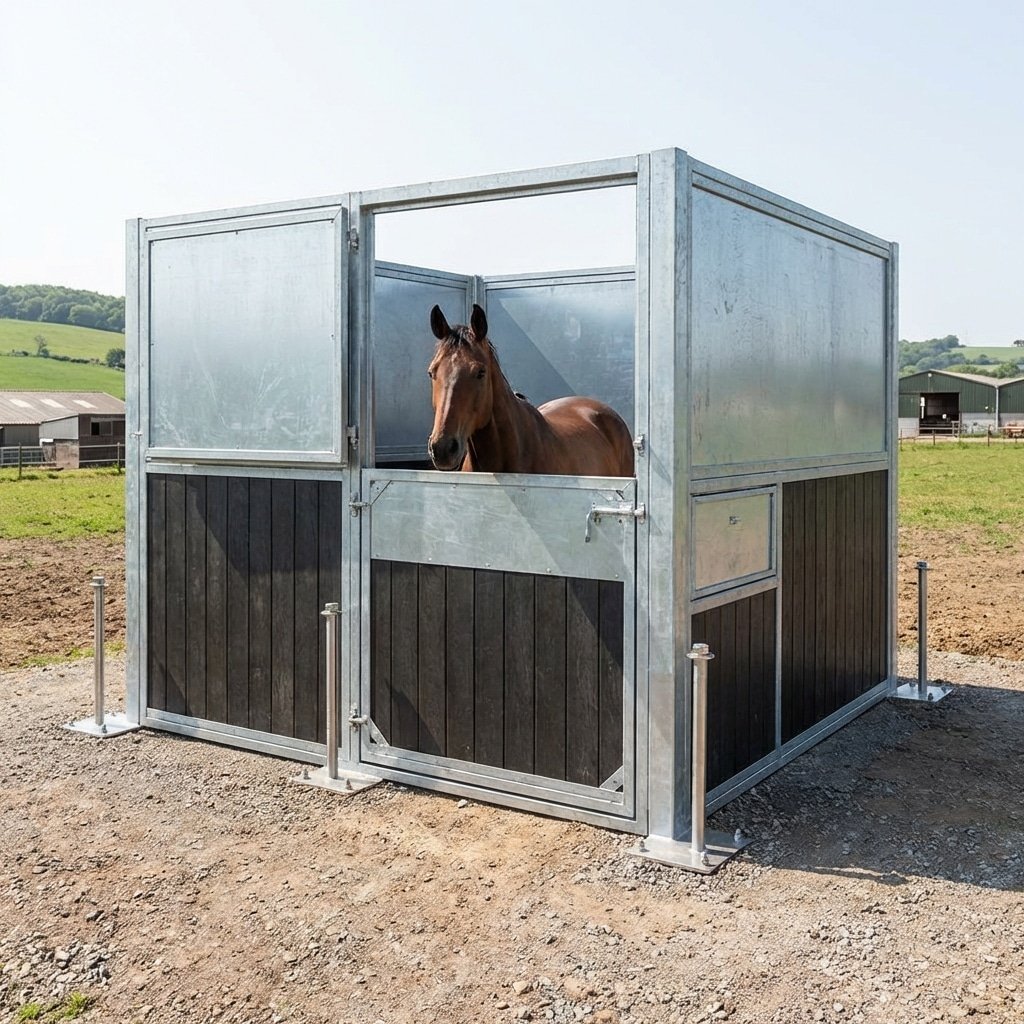
For our partners, this means an opportunity to supply systems engineered for durability. Our commitment to hot-dip galvanizing after fabrication, meeting the ISO 1461 standard with coating thickness over 70 microns, directly counters the corrosion challenges found in Australian coastal areas. Paired with our UV-stabilized HDPE infill that prevents cracking and fading under extreme sun, our stables provide the “zero maintenance” and longevity that discerning Australian buyers demand.
Top Local Brands (Do they manufacture or import?)
In the Australian equestrian market, stable suppliers generally fit into two business models. Local fabricators are smaller, hands-on workshops offering deep customization, while distributors partner with specialized overseas manufacturers to import pre-engineered systems that provide access to advanced materials and logistical efficiencies.
The Local Artisan & Fabricator Model
This model consists of smaller workshops or individual craftspeople who design and build stables from scratch within Australia. Their primary advantage is a high degree of customization, making them an ideal choice for unique architectural projects or specific one-off requirements for private estates.
The main challenges with this approach are often limited production capacity and longer lead times. Costs can also be higher due to local labor and materials. For smaller operations, achieving industrial-grade rust protection, such as hot-dip galvanization that complies with ISO 1461 standards, can be difficult to manage consistently.
The Distributor & Importer Model
Most of Australia’s well-known stable brands operate as distributors. They establish partnerships with large-scale, specialized overseas manufacturers like us to import complete, pre-engineered stable systems. This model provides Australian projects access to advanced production techniques and materials at a competitive price point, including processes like hot-dip galvanization after fabrication and premium infills like our high-density bamboo boards.
Distributors and their clients benefit from systems engineered for safety, efficiency, and longevity, using tested materials like Q235 structural steel. A key advantage for our partners is our smart logistics. By using a flat-pack design shipped on steel pallets, we can fit significantly more stables into a container, which protects profit margins by keeping freight costs manageable.
The “Import Direct” Option: Saving on GST and Margin
For our Australian partners, importing directly from our factory offers two major financial advantages. You can improve project cash flow by deferring the 10% GST payment at the border and significantly boost profit margins by eliminating local reseller markups and slashing per-unit freight costs.
How Direct Importing Lowers Your GST Burden
When you import goods into Australia, a 10% GST is typically due at the border. For large projects, this can tie up a significant amount of capital. By importing directly, eligible businesses can use the Deferred GST Scheme. This program allows you to delay the GST payment until you lodge your next Business Activity Statement (BAS). This frees up your cash flow, letting you put that money to work in your business instead of having it held up in taxes during shipment.
Bypassing Middlemen to Improve Margins
Sourcing your stable systems directly from us as the factory cuts out the additional layer of cost added by local resellers. Every dollar a middleman adds to the price is a dollar taken from your profit margin. By establishing a direct partnership, you gain a clear cost advantage on every stable you install or sell.
We also engineered our packaging for “Profit Protection.” A standard 40HQ container might only fit 12-15 fully welded stable sets. Our steel pallet flat-pack system allows you to load between 30 and 45 sets into the same container. This simple change can cut your per-unit sea freight costs by over 60%, directly protecting your bottom line and making your pricing more competitive in the Australian market.
Compliance Check: Galvanization Standards for Coastal Oz
For Australian distributors, ensuring horse stables can withstand coastal corrosion is critical for product longevity and client satisfaction. Australian standards like AS/NZS 4680 define corrosivity zones, each requiring a specific minimum zinc coating thickness. Our hot-dip galvanization process consistently achieves a coating of over 70-85 microns, engineered to meet and surpass the demands of high salt-spray C4 coastal environments.
Understanding Corrosivity Zones in Coastal Australia
Australian standards, specifically AS/NZS 4680, classify coastal areas based on their corrosivity level, ranging from C3 (Medium) to C5 (Very High). This classification is not just about being near the ocean; it’s about the intensity of salt spray exposure. Stables built directly facing breaking surf face the highest risk and require a far more robust level of protection than those located even a few hundred meters inland. This system helps our distributors and their clients select the right specifications to prevent premature rust and structural failure, protecting their investment.
Meeting the Standard: Minimum Coating Thickness Explained
The key to compliance and long-term durability is the thickness of the protective zinc coating, measured in microns (μm). The standard dictates the minimum thickness needed to provide a reliable service life. We guarantee our “hot-dip after fabrication” process meets the stringent BS EN ISO 1461 standard, achieving an average coating thickness well over 70-85 microns. This heavy-duty coating provides the necessary barrier to withstand the high salt spray and humidity typical of C4 coastal zones, ensuring our stable systems deliver on their promise of safety and longevity.
UV Resistance: Why Australian Sun Destroys Cheap Plastic
Australia’s intense sunlight rapidly degrades cheap, unprotected plastics, causing them to become brittle, crack, and fail. This process, called photodegradation, compromises safety in critical applications like horse stables. Our solution is to use infill materials with UV stabilizers integrated directly into the polymer, ensuring they absorb impact and provide a long, zero-maintenance service life under harsh Australian conditions.
How Intense UV Radiation Breaks Down Plastic Polymers
Australia’s high levels of ultraviolet (UV) radiation trigger a destructive process in plastics known as photodegradation. The sun’s energy attacks and breaks the chemical bonds that hold the plastic polymers together. At first, the damage is cosmetic, appearing as surface discoloration, yellowing, or a chalky texture. But the most critical damage is structural. This chemical breakdown causes a severe loss of integrity, making the material brittle and dangerously prone to cracking. For load-bearing applications like stable walls, this means the plastic can no longer absorb impact, creating a significant safety hazard for both animals and handlers.
UV Stabilization: The Protective Additive for Australian Conditions
To combat photodegradation, quality plastics include UV stabilizer additives. These protective compounds are not a surface coating but are mixed directly into the polymer during manufacturing. They work by absorbing or reflecting harmful UV rays before they can damage the plastic’s chemical structure. For horse stable construction in Australia, using materials like our UV-stabilized HDPE infill is non-negotiable. This built-in protection ensures our stable walls remain flexible and impact-absorbing throughout their lifespan. It prevents the infill from becoming brittle or cracking, which guarantees horse safety and delivers on the promise of a zero-maintenance product that protects our clients’ investment.
Reflexiones finales
The debate isn’t local vs. import—it’s between verified engineering and commercial risk. Non-compliant galvanization and cheap plastics will fail under Australian sun and salt, leading to warranty claims that damage your reputation. Our systems are built to ISO 1461 with UV-stabilized materials to secure your investment.
Verify our quality firsthand. We recommend a trial order to confirm our engineering standards and finish. Contact our team for a distributor catalog and a detailed quote that outlines how our logistics protect your project margins.
Preguntas frecuentes
Who are the best horse stable builders in Australia?
As a global B2B manufacturer, we are the source factory that supplies high-quality stable systems to many top-tier Australian distributors and equine project managers. Our expertise is in engineering safe, durable systems compliant with local standards, like our hot-dip galvanization process which meets ISO 1461. We do not build or retail directly, but we are happy to connect clients with large projects to our qualified partners in Australia.
What is the cost to import horse stables to Australia?
The primary cost driver when importing stables is ocean freight. To protect our partners’ profit margins, we developed a flat-pack shipping system that dramatically cuts this expense. Our system allows 30-45 stable sets to fit into a single 40HQ container, saving distributors over 60% on shipping compared to fully-welded imports. We also classify our products under HS code 7308.90 to ensure standard tariff rates and protect your budget from surprise import duties.
Is the quality of local Australian stables better than imported ones?
Quality is determined by the manufacturing standard, not the location. We engineer our stable systems specifically for demanding Australian conditions. For example, our hot-dip galvanization is done *after fabrication* and conforms to ISO 1461, providing superior rust protection that is essential for coastal areas. We use Q235B structural steel and UV-stabilized HDPE infills to withstand high UV exposure and prevent material degradation, ensuring a long service life.
What are the standard horse stable dimensions in Australia?
The common stable size in Australia is around 3.6m x 3.6m. Our panels are manufactured in standard lengths from 3.0m to 4.0m to accommodate these typical layouts seamlessly. As an OEM factory partner, we also have the capability to produce custom dimensions to meet the specific requirements of any large-scale project for our B2B clients.
Do I need a customs broker to import stables to Australia?
Yes, for B2B imports, we strongly recommend our clients use a professional customs broker. A broker manages all customs clearance, GST, and biosecurity compliance, ensuring the process is smooth and predictable. This allows our distributor and project partners to focus on their business while the logistics are handled by an expert, guaranteeing a seamless delivery from our factory to your site.

 Spanish
  English
  French
  Arabic
  German
0 comentarios