


Commercial Boarding profitability is decided by design choices that either lock you into low-margin volume or unlock premium rates. The wrong structural decisions, from inefficient layouts to high-maintenance materials, directly erode your operational budget and limit the facility’s long-term valuation.
This analysis evaluates the physical hardware that justifies higher fees. We break down the operational impact of key components, from the space saved by sliding doors with hidden track systems to the labor reduction from integrated swivel feeders, providing a data-driven blueprint for designing a profitable equestrian center.
The Profit Equation: More Horses vs. Better Care
Profitability in horse boarding is a choice. A volume model fills stalls at standard rates to lower overhead. A premium model justifies higher fees with superior care, increasing the facility’s value.
Breaking Down the Volume vs. Premium Models
The volume strategy is a numbers game. You aim for maximum occupancy to spread fixed costs like property taxes and insurance across as many horses as possible. This lowers your per-horse overhead, but it also means lower per-horse profit. If your costs are $450 per horse and you charge $600, your gross margin is just 25%. It’s a model built on keeping stalls full, not on maximizing the value of each stall.
A premium care model flips the equation. It focuses on fewer horses but at much higher monthly rates, often between $600 and $1,200. This approach relies on tangible, high-quality amenities to justify the price. Investors notice this. A premium facility with a strong reputation can attract higher valuation multiples, sometimes trading at 2.0 to 4.0 times Seller’s Discretionary Earnings (SDE), a benchmark unattainable for a basic, volume-focused operation.
How Stable Tiers Justify Higher Boarding Fees
Boarders won’t pay premium rates for a facility that looks and feels standard. The hardware you choose sends a clear signal about the level of care you provide. Upgrading your stables is not just an expense; it’s a direct investment in your pricing power.
- The Professional Series provides the features that clients can see and feel. Investing in stables with High-Density Bamboo infill and integrated Swivel Feeders gives you specific, tangible amenities to point to when you set your premium board rates. It shows you prioritize durability, safety, and operational efficiency.
- The Royal Series positions your facility at the absolute top of the market. The dual-protection Powder Coat over Galvanized finish and custom aesthetic details like European arches appeal directly to affluent clientele. This isn’t just a horse stall; it’s a statement that justifies the highest boarding fees in your region.
Space Saving 101: Why Sliding Doors are Mandatory
Sliding doors are mandatory for efficient barn design because they eliminate a door’s swing arc, saving up to 25 square feet of valuable floor space per stall.
Eliminating the Swing Arc in Barn Aisles
Hinged doors are a liability in a commercial barn. Their swing arc consumes valuable floor space, creates dangerous pinch points, and turns a busy aisle into a logistical bottleneck during feeding and turnout. This isn’t just an inconvenience; it’s an operational flaw that costs money and compromises safety. Removing the swing arc gives you back that dead space.
- Recovered Floor Space: By sliding parallel to the wall, the door completely removes the need for a wide clearance zone, instantly making aisles feel wider and more functional.
- Improved Workflow: Handlers can move horses, feed carts, and equipment without a swinging door blocking their path, which is critical for safety and efficiency in high-traffic stables.
- Full Wall Utilization: The wall area next to the doorway becomes usable again. You can now place saddle racks, blanket bars, or other equipment without worrying about door clearance.
The Professional Series Hidden Track System
Beyond just saving space, the engineering of the sliding mechanism itself dictates safety and longevity. An exposed or poorly designed track system creates more problems than it solves. Our Professional Series addresses this directly with a hidden track system designed specifically for high-traffic equestrian centers.
- Concealed Hardware: The entire track mechanism is shielded, protecting both horses and handlers from protruding rollers or sharp edges that can cause injury.
- Quiet Operation: The system ensures a smooth, quiet roll every time. This helps maintain a low-stress environment by eliminating the jarring noise of rattling doors.
- Built for Professionals: This isn’t an optional upgrade. The hidden track system is a standard feature in our Professional Series stables, engineered for the daily demands of busy riding schools and training centers.
Invierte en establos diseñados para durar
Feeding Efficiency: Swivel Feeders and Aisle Carts
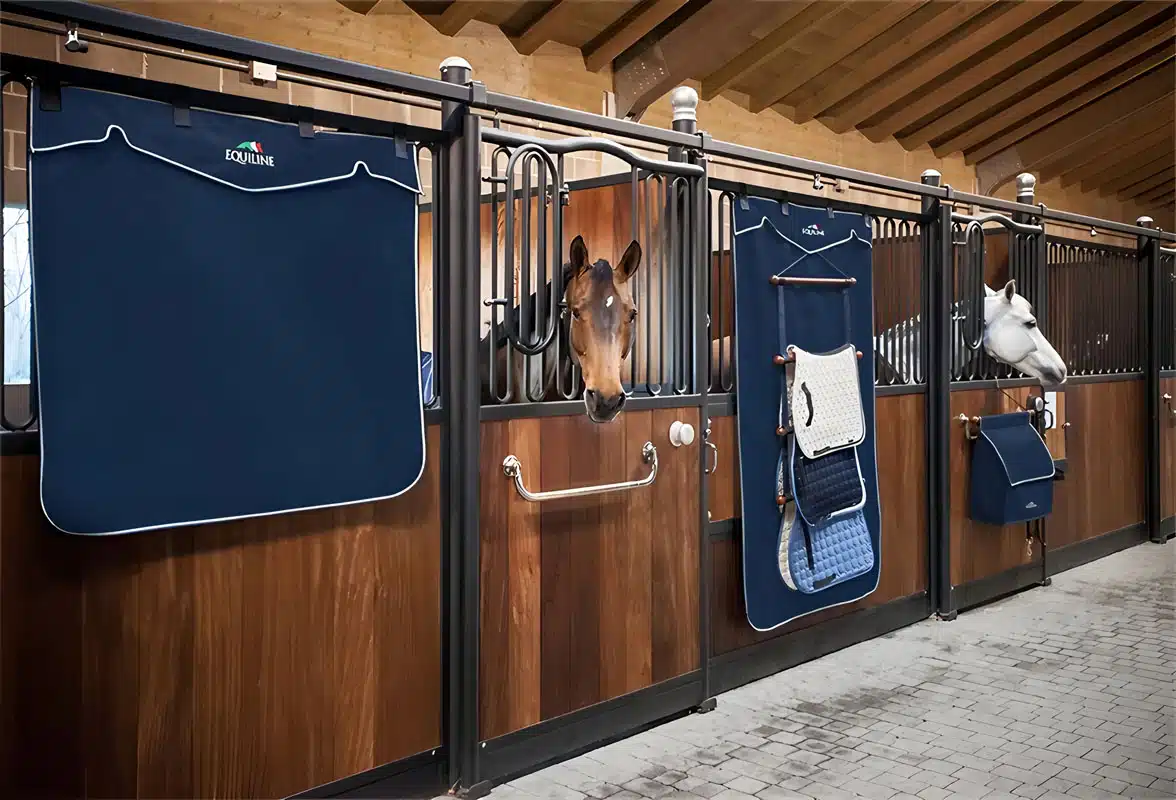
Swivel feeders let staff deliver food from the aisle without entering the stall. This cuts labor time, reduces horse stress, and improves handler safety—a critical feature for professional equestrian centers.
How Swivel Feeders Reduce Labor and Increase Safety
The core function of a swivel feeder is to create a barrier between the handler and the horse during feeding times. By allowing staff to fill food and water bowls from the aisle, it eliminates the need to open the stall door, enter the space, and interact directly with the animal. This simple design change has major operational benefits.
For a commercial facility, the time savings are significant. The process of unlatching a gate, entering a stall, and securing it again takes minutes. A swivel feeder reduces that task to seconds. This efficiency compounds quickly across a large barn, leading to a direct reduction in annual labor costs.
It also creates a much safer environment. Handlers avoid entering the personal space of horses that might be anxious, territorial, or aggressive around feeding time. This minimizes the risk of kicks, bites, or other injuries, while also reducing the stress placed on the horses themselves.
Integrated Feeders in the Professional Series
Swivel feeders are not an afterthought or an accessory; they are a standard, integrated feature of our Professional Series stable systems. We build them directly into the stall fronts during manufacturing. This ensures a perfect, rattle-free fit that can withstand daily use in a busy equestrian center.
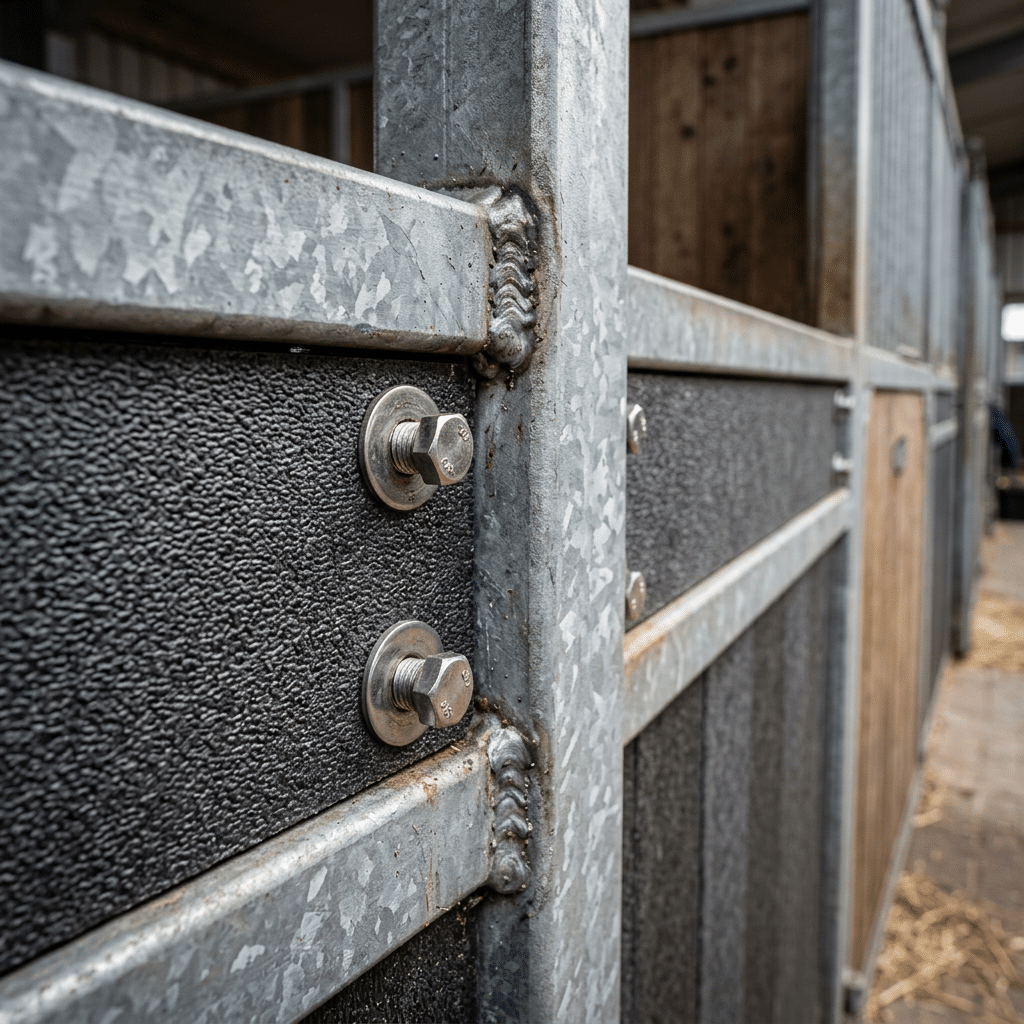
The entire assembly is constructed for longevity. Like our stable frames, the feeder systems are made from structural steel and then hot-dip galvanized after all welding is complete. This process provides a thick, protective zinc coating that prevents rust, even in demanding barn environments with constant moisture and cleaning.
Tack Room Decentralization: Lockers vs. Central Hubs
The choice between a central tack room and individual lockers is a trade-off between the climate control of a hub and the convenience and safety of direct access.
The Operational Choice: Shared Hub vs. Individual Access
Central tack rooms offer one major advantage: superior climate control. In humid regions, this is non-negotiable for preventing mold and mildew growth on expensive leather saddles and bridles. A single, well-ventilated, and dehumidified space protects thousands of dollars in boar
der equipment.
Individual lockers solve a different problem: barn aisle congestion. Placing storage directly where it’s needed frees up critical space around high-traffic areas like wash stalls and cross-ties. Boarders can grab their gear and go without creating a bottleneck, which improves daily workflow and safety for everyone.
The main design constraint for aisle-facing lockers is space. To avoid creating a safety hazard, the barn aisle must be at least 12 feet wide. This ensures that even with a locker door swung open, there is still enough room for a horse and handler to pass by safely.
Integrating Storage into Modular Stable Designs
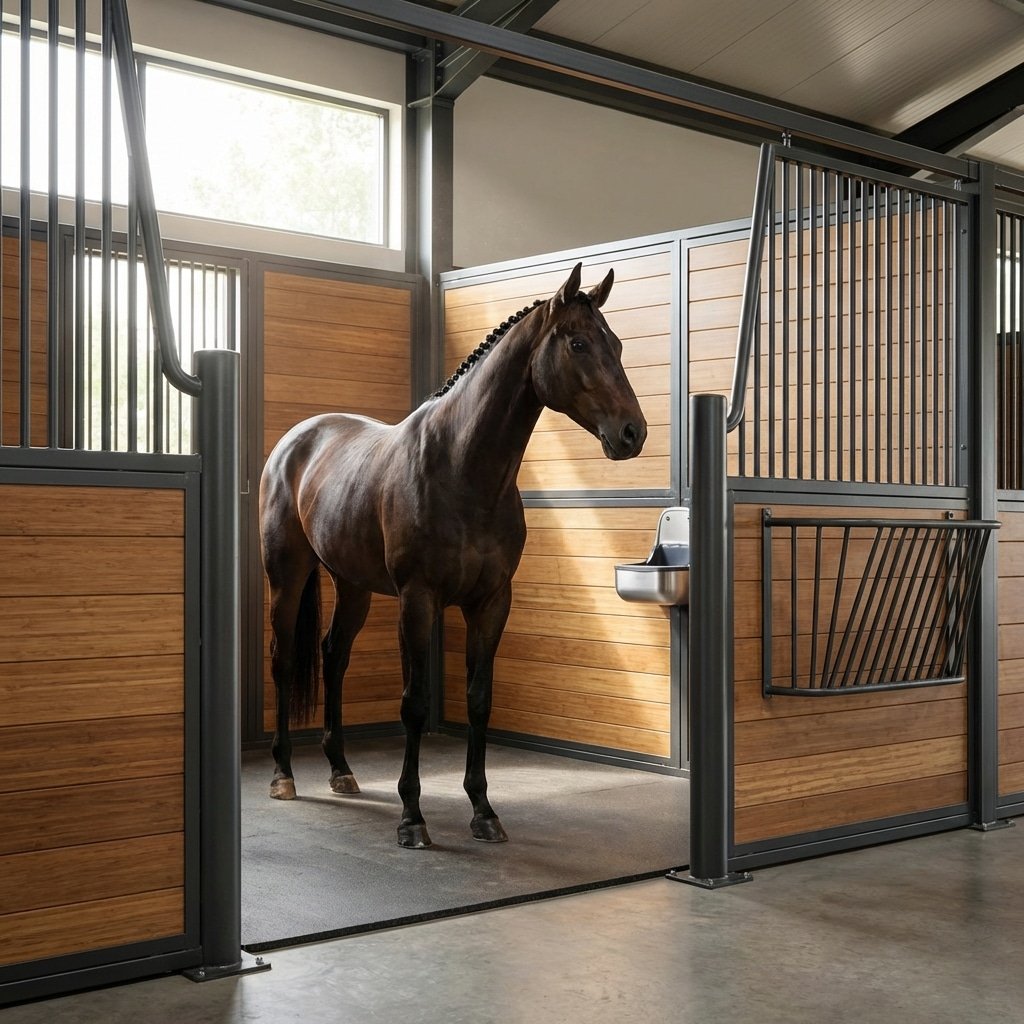
As a B2B OEM/ODM manufacturer, we don’t just supply standard stalls. For large project orders, we can engineer our stable systems from the factory to include fully integrated tack lockers. This ensures a consistent design and structural integrity from day one.
The lockers are built to the same standards as our stables, using the same robust materials. This means they get the same Hot-Dip Galvanized Steel frames and can be specified with our zero-maintenance HDPE infill, ensuring a perfect match in both appearance and durability.
Logistically, this approach is highly efficient. Our flat-pack shipping system allows us to load custom storage components onto the same steel pallets as the stable fronts and partitions. Everything for the project arrives together in a single container, protecting our distributors’ margins by simplifying freight and on-site management.
Phased Expansion: Why Modular Kits Win
Modular kits let you expand incrementally, protecting cash flow and slashing freight costs. This approach makes facility growth predictable and financially manageable for any operator.
| Factor | Phased Modular Expansion (DB Stable Kits)<
/th> | Traditional Lump-Sum Construction |
|---|---|---|
| Initial Capital Outlay | Low. Add stalls only as demand requires, preserving cash for operations. | High. Requires massive upfront investment for the entire projected capacity. |
| Speed to Revenue | Fast. Off-site fabrication and rapid assembly mean new stalls are operational in days. | Slow. Lengthy construction timelines delay revenue generation for months or years. |
| Freight & Logistics | Highly efficient. Flat-pack design saves over 60% on shipping costs. | Costly and complex. Requires sourcing and transporting bulk raw materials on-site. |
| Control de calidad | Consistent. Factory-controlled production ensures every stall meets identical standards. | Variable. Depends heavily on the skill of on-site crews and can vary across the project. |
Scaling Your Facility with Predictable Costs
The biggest hurdle to scaling an equestrian facility isn’t ambition; it’s capital. Traditional construction demands a huge upfront investment for a projected capacity that might take years to fill. Modular kits flip that script. You can start with a smaller, manageable number of stalls and add more only when your waitlist and revenue justify it. This incremental approach protects your cash flow and reduces financial risk.
Speed is another critical factor. Because our kits are fabricated off-site to precise ISO 9001 standards, you bypass months of on-site construction delays. While your site is being prepared, the stalls are already being built. Installation is a simple assembly process, not a construction project. This means your new stalls can start generating revenue almost immediately, turning a capital expense into a productive asset in a fraction of the time.
Every expansion phase also delivers identical quality. With on-site builds, consistency can drift depending on the crew and materials available. Our factory-controlled process ensures that the stalls you add in year five are built to the exact same specifications and tolerances as your day-one installation. This maintains a professional, uniform look across your entire facility and guarantees predictable performance.
The Flat-Pack System: Maximizing Shipping Efficiency
For our B2B distributors and large-scale project managers, logistics costs can make or break a project’s profitability. Fully welded, pre-assembled stable panels are bulky and inefficient to ship, wasting valuable container space. This is a direct hit to your bottom line. Our Steel Pallet Flat-Pack system was engineered specifically to solve this problem and deliver real profit protection.
The numbers are straightforward. A standard 40HQ container can typically fit only 12-15 bulky, pre-welded stable sets. With our flat-pack design, we can load 30 to 45 complete stable sets into that same container. This simple change in logistics saves our partners over 60% on freight costs per unit, providing a massive competitive advantage and protecting margins from shipping volatility.
This efficiency doesn’t compromise completeness. Each kit is a self-contained system. It arrives on a steel pallet with every component needed for immediate assembly—from the galvanized frames and infill planks to the last nut and bolt. All included hardware is 304 Stainless Steel to prevent corrosion and ensure a secure, long-lasting installation right out of the box.
Preguntas frecuentes
What are the standard stall and aisle dimensions for a professional boarding facility?
For professional facilities, stalls should be at least 12×12 feet for average horses, expanding to 14×14 feet for larger breeds. The most critical element for workflow is the aisle width, which should be between 14 and 16 feet to safely accommodate horses, handlers, and equipment without congestion.
Why is Q345B steel recommended for stables in cold climates?
In freezing temperatures, standard steel can become brittle. Q345B steel is a low-alloy, high-strength material with superior low-temperature impact toughness. This ensures the stable framework can withstand powerful kicks without fracturing in winter, providing a crucial safety feature for colder regions in Europe and North America.
What is the difference between your galvanization process and cheaper alternatives?
We use a ‘Hot-Dip Galvanization After Fabrication’ process. This means we build the entire stable panel first from raw steel and then dip the completed structure into molten zinc. This fully coats every weld and crevice according to the strict ISO 1461 standard. Cheaper methods use pre-galvanized tubes and weld them, leaving the critical weld points exposed and prone to immediate rusting.
¿Cómo reduce vuestro sistema de embalaje desmontable los gastos de envío para los distribuidores?
A standard 40HQ container can only fit 12-15 fully-welded stable sets. Our modular, flat-pack design allows us to load between 30 and 45 sets into the same container. This high-density packing can save our distributors over 60% on ocean freight per unit, directly protecting their profit margins.
Reflexiones finales
While generic stalls promise a lower entry price, that cost is quickly offset by maintenance demands and rust complaints. Our ISO 1461 ‘Hot-Dip After Fabrication’ process coats every weld to eliminate this liability and protect your professional reputation. This isn’t an upgrade; it is the commercial standard for building an asset that holds its value.
The specs on paper are clear, but the financial impact is what matters. Request a quote for a trial order to validate the quality, or price a full container to see our flat-pack freight savings on your balance sheet. Our team is ready to configure the system your project demands.

 Spanish
  English
  French
  Arabic
  German
0 comentarios