


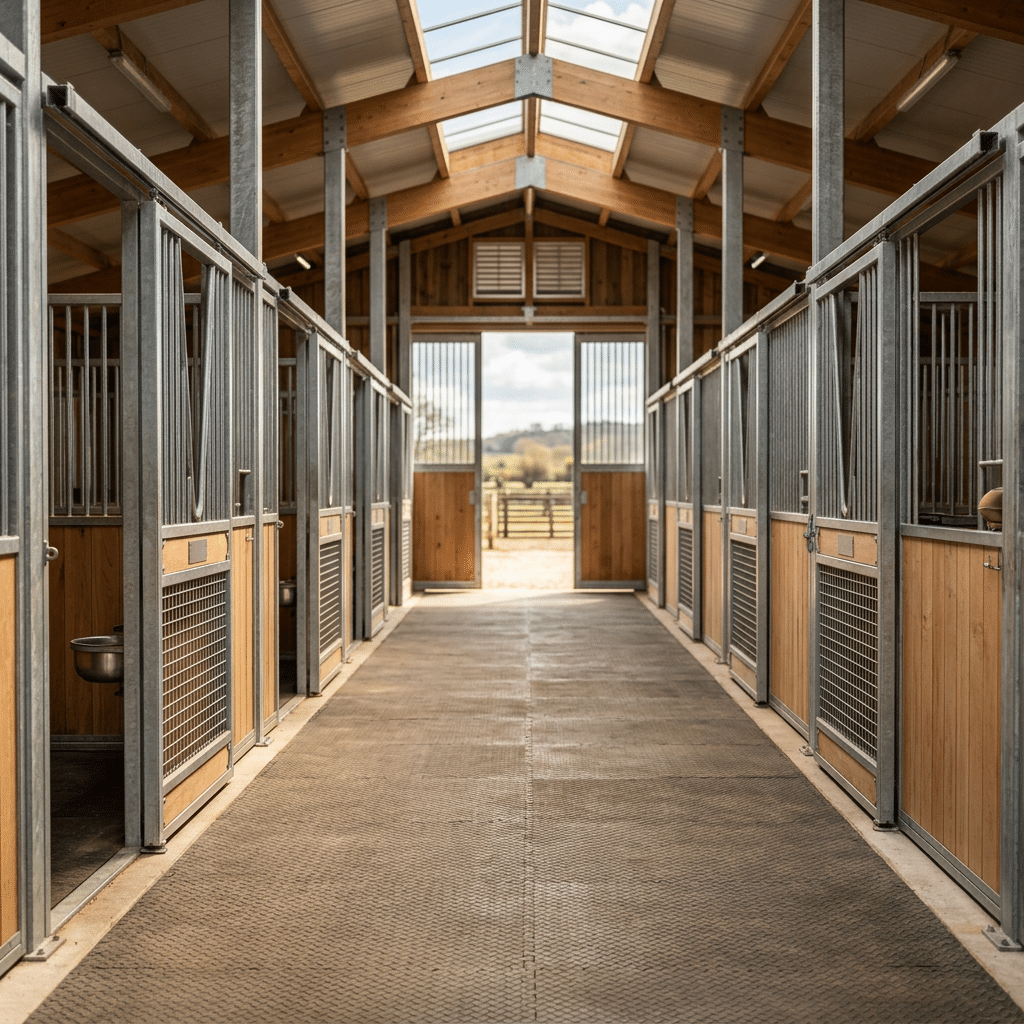
Global Export strategies for horse stalls often collapse under the weight of logistical inefficiency. Importing traditional fully welded frames forces distributors to pay for shipping air, limiting a 40HQ container to just 12 units and decimating potential profit margins.
This report analyzes how a modular flat-pack system triples container capacity to 45 sets while adhering to ISO 1461 Galvanización en caliente standards. We detail the engineering shift from welded cages to Q235B structural steel components that reduce landed freight costs by over 60%.
The High Cost of Domestic Horse Stall Manufacturers
Domestic pricing is driven by Western skilled labor rates and the logistical inefficiency of shipping fully welded frames, which limits cargo density and inflates per-unit freight costs.
Impact of Skilled Labor and Custom Engineering
The premium price tag on domestically manufactured stalls often comes down to the hourly rate on the shop floor. Certified welders in Western markets demand high wages, and this labor cost is baked directly into every weld on the frame. Unlike standardized production lines that rely on automation, domestic fabrication often involves manual processing that drives up the base invoice before the steel even leaves the factory.
- Certified Welding Costs: High hourly wages for skilled tradesmen in North America and Europe significantly increase production overhead compared to import markets.
- Architectural Detailing: Features like European arches or brass finials require expensive CAD engineering and manual finishing, preventing the speed inherent in mass production.
- Lack of Scale: Bespoke, made-to-order projects cannot leverage the economies of scale found in standardized manufacturing, keeping unit costs high.
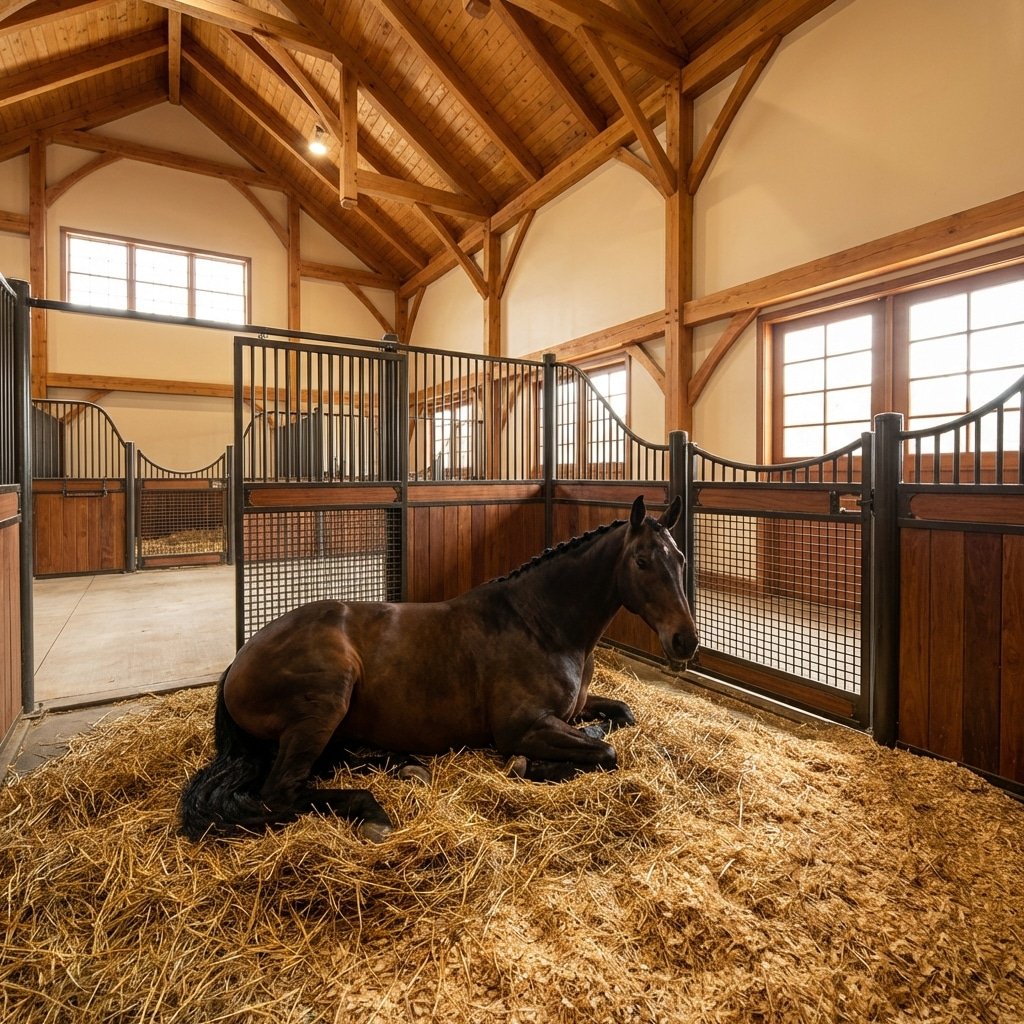
The Logistics Disadvantage of Fully Welded Structures
Logistics is the silent margin killer for traditional stall manufacturers. The industry standard for domestic or rigid import stalls involves shipping fully welded frames. This creates a massive inefficiency: you are paying to ship air. A fully welded frame consumes excessive cargo space relative to its actual material volume, capping the capacity of a truck or container and skyrocketing the landed cost per unit.
- Limited Density: A standard 40HQ container can only hold approximately 12-15 sets of fully welded stalls due to their rigid shape.
- Freight Inflation: Shipping empty space inside welded frames results in exorbitant freight costs that must be passed on to the distributor or end-client.
- The Modular Advantage: Flat-pack systems utilize high-density loading, allowing for 30-45 sets per container, effectively cutting logistics overhead by more than half.
What is a Flat-Pack Horse Stall Kit?
A flat-pack kit is a modular, pre-engineered stable system designed for high-density shipping and rapid bolt-together assembly, eliminating the need for on-site welding or professional fabrication.
Traditional stable construction often requires hiring skilled welders or carpenters to build stalls from raw materials on-site. This approach is slow, labor-intensive, and notoriously difficult to estimate cost-wise. A flat-pack horse stall kit solves these in
efficiencies by treating the stable as a manufactured product rather than a construction project. These kits arrive as a complete package of prefabricated steel frames, pre-cut infill boards, and hardware, ready for immediate assembly using simple hand tools.
The Modular Self-Assembly Design
The core value of the flat-pack system lies in its modularity. We engineer every component to bolt together through pre-drilled connection points. This design removes the need for “hot works” (welding) or complex cutting at the facility. If you can operate a wrench and a drill, you can install these stalls.
For B2B distributors and large facility managers, this modularity protects profit margins through flexibility:
- Expandability: Single stalls easily grow into multi-unit rows. By using shared partition walls, you reduce material costs and installation time for larger projects.
- Reversible Layouts: Panel designs often allow for reversible door placement (left or right opening), letting facility owners adapt layouts even after the product arrives on site.
- Eficiencia logística: Unlike fully welded cages that ship mostly air, our flat-pack design stacks densely. We fit 30-45 sets in a 40HQ container, compared to just 12-15 sets of fully welded units.
Inside the DB Stable Installation System
We do not believe in “partial” kits where the builder must source lumber or screws locally. A true B2B flat-pack solution must be comprehensive to ensure quality control across the entire project. When a DB Stable kit arrives, it contains the specific components outlined in our Product Bible:
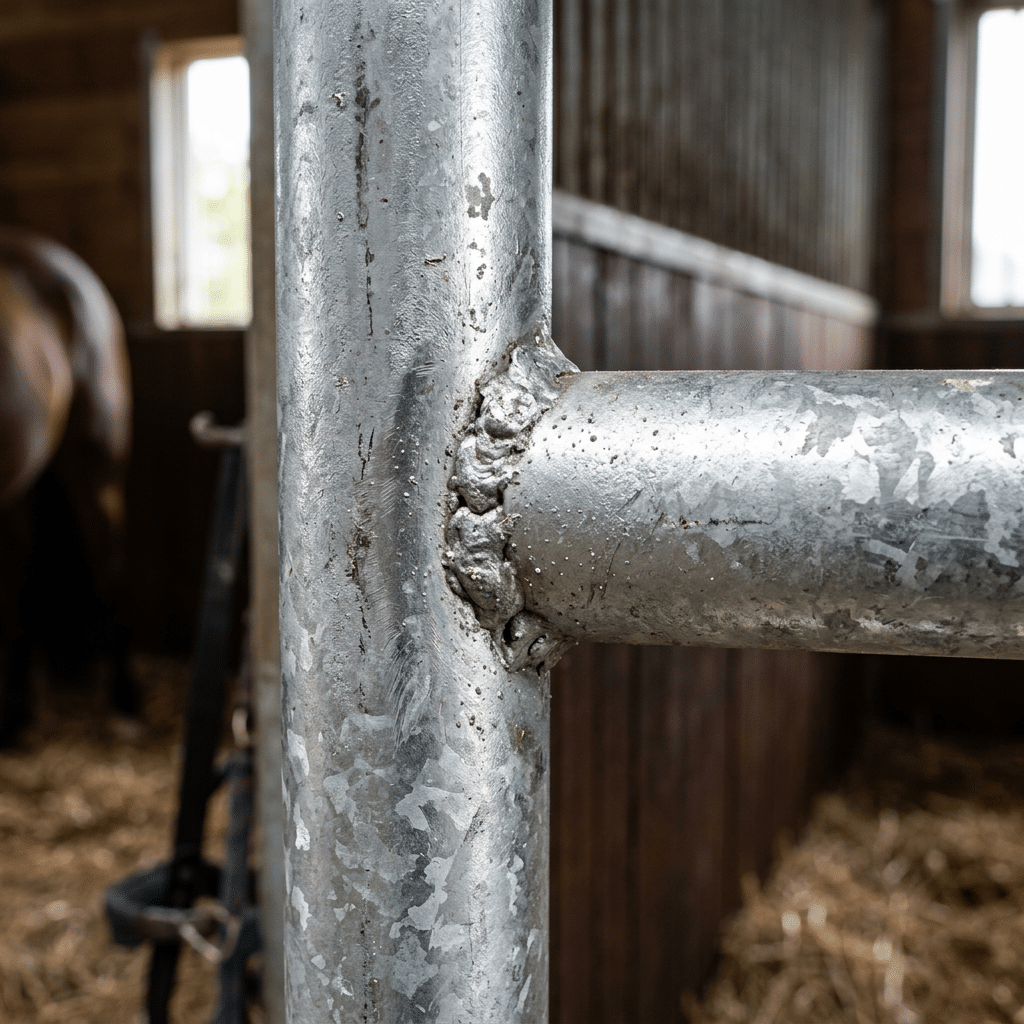
- Prefabricated Steel Frames: We use 14-gauge (2.0mm+) structural steel, hot-dip galvanized después de fabrication to ISO 1461 standards. This ensures every weld point is sealed against rust before it ever reaches the customer.
- Pre-Cut Infill Boards: Whether you select high-density Bamboo or zero-maintenance HDPE, we cut every plank to the exact length required. These slide directly into the frame’s U-channels, requiring no sawing on site.
- 304 Stainless Steel Hardware: We provide all necessary connectors, anchor bolts, and screws in 304-grade stainless steel to prevent the common issue of fasteners rusting out before the stall does.
- Finishing Kit: Every shipment includes cold galvanizing spray. Installation often results in minor scratches; this allows the installer to seal those marks immediately, maintaining the integrity of the rust protection.
Durable, Compliance-Ready Stables Direct From Factory

Container Logistics: Fitting 40 Stall Panels in a 40HQ
Fitting 40 stall panels into a 40HQ requires a flat-pack system on steel pallets, tripling capacity from 12 to 45 sets while maximizing the 28.5-tonne payload limit.
| Logistics Parameter | Traditional Fully Welded | DB Flat-Pack System |
|---|---|---|
| Loading Quantity (40HQ) | 12 - 15 series | 30 - 45 series |
| Volume Utilization | Low (Shipping “Air”) | High (Dense Stacking) |
| Unloading Safety | Risk of shifting/toppling | Forklift-ready Steel Pallets |
| Freight Cost Per Unit | Exorbitant | Reduced by ~60% |
Calculating Volume and Payload Constraints
Shipping heavy steel infrastructure requires a precise balance between weight and volume. A standard 40-foot High Cube (40HQ) container offers a theoretical volume of roughly 76m³, but for steel products, the payload limit is the hard ceiling. You must work within a maximum payload of approximately 28.5 tonnes (28,500 kg). Exceeding this triggers heavy overweight surcharges or rejection at the port.
The primary inefficiency in our industry is “shipping air.” Horse stalls are large, framed structures. If you ship them fully assembled, the volume fills up long before you hit the weight limit, destroying your profit margins on freight. You also face strict geometric constraints: the container door opening is 2.34m wide. Any panel wider than this must be loaded at an angle or disassembled, complicating the loading plan significantly.
- Internal Dimensions: 12.03m length x 2.35m width x 2.70m height.
- Weight Limit: Strict cap at ~28.5 tonnes payload.
- Door Constraint: 2.34m width limits the entry of pre-welded wide panels.
- Density Goal: Packing heavy steel components tightly to hit the weight limit simultaneously with the volume limit.

The Steel Pallet Flat-Pack Configuration
To solve the volume problem, we utilize the DB Flat-Pack System. Traditional fully welded stalls limit a 40HQ container to just 12-15 sets because the empty space inside each stall frame is wasted. By shifting to a modular, flat-pack design, we stack panels horizontally. This method triples the loading quantity to approximately 30-45 sets per container, depending on the specific model and weight.
Safety during unloading is just as critical as capacity. Loose-loading heavy steel panels is a liability; they can shift during transit and topple when doors open. We strictly use compact steel pallets for all shipments. This ensures the cargo is secure and allows distributors to unload the entire container quickly using standard forklifts, rather than risking manual labor on heavy, unstable steel.
- Capacity Shift: Increases load from 12-15 sets (welded) to 30-45 sets (flat-pack).
- Vertical Stacking: Panels are laid flat on steel pallets to utilize the full 2.70m height.
- Mechanized Unloading: Palletized units accommodate forklifts, eliminating manual handling risks.
- Protección de beneficios: drastically lowers the freight cost allocation per stall unit.
The Steel Pallet Advantage for Safe Unloading
Steel pallets provide a rigid, non-combustible platform capable of supporting 450kg stable sets without collapsing, eliminating the splintering and instability risks inherent to timber logistics.
Structural Superiority Over Wooden Skids
Shipping heavy steel components on timber pallets is an operational gamble. Wooden skids frequently buckle under the localized point loads of stacked stable fronts, leading to leaning stacks inside the container that endanger unloading crews. We replaced timber with steel because a transport base must be as durable as the product it carries.
- Load Deformation Resistance: Steel pallets maintain rigidity under heavy vertical compression, preventing the “stack collapse” often seen with wood that absorbs moisture or rots during transit.
- Zero Fire Load: Unlike dry timber, which presents a significant fire hazard in port storage, steel pallets are non-combustible and lower the overall risk profile of the shipment.
- Predictable Handling: The uniform dimensions of steel pallets provide a stable engagement point for forklifts, unlike broken wooden runners that can cause loads to shift unpredictably during lifting.
The DB Flat-Pack Protocol: Eliminating Loose Loading Risks
The “Loose Loading” method—stuffing components individually into a container to maximize volume—is a liability we strictly prohibit. It saves pennies on freight but costs hours in manual labor and risks worker injury from falling parts. We utilize the DB Flat-Pack System to consolidate components into secure, unified blocks.
- Unified Heavy Sets: We strap fronts, partitions, and hardware into single 250kg-450kg units. This prevents cargo from shifting and turning into a projectile during rough ocean transit.
- Protection of Galvanization: By securing components firmly within a steel frame, we prevent the abrasive rubbing that strips zinc coatings on loose-loaded parts, ensuring the product arrives without red rust.
- Mechanized Unloading: Crews can empty a 40HQ container in under an hour using standard forklifts, rather than spending a full day manually hauling loose gates and bars.
- Safety First: The flat-pack system ensures that when container doors open, the load is exactly where it was placed at the factory, protecting your team from the dangerous “avalanche” effect of shifted cargo.
How B2B Dealerships Profit from Factory-Direct Stalls
Switching to a flat-pack stocking model cuts landed costs by over 60%, allowing dealers to capture higher margins while focusing capital on local service and installation.
B2B dealerships increase profitability by shifting from high-overhead manufacturing to a service-focused distribution model. By leveraging factory-direct flat-pack systems, dealers can fit 30-45 sets in a single 40HQ container, reducing landed costs by over 60% compared to fully welded alternatives. This allows for competitive local pricing while maintaining healthy margins and reducing capital tied up in slow-moving inventory.
The Strategic Shift to Low-Inventory Dealerships
The traditional dealership model often traps capital in raw materials and manufacturing overhead. Smart dealerships are transitioning from heavy inventory ownership to agile distribution models. This shift reduces financial risk by eliminating the need for expensive on-site fabrication machinery and the skilled labor required to operate it.
By outsourcing the heavy lifting to a dedicated OEM like DB Stable, you free up resources to focus on “Service Excellence.” Your value proposition shifts from simply selling steel to providing complete solutions.
- Risk Reduction: Moving to immediate-turnover models prevents capital from sitting stagnant in raw steel stock.
- Overhead Elimination: You cut the costs of welding gases, consumables, and facility maintenance.
- Local Value: Dealerships leverage proximity for installation and warranty work, creating a service layer that remote factories cannot replicate.
Maximizing ROI with DB Stable’s 40HQ Flat-Pack System
Freight costs often kill margins in the heavy equipment sector. If you ship fully welded fronts, you are essentially paying to ship air. Our specific flat-pack engineering solves this via the “Distributor’s Edge” capacity protocol.
We load 30-45 series per 40HQ container. Compare this to the industry standard of 12-15 welded sets, and the math becomes clear. This density significantly lowers the freight cost per unit, ensuring “Profit Protection” for the dealer even when ocean freight rates fluctuate.
- Eficiencia logística: High-density loading reduces landed cost per stable by over 60%.
- Steel Pallet Design: We use steel pallets exclusively to ensure safe unloading and efficient vertical storage.
- Damage Control: Proper flat-packing minimizes the transit damage common with loose-loaded welded frames.
Preguntas frecuentes
What is the logistical advantage of the Flat-Pack system?
Freight often kills net margins in this industry. Traditional fully welded stalls are mostly air, limiting a 40HQ container to a mere 12-15 sets. Our Flat-Pack modular design solves this by densifying the load, fitting 30-45 sets per container.
This efficiency slashes per-unit shipping expenses by over 60%. For distributors, this means you are paying for steel, not empty space.
How are the stalls packaged for safe unloading?
We use a Steel Pallet Flat-Pack method. Loose-loaded shipments are a liability; they require dangerous, time-consuming manual handling to unload. We strap components onto stackable steel pallets that lock securely into the container.
A standard 2.5-ton forklift can unload the entire 40HQ container safely in a fraction of the time, reducing labor costs and injury risk at your warehouse.
What rust protection process is applied to the steel?
We strictly use Hot-Dip Galvanization After Fabrication, conforming to BS EN ISO 1461. Many competitors use pre-galvanized tubing, which leaves weld points exposed to rust immediately.
We weld the black steel frame first, then dip the entire unit into molten zinc. This achieves a coating exceeding 85 microns on structural parts, providing long-term protection against the high-ammonia environment of a stable.
Which HS Code is recommended for customs clearance?
We advise using HS Code 7308.90 (Structures of Iron/Steel). Importers frequently face issues when using “Prefabricated Buildings” classifications, which can trigger complex regulations and higher tariffs in markets like the USA and Europe.
Classifying the product as steel structures simplifies the customs process and avoids unnecessary regulatory red tape.
Are the stalls suitable for cold climates with heavy impact risks?
Yes. Standard steel can become brittle in freezing temperatures. For cold regions, we upgrade to Q345B Low Alloy High Strength Steel (equivalent to ASTM Grade 50).
This material possesses superior low-temperature impact toughness compared to standard Q235B. If a horse kicks the stall during a deep freeze, the frame absorbs the energy without fracturing.
Reflexiones finales
Sourcing domestic stalls forces you to pay for high-wage labor and ship empty air, effectively destroying your net margins. By switching to the DB Flat-Pack system, you secure a 60% freight reduction without sacrificing the structural integrity of hot-dip galvanization after fabrication. This logistical efficiency is the only path to maintaining competitive local pricing while ensuring your inventory survives harsh stable environments.
Do not let logistics inefficiencies dictate your profitability; verify the savings directly with a landed cost calculation. We recommend initiating a specific project quote or a trial 20GP order to test our steel pallet loading and assembly speed firsthand. Contact our engineering team today to configure a high-density container load tailored to your distribution targets.

 Spanish
  English
  French
  Arabic
  German
0 comentarios