


Calculating Hardware Replacement ROI reveals that cheap zinc-plated bolts frequently seize in high-ammonia barn environments. This failure turns initial material savings into significant long-term costs from maintenance labor and operational downtime.
This cost analysis benchmarks standard zinc plating against the 304 Stainless Steel hardware standard included with every DB Stable system. We compare material lifespan and total cost of ownership to demonstrate how superior components prevent seized fasteners and protect long-term value.
The Corrosive Reality of Barn Dust and Moisture
Barn humidity mixes with ammonia from horse waste, creating a corrosive atmosphere. This acidic moisture attacks steel, rapidly degrading hardware and creating serious safety risks.
How Ammonia and Humidity Create a Corrosive Atmosphere
A horse barn is a uniquely hostile environment for steel. The air isn’t just damp; it’s chemically aggressive. Ammonia gas, a natural byproduct of urine and manure, is constantly being released. This gas dissolves easily into the airborne moisture, forming an alkaline solution called ammonium hydroxide.
This solution directly attacks the protective coatings on metal hardware and then the base steel itself. The constant presence of dust, bedding, and other organic debris makes things worse. This material acts like a sponge, trapping the corrosive moisture against steel surfaces. This prolonged contact dramatically accelerates the rusting process, compromising the structural integrity of everything from stall fronts to gate latches.
The Critical Role of Hot-Dip Galvanization After Fabrication
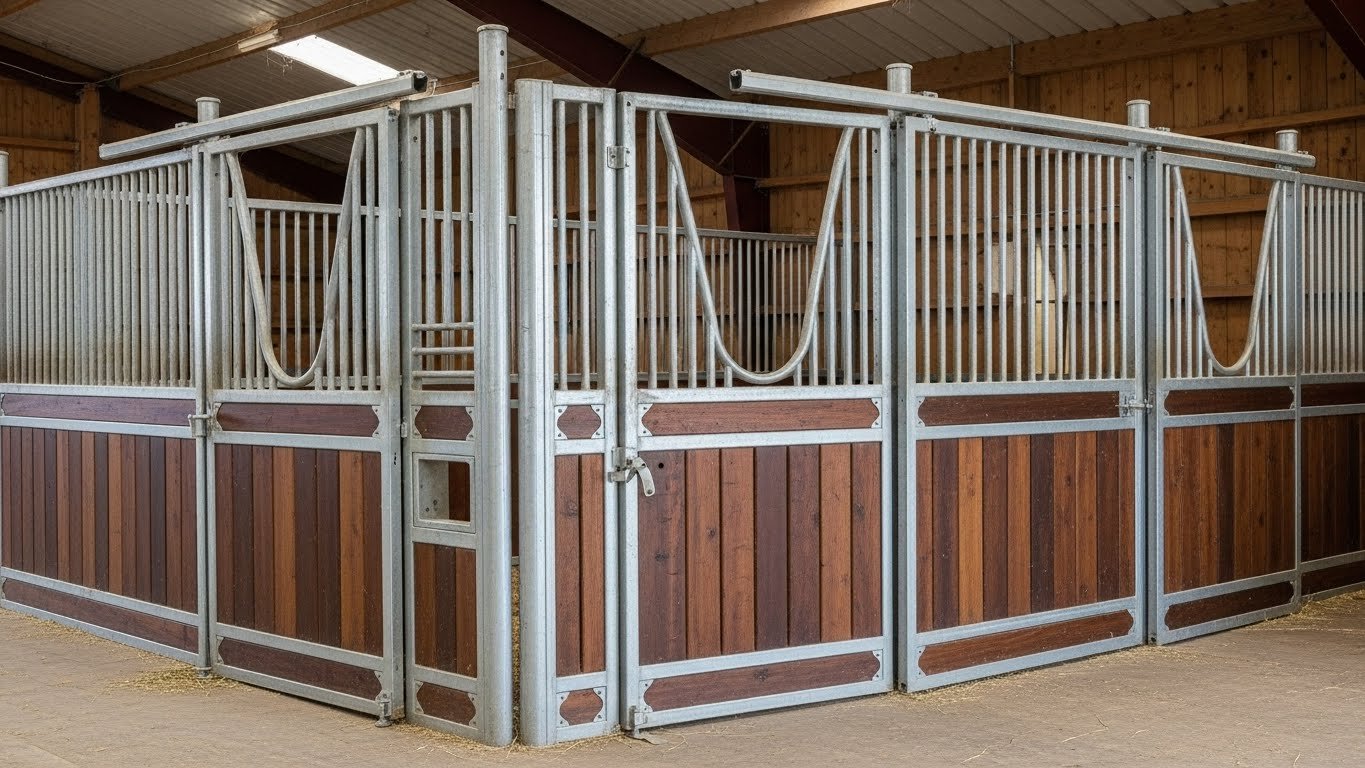
Protecting steel in this environment requires a specific industrial process: hot-dip galvanization *after* fabrication. Many low-cost stable systems are built from pre-galvanized tubing that is then cut and welded. This approach leaves the most vulnerable areas—the welds and cut edges—completely exposed to corrosion.
At DB Stable, we build all components from raw steel first. Then, the entire finished piece is submerged in molten zinc. This process ensures every surface, edge, and weld is completely sealed under a thick, durable coating. The result is a metallurgically bonded zinc layer that exceeds 70 microns, compliant with the global ISO 1461 standard for galvanization. This method eliminates the exposed welds that serve as the primary failure point for cheaper alternatives in a high-ammonia barn environment.
Year 2: When Zinc-Plating Fails (The White Rust)
White rust is zinc hydroxide, a chalky corrosion that forms when moisture gets trapped on new galvanized steel without airflow. It eats the zinc layer, especially on bundled hardware.
Many stable manufacturers rely on zinc-plated hardware, assuming it provides long-term rust protection. But this common coating often fails prematurely, leading to seized bolts and costly maintenance issues. The problem isn’t the familiar red rust; it’s a more insidious corrosion called white rust.
How White Rust Forms on Zinc-Coated Hardware
White rust isn’t iron oxide. It’s zinc hydroxide, a chalky white powder that appears on new galvanized surfaces. It forms when moisture gets trapped on the zinc coating in an environment with poor airflow. This prevents the zinc from forming its stable, protective patina (zinc carbonate) that normally develops when exposed to air.
This failure is especially common when hardware is bundled tightly for shipping or stored in humid conditions. The tight packing creates pockets where condensation forms but can’t evaporate. The trapped moisture reacts directly with the zinc, consuming the protective layer long before it ever sees service.
The Weak Point: Why Fasteners Need More Than a Coating
While hot-dip galvanizing works well for large, open structural parts, the threads and contact points of bolts, nuts, and connectors are highly susceptible to this type of corrosion. Once the zinc coating is compromised on a fastener, it can seize, making routine maintenance or future disassembly nearly impossible without a drill or cutting torch.
This is a critical failure point in any pre-fabricated structure. To prevent it, all of DB Stable’s hardware kits—including the anchor bolts, connectors, and screws—are made from 304 Stainless Steel. This material has inherent corrosion resistance built into its chemistry, so it doesn’t rely on a fragile coating that can fail in storage or during installation.
Global Horse Stables with 20-Year Durability.
The Labor Cost of Drilling Out Seized Bolts
Removing a seized bolt is rarely simple. Labor costs escalate with specialized tools and complications, making the initial hardware choice critical for avoiding future expenses and downtime.
The Hidden Variables of Bolt Removal
The time and money spent getting a seized bolt out is completely unpredictable. A simple job might just need some penetrating oil and heat. But a difficult one can quickly turn into hours of drilling. Costs multiply if an extractor tool snaps off inside the bolt, a common problem that often ends with a trip to a machine shop. The bolt’s location and the material it’s stuck in also dictate the approach. Extracting a fastener from a tight corner in a steel frame requires different tools and a lot more time than one with easy access.
Preventing Seizure with 304 Stainless Steel Hardware
The best way to deal with seized hardware is to make sure it never happens. Every DB Stable installation kit comes with anchor bolts, connectors, and screws made from 304 Stainless Steel. This material’s natural corrosion resistance stops rust before it starts, even in the damp, high-ammonia air common in barns. By including 304 Stainless Steel as our standard, we design out the future labor costs and headaches of drilling, cutting, or welding inferior, corroded fasteners.
The “Buy It For Life” Math of 304 Stainless
304 stainless has a higher initial cost but a superior ROI over 50+ years. It eliminates recurring hardware replacement and maintenance, significantly lowering total cost of ownership.
Calculating Total Cost vs. Upfront Price
The upfront price tag for hardware is misleading. The real number is the total cost of ownership over decades. A fastener or bracket made from 304 stainless steel can easily last 50 years or more in typical barn conditions, where moisture and corrosive gases are a consta
nt.
This durability completely removes the budget item for buying replacement hardware every 15-20 years. The true financial calculation isn’t just the cost of a new bag of bolts. It’s the original material cost plus the future labor, specialized tools, and operational downtime needed to drill out seized, rusted-out hardware and install the replacements.
The Standard 304 Stainless Steel Hardware Kit
This is why every DB Stable system includes a full hardware kit made from 304 stainless steel. All anchor bolts, connectors, and screws meet this standard. It’s not an optional upgrade; it’s fundamental to the system’s design.
This decision ensures that fasteners will not seize from rust, allowing for simple maintenance or even relocation of stable panels years later. By providing this as a standard feature, we guarantee the long-term structural integrity and safety of the installation from day one, protecting the value of the entire investment.
Why DB Includes 304 Stainless as Standard, Not an Upgrade
DB includes a full 304 stainless hardware kit as standard. This prevents seized bolts and future replacement costs in corrosive barns, lowering the total cost of ownership.
Calculating True Cost: Initial Price vs. Lifetime Value
Focusing only on the initial price of hardware is a common but costly mistake. Standard zinc-plated bolts have a low upfront cost, but they fail quickly when exposed to the high humidity and corrosive ammonia common
in barn environments. The hardware rusts, seizes, and eventually compromises the structure.
The true cost of that “cheaper” hardware must include future expenses. This means factoring in the cost of replacement parts, the hours of labor spent drilling out seized bolts, and the operational downtime. 304 stainless steel’s resistance to corrosion makes it the most economically sound choice over the operational life of the stable. It’s a one-time investment that prevents years of repair bills.
| Feature | Standard Zinc-Plated Bolts | 304 Stainless Steel (DB Standard) |
|---|---|---|
| Corrosion Resistance | Acts as a sacrificial barrier. The zinc coating corrodes (“white rust”) and wears away, exposing the steel underneath. | Forms a self-healing passive chromium oxide layer. Offers exceptionally high resistance to rust and seizing, even if scratched. |
| Typical Lifespan | Short-term. Requires replacement cycles every few years in a typical barn environment as the coating fails. | Long-term. A “buy it for life” solution designed to last for the entire operational life of the stable (50+ years). |
| Failure Mode | Seizes in place, forcing difficult removal with drills or cutting tools. Can also snap under load once weakened by rust. | Maintains structural integrity and remains removable for maintenance or relocation. Does not seize from corrosion. |
| Total Cost of Ownership | Low initial cost but high long-term costs due to repeated parts purchases, labor for removal, and facility downtime. | Higher initial material cost but near-zero lifetime costs for replacement hardware or specialized labor. |
The DB Standard: A Complete 304 Stainless Steel Hardware Kit
Based on this operational reality, we made a strategic decision. Every DB Stable system ships with a full hardware kit where every component is 304 stainless steel. This includes all necessary anchor bolts, connectors, and screws. It’s not an optional upgrade because we see it as a fundamental part of the stable’s structural integrity. This standard eliminates a common and frustrating failure point, saving our clients from future headaches and hidden repair costs.
Frequently Asked Questions
Will zinc-plated bolts eventually rust in a stable?
Yes, they will. Zinc plating is rust-resistant, not rust-proof. The zinc acts as a sacrificial coating that corrodes first to protect the steel underneath, but it will eventually wear away, especially in a damp barn environment. Hot-dip galvanizing provides a much thicker, more durable layer that lasts significantly longer than standard, cheaper electro-plating.
What’s the real difference between 304 stainless and zinc-plated hardware?
The key difference is how they prevent rust. 304 stainless steel has chromium mixed into the steel itself, creating a surface that is naturally and permanently rust-proof. Zinc-plated hardware is just plain steel with a thin protective coating. Once that coating is scratched or wears off, the steel underneath will begin to rust. Stainless steel is a lifetime solution, while zinc-plating is a temporary one.
How much does it really cost to replace rusted stable hardware?
The cost varies widely. Replacing a few individual rusted bolts might be minor, but replacing an entire seized sliding door track system can be expensive, with professional kits ranging from $130 to over $1,500, not including the labor required to cut out the old hardware. The true cost includes not just parts but also the downtime and effort involved.
What’s the best way to remove a bolt that’s rusted solid?
Start with a good penetrating oil, applying it and letting it soak for several hours. If that doesn’t work, applying heat directly to the bolt with a torch and then letting it cool can help break the rust’s grip. For really stubborn bolts, an impact wrench provides the force needed to break it free. If the head is stripped, a bolt extractor is the specialized tool for the job.
What is the best hardware material for a damp, corrosive barn environment?
For corrosive environments with high moisture and ammonia, like a horse stable, 304 stainless steel is the superior choice. It offers the best long-term protection against rust and seizure. The second-best option is steel that has been hot-dip galvanized after fabrication, which provides a very thick and resilient zinc coating.
Final Thoughts
While zinc-plated hardware lowers the initial invoice, our standard 304 Stainless Steel kit is designed to prevent maintenance claims. This isn’t an optional upgrade; it’s a core feature that eliminates the long-term cost and liability of seized bolts. Delivering a system engineered to last protects your reputation and secures repeat business.
The best way to verify this standard is to see it firsthand. We recommend a small trial order to evaluate our hardware quality and ISO 1461 galvanizing before committing to a full container. Contact our team to configure a shipment and discuss OEM options for your market.

 English
  Spanish
  French
  Arabic
  German
0 Comments