


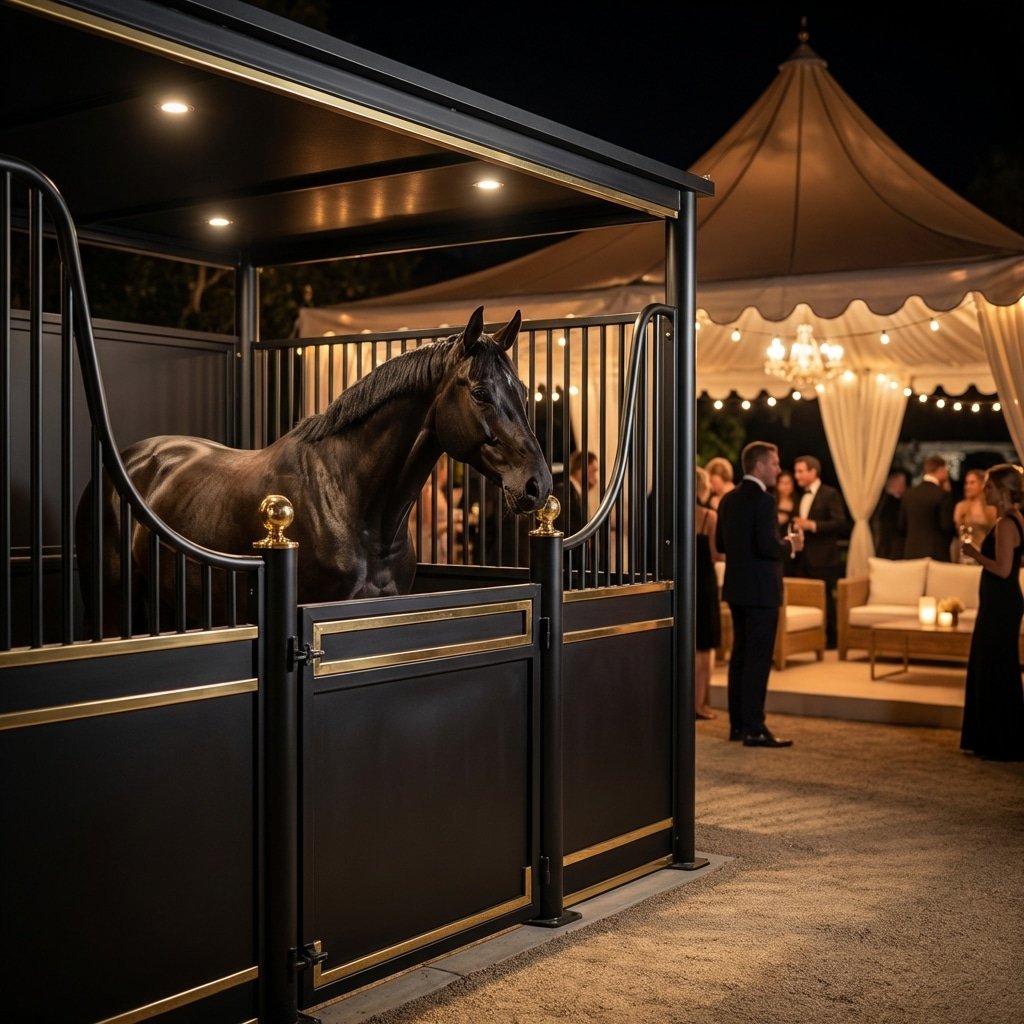
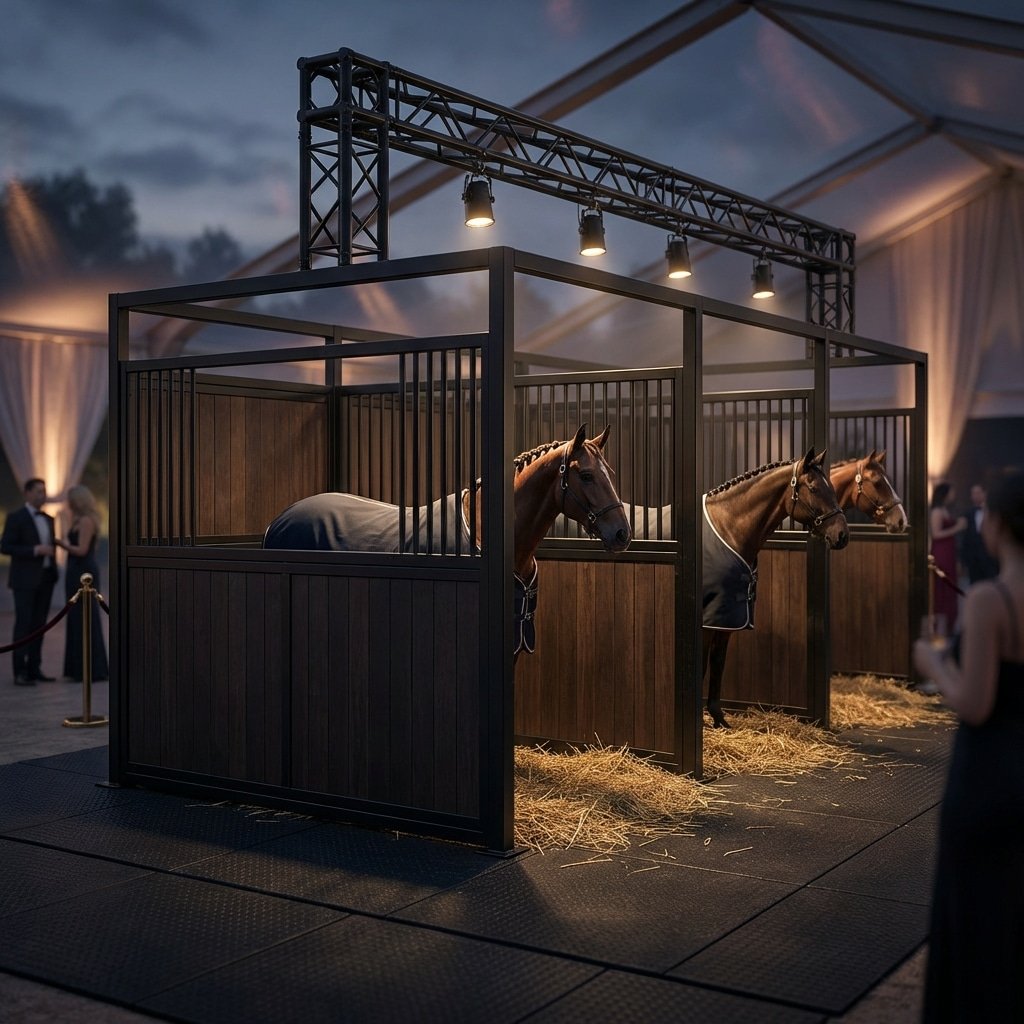
Custom Branding transforms temporary stabling from a logistical necessity into a high-value sponsorship asset. For elite organizers, deploying generic galvanized stalls in VIP zones risks diluting the visual impact of premium partners. A rusted or mismatched stable front immediately degrades the event prestige, potentially jeopardizing future sponsorship revenue and the broadcast aesthetic required for global television coverage.
We analyze the Royal Series specification which combines specific RAL color matching with a dual-layer protection system. By applying architectural powder coating over BS EN ISO 1461 hot-dip galvanized steel, we ensure the finish survives repeated transport without chipping or corrosion. This approach allows organizers to maintain a flawless brand presentation across multiple tour stops while optimizing logistics through high-density flat-pack shipping.
The Rise of ESG (Environmental, Social, Governance) in Construction
By 2026, ESG is a strategic mandate, not a trend. Reducing the sector’s 34% share of global CO2 emissions requires shifting to ISO 1461 galvanized steel and high-density logistics
.
Decarbonization Mandates and the Circular Economy
The construction industry generates approximately 34% of global CO2 emissions. This massive footprint has triggered a regulatory shift from voluntary “green” guidelines to strict compliance requirements for project approvals and financing. In 2026, you cannot bid on major institutional or government projects without a clear decarbonization strategy.
The market now prioritizes the circular economy. This model rejects the “take-make-waste” linear approach in favor of materials that manufacturers can recycle or repurpose at the end of their lifecycle. Project managers also face intense scrutiny regarding Scope 3 emissions. You are now accountable for the carbon footprint of your entire supply chain, including the fuel burned to transport materials to the site.
Reducing Lifecycle Carbon with ISO 1461 Durability and Flat-Pack Logistics
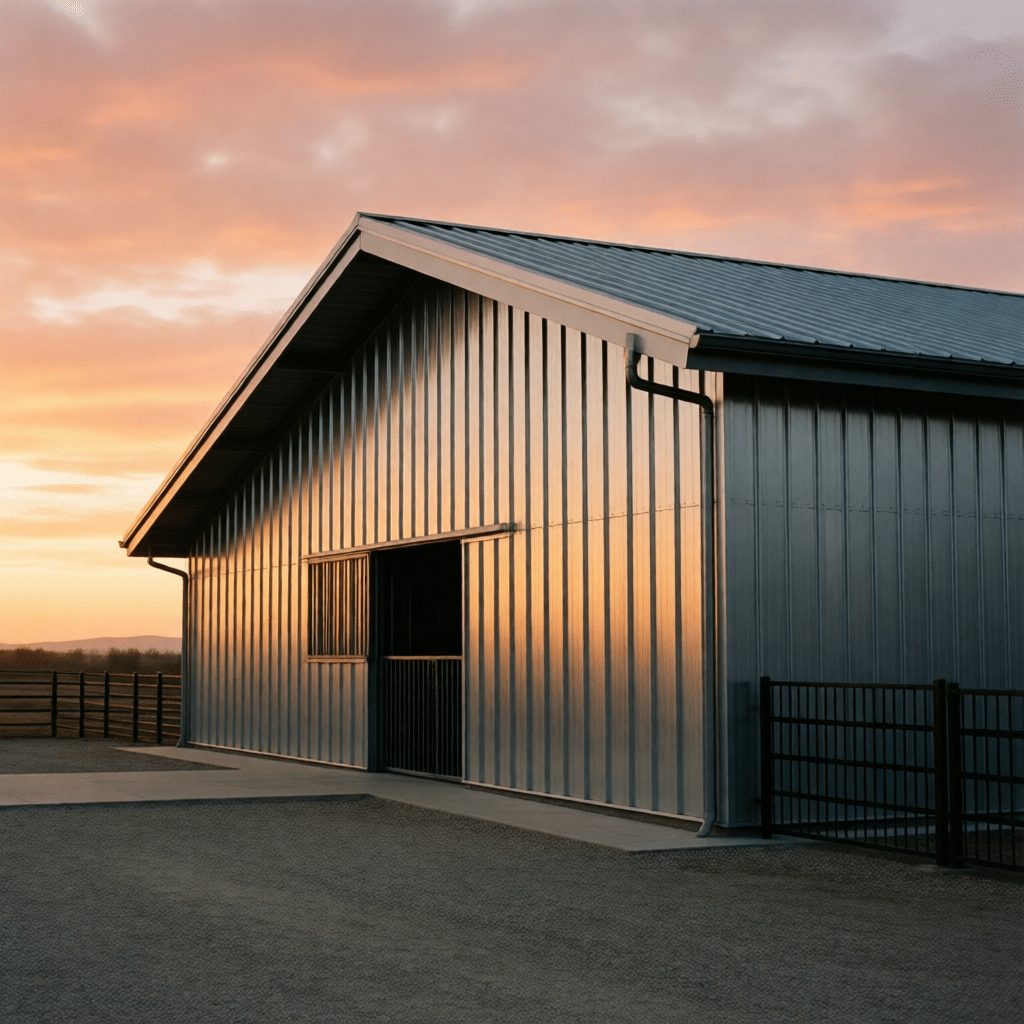
Real ESG progress happens at the specification level. A stable that rusts and requires replacement in three years is an environmental failure, regardless of how “green” the initial materials seemed. We align DB Stable specifications with ESG goals by focusing on durability and logistics efficiency.
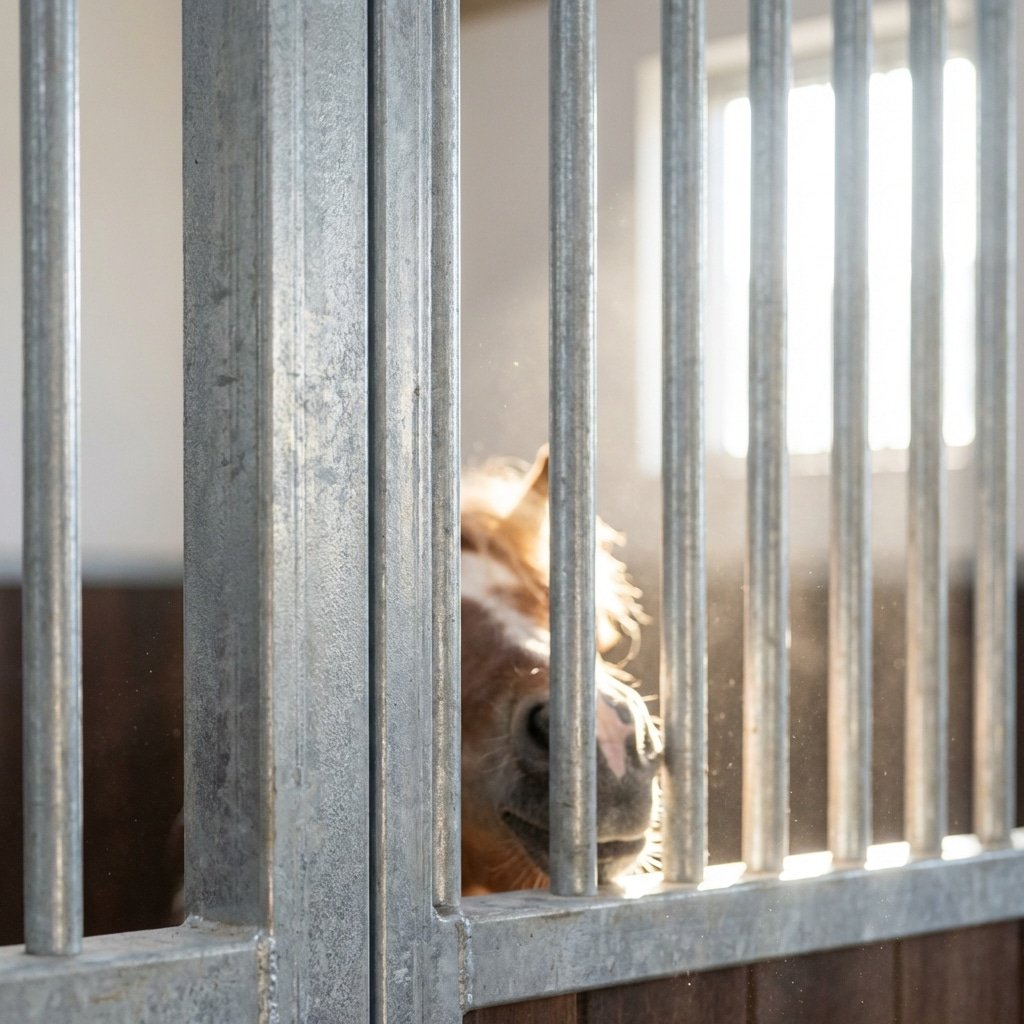
- Extended Lifecycle (BS EN ISO 1461): We utilize Hot-Dip Galvanization After Fabrication. This bonds zinc to steel at 450°C, creating a coating thickness exceeding 85 microns on structural parts. This ensures a rust-free lifespan of over 10 years, drastically reducing the carbon cost associated with manufacturing and shipping replacement stables.
- Material Sustainability (High-Density Bamboo): Our bamboo infill achieves a Janka Hardness rating greater than 3000 lbf. It offers the durability of tropical hardwoods but matures in 3-5 years rather than 50. This provides a rapidly renewable resource that resists horse kicks and rot without depleting old-growth forests.
- Logistics Efficiency (Scope 3 Reduction): Shipping “air” is a major source of avoidable emissions. Traditional welded stables fill a container with only 12-15 sets. Our DB Flat-Pack System loads 30-45 sets per 40HQ container. This efficiency cuts freight-related carbon emissions by over 60% per unit delivered.
Moving Away from Old-Growth Timber (Oak/Pine)
Modern stables are abandoning slow-growth timber for High-Density Strand Woven Bamboo and HDPE, eliminating rot and cribbing while tripling impact resistance compared to traditional hardwoods.
The Environmental and Practical Limitations of Harvested Timber
For decades, Oak and Pine were the default choices for stable infills. But in a high-traffic equestrian facility, these natural materials fail faster than they can be regrown. The industry is facing a dual crisis: the unsustainability of harvesting 100-year-old hardwoods and the maintenance nightmare of managing organic material in a wet, ammonia-rich environment.
We advise distributors and facility managers to move away from natural timber for three specific reasons:
- Cribbing and Splintering: Softwoods like Pine are vulnerable to horses “cribbing” (chewing). This creates sharp splinters that cause oral injuries and compromises the structural integrity of the partition.
- Bio-Hazard Absorption: Natural timber is porous. It absorbs urine and ammonia, creating a permanent hygiene risk. Over time, this leads to deep-set rot that power washing cannot fix.
- Supply Chain Instability: Relying on old-growth forests is no longer commercially viable. Regeneration rates for Oak are too slow to meet global construction demand without driving prices up and inviting regulatory scrutiny.
High-Density Strand Woven Bamboo: The Engineered Successor
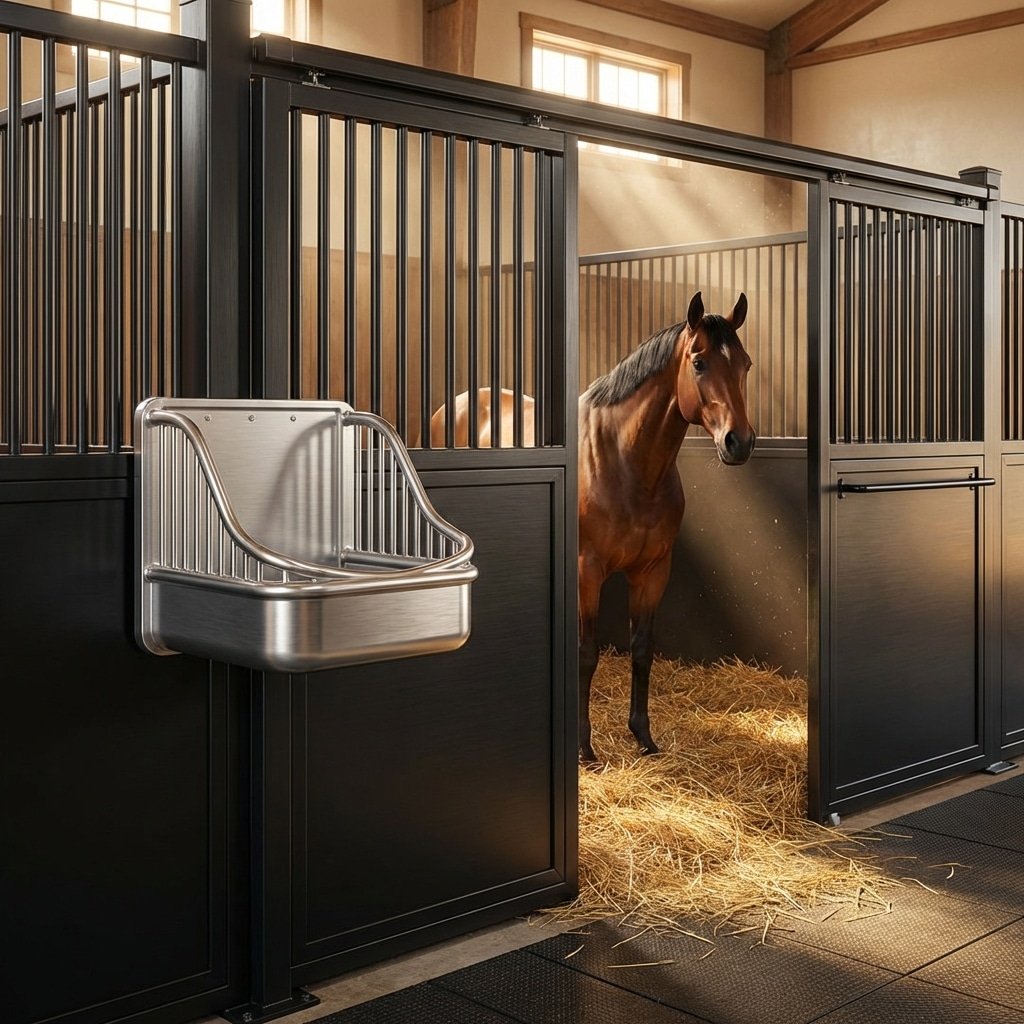
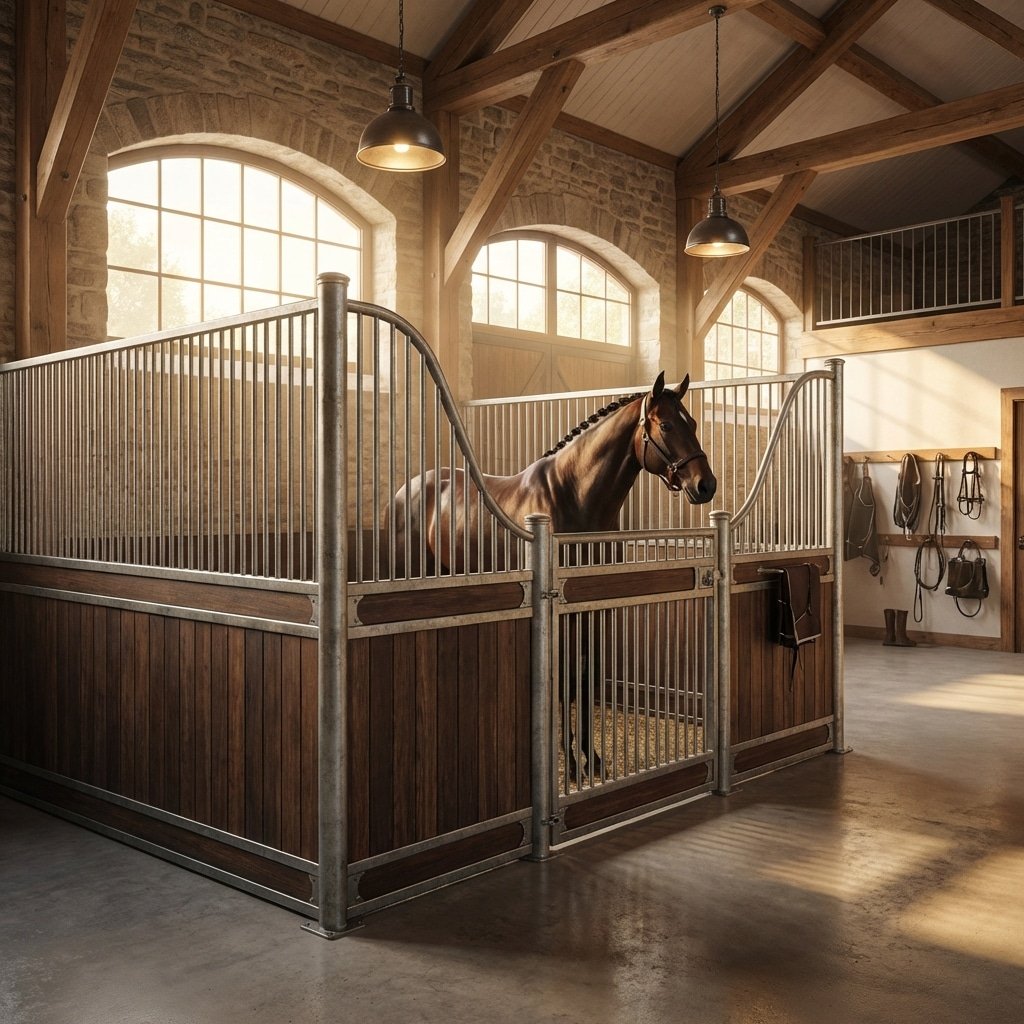
To solve the durability issues of softwood without losing the aesthetic warmth of wood, we standardized our Professional Series on High-Density Strand Woven Bamboo. This is not the hollow decorative bamboo used in garden furniture. It is an engineered material where bamboo fibers are compressed under extreme pressure (2,500+ tons) with eco-friendly resins.
The result is a board that behaves more like steel than wood:
- Impact Spec: We require a Janka Hardness rating of > 3000 lbf. This makes our bamboo approximately three times harder than Red Oak, rendering it effectively “kick-proof.”
- Board Thickness: We utilize 28mm, 32mm, and 38mm profiles depending on the specific stable model, ensuring no flex under impact.
- Resistance Profile: Unlike pine, strand woven bamboo is naturally resistant to mold, rot, and insect damage without requiring toxic chemical treatments that could harm the animal.
Durable Custom Stables Built for Extreme Climates

Top Factories Embracing Sustainable Materials
Global leaders like Siemens and Lego prove that sustainability is an operational asset, not a cost. They prioritize digital tracking and closed-loop systems to maximize material efficiency.
Manufacturing is shifting from a linear “take-make-waste” model to a circular economy. The factories listed below are not just purchasing carbon credits; they are fundamentally re-engineering their production lines. For B2B buyers and industry observers, these facilities represent the current gold standard in operational efficiency and environmental responsibility.
| Factory / Brand | Location | Core Achievement |
|---|---|---|
| Siemens Electronics Works | Reduced waste by 48% using Digital Twins. | |
| Lego Group | Vietnam | US$1bn investment in carbon-neutral infrastructure. |
| IKEA | Zbąszynek, Poland | 100% renewable electricity adoption across the hub. |
| Schneider Electric | Barcelona, Spain | Zero CO₂ status via integrated microgrids. |
| Tesla Gigafactory | Shanghai, China | 97% waste recycling rate in battery production. |
1. Siemens Electronics Works (SEWC) – China
Siemens has designated its Chengdu facility as a “Sustainability Lighthouse.” Rather than simply upgrading hardware, they deployed advanced software solutions including AI and digital twins to model production in real-time. This allows for precise resource allocation, ensuring raw materials are used only when necessary.
- Output Increase: 92% growth in production volume.
- Resource Reduction: Energy consumption per unit dropped by 24%.
- Waste Management: Production waste slashed by 48% since 2019.
2. Lego Factory – Vietnam
Lego is constructing its first carbon-neutral run factory, representing a US$1 billion investment in sustainable infrastructure. This facility moves beyond standard grid dependence by generating its own power on-site, a critical move for manufacturing resilience and emissions control.
- Power Source: 12,400 rooftop solar panels.
- Energy Storage: Utilizes Vietnam’s first large-scale battery storage solution.
- Target: Full clean energy transition by early 2026.
3. IKEA – Poland
The Zbąszynek facility serves as the central hub for IKEA’s aggressive sustainability strategy. The company is tackling the most difficult aspect of manufacturing: energy sourcing. By switching factories and suppliers to renewable electricity, they address Scope 2 and Scope 3 emissions directly.
- Scale: 408 factories and suppliers converted to 100% renewable electricity by 2023.
- Goal: Halve total greenhouse gas emissions by 2030.
- Strategy: Direct investment in wind and solar farms to support production loads.
4. Schneider Electric – Global Hubs
Schneider Electric operates “Advanced Lighthouse” factories in the US, China, and Spain. Their approach focuses on electrification and digitization. The Barcelona facility is particularly notable for achieving Zero CO₂ status not through offsets, but through integrated microgrid technology that manages solar inputs and battery storage autonomously.
5. Tesla Gigafactory – China
Tesla’s Shanghai facility demonstrates that high-volume manufacturing does not require high-volume waste. The factory utilizes circular economy principles, specifically in the recovery of aluminum and battery materials, to minimize landfill contributions.
- Process: Advanced steam condensate recovery systems.
- Efficiency: Optimized die-casting reduces scrap metal generation.
- Result: Zero manufacturing waste to landfill status.
Strand-Woven Bamboo: A High-Yield Carbon Sink
Strand-woven bamboo acts as a massive carbon sink, sequestering 50–60kg of CO2 during rapid growth. DB Stable seals this carbon into high-density panels exceeding 3000 lbf Janka hardness.
Carbon Sequestration and Rapid Renewability
Traditional timber management is slow. Hardwoods like oak or maple require decades to reach maturity, creating a long deficit between harvest and regeneration. Bamboo culms reach full maturity in just 4-6 years. This aggressive growth cycle allows for frequent harvesting without depleting the resource base, as the root system (rhizome) remains intact to sprout new shoots immediately.
During this short lifespan, a single culm absorbs approximately 50-60kg of CO2. When we process this into strand-woven boards, we lock that carbon into the building structure rather than releasing it through decomposition or burning. The manufacturing process itself is highly efficient; unlike traditional milling that discards significant outer wood, strand-woven technology shreds the fiber and utilizes the vast majority of the biomass, maximizing the yield from every harvested acre.
High-Density Material Specs: Janka Hardness > 3000 lbf
Environmental benefits mean nothing if the product fails in the field. For stable construction, density is the primary metric for longevity. DB Stable utilizes 28mm-38mm high-density strand woven bamboo, engineered to achieve a Janka Hardness rating exceeding 3000 lbf. This makes the material approximately three times harder than oak, providing a critical defense against the kick forces generated by stabled horses.
- Impact Resistance: The compressed fiber structure prevents the splintering common in softwoods like pine.
- Rot & Mold Defense: High density leaves no room for moisture ingress, solving the hygiene issues of porous timber.
- Carbon Storage: By extending the lifecycle of the stable infill, we ensure the embedded carbon remains sequestered for decades, eliminating the carbon cost of frequent replacements.
Q235B Steel: The 100% Recyclable Framework
Q235B is a high-strength carbon structural steel equivalent to ASTM A36. It offers 235 MPa yield strength for safety and is 100% recyclable, supporting infinite material lifecycles.
Yield Strength & ASTM A36 Compliance
Structural integrity in equestrian facilities relies on the material’s ability to withstand sudden, high-impact force. Q235B structural steel delivers a yield strength of 235 MPa (approximately 34 ksi). This specific grade provides the necessary ductility and impact resistance to absorb the force of a kicking horse without brittle fracture, a risk common in lower-grade or high-carbon steels.
For international engineering standards, Q235B is the direct equivalent to ASTM A36 (USA) and S235JR (Europe). This equivalence ensures that the framework meets global compliance requirements for structural load-bearing capacity. While some manufacturers cut costs by using thinner tubing, DB Stable strictly utilizes this grade in a 14-Gauge (2.0mm – 2.5mm) wall thickness. This specification is non-negotiable to guarantee the framework holds its shape and strength over decades of commercial use.
Eco-Friendly Framework: Infinite Recyclability
Sustainability in construction often focuses on the origin of materials, but the “end of life” phase is equally critical. Treated lumber and PVC composites often end up in landfills due to chemical additives that make recycling difficult or toxic. In contrast, carbon steel is 100% recyclable.
Steel operates within a closed circular economy. When a steel barn reaches the end of its service life, the material can be reclaimed, re-smelted, and repurposed without any degradation in quality or structural properties. Choosing steel frames reduces the facility’s long-term environmental footprint and retains residual asset value, as the scrap steel market remains robust globally.
Frequently Asked Questions
How to build an ESG compliant equestrian center?
Building an ESG-compliant facility requires integrating specific environmental, social, and governance protocols into the design and operation.
Environmental: Focus on energy independence. Leading facilities generate up to 80% of their electricity via on-site solar and achieve water self-sufficiency through rainwater harvesting. Biodiversity is also key; replace manicured lawns with pollinator-friendly vegetation.
Social: Prioritize safety and welfare. This includes strict safety protocols for handling horses, machinery, and veterinary equipment. Staff welfare is equally critical, requiring decent workspaces and mental health support.
Governance: Enforce ethical business conduct. Implement a Code of Ethics prohibiting corruption and ensuring transparency. Plan for comprehensive ESG reporting (using frameworks like SASB) by year two or three of operations.
Is bamboo a sustainable building material?
Yes. Bamboo is arguably superior to traditional timber for sustainable construction due to its rapid regeneration rate. While hardwoods like oak take 30-50 years to mature, bamboo reaches harvest maturity in just 3-5 years.
Bamboo acts as a high-yield carbon sink, absorbing up to four times more CO₂ than many tree species. The harvesting process is also less invasive; the root system (rhizome) remains intact, preventing soil erosion and allowing the plant to regrow without replanting. Physically, high-density strand woven bamboo (used in professional stables) is significantly harder than oak, offering extreme durability without the deforestation impact associated with old-growth timber.
Environmental impact of steel vs wood barns?
The comparison depends on whether you prioritize “embodied carbon” (production) or “lifecycle” (longevity and recycling).
Wood: Generally has lower initial embodied carbon because trees absorb CO₂ while growing. However, wood is susceptible to rot, cribbing (horses chewing), and pests, often requiring chemical treatments or earlier replacement.
Steel: Production is energy-intensive, but steel offers superior longevity and is 100% recyclable. A galvanized steel barn can last 50+ years with minimal maintenance. At the end of its life, steel is not waste; it is a resource that is melted down to create new products, supporting a circular economy that wood cannot match once treated or rotted.
Green certifications for horse stables?
Standard certifications like LEED are often ill-suited for agricultural buildings, as they focus heavily on commercial HVAC and urban density metrics. While large public equestrian centers can apply for LEED, it is often cost-prohibitive and technically misaligned for private barns.
A more practical alternative is the CalGreen Code (mandatory in California), which specifically addresses agricultural structures. It focuses on water conservation, construction waste reduction, and material efficiency. Additionally, conducting independent energy audits to identify inefficiencies provides actionable data that is often more valuable than a plaque on the wall.
Eco-friendly horse barn manufacturers?
Eco-friendly manufacturing in this sector is defined by material sourcing and production efficiency. Leading manufacturers prioritize prefabricated modular systems. Prefabrication significantly reduces on-site waste compared to traditional stick-built construction.
Look for manufacturers using:
1. Recycled Steel: Brands utilizing steel grades like Q235B leverage the high recycling rate of the metal sector.
2. Sustainable Infills: Companies replacing old-growth timber with high-density bamboo or FSC-certified mass timber (CLT).
3. Efficient Logistics: Flat-pack shipping methods maximize container space, drastically reducing the carbon footprint per unit transported compared to fully welded structures.
Frequently Asked Questions
Can I match the stable finish to my brand’s specific RAL color?
Yes. Our Royal Series features a Powder Coat over Galvanized dual-finish system. This allows you to specify exact corporate RAL codes for branding consistency while retaining the underlying hot-dip galvanization (BS EN ISO 1461) to prevent rust.
How does the flat-pack system protect the custom finish during shipping?
Unlike traditional loose loading, DB Stable utilizes Steel Pallet Flat-Packs where panels are rigidly secured. This prevents friction and abrasion during the 35-45 day ocean transit, ensuring the aesthetic integrity of the powder coat upon arrival.
Is bamboo infill a sustainable alternative to traditional hardwood?
Yes. Bamboo absorbs 35% more CO₂ than trees and regenerates full structural strength in just 3-5 years. Technically, our High Density Strand Woven Bamboo (Janka > 3000 lbf) is 3x harder than Oak, offering superior impact resistance for high-traffic VIP areas.
Why is steel considered an eco-friendly choice for stable construction?
Steel is 100% recyclable and can be repurposed indefinitely without strength loss. While wood has lower initial carbon emissions, the infinite recyclability and long lifecycle of hot-dip galvanized steel reduce the environmental burden of frequent replacements associated with rotting timber.
What maintenance is required for the installation?
Minimal. Our HDPE infill options are UV stabilized and require zero maintenance. For the steel framework, every installation kit includes Cold Galvanizing Touch-up Spray to instantly repair any minor surface scratches that may occur during the assembly process.
Final Thoughts
Elite events demand infrastructure that survives the scrutiny of both VIP sponsors and environmental auditors. By layering a custom RAL powder coat over Hot-Dip Galvanized Q235B steel, you secure a rust-proof asset that aligns perfectly with 2026 ESG mandates. This approach transforms necessary operational equipment into a reusable, carbon-efficient branding tool that pays for itself through longevity.
Stop relying on degrading rental stock that weakens your event’s visual impact. Reach out to our engineering department to prototype your custom colorway and verify the logistics savings of our high-density flat-pack system. Let’s define your specifications today to ensure delivery ahead of your next major tour.

 English
  Spanish
  French
  Arabic
  German
0 Comments