Mucking efficiency is a direct multiplier for payroll costs, with stall cleaning times ranging from five to over twenty minutes. This operational drag isn’t about staff effort; it’s a result of poor stable design—from aisle-blocking hinged doors to inadequate drainage—that systematically inflates labor budgets.
This analysis focuses on the engineering that solves labor waste. We measure the impact of built-in features like aisle-clear sliding doors, Swivel Feeders, and Cast-Proof drainage gaps. These design choices provide a clear framework for reducing daily chore time and material costs.
Time is Money: Analyzing Daily Barn Chores
Daily chore efficiency comes down to your mucking regimen, bedding choice, and workflow. Stable designs with features like swivel feeders and zero-maintenance materials directly reduce labor.
The Science of Stall Cleaning Efficiency
The time spent mucking stalls is a direct result of operational choices, not just effort. How you clean, what you clean, and what materials you use create huge swings in productivity. The time to clean one stall can range from 5 minutes to over 20, and the difference is in the details.
Research shows that a partial muck-out, removing only feces daily, produces 32% less ammonia than a complete daily cleanout. Complete daily mucking shouldn’t be the standard, as it generates more airborne dust and gas. Bedding selection also plays a major role. Wheat straw, for example, generates lower ammonia concentrations than wood shavings, which can also affect your composting process.
Built-In Features That Reduce Chore Time
Smart stable design automates efficiency by building it directly into the hardware. This isn’t about working harder; it’s about eliminating unnecessary steps from the daily routine. The right equipment choices can cut down chore time significantly.
Swivel Feeders: A core feature of our Professional Series, these allow staff to feed and water horses from the aisle without entering the stall. This saves considerable time during busy morning and evening routines.
Zero-Maintenance HDPE Infill: Traditional wood needs to be painted, sealed, and eventually replaced. Our impact-absorbing HDPE infill is non-porous and easy to clean, removing that maintenance overhead entirely.
Cast-Proof Design: We engineer our stalls with a minimal bottom gap. This simplifies bedding management by keeping it inside the stall and, more importantly, prevents horses from getting their legs stuck when rolling.
The Aisle Bottleneck: Why Hinged Doors Slow You Down
Outward Swing and Aisle Obstruction
The core problem with a hinged stall door is its design. To open fully, the door must swing directly into the barn aisle. This action instantly creates a physical barrier that can block more than half of the entire walkway. All other activity comes to a halt.
Any staff moving with a feed cart, a wheelbarrow full of bedding, or another horse has to stop and wait until the door is closed again. In a busy facility, this constant stop-and-go creates a major workflow bottleneck, wasting time and energy during daily chores.
Sliding Doors: The Clear Aisle Solution
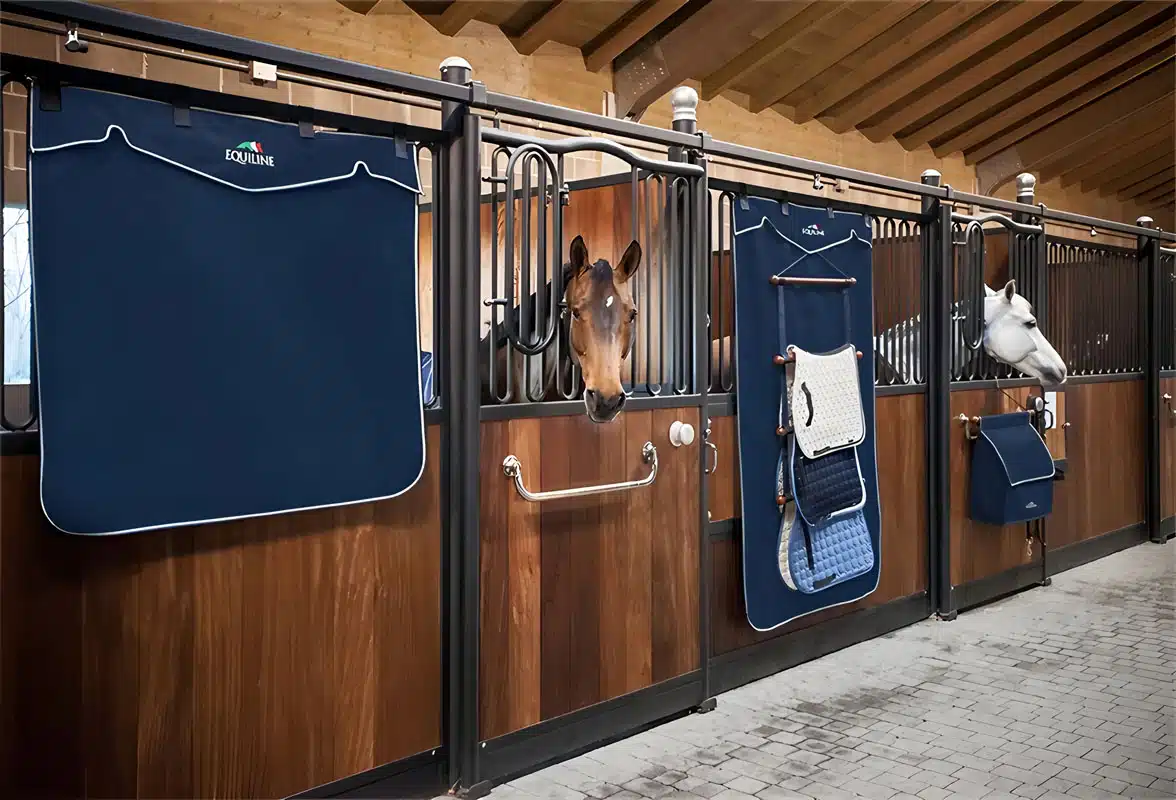
DB Stable systems solve this problem with sliding doors. They operate on a track that runs parallel to the stable front, so the door never protrudes into the aisle. This simple mechanical difference ensures the walkway remains 100% clear, even when the stall is open.
For high-traffic environments like training centers, our Professional Series features a ‘Hidden Track System.’ This design not only provides a cleaner look but also delivers exceptionally smooth, jam-free operation for maximum daily efficiency.
Engineered Stables for Any Global Climate
Our hot-dipped galvanized steel stables offer 20 years of rust-proof performance, ensuring long-term value and safety. With a 500+ unit monthly capacity and designs proven from 40°C to -10°C, we reliably supply durable solutions worldwide.
Swivel Feeders: Feeding Without Entering the Stall
Swivel feeders rotate out into the aisle, letting staff refill food and water without opening the stall door. This speeds up chores, improves safety, and reduces animal stress.
How Swivel Systems Improve Safety and Workflow
The main advantage is eliminating the need for staff to enter a stall during feeding time. This immediately reduces the risk of injury when dealing with anxious, territorial, or aggressive horses. You can safely manage the entire barn’s feeding schedule from the security of the aisle, without confronting a difficult animal in a confined space.
This design also separates tasks cleanly. Feeding becomes a fast, streamlined process that can be completed without interrupting other duties. Staff can dedicate uninterrupted blocks of time to mucking and other barn chores, instead of constantly opening and closing doors. It creates a more predictable and efficient daily routine.
Minimizing human intrusion into the horse’s personal space also lowers animal stress. A calmer horse is generally healthier and less prone to behavioral issues. Less disruption during feeding routines contributes to better overall stable hygiene and a more controlled environment.
The Benefits of an Aluminum Feeder Design
When these systems are built from lightweight aluminum, like those in professional-grade stable lines, the swivel action is smooth and requires little effort. Any staff member can operate the feeder easily without straining, which makes a real difference over dozens of stalls each day.
Aluminum also provides natural resistance to rust. Steel feeders can corrode over time, especially with constant exposure to water and moisture from feed. An aluminum design ensures long-term durability and prevents rust from contaminating the horse’s food and water supply.
Custom Tractor Clearances for Mechanical Mucking
Mechanical mucking requires custom tractor clearances to prevent damage. This involves fitting devices like drop-tube systems to increase ground clearance for operating over obstacles and uneven terrain.
Operational Challenge
Common Solution
Standard low-clearance points (idler brackets, drive sprockets) hit built-up bedding.
Model-specific fabricated devices that shield or raise critical components.
Working over large obstacles or on highly uneven ground requires significant height.
Drop-tube systems and axle modifications to achieve 48–54 inches of ground clearance.
Extreme conditions like steep slopes or marshes demand specialized equipment.
High-clearance machinery built for stability and precision, such as the Menzi Muck.
Why Standard Tractors Require Clearance Modifications
Off-the-shelf tractors aren’t designed for the demands of mechanical mucking. Their standard ground clearance creates operational bottlenecks. Critical low-hanging components, like front idler brackets and rear drive sprocket shrouds, are vulnerable to damage from built-up bedding, uneven ground, and hidden debris. Without modification, operators risk costly equipment failures and significant downtime. These adjustments are not optional; they are essential for keeping machinery running efficiently in challenging environments.
Key Technologies for Enhancing Ground Clearance
To solve the clearance problem, the industry relies on a few proven technologies. Custom-fabricated devices are tailored to specific machine models, protecting the most vulnerable parts of the undercarriage. For more significant height gains, operators install drop-tube systems and modify rear axles to lift the entire machine, often achieving an operational ground clearance of 48 to 54 inches. In the most demanding situations, such as mucking on steep slopes or in marshes, operations turn to specialized machinery. Equipment like the Menzi Muck is engineered from the ground up with high-clearance capabilities, providing the stability and precision needed for jobs standard tractors simply cannot handle.
Drainage Slopes: Reducing Bedding Waste
Engineered drainage, like minimal bottom gaps, lets liquids escape instead of pooling. This keeps bedding drier, reducing daily waste, material costs, and mucking time.
How Water Pooling Accelerates Bedding Waste
When a stall can’t drain properly, urine and water have nowhere to go. They pool at the base and soak upwards into the bedding, creating saturated spots that quickly become ammonia hotspots.
This trapped moisture doesn’t stay put. It spreads horizontally, contaminating clean, dry bedding nearby. You end up removing far more material than what was initially soiled, driving up bedding costs and the labor needed to muck out heavy, wet waste.
The Cast-Proof Gap: A Design for Drainage and Safety
We solve this problem at the source. Our stalls incorporate a ‘Cast-Proof Design’ with a minimal bottom gap of approximately 50mm.
This gap is engineered to be large enough for liquids to drain out freely, but small enough to prevent a horse’s hoof from getting trapped if it lies down or rolls. This simple feature maintains a much drier stall environment, extending the life of your bedding while ensuring horse safety.
Frequently Asked Questions
How can I clean horse stalls faster?
To clean stalls faster, use the right tools like a quality manure fork and an efficient wheelbarrow. Develop a consistent system, such as always cleaning from front-to-back. Remove large manure first, then the main wet spot. Rake cleaner bedding into that area before adding fresh bedding on top. This rotation keeps stalls cleaner and reduces waste.
Are sliding doors better for tractor access in a barn?
Yes, sliding doors are often better for accessing stalls with a tractor. They don’t swing out into the aisle, which saves critical space and removes obstructions. This makes it safer and more efficient to maneuver large equipment for mechanical mucking compared to traditional hinged doors.
What are the key barn design features for easier mucking?
An efficient barn design includes wide aisles, at least 14-16 feet, to easily accommodate wheelbarrows and equipment without congestion. Storing bedding near the stalls and having indoor water sources also reduces travel time. Finally, placing the manure pile for convenient access can dramatically speed up the cleaning process.
What is a swivel feeder and how does it improve efficiency?
A swivel feeder is a built-in trough that rotates from the aisle into the stall. This lets you provide feed and water without opening the stall door. It improves safety for both the handler and the horse and makes feeding times much quicker by removing the need to unlatch and secure gates for every meal.
Final Thoughts
The labor savings from smart design are lost if the hardware fails under pressure. While pre-galvanized stalls seem cheaper, our Hot-Dip After Fabrication standard is the only way to prevent rust and protect your clients from costly downtime. This engineering choice is what separates a one-time sale from a long-term supply partnership.
Verify the engineering for yourself. We recommend a trial order to test our panel fitment, hardware quality, and the smooth action of our Professional Series sliding doors. Contact our team to get the technical catalog and discuss OEM options for your market.
Hey, I’m Frank Zhang, the founder of DB Stable, Family-run business, An expert of Horse Stable specialist. In the past 15 years, we have helped 55 countries and 120+ Clients like ranch, farm to protect their horses. The purpose of this article is to share with the knowledge related to horse stable keep your horse safe.





 English
  Spanish
  French
  Arabic
  German
0 Comments