


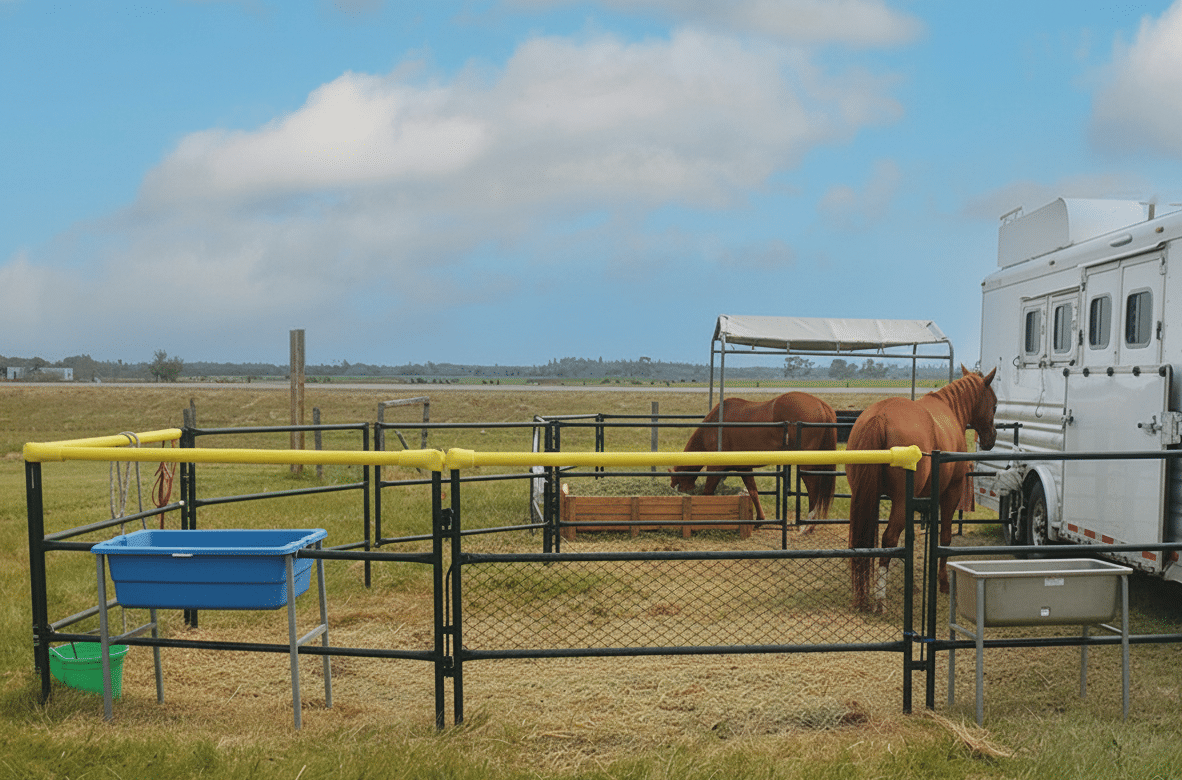
A wind break mesh turns a fence line into a sail, and most yards add it without ever asking what that does to the posts. Rails and open infill let wind pass through; a sheet of solid or tightly woven screen does not, so the load that used to escape through the fence now arrives at the post, its footing and the ground behind it. That transfer is the whole subject, because it is decided before the mesh arrives and cannot be fixed afterwards without digging.
Start with what this manufacturer actually publishes. The fencing range is economic galvanized horse fence panels plus UV-resistant PVC arena fencing, with a stated MOQ of 50 panels or 10 stall systems, 20 years of rust resistance for hot-dip galvanized steel and 15 years of life for UV-resistant PVC. No wind break mesh, screen fabric or shade cloth appears anywhere in the published range. That makes a mesh an added line from someone else, fitted to a fence line you bought here — which is exactly the situation where fixing details and post load get missed.
Key Takeaways
- Permeability is the design variable. A rail fence passes most wind through it; a wind break mesh with a tight weave loads the whole post line instead.
- No mesh is published in this range. The fencing line documented here is galvanized panels and UV-resistant PVC rails, so the screen is a third-party item on your order drawing.
- Fixing method decides the failure. Ties, battens, screws and straps each concentrate load differently, and every one of them rubs something.
- Gates are often the first place it shows. A screened leaf is heavier, catches more wind on the swing and sags at the hinge, typically before the line does.
- Post load is a written question, not an assumption. Nothing published here carries a wind load rating, a post dimension or a footing depth for a screened line — confirm all three in writing.
- Maintenance changes character. A screened line holds moisture against the rails and shade against the ground, which moves your inspection list from rust spots to chafing points, mildew and standing water.
What a screen does to a fence line
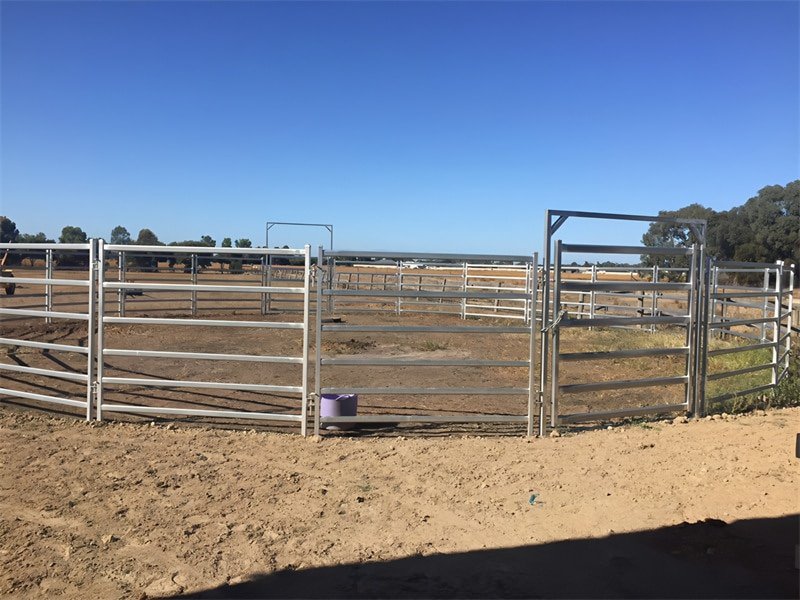
Wind does not load a fence the way a horse does. A horse applies a short, local force at one height; wind applies a sustained, distributed force across the whole panel face, and it applies it high up, where the lever arm on the post is longest. A rails-only line sheds most of that through the gaps. Close the gaps with mesh and the line becomes a wall that happens to be very tall and very thin, anchored only by its posts and their footings.
The consequence is rarely dramatic on the day it blows. It shows up as posts leaning downwind, footing collars cracking at the ground line where these exist, and rails working loose at their connections toward the end of a long run, where the corner assemblies carry what the intermediate posts gave up. Long uninterrupted runs are the exposure, so the first planning question is how far the screen goes before a gap, a gate or a corner breaks the sail up.
What is published, and what you are adding
Be precise about the boundary. The documented fencing here is galvanized horse panels for paddocks and UV-stabilized PVC for arena rails, welded by automated 360-degree equipment off CNC-machined stock, with a stated capacity of 500+ sets a month. The two durability figures describe coating and material on the product as supplied. Neither extends to a screen you fasten across it later, and nothing published states a wind load rating, a post dimension, a maximum run length or a footing depth for a line carrying mesh.
That gap has to be closed in writing with two parties rather than one. The panel supplier needs to say whether attaching a screen is permitted at all, and whether doing so affects the 20-year statement where fasteners penetrate the coating or trap moisture against it. The designer or builder needs to state what the posts and footings are sized for once permeability changes. Wind load on an open fence line, and how it interacts with drainage and ground conditions, is worked on this site for a wet, exposed market in paddock fencing and wind load; that article covers the open line, this one covers the closed line.
Fixing details: four ways a mesh fails
Failure starts where the load is transferred — at the attachments. Each fixing method moves load differently and creates its own wear point, so choose the method on the drawing rather than in the field with whatever is in the truck.
| Fixing method | Where load concentrates | What it wears |
|---|---|---|
| Ties or straps to rails | Every tie point, with the rail carrying the pull | Coating under the tie, and the mesh edge at the knot |
| Batten clamped over the top | The top edge line, transferring into posts at each fixing | The batten itself, plus water held at the clamp |
| Screwed through a timber rail | Each fastener hole, which is also where a tear starts | The mesh around the hole and the timber at the edge |
| Gate-leaf attachment | Hinge and latch, from a heavier sail on the swing side | Hinge pins and the latch strike |

Two rules are worth writing into the specification. Never let a screen bridge a joint between panels without a deliberate break there, because the joint is where movement happens. And treat every penetration of the coating as a maintenance item from day one, since the galvanized protection is continuous on a rail that nothing is bolted through. How load moves through pins and clamps between panels is covered in fence panel connection systems.
Maintenance questions for a screened line
Once a line holds wind, it also holds water and shade, and the inspection list changes. Ask four questions before the first season rather than after the first failure. What does the mesh do to the coating underneath where it sits against a rail, and how often should that be looked at. Does retained moisture reach the ground line, and does a screened run drain the way an open run does. What is the UV exposure of the screen itself, given that a 15-year figure published for UV-resistant PVC is a statement about that product and cannot be borrowed by a fabric bought elsewhere. And how does the mesh behave in your ground conditions — a line carrying shade and damp through a stated -10°C winter in Poland is a different case from one drying out in a 40°C Australian summer.
Write the answers onto one page and photograph the line against it twice a year, at the corners and at the gate. A screen that has begun to work loose shows at the fixings long before a post moves, and dated photographs are what turn a leaning corner from an argument into a repair order. The range the line is built from is on the horse fence page.
Frequently Asked Questions
Can I add wind break mesh to galvanized horse panels?
Often it is done, with posts and footings sized for it, but no published spec here covers it. Ask the supplier in writing whether attaching a screen is permitted and what it does to the coating position.
What mesh openness should I buy?
Treat permeability as a trade rather than a target. A tighter weave shelters more and loads the line more, and the right choice depends on your exposure, run length and post spec, which are yours to establish.
Do the posts need to be stronger for a screened line?
Assume yes and get it stated. A screen changes how much wind the line keeps, and that lands on post dimensions and footing depth; nothing published here gives either figure.
Will a screened gate sag?
It is a likely first place to look. A screened leaf adds weight and wind catch on the swing side, so ask for hinge and latch guidance and check the leaf twice a year against photographs.
Conclusion
A wind break mesh is not a fence accessory you clip on and forget. It changes what the line is asked to hold, and it changes what you will be inspecting for the next several seasons.
Decide the permeability first, then have the post and footing specification written against that decision, with the fixing method named on the drawing and the gate treated as its own problem. Get those in writing before the panels ship, and a screened line becomes a design rather than an experiment billed to you afterwards.



 English
 Spanish
 French
 Arabic
 German
0 Comments