


Proper Mat Integration determines whether your facility lasts decades or requires expensive retrofitting within months. Placing heavy steel frames on compressible rubber creates a soft joint that inevitably loosens hardware and compromises structural safety. This common error risks catastrophic failure when a 500kg animal leans against the wall, turning a cosmetic gap into a serious liability.
Our engineering protocols strictly require a metal-to-concrete connection for all Q235B structural steel frames. We analyze the critical 50mm Cast-Proof Design standard that balances drainage with hoof safety. Correctly cutting mats to fit inside the frame ensures the anchor bolts hold tension and your facility meets professional safety benchmarks.

The Flooring Dilemma: Concrete vs 17mm Rubber Mats
Concrete offers a cheap base, but 17mm rubber mats are the non-negotiable standard for shock absorption, thermal insulation, and long-term joint health.
Animal Welfare: Impact Absorption and Thermal Properties
Concrete floors are functionally brutal on equine physiology. When a 500kg horse stands or moves on bare concrete, the surface creates jarring impacts that reverberate back into the hoof capsule and joints. Over time, this leads to chronic inflammation and lameness. Rubber mats provide a necessary buffer, absorbing shock and protecting the structural integrity of the animal, which is vital for older horses or those in heavy work.
Temperature control is equally critical. Concrete acts as a thermal bridge, conducting cold from the ground and creating a damp environment that sucks body heat from a lying horse. Rubber acts as an insulator. It breaks that thermal bridge, maintaining a warmer, drier surface that prevents stiffness and reduces the caloric energy the horse burns just to stay warm.
- Shock Absorption: Mitigates impact stress on joints and tendons unlike unyielding concrete.
- Thermal Barrier: Prevents the “cold sink” effect of concrete, keeping stabled animals warmer.
- Traction Control: Textured surfaces prevent the catastrophic slips common on wet, slick concrete.
The 17mm Standard: Hygiene, Drainage, and ROI
In the professional sector, 17mm thickness is the established baseline. It offers enough density to resist curling and shifting while providing adequate cushion. Thinner mats often fail under the twisting force of a shod hoof, and porous concrete surfaces trap urine and bacteria deep within their structure, making true disinfection impossible.
Rubber mats solve this with integrated drainage channels on the underside, allowing fluids to run off towards the drain rather than pooling or soaking in. While the initial capital expenditure for rubber is higher than a simple concrete pour, the operational math favors the mats. You save significantly on bedding materials—since you aren’t piling shavings just to soften the floor—and you reduce veterinary overhead related to hock sores and respiratory issues.
- Industry Standard: 17mm offers the optimal balance of weight, durability, and cushion.
- Sanitation: Non-porous surfaces with drainage channels prevent bacterial buildup.
- Operational ROI: Reduced bedding requirements and lower veterinary costs offset setup prices.
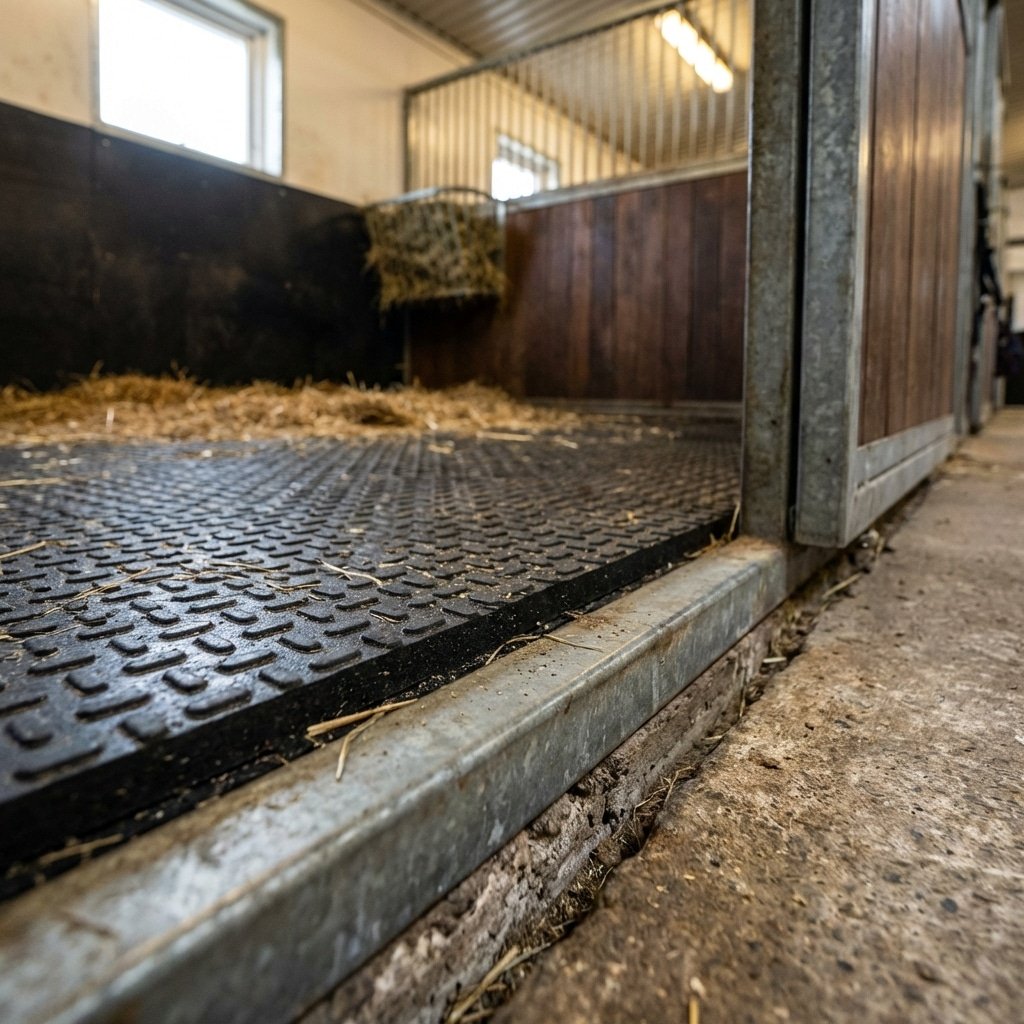
Why You Should Never Bolt Stall Panels Over Mats
Bolting steel panels over rubber mats creates a “soft joint” that inevitably loosens. For structural safety, anchor frames directly to concrete and cut mats to fit around them.
Mat Compression and the Risk of Loosening Hardware
We frequently see installation failures where contractors attempt to save time by installing stable fronts directly on top of rubber flooring. This is a fundamental engineering error. Rubber mats act as a compressible substrate. They simply cannot support the static load of a 250kg+ steel panel without deforming over time.
The mechanics of this failure are predictable. As the rubber compresses or shifts under the weight of the steel, the tension on your anchor bolts drops. This loss of tension creates a gap between the base plate and the true floor, causing the stable walls to wobble or lean. In a professional facility, a leaning wall is a liability, not just a cosmetic issue.
- The “Soft Joint” Failure: When a horse kicks a wall anchored over rubber, the base plate moves. This movement creates shear force that can snap standard bolts instantly.
- Moisture Traps: Sandwiching rubber between steel and concrete traps urine and wash-down water. This creates an unseen breeding ground for bacteria and accelerates corrosion at the anchor points.
Achieving Maximum Rigidity with Direct Concrete Anchoring
Structural integrity relies on a metal-to-concrete connection. To ensure the safety of the animals and the longevity of the facility, you must anchor the panels directly to the concrete subfloor. This prevents the “floating floor” effect and ensures the frame remains rigid against impact.
Our installation protocols at DB Stable strictly require this method to maintain our “Kick-Proof Guarantee.” Direct anchoring allows for precise leveling of the door frames, whereas uneven mat surfaces often distort alignment, causing sliding doors to jam or derail.
- Solid Foundation: Our Q235B structural steel frames require a non-compressible base to perform effectively.
- Correct Hardware: We supply 304 Stainless Steel anchor bolts specifically designed for concrete embedment, not for bridging soft gaps.
- Professional Finish: Install the panels first, then cut the mats to fit snugly against the bottom channel. This locks the mats in place and prevents shifting.
Premium Custom Stables Built For 20-Year Durability

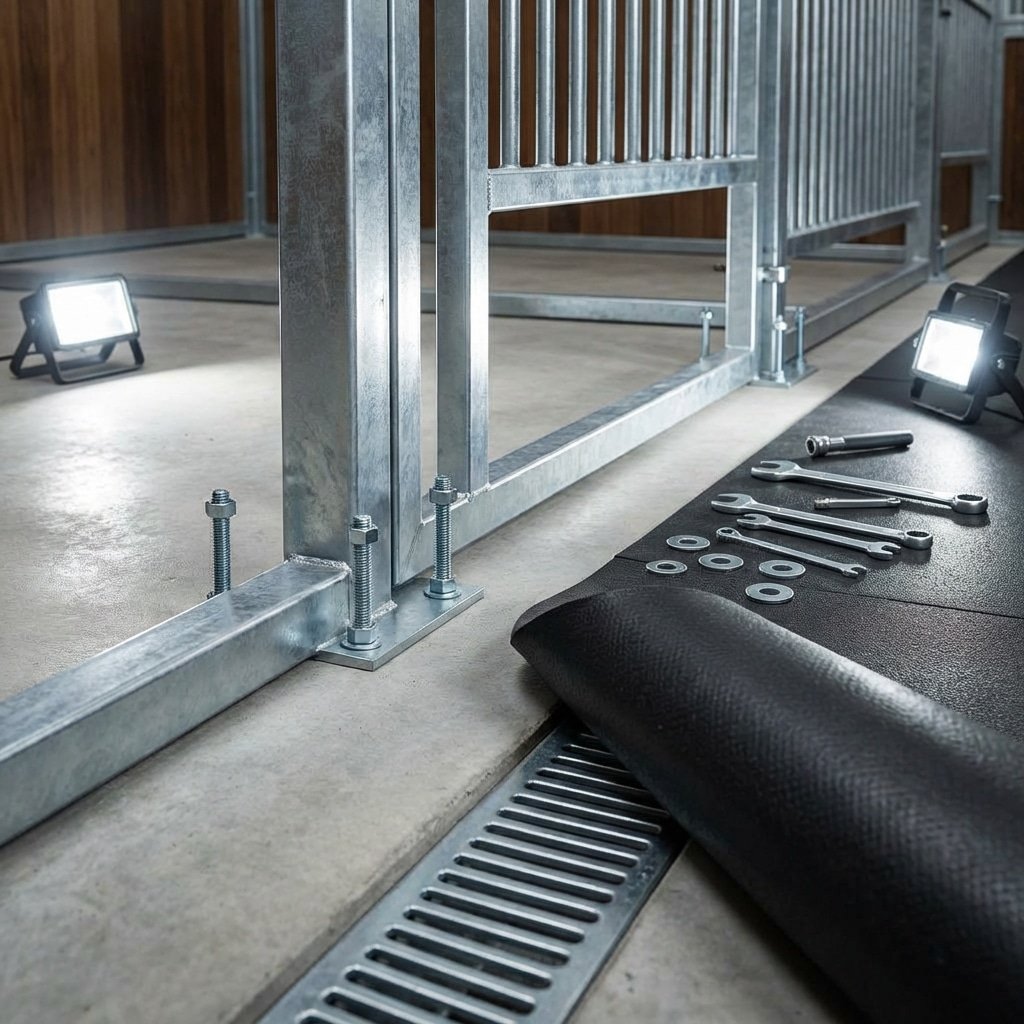
The 50mm Gap: Engineering Horse Stalls for Mats
The 50mm clearance is a safety-critical standard that balances drainage needs with cast prevention, ensuring the final gap remains under 35mm after mat installation.
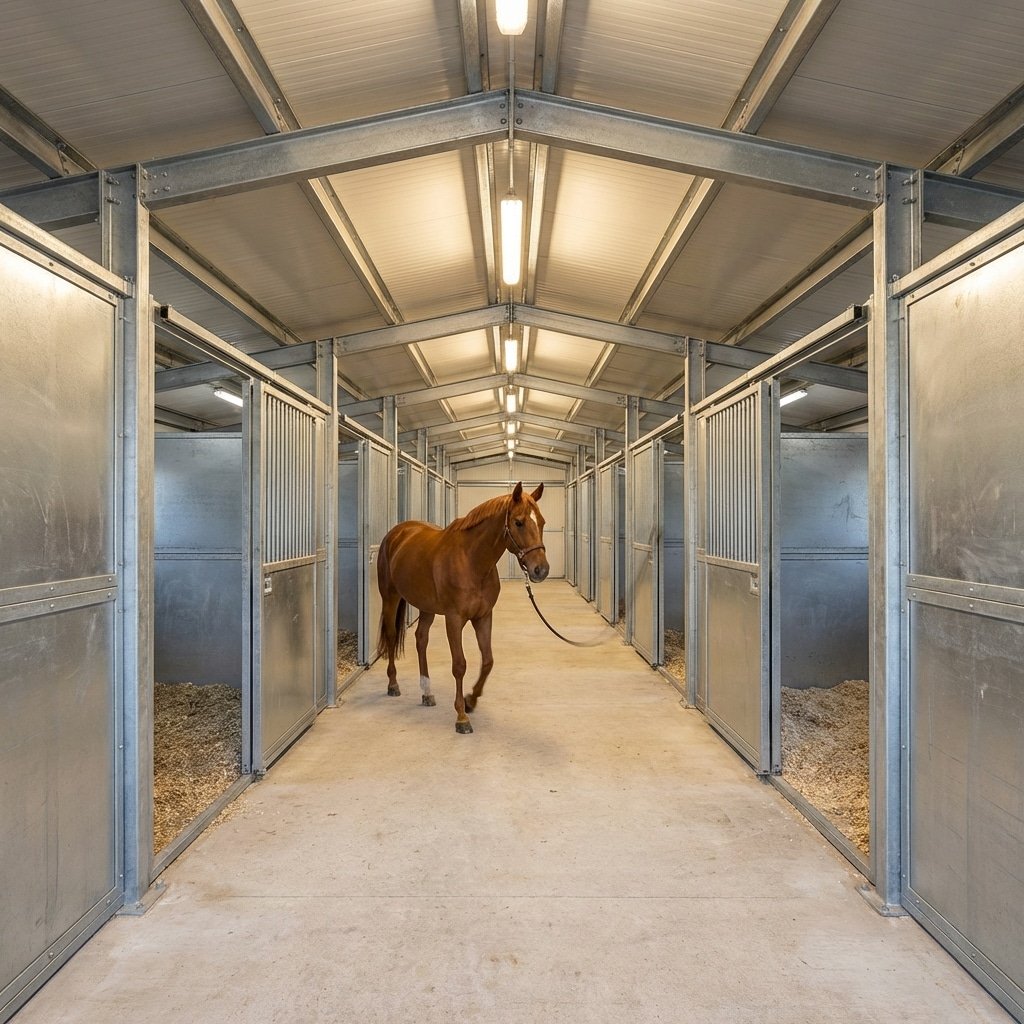
The “50mm Gap” is a calculated safety tolerance, not a suggestion. We engineer stable frames to sit exactly 50mm above the subfloor to balance fluid dynamics with equine safety. This clearance allows for washout drainage under rubber mats while ensuring the opening remains too small for a hoof to penetrate. Once standard flooring is installed, this gap effectively reduces to roughly 33mm, securing the stall against entrapment risks.
| Engineering Parameter | Measurement Specification | Operational Function |
|---|---|---|
| Frame Clearance | 50mm (Fixed) | Prevents corrosion; allows washout drainage. |
| Mat Thickness | 17mm – 20mm | Standard industry flooring buffer. |
| Net Safety Gap | 30mm – 33mm | Prevents hoof entry (Anti-Cast). |
Optimizing Airflow and Drainage with Mat Systems
Rubber mats are non-porous, meaning liquids require a physical escape route. If a stable frame sits flush against the concrete subfloor, urine and water get trapped inside the stall perimeter, leading to rapid ammonia buildup and bacterial growth. Elevating the frame creates a necessary washout channel that allows fluids to drain into the aisle or designated gutters without pooling.
This clearance also solves mechanical interference. Standard heavy-duty rubber mats range from 17mm to 20mm thick. Without the pre-engineered 50mm lift, these mats would obstruct the bottom of swinging doors or sliding mechanisms, forcing you to cut mats around the door path—a mistake that compromises the floor’s integrity and creates trip hazards.
The Cast-Proof Design Standard
In our Product Bible, this is defined as “Cast-Proof Design.” We strictly limit bottom clearance to approximately 50mm to prevent hoof entrapment. A gap larger than this creates a lethal hazard; if a horse rolls and gets a leg under the rail, the leverage can snap a bone instantly. Our engineering strictly adheres to the following safety logic:
- Defined Tolerance: The frame must not exceed 50mm from the subfloor to the bottom rail.
- Mat Integration: Once a standard 17mm mat is laid, the effective gap reduces to roughly 33mm.
- Safety Threshold: A 33mm gap is too narrow for even a foal’s hoof to penetrate, eliminating the risk of casting injuries while maintaining drainage.
Preventing Cast Horses with Proper Panel Clearances
Proper panel clearance prevents life-threatening injuries. We engineer a strict 50mm bottom gap—wide enough for drainage, but too narrow for a hoof to slide under and get trapped.
How Excessive Bottom Gaps Trap Hooves
When a horse casts (rolls and gets stuck against a wall), its natural instinct is to extend its legs violently to find leverage for righting itself. This is where poor engineering becomes a liability. If the clearance between the bottom of the stall panel and the floor exceeds 80mm to 100mm, it creates a mechanical “trap zone.”
In this scenario, the hoof slides effortlessly under the rail during the extension phase. However, when the horse attempts to retract the leg, the coronet band catches on the bottom bar. The leg is now pinned. The horse’s subsequent panic response generates immense torque, often resulting in severe tendon damage or spiral fractures before stable staff can intervene.
The “Cast-Proof” Design Standard (50mm Limit)
To eliminate this risk, DB Stable utilizes a “Cast-Proof Design” protocol. We reject general fabrication tolerances in favor of a strict 50mm (approx. 2 inch) bottom clearance. This specific dimension is critical: it allows necessary urine drainage and air circulation to prevent ammonia buildup, yet remains physically too narrow for a hoof to penetrate.
- Precision 50mm Gap: Acts as a physical stop, preventing the hoof from entering the space under the wall entirely.
- Impact-Absorbing Infill: We use 28mm-32mm HDPE lower walls rather than steel bars at the bottom. If a cast horse kicks the wall, the HDPE absorbs the shock, reducing the chance of leg fractures compared to rigid concrete or steel slats.
- Structural Resilience: The frame utilizes Q345B Low Alloy High Strength Steel. This withstands the significant lateral force of a 500kg animal pushing against the wall without buckling, ensuring the trap zone gap does not widen under pressure.
Frequently Asked Questions
Should I install the stable panels on top of the rubber mats?
No. Structural stability relies entirely on metal-to-concrete contact. Rubber mats are compressible materials. If you bolt heavy steel panels through the rubber, the movement of the horse will eventually compress the mat, causing the anchor bolts to lose tension. This leads to wobbling walls and compromised structural integrity. Always anchor the steel channel directly to the concrete subfloor or curb, then cut the mats to fit inside the stall frame.
What is the safe clearance gap for the bottom of the stall door?
To prevent a horse from getting a hoof trapped (casting), the bottom clearance must be strictly less than 76mm (3 inches). DB Stable engineers a standard 50mm gap on all Professional and Royal Series fronts. This gap is large enough to allow urine drainage and ventilation—supporting the “stack effect”—but small enough to ensure a hoof cannot slide underneath and get stuck during a roll.
How much space should I leave between the mats and the stable walls?
You must leave an expansion gap of approximately 6mm to 12mm (1/4 to 1/2 inch) around the perimeter. Rubber mats expand and contract significantly with temperature changes. If you fit them too tightly against the steel U-channel, they will buckle when the temperature rises, creating an uneven surface and a severe tripping hazard for the animal.
Can I use sand or gravel instead of concrete for the base?
While rubber mats can be laid over compacted stone dust (approx. 4 inches deep), the stable panels themselves require a solid footing for the mechanical anchors. For safety and longevity, we recommend pouring a concrete curb (perimeter footer) to anchor the panels, even if the center of the stall remains natural ground. Anchoring heavy steel posts into dirt or gravel provides zero tensile strength against a horse leaning or kicking against the wall.
Final Thoughts
Cutting corners on installation by bolting over mats creates immediate structural liability and risks severe equine injury. Adhering to the “Cast-Proof” 50mm gap standard protects your clients’ assets and solidifies your reputation as a safety-first distributor. Your long-term margins depend on supplying systems that withstand abuse, not hardware that loosens after a month.
Stop gambling on generic fabrication tolerances that trap hooves and rust prematurely. Request our technical specification sheet to see how our ISO 1461 Hot-Dip Galvanizing creates a maintenance-free asset for your inventory. Secure a trial container today to validate our heavy-duty engineering against your current suppliers.

 English
  Spanish
  French
  Arabic
  German
0 Comments