


Optimizing stabling infrastructure for State Fairgrounds is a direct pivot from recurring rental expenses to asset-based profitability. Relying on disposable rental fleets drains potential revenue, whereas owning a modular system captures 100% of exhibitor fees while eliminating the volatility of third-party availability.
We evaluate manufacturers based on the Q235B Structural Steel and Hot-Dip Galvanization to BS EN ISO 1461 standards required for high-traffic durability. This guide benchmarks effective capacity and flat-pack logistics to identify suppliers capable of delivering 500+ sets within strict event timelines.
The Economics of Mega-Events: Renting vs. Owning Stalls
Quick Comparison
| Strategy / Model | Primary Beneficiary | Key Components | Verdict |
|---|---|---|---|
| Revenue Dynamics for Concessionaires | Event Attendees | Food, Drinks, Merchandise | Vendor revenue from food, drinks, and merchandise is a substantial, separately tracked component that operates independently of fairground operational reporting. |
| Renting Advantage (Operational Model) | Fairground Operators | Rental Contracts, Flexible Space | The preferred model for operators, generating direct revenue without capital investment while allowing layout flexibility for year-round event schedules. |
| Owning Consideration (Vendor Perspective) | Long-term Vendors | Permanent Stalls, Equity | Beneficial for high-volume vendors over 5-10 year horizons, offering equity building and reduced setup costs for regular participants. |
| Hotel & Hospitality Multiplier | Local Municipalities | Room Nights, Tourism Spending | Mega-events drive significant out-of-town attendance, generating ancillary demand for local hotels, restaurants, and retail. |
| Tax Revenue Capture | State Budgets | Sales Tax, Business Volume | State and local governments capture significant sales taxes from vendor transactions, incentivizing regulatory frameworks that favor high-volume participation. |
| Seasonal Concentration Risk | Event Planners | Asset Utilization, Seasonal Planning | The concentration of attendance during specific seasons favors rental models to avoid the inefficiency of permanent stalls sitting empty during off-peak times. |
Revenue Dynamics for Concessionaires
This component operates independently of operational reporting, **significantly boosting total economic impact** through parallel revenue channels.
Vendor revenue derived from food, drinks, and merchandise functions as a substantial, separately tracked financial stream. It operates distinct from standard fairground reporting, creating a crucial layer of economic activity often overlooked in basic metrics.
By isolating these revenue streams, organizers gain a clearer picture of attendee spending behavior. This approach highlights the true value of ancillary spending beyond basic admission fees.
📊 At a Glance:
- 📍 Context: Financial Analysis
- 🏭 Key Drivers: Food, Drinks, Merchandise
- 🌍 Primary Audience: Event Attendees
Why It Matters:
| ✅ The Wins | ⚠️ Trade-offs |
|---|---|
|
|
Renting Advantage (Operational Model)
A zero-capex revenue driver that eliminates infrastructure costs while maximizing layout flexibility for year-round event schedules.
This operational model serves as the preferred strategy for operators focused on liquid assets rather than fixed infrastructure. It generates direct revenue streams immediately without the heavy capital expenditure typically associated with permanent stall construction.
By transferring maintenance and liability risks to vendors, this approach significantly lowers operational overhead. It enables organizers to dynamically reconfigure event spaces to suit over 200 different annual occasions, ensuring high asset utilization.
📊 At a Glance:
- 📍 Location: Operational Strategy
- 🏭 Core Strength: Rental Contracts, Flexible Space
- 🌍 Key Markets: Fairground Operators
Why We Picked Them:
| ✅ The Wins | ⚠️ Trade-offs |
|---|---|
|
|
Owning Consideration (Vendor Perspective)
**Best for committed vendors**, this model trades upfront capital for long-term equity and lower operational costs.
This approach serves as a strategic financial play for high-volume vendors operating over 5 to 10-year horizons. By transitioning from a rental model to ownership, businesses gain a permanent foothold in the event ecosystem and build tangible asset equity.
The primary advantage lies in operational efficiency and cost control. Owners bypass the repetitive logistical costs of setup and breakdown while eliminating rental fees, though this comes with the responsibility of managing assets during off-peak seasons.
📊 At a Glance:
- 📍 Location: Vendor Strategy
- 🏭 Core Strength: Permanent Stalls, Equity
- 🌍 Key Markets: Long-term Vendors
Why We Picked Them:
| ✅ The Wins | ⚠️ Trade-offs |
|---|---|
|
|
Hotel & Hospitality Multiplier
Mega-events act as **powerful economic engines**, driving significant out-of-town attendance that creates massive ancillary demand for local hotels and retail.
Mega-events drive significant out-of-town attendance, generating ancillary demand for local hotels, restaurants, and retail. This influx transforms a single event into a broad stimulus for the regional economy.
The primary economic outputs are increased room nights and tourism spending. This multiplier effect benefits local municipalities by supporting the broader business ecosystem beyond the event venue itself.
📊 At a Glance:
- 📍 Location: Local Economy
- 🏭 Core Strength: Room Nights, Tourism Spending
- 🌍 Key Markets: Local Municipalities
Why We Picked Them:
| ✅ The Wins | ⚠️ Trade-offs |
|---|---|
|
|
Tax Revenue Capture
**Mega-events serve as critical fiscal generators**, capturing sales tax from high-volume vendor transactions to directly fund state and local municipal budgets.
State and local governments capture significant sales taxes from vendor transactions, creating a direct pipeline from event commerce to public funds. This fiscal injection incentivizes regulatory frameworks that actively favor high-volume participation and event expansion.
The model transforms temporary marketplaces into substantial revenue drivers for state budgets. However, capitalizing on this volume requires efficient tracking mechanisms to ensure every transaction contributes to the local economy.
📊 At a Glance:
- 📍 Location: Government/Fiscal
- 🏭 Core Strength: Sales Tax, Business Volume
- 🌍 Key Markets: State Budgets
Why We Picked Them:
| ✅ The Wins | ⚠️ Trade-offs |
|---|---|
|
|
Seasonal Concentration Risk
**Flexible rental models** are critical here, preventing capital from being tied up in empty infrastructure during off-peak months.
The concentration of attendance during specific seasons creates a “boom and bust” cycle for infrastructure usage. To avoid the significant inefficiency of permanent stalls sitting empty during off-peak times, the rental model is heavily favored.
This approach focuses on maximizing asset utilization through precise seasonal planning. By aligning infrastructure availability strictly with revenue-generating windows, event planners can eliminate the financial drag of maintaining unused assets year-round.
📊 At a Glance:
- 📍 Location: Risk Management
- 🏭 Core Strength: Asset Utilization, Seasonal Planning
- 🌍 Key Markets: Event Planners
Why We Picked Them:
| ✅ The Wins | ⚠️ Trade-offs |
|---|---|
|
|
Engineered to Last: 20-Year Rust-Free Guarantee
The Economics of Mega-Events: Renting vs. Owning Stalls
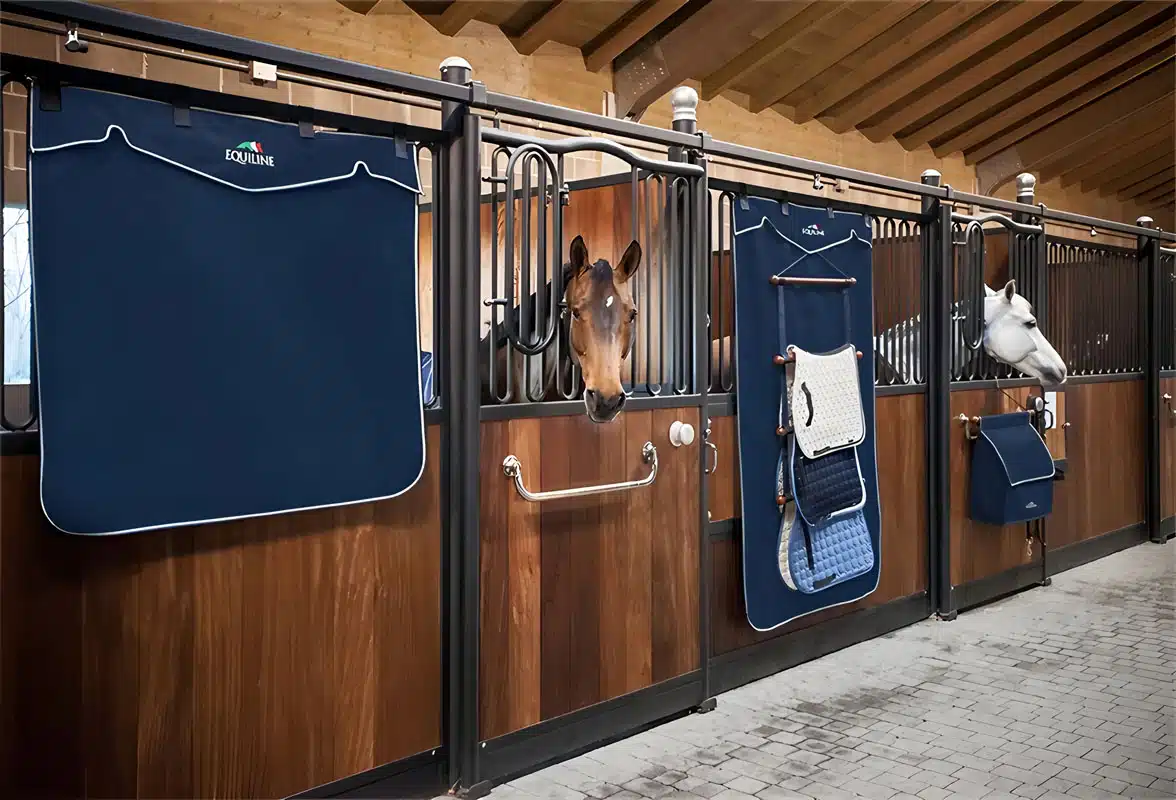
For venue operators and state fair organizers, shifting from renting temporary stabling to owning a permanent fleet represents a critical strategic asset pivot. While renting appears to preserve short-term cash flow, owning our modular Economy Series transforms a recurring operational expense into a long-term revenue generator, capturing 100% of exhibitor rental fees while minimizing maintenance costs through industrial-grade materials.
The Financial Advantage of Infrastructure Ownership
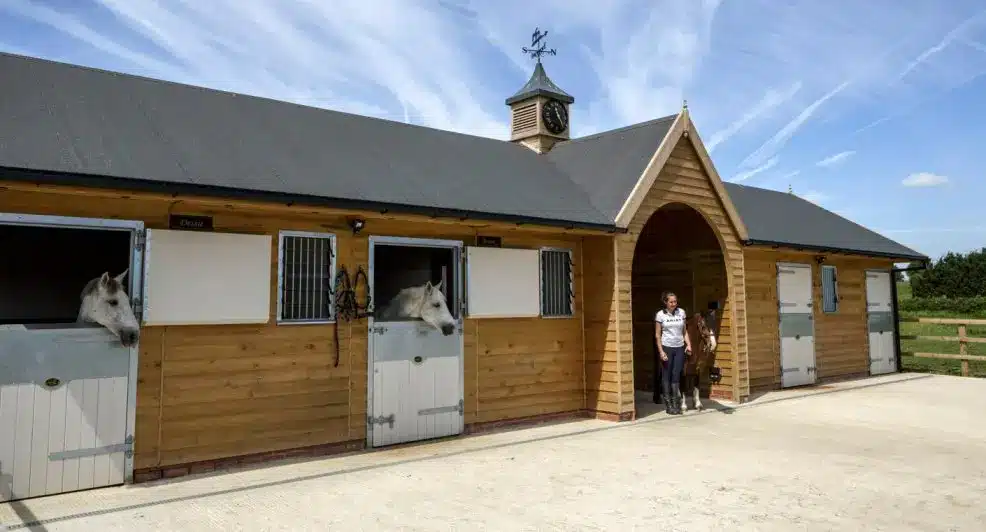
State fairs and expo centers frequently bleed potential revenue by outsourcing stabling to third-party rental agencies. By investing in a proprietary fleet of DB Stable’s **Economy Series**, organizers instantly stop passing margins to vendors and begin capturing the full stall rental fee paid by exhibitors. This shift turns necessary infrastructure into a direct profit center, where the initial capital expense is amortized rapidly over just a few event seasons.
Durability determines the ROI of this strategy. Unlike disposable rental units often built from thin-gauge tubing, we manufacture our systems using **Q235B structural steel** (equivalent to ASTM A36). We protect this investment with **Hot-Dip Galvanization to BS EN ISO 1461** standards, applying a zinc coating exceeding 70 microns after fabrication. This ensures the frames withstand decades of ammonia exposure and wash-downs without developing the red rust common in painted or pre-galvanized alternatives, effectively eliminating replacement costs.
Logistics and Seasonal Storage Efficiency
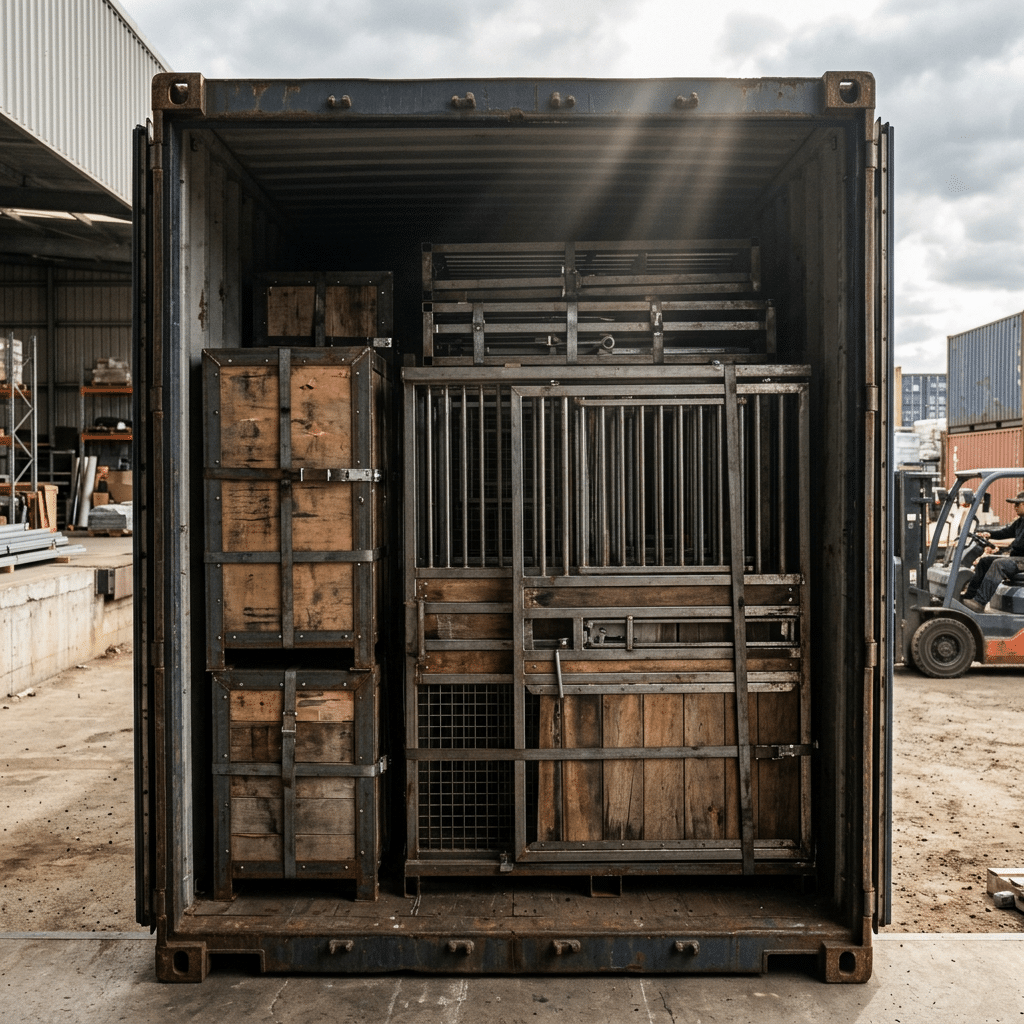
For multi-purpose venues hosting diverse events like the Iowa State Fair, the speed of deployment and storage density drives operational margins. Owning infrastructure requires efficient warehousing, which is why we engineered our **Flat-Pack System** to maximize spatial efficiency. Venues can stack **30-45 sets** of our stables within the footprint of a single 40HQ container, significantly reducing the warehouse square footage required during off-peak seasons compared to fully welded cages.
Turnaround speed is equally critical when scheduling back-to-back events. We utilize **HDPE infill** specifically for its **Zero Maintenance** properties; staff can simply power-wash the planks between events without the need for sanding, staining, or painting associated with wood. Combined with our standardized pin connector system, this design supports a “Profit Protection” model where labor costs for setup, teardown, and cleaning are kept to an absolute minimum.
Manufacturing Capacity: Who Can Deliver 500 Sets in 60 Days?
To deliver 500 stable sets within a strict 60-day window, a manufacturer must maintain a sustained “Effective Capacity” of approximately 10 units per day, accounting for weekends and maintenance. This requires more than just welding speed; it demands secured raw material stock (Q235B or Q345B steel) and reserved slots at the galvanizing plant. At DB Stable, we validate project timelines using rolling production data rather than theoretical maximums, ensuring your project schedule is based on engineering facts.
Calculating True Factory Output: Beyond Theoretical Numbers
The first step in securing this volume is raw material allocation. Upstream delays are the most common cause of missed deadlines. We prevent this by securing the necessary tonnage of **Q235B Structural Steel** (or **Q345B** for cold climate specs) immediately upon order confirmation. By holding the steel stock on our floor before the first cut is made, we eliminate the risk of market shortages impacting your daily production rate.
The Critical Path: Managing the Galvanization Bottleneck
The primary constraint in high-volume production is rarely the welding; it is the **Hot-Dip Galvanization After Fabrication** process. Unlike painting, which can be done in-house rapidly, true hot-dip galvanization to **BS EN ISO 1461** standards requires dipping large batches of steel into molten zinc. This process requires precise scheduling with the galvanizing plant. For an order of 500 sets, we coordinate massive throughput to ensure the 35-45 day lead time includes the necessary time for dipping, cooling, and inspection.
Logistics throughput is the final indicator of capacity. Shipping 500 sets is a massive logistical operation. With traditional fully welded stalls, this would require nearly 40 shipping containers, creating a bottleneck at the loading dock. However, our **Flat-Pack System** allows us to load 30-45 sets per 40HQ container. This means we only need to stage and load approximately 12-15 containers. This efficiency protects your “Profit Protection” by drastically reducing freight costs and ensures that the finished product clears our factory floor fast enough to keep the production line moving.
The Assembly Speed Requirement (Pin Connectors)
For mega-events and temporary fairgrounds, installation speed directly impacts profitability. Our drop-pin connector system eliminates complex welding and bolting, allowing crews to rapidly assemble Q235B steel frames without specialized heavy machinery. This modular design ensures that high-volume shipments—up to 45 sets per container—can be deployed in days rather than weeks, securing operational timelines for large-scale organizers.
Mechanics of Modular Connections
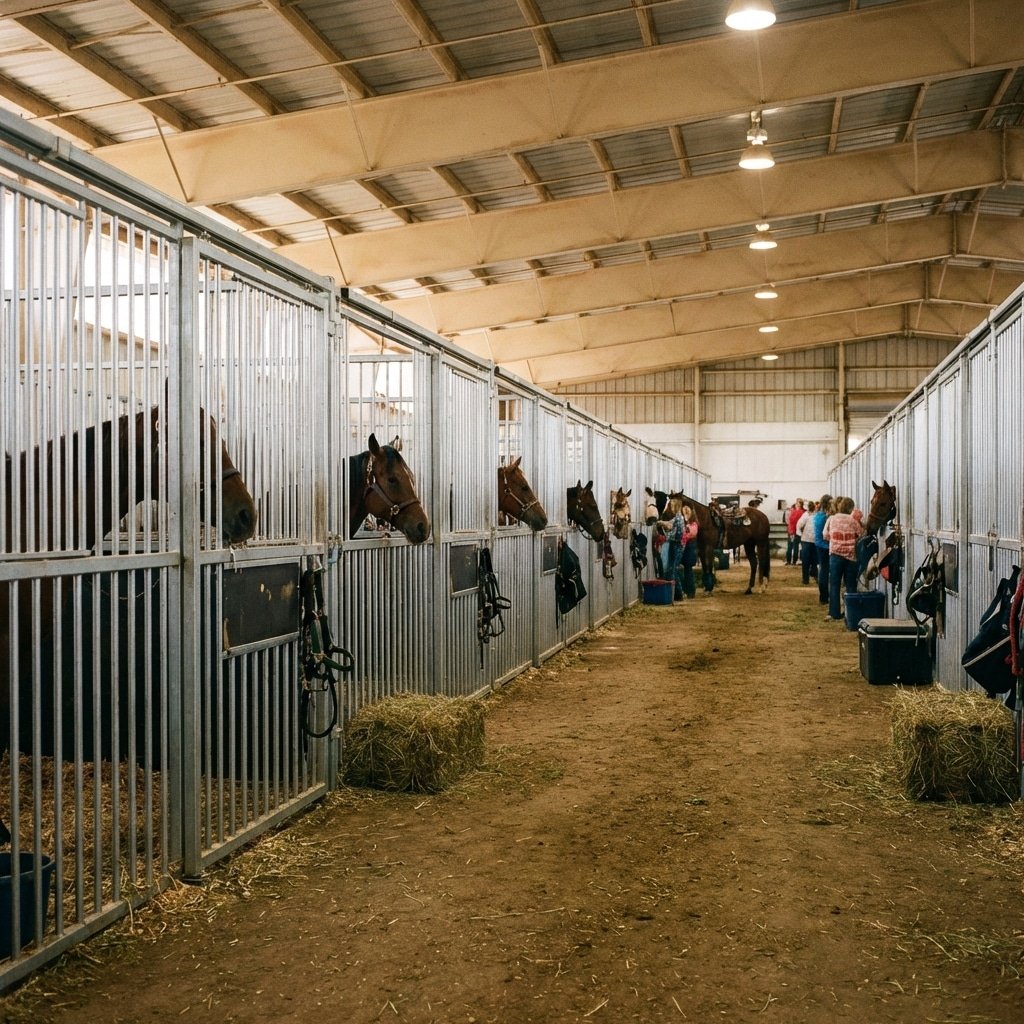
Temporary stabling for mega-events relies on speed and simplicity. Unlike permanent infrastructure that demands on-site welding, we utilize a drop-pin connector system designed for rapid deployment. This approach supports our Economy Series, where open top grills and lightweight frames must be secured quickly to meet tight event setup windows.
Durability during repeated assembly cycles is non-negotiable. The DB Stable Installation Kit utilizes 304 Stainless Steel for all connectors and anchor bolts. This ensures that hardware does not seize or rust, allowing fairground operators to assemble and disassemble the stalls season after season without degrading the connection points.
By using Q235B Structural Steel frames (equivalent to ASTM A36) paired with these pin connectors, we allow event organizers to create sturdy, safe enclosures. The primary advantage here is logistical independence; teams can erect hundreds of stalls on a fairground floor without requiring specialized power tools or heavy lifting machinery.
Quantifying Installation Efficiency
Speed is critical when converting logistics into infrastructure. Our Steel Pallet Flat-Pack system allows us to load 30-45 sets per 40HQ container. This density creates a high-volume receiving area that requires fast processing to prevent bottlenecks. Pin connectors significantly reduce the labor hours required per stall compared to bolted systems, streamlining the transition from off-loading to finished assembly.
While our Production Lead Time is 35-45 days—necessary to achieve our Hot-Dip Galvanization standard (ASTM B117 Salt Spray Test > 96 hours)—the on-site assembly speed protects the profit margins of rental companies. Teams can erect hundreds of stalls in days, ensuring the venue is ready for horses well before the event begins.
Rapid installation often leads to minor surface abrasions. To maintain the integrity of the zinc coating, every system includes a Touch-up Spray (Cold Galvanizing). This allows installation crews to instantly repair any scratches that occur during the rapid-fire setup process, ensuring the “Lifetime” rust protection standard is maintained even in high-traffic event environments.
DB’s Economy Event Series and Flat-Pack Logistics
For large-scale events and rental businesses, logistics expenses often dictate the bottom line. Our Economy Event Series combines hot-dip galvanized durability with an engineered flat-pack design that fits up to 45 sets in a single container, drastically reducing freight costs while delivering a “Zero Maintenance” solution built to withstand high-turnover environments.
Technical Specs of the Economy Series
We build the Economy Series specifically for high-turnover environments like rental stables and quarantine units where equipment abuse is common. The framework utilizes Q235B Structural Steel with a robust wall thickness of 2.5mm. This heavy-duty specification ensures the panels withstand frequent assembly and disassembly cycles far better than standard light-duty temporary panels often found in the market.
To minimize upkeep costs for organizers, this series utilizes 28mm-32mm UV Stabilized HDPE planks. Unlike wood, which requires constant staining and replacement, our HDPE infill resists moisture, bacteria, and chewing. This makes it the ideal “Zero Maintenance” solution for maintaining biosecurity between different events, while the impact-absorbing material protects both the horse and the structure during transport and use.
Corrosion defense i
s non-negotiable for equipment stored outdoors between fair seasons. Every component in the Economy Series undergoes Hot-Dip Galvanization After Fabrication to BS EN ISO 1461 standards. With an average zinc coating greater than 70 microns on tubing, we ensure these stalls resist rust and degradation even in harsh weather conditions, offering a lifespan that far exceeds pre-galvanized alternatives.
The Flat-Pack Advantage: Shipping 45 Sets Per Container
Traditional fully welded stalls create a significant freight bottleneck, limiting shipping capacity to just 12-15 sets per 40HQ container. This inefficiency leads to exorbitant freight costs for large events. Our engineered Flat-Pack System maximizes volume, allowing us to load 30-45 sets in a single 40HQ container. This density solves the logistical challenge of outfitting large venues efficiently.
Logistics efficiency extends beyond just shipping volume. We package every unit on steel pallets rather than loose loading, which ensures safe, rapid unloading at the venue using standard forklifts. This reduces labor costs during setup and breakdown, protecting the margins of distributors and organizers who need to outfit entire expo centers quickly.
We call this “Profit Protection.” By optimizing the physical footprint of the stalls during transport, we significantly lower the landed cost per unit. This logistics model allows fairgrounds to acquire 100+ stalls with significantly fewer containers compared to local fabrication or inefficient welded imports, ensuring that budget is spent on asset quality rather than ocean freight.
Final Thoughts
Shifting from rental expenses to owning a permanent fleet of Hot-Dip Galvanized stalls turns your annual infrastructure budget into a revenue-generating asset. While painted tubing offers a lower upfront sticker price, only our BS EN ISO 1461 galvanization standard withstands the ammonia and abuse typical of high-traffic state fairs without corroding. Investing in Q235B structural steel now eliminates the recurring cycle of rental fees and repair costs later.
Secure your next event’s infrastructure by validating our logistics capacity directly. We encourage venue directors to request a Flat-Pack Loading Plan, demonstrating how we fit 30-45 sets per 40HQ container to slash your landed costs. Contact our engineering team today to reserve your production slot and guarantee delivery within our 35-45 day manufacturing window.
Frequently Asked Questions
Who manufactures temporary stalls for State Fairs?
DB Stable manufactures temporary stabling directly for large-scale events and distributors. We serve as an OEM source factory, producing ISO-certified, hot-dip galvanized panels designed to withstand the high traffic of state fairs while maintaining strict safety standards.
How fast can you build 100 horse stalls?
For a volume of 100 stalls, our production cycle typically runs 35 to 45 days. This timeline accounts for our rigorous hot-dip galvanizing process after fabrication, ensuring your infrastructure is ready well before opening day without compromising quality.
Best bulk horse stabling suppliers?
The most reliable suppliers are direct manufacturers who control the galvanizing process. We provide bulk solutions with “Hot-Dip After Fabrication” technology, guaranteeing that your investment resists rust for decades, unlike resellers offering cheaper pre-galvanized tubing.
Cost to outfit an equestrian expo center?
Pricing depends on the selected series, such as our Economy or Professional lines. However, our flat-pack logistics model significantly lowers the total landed cost by fitting 30-45 sets in a single 40HQ container, saving roughly 60% on freight compared to fully welded options.
Storage for portable horse stables?
We design our portable stables with off-season storage in mind. Each unit arrives on a stackable steel pallet, allowing venue operators to safely store dismantled panels compactly without risking damage or consuming excessive warehouse space.

 English
  Spanish
  French
  Arabic
  German
0 Comments