



Rain is not the hard part of UK equestrian fencing. Most fence types shrug off a wet week. The hard part is what twelve months of damp soil, freeze-thaw in the cold snap and hoof pressure do at the ground line — where the post meets the mud, where the coating sits in standing water, and where the fence line quietly becomes the drain that carries the field’s water off the site. Buyers who specify a British line by rail count and color alone end up replacing posts, not rails.
DB HorseStable supplies the UK and New Zealand markets from a brief built around exactly that: high-drainage detailing and BHS-aligned design for wet climates. What follows is how the guidance and the ground work together, and what belongs on the order before a single post is cut.
Key Takeaways
- Specify the fence line as part of the drainage plan. Where surface water runs along a boundary rather than off it, the base does the failing and the steel never gets a chance.
- BHS field guidance gives the numbers to design against: generally about 1.25 m high with the lower rail around 0.5 m off the ground, with wider ranges for horses, ponies and stallions.
- Minimum heights need a second line. Where the low end of the range is used, BHS advises a double fence line with an electric line along the top of the boundary.
- Ground-line water is what ages galvanized steel. Hot-dip galvanized product carries a 20-year rust-protection specification, but that assumes the base drains.
- Inspection is a cost line, not an afterthought. BHS recommends checking fencing daily and notes that an escape through an inadequate boundary can leave the keeper liable.
- Order terms for a UK site: fencing from a 50-panel MOQ, 5-15% tiered volume discount, 4-6 weeks global delivery, 1-2 weeks from Warsaw hub stock.
Why the Wet Season Sets the Spec
A British grazing season is a long, soft argument about water. Clay-heavy fields hold standing water well after the rain stops, and the wettest ground on any paddock is almost always the gateway, the feeder corner and the line the horses walk daily. That is also where the fence is loaded: animals crowd it, lean it and put a hoof against it. Water and traffic concentrate in the same narrow band along the fence line, and the boundary fails there rather than in the middle of the run.
The second mechanism is cold inside the wet. A saturated base that freezes and thaws a handful of times through a British winter moves each post a little, and a line that was packed true in spring is out of plumb by the following autumn. This is the same freeze-thaw logic that governs northern European anchoring, and it is why a UK spec written only in rails and posts is incomplete: the drawing has to say what the ground under each post does.
What BHS Guidance Actually Pins Down
The British Horse Society’s field fencing guidance is the reference most UK buyers and yards expect to see respected, and it is more specific than the marketing summaries suggest. Its general recommendation is a fence about 1.25 m high with the lower rail set roughly 0.5 m above the ground, with a working range by animal: around 1.08-1.38 m for horses, 1-1.3 m for ponies and 1.25-2 m for stallions. Where the minimum of a range is used, it advises a double fence line with an electric line along the top of the field boundary rather than a single cheaper run. Where an arena’s own rail heights differ by discipline, that is a separate calculation, set out in our guide to riding arena fence heights by discipline.
Two other points matter on wet ground. First, visibility: the guidance treats poor-visibility wire as unsuitable as a standalone boundary, which rules out the cheapest way to close a soaked field. Second, hedgerows used as the only boundary need reinforcement — they weaken exactly where the soil is softest. Barbed wire sits on that unsuitable list outright, and plain wire is acceptable under the guidance only with a timber top rail kept tight. These are the guidance’s own terms rather than statute, so check the current edition before you specify; they narrow the product field more than height does.
| BHS point | On a wet UK site | On the order |
|---|---|---|
| About 1.25 m high, lower rail 0.5 m clear | The clear bottom band is what lets a grazed-out, muddy fence line stay readable and unburied | Rail count, top height and bottom clearance stated per position |
| Minimum height plus a second line | Where the low end of a range is used, the second line is what makes the boundary defensible | Offset second line and its stays, not an afterthought |
| Poor-visibility wire unsuitable alone | Invisible fencing invites the contact that a wet base then makes structural | A visible rail or mesh profile as the primary boundary |
| Daily inspection expected | Inspection is only cheap if the line can be walked without fighting mud | Gate widths, hardstanding at pinch points, replaceable sections |
Drainage Is a Fence-Line Problem
The single most useful decision on a wet British site is not a heavier post. It is giving the water somewhere else to go before the fence is built. Field water travels along the lowest line, and a fence run laid out without thinking about fall turns itself into a dam: water ponds against the upstream side of every panel, the ground under the post stays saturated, and the base softens through the season. Set the line on the contour that drains, or cut a shallow swale or pipe run along the boundary, and the same specification behaves very differently.

Pinch points deserve their own detail. Gateways, feeder corners and the strip outside a barn door are where a paddock is poached first, and a wet boundary line is only as good as the dry ground in front of it. Stone or grid reinforcement at those positions is cheap relative to a post pulled out of soup in February. The same ground-line logic governs how a galvanized line ages; the zones where coating life is won or lost are set out in our guide to corrosion zones along horse fence lines, and hardstanding drainage in barns is covered in our guide to stable drainage planning.
Ordering a UK Line: Material, Terms and Timing
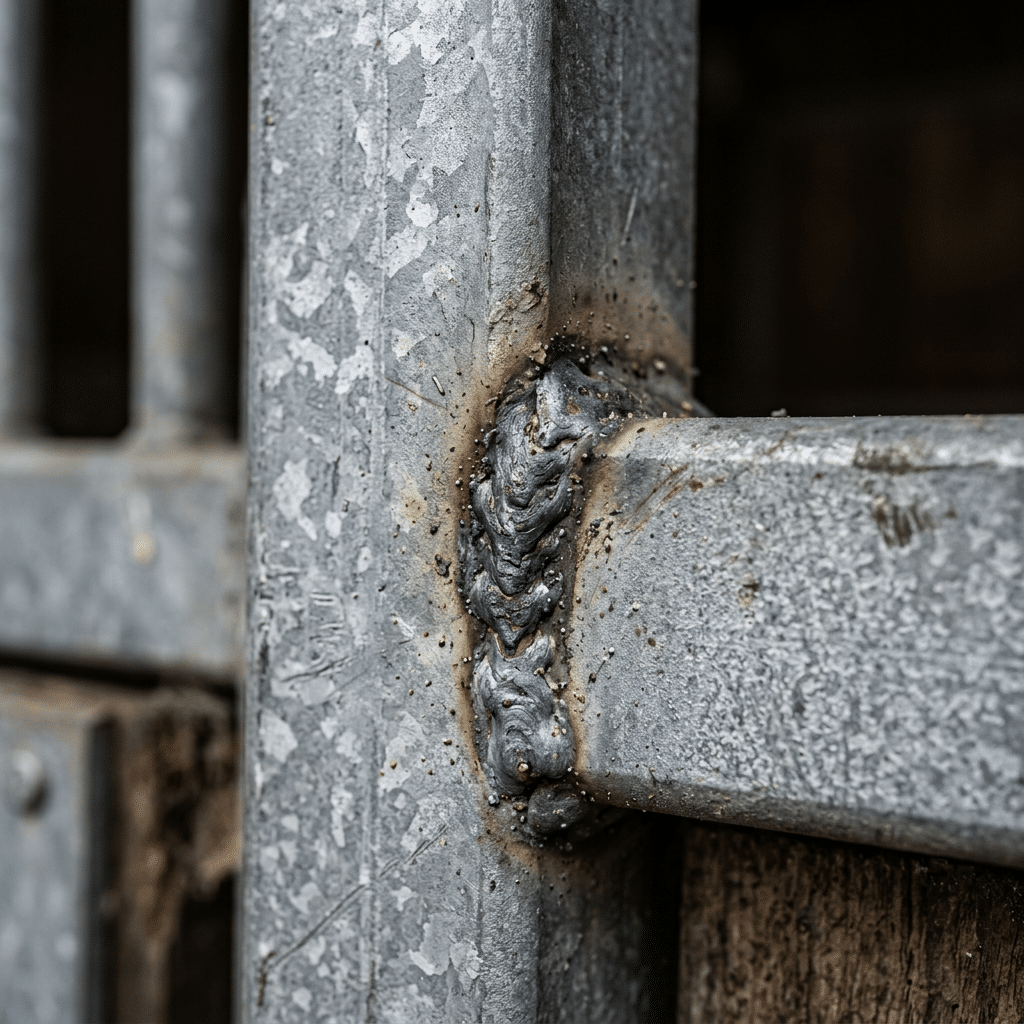
Two specifications carry the wet-climate argument. Hot-dip galvanized steel panel lines are built to a 20-year rust-protection specification and take the stock, wildlife and weather contact a British boundary sees; that protection matters most at the ground line, where the coating is in contact with wet soil longest. UV-resistant PVC is specified to a 15-year service life and suits yards where repainting cycles are the real cost. Panel and post gauge, tube size and the base fixing are stated per configuration on request — confirm them in writing against your own layout, since no catalog number substitutes for a drawing checked against your ground.
Commercially, a boundary is a panel order: fencing starts at a 50-panel MOQ with a 5-15% tiered volume discount on batch orders, and stabling starts at 10 sets. Global production and shipping run 4-6 weeks, with Sydney and Warsaw hub stock shortening expedited regional supply to 1-2 weeks — the Warsaw route is the one that matters for British and northern European projects, and it is what lets a wet-season job be closed in the dry window. Orders of 20 sets and up are assigned a dedicated regional account manager, which is where the drainage and fixing detail should be settled rather than discovered on site. Manufacturing runs on CNC machining and automated 360-degree welding at 500-plus sets a month under ISO 9001 and CE certification.
Häufig gestellte Fragen
How high should paddock fencing be in the UK?
BHS guidance generally recommends about 1.25 m with the lower rail roughly 0.5 m off the ground, with ranges by animal — around 1.08-1.38 m for horses and 1-1.3 m for ponies. Check the current edition before you order.
What is the cheapest safe way to fence a wet field?
Drain it first. Fall away from the line, a swale or pipe along the boundary and reinforcement at the gate cost less than the posts a waterlogged base pulls out, and they keep a visible primary fence honest.
Is galvanized steel or PVC better for a wet climate?
Both work if the base drains. Hot-dip galvanized steel carries a 20-year rust-protection specification and takes impact; UV-resistant PVC is specified to a 15-year service life and avoids repainting. Decide by position, not by preference.
Does a low fence line need a second one?
Where the minimum of a height range is used, BHS advises a double fence line with an electric line along the top of the boundary. A single low run on a busy boundary is the arrangement most likely to be questioned after an escape.
How long does a UK boundary order take to arrive?
Global orders run 4-6 weeks from a 50-panel minimum, and Warsaw hub stock shortens expedited European supply to 1-2 weeks. Book the wet-season work in the dry window rather than chasing it.
Schlussfolgerung
A wet-climate boundary is decided by water before it is decided by rails: drainage set along the line, a visible primary fence built to the heights the guidance expects, and a galvanized specification that keeps its coating at the ground line. Get those three right and the line is cheap to walk, inspect and keep.
Specify the line by position, put the drainage and fixing detail on the same drawing as the panels, and confirm gauge and clearance in writing against your own site — our UK solutions page und horse fence range are where that conversation starts.


 German
 English
 Spanish
 French
 Arabic
0 Kommentare