


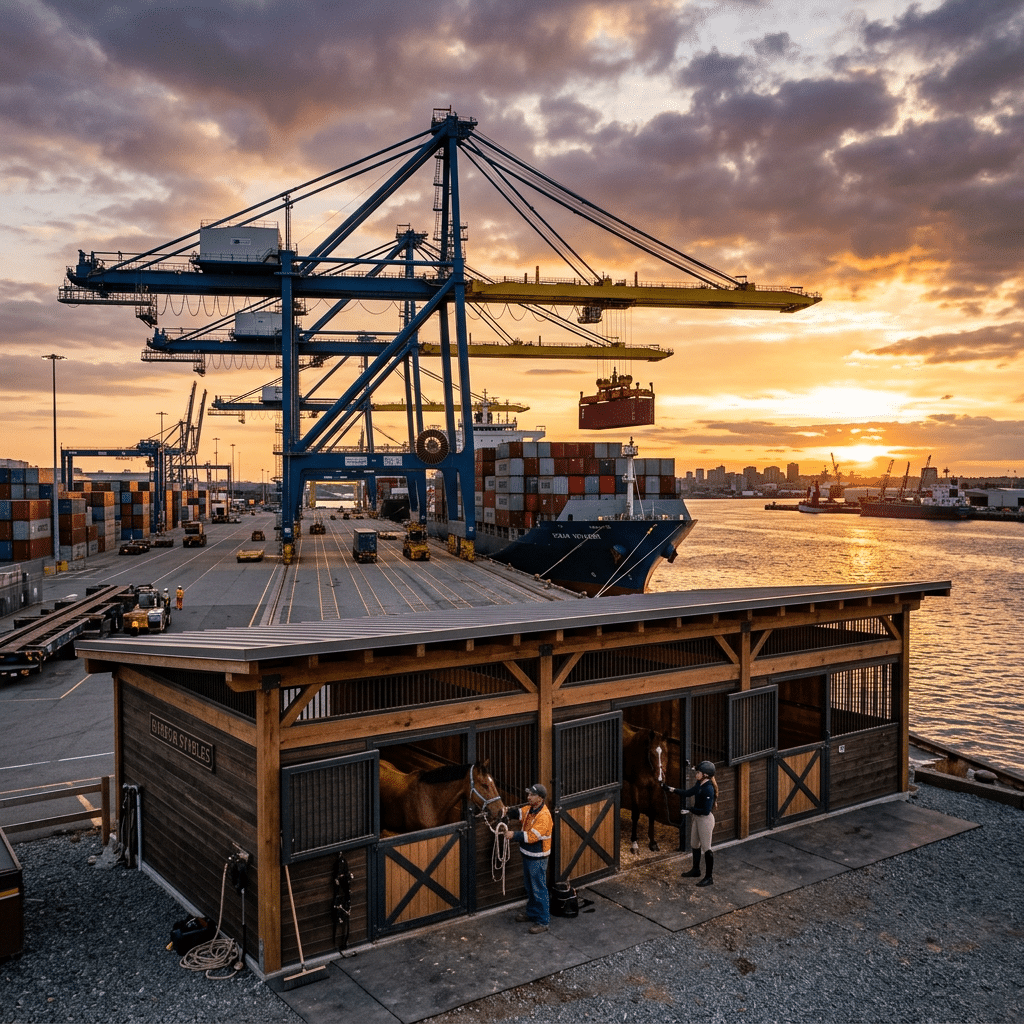
Sourcing infrastructure for Mounted Police Units demands engineering that far exceeds standard equestrian specifications. Generic stable systems frequently fail under the massive impact of 700kg draft-cross breeds, creating liability risks and expensive veterinary claims that drain public resources. Contractors bidding on government tenders must prioritize structural yield strength to prevent catastrophic failures during crowd control training or cold-weather deployments.
This report benchmarks heavy-duty manufacturers against the Q345B Niedrig legierter hochfester Stahl standard essential for institutional safety. We evaluate suppliers on their adherence to ISO 1461 Feuerverzinkung protocols and their ability to provide ISO 9001 material traceability, ensuring your project meets the rigorous audit requirements of public sector procurement.
The Unique Demands of Institutional Mounted Units
Schneller Vergleich
| Operational Area | Domain | Core Objective | Urteil |
|---|---|---|---|
| Training and Personnel Requirements | Personnel Development | High Proficiency & Safety | Rigorous qualification involving 3 years patrol experience ensures high competency, though requires long training lead times. |
| Operational Scope and Constraints | Standard Operating Procedures | Specialized Support | Functions as specialized support with discretionary safety authority; strictly prohibited from traffic stops to prevent misuse. |
| Resource and Infrastructure Management | Infrastructure & Logistics | Asset Preservation | Demands dedicated climate-controlled facilities and daily equipment management to ensure asset preservation and compliance. |
| Community and Crowd Management Advantages | Tactical & Community Relations | Visibility & Engagement | Provides superior vantage points and psychological advantages for crowd control while fostering positive community engagement. |
Training and Personnel Requirements
rigorous screening process and **comprehensive six-month curriculum** ensure high operational safety and competency.
Mounted officers face strict qualification pathways, starting with a mandatory minimum of three years of patrol experience. This prerequisite ensures candidates possess foundational law enforcement skills before specialized mounted training begins.
The subsequent six-month program covers equitation, equine health, and crowd control tactics. Both officers and horses must adhere to continuous performance standards to remain eligible for active deployment.
📊 Auf einen Blick:
- 📍 Kategorie: Personnel Development
- 🏭 Hauptschwerpunkt: High Proficiency & Safety
- 🌍 Key Stakeholders: Internal Departments
Warum wir sie ausgewählt haben:
| ✅ Die Siege | ⚠️ Abwägungen |
|---|---|
|
|
Operational Scope and Constraints
Defining clear boundaries **enhances safety and effectiveness** by keeping mounted units focused on crowd management rather than high-risk traffic stops.
Mounted teams operate primarily as support units, focusing on managing large crowds and community functions. Regulations explicitly prohibit them from conducting vehicular traffic stops, reducing the risk of collisions and unnecessary danger.
Officers retain the discretionary authority to assess whether specific assignments are safe for their horses. This operational flexibility ensures that the animal’s welfare and the officer’s safety remain the top priority during deployment.
📊 Auf einen Blick:
- 📍 Context: Standard Operating Procedures
- 🏭 Core Function: Specialized Support
- 🌍 Sector: Public Safety
Why It Matters:
| ✅ Die Siege | ⚠️ Abwägungen |
|---|---|
|
|
Resource and Infrastructure Management
Success relies on **specialized climate-controlled facilities** and rigorous maintenance protocols to ensure asset preservation.
Institutional mounted units require dedicated, climate-controlled stable facilities to function effectively. These structures must integrate specialized drainage systems and non-flammable materials to meet rigorous safety codes and ensure animal welfare.
Daily operations involve complex inventory management, spanning specialized equestrian tack (saddles, hoof picks) to standard police issue gear. Routine upkeep is essential to prevent rapid depreciation of these high-value assets.
📊 Auf einen Blick:
- 📍 Standort: Infrastructure & Logistics
- 🏭 Kernkraft: Asset Preservation
- 🌍 Wichtige Märkte: Facility Management
Warum wir sie ausgewählt haben:
| ✅ Die Siege | ⚠️ Abwägungen |
|---|---|
|
|
Community and Crowd Management Advantages
Mounted units deliver **superior crowd observation and de-escalation**, combining a high tactical vantage point with a psychological presence that vehicles cannot replicate.
The elevated vantage point allows officers to observe inaccessible areas and manage crowds effectively, while the horse’s visibility offers psychological advantages during protests. This unique stature acts as a natural barrier and provides command presence without immediate aggression.
Additionally, mounted patrols are more approachable than vehicles, facilitating positive community relationship-building. The biological nature of the mount often acts as an icebreaker, allowing officers to transition seamlessly from tactical enforcement to public outreach roles.
📊 Auf einen Blick:
- 📍 Standort: Tactical & Community Relations
- 🏭 Kernkraft: Visibility & Engagement
- 🌍 Wichtige Märkte: Community Outreach
Warum wir sie ausgewählt haben:
| ✅ Die Siege | ⚠️ Abwägungen |
|---|---|
|
|
Engineered for Durability: 20-Year Rust-Resistant Stables

The Unique Demands of Institutional Mounted Units
Institutional mounted units operate under distinct constraints that require infrastructure far surpassing standard equestrian facilities. We engineer our institutional systems using Q345B high-strength steel and maintenance-free materials to handle the immense impact of draft-cross breeds while ensuring officer safety and operational readiness.
Infrastructure Resilience for Heavy-Duty Draft Breeds
Mounted police units frequently utilize large draft-cross horses for their commanding physical presence during crowd control. These powerful animals exert massive impact forces on stable walls, far exceeding the stress loads found in private equestrian facilities. Standard Q235 steel often lacks the necessary yield strength for these critical applications. We exclusively engineer institutional stalls using Q345B Niedrig legierter hochfester Stahl, which provides superior impact toughness to prevent brittle fractures from heavy kicks, especially in freezing conditions.
Furthermore, safety protocols dictate a “Cast-Proof Design” to protect these high-value government service animals. We limit bottom gaps to approximately 50mm to prevent horses from trapping their legs when rolling. This critical specification ensures that the facility remains safe for the animals, minimizing the risk of injury and reducing potential veterinary claims.
Operational Readiness and Maintenance Protocols
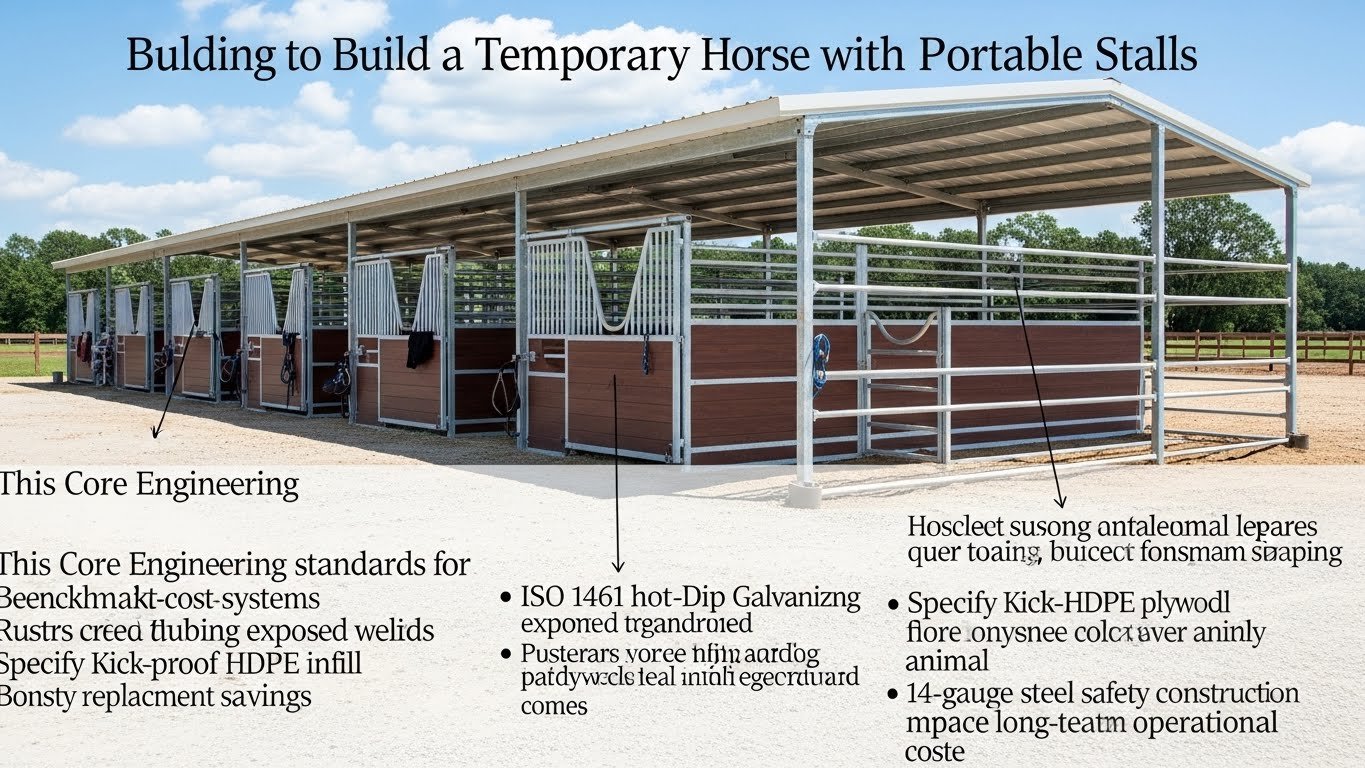
Departmental procedures require officers to maintain their equipment, but excessive facility upkeep detracts from essential patrol duties. Institutional stables must offer “Zero Maintenance” durability to maximize operational efficiency. We implement Feuerverzinkung nach der Herstellung (ISO 1461) to ensure structural longevity. With a zinc coating thickness exceeding 85 microns, our steel withstands daily high-pressure washdowns and corrosive ammonia exposure without developing red rust.
To comply with strict fire codes and hygiene standards, we recommend HDPE-Füllungsplanken over wood. These UV-stabilized materials resist bacteria, will not rot, and eliminate the risk of splintering. This ensures the facility remains safe and serviceable year-round, allowing personnel to focus on deployment readiness rather than facility repairs.
Steel Yield Strength: Q235B vs. Q345B for Draft Crosses
For heavy draft crosses used in mounted police work, standard structural steel often lacks the necessary yield threshold. We recommend upgrading to Q345B Niedrig legierter hochfester Stahl for these applications. With a yield strength of 345 MPa—47% higher than standard Q235B—this material ensures partitions withstand high-velocity impacts from 700kg+ animals and prevents brittle fracture in sub-zero operational environments.
The Structural Advantage of 345 MPa Low-Alloy Steel
Draft crosses utilized by mounted police units typically weigh over 700kg, generating impact forces that far exceed the capacity
of standard recreational stable equipment. Q345B steel provides a minimum yield strength of 345 MPa, delivering approximately 47% greater resistance to deformation compared to the 235 MPa limit of standard Q235B (A36 equivalent).
Wir entwickeln unsere Profi-Serie frames using Q345B to ensure they withstand direct high-velocity kicks from heavy breeds without permanent bending or structural compromise. The inclusion of microalloying elements like vanadium and titanium allows us to maintain a manageable 14er-Spur (2.0mm – 2.5mm) wall thickness while significantly boosting the safety factor for volatile animals.
Preventing Brittle Fracture in Cold Weather Deployments
Standard carbon steels like Q235B often lose ductility and suffer from reduced impact toughness when exposed to sub-zero temperatures typical of Northern Hemisphere winters. Q345B acts as a strategic cold-climate option because its low-alloy composition retains resilience in freezing conditions, preventing the steel from becoming brittle.
Specifying this grade eliminates the risk of catastrophic “shatter” failures where a metal post might snap rather than bend upon impact during a frost event. For government contracts in regions like Scandinavia or Canada, we mandate Q345B to protect high-value service animals from injury caused by material failure under thermal stress.
Tamper-Proof Hardware and Flush-Mounted Latches
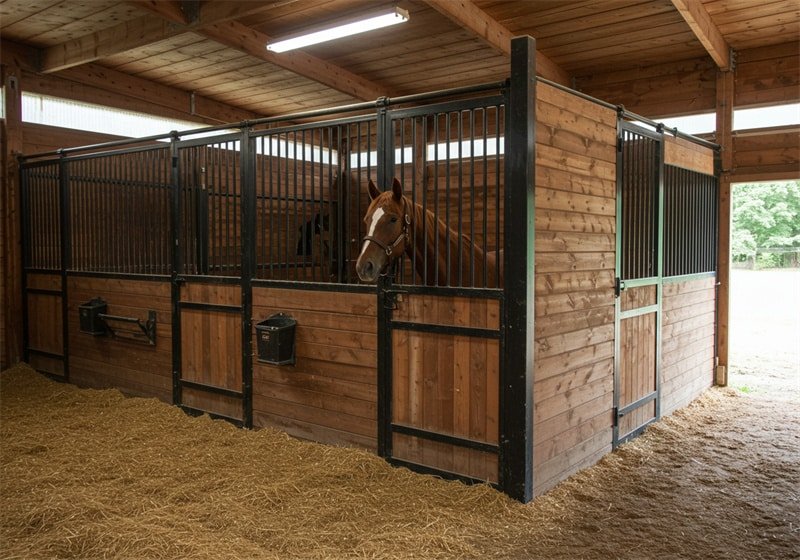
We engineer our latch systems to sit flush within 50mm RHS door posts, eliminating dangerous snag points for police horses equipped with bulky riot tack. By recessing locking mechanisms into heavy-duty Q345B steel frames and utilizing countersunk 304 Stainless Steel fasteners, we create a tamper-proof barrier that withstands both the brute force of draft-crosses and the corrosive environments of institutional stables.
Minimizing Injury Risks with Flush-Mounted Designs
Police horses often exit stables rapidly while wearing bulky riot tack or ceremonial harnesses. Protruding latches create dangerous snag points that can damage expensive equipment or injure the animal during deployment. Standard surface-mounted bolts risk catching on stirrups or reins, potentially causing panic in high-stakes situations where speed and safety are paramount.
We engineer our latch systems to sit flush within the 50mm RHS door posts. This design maintains a smooth surface profile, ensuring that a horse rubbing against the door frame will not encounter sharp metal edges or handles. This “Cast-Proof Design” philosophy extends to our hardware, ensuring that the stable environment remains safe even when animals are agitated or moving quickly.
Flush mounting protects the locking mechanism itself from direct impact. By recessing the hardware into the heavy-duty Q345B steel frame, we shield vital components from the brute force of kicks, preserving functionality over decades of use. This structural integration ensures that the locking system benefits from the superior yield strength of our cold-climate steel, preventing deformation that could jam doors during emergencies.
Engineering Tamper-Resistance for High-Stress Environments
Intelligent draft-crosses used in police work frequently attempt to manipulate door locks. We utilize complex, dual-action opening mechanisms that require human dexterity, effectively preventing horses from escaping or letting themselves out. This design creates a secure containment system that relies on cognitive complexity rather than just physical barriers to keep intelligent animals safe.
Tamper-proof construction extends to the assembly hardware. We use countersunk 304 Stainless Steel fasteners that sit below the surface level, preventing bored horses from using their teeth to loosen or remove bolts. This attention to detail ensures that the structural integrity of the front panel is not compromised by the animals’ curiosity or boredom during long periods of confinement.
Security relies on material resilience. Unlike standard zinc-plated hardware which rusts and weakens, our 304 Stainless Steel components withstand the corrosive ammonia environment of busy stables, ensuring the hardware remains secure and operable without maintenance. This corrosion resistance is critical for institutional facilities where maintenance windows are limited, guaranteeing that every bolt and latch performs reliably year after year.
DB’s ISO 9001 Traceability for Gov Contracts
We provide complete material traceability for government tenders, ensuring every stable front and partition meets strict ISO 9001 quality standards. From verifying the yield strength of Q345B steel to documenting zinc coating thickness, our audit-ready records protect procurement officers and ensure long-term public safety.
Verifiable Steel Origins and Production Standards
We enforce strict lot tracking for all Q345B Low Alloy High Strength Steel used in our heavy-duty systems. This material choice is critical for mounted police units and government facilities, as Q345B offers superior impact toughness compared to standard carbon steel, preventing brittle fractures during winter or under heavy impact. By recording specific heat numbers, we eliminate the risk of receiving sub-standard materials in critical infrastructure projects.
Our ISO 9001 protocols also extend to the galvaniz
ation process. We record specific zinc coating data for every batch to verify compliance with BS EN ISO 1461 standards. While standard tubing may vary, our structural parts consistently achieve an average coating greater than 85 microns. This level of detail ensures that the delivered product matches the specifications promised in the tender.
Audit-Ready Documentation for Public Tenders
Government procurement officers require validation that public funds are purchasing durable, safe equipment. We supply comprehensive quality logs, including weld inspection reports and ASTM B117 salt spray test results showing no red rust after 96 hours. These documents are prepared to streamline the approval process and provide immediate proof of quality.
These records provide the necessary audit trail to protect agencies from liability. By choosing our flat-pack, hot-dip galvanized system, departments can prove they have selected a product designed for longevity and safety, backed by data that stands up to scrutiny during internal or external audits.
Abschließende Überlegungen
Specifying standard carbon steel for police draft crosses invites structural failure and costly liability claims. Our Q345B Professional Series withstands the 700kg+ impact forces of riot horses, while ISO 1461 hot-dip galvanization eliminates annual maintenance budgets. Choosing audit-ready, heavy-duty infrastructure protects both your officers and the agency’s long-term procurement reputation.
Government tenders require verifiable proof of quality, not just promises. Contact our engineering team today to request material traceability logs and a precise flat-pack logistics quote for your bid. Secure your facility’s operational readiness with a manufacturer that delivers certified safety standards.
Häufig gestellte Fragen
How to build stables for police horses?
Police stables require heavy-duty engineering to handle high-traffic use and powerful breeds. We recommend our Professional Series using Q345B steel and 14-gauge tubing. Key features should include hot-dip galvanization (ISO 1461) for longevity and a ‘cast-proof’ design with minimal bottom gaps (approx. 50mm) to ensure animal safety.
What is Q345B high strength steel?
Q345B is a low alloy high-strength structural steel, equivalent to ASTM Grade 50. Unlike standard carbon steel, it offers superior impact toughness, particularly in cold climates. We use this material for institutional projects to prevent brittle fractures if a heavy draft cross kicks the stall frame during winter.
Are flush mount latches safer?
Yes, flush mount latches significantly reduce injury risks by eliminating protruding metal that can snag on tack, blankets, or a horse’s skin. For mounted units, they also provide a tamper-proof advantage. We manufacture these using 304 stainless steel to ensure smooth operation without rust or jamming.
How to win government equestrian contracts?
Winning tenders relies on proving compliance and durability. As a source factory, we support distributors with ISO 9001 quality traceability and ISO 1461 galvanizing certificates. Our flat-pack logistics (loading 30-45 sets per container) also help bidders lower total project costs to meet strict government budget requirements.
Stall size for draft cross police horses?
Draft crosses require more space than standard riding horses. We typically engineer 3.5m to 4.0m frontage panels for these breeds. Crucially, the frame must use minimum 2.0mm (14-gauge) wall thickness and reinforced bamboo infill (Janka hardness > 3000 lbf) to withstand the sheer mass and force of these animals.

 German
  English
  Spanish
  French
  Arabic
0 Kommentare