


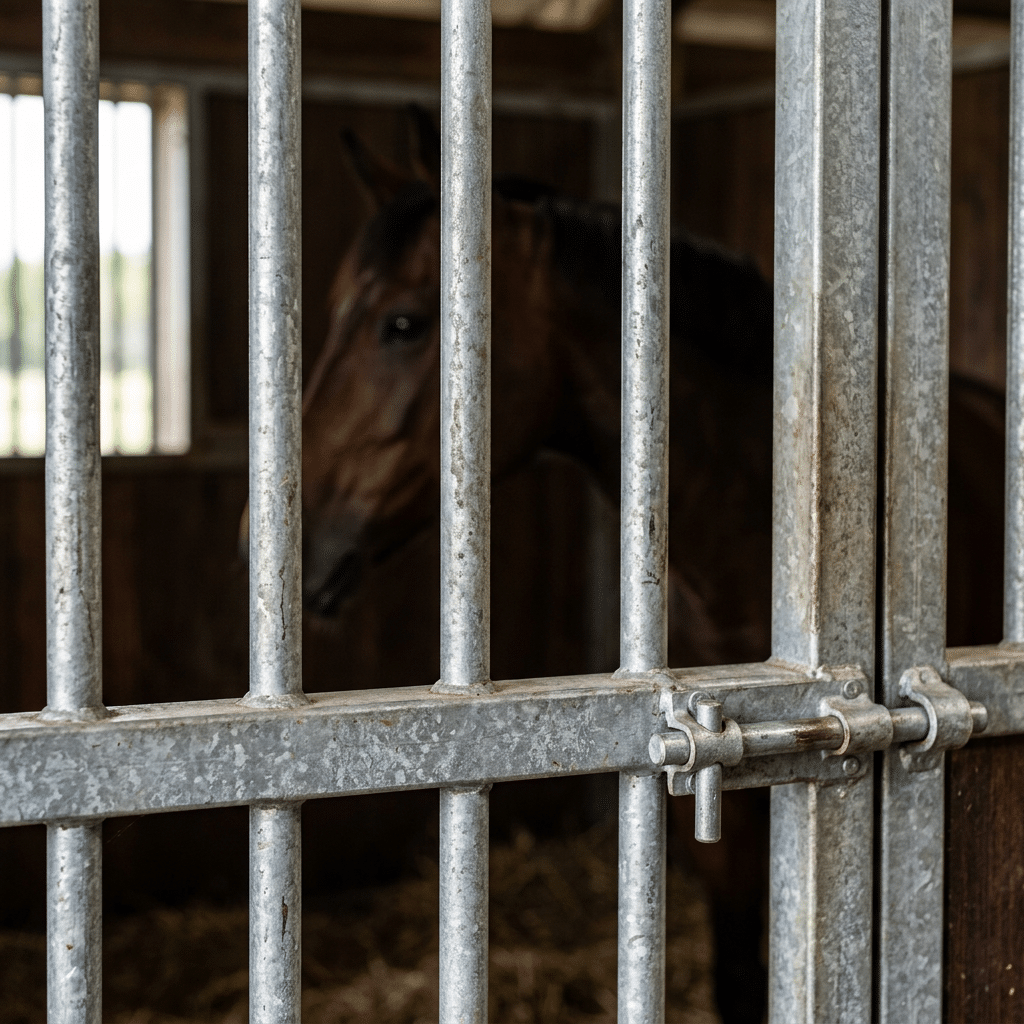
Sourcing for Equestrian Event Centers is a logistics operation where stall design directly impacts profitability. Inefficient, fully-welded stalls inflate freight costs and drain labor budgets with slow assembly. Without proper rust protection, these systems require replacement after only a few seasons, turning a capital asset into a recurring liability.
This analysis measures temporary stall systems against critical performance standards. We evaluate suppliers based on Hot-Dip Galvanization after fabrication and the use of power-washable HDPE infill. It also benchmarks the shipping density of flat-pack systems, a key factor in controlling project costs for large-scale deployments.
Das Mikroklima in einer Waschbucht: Wärme, Wasser und Gülle
A horse wash bay’s micro-climate mixes high humidity, temperature swings, and corrosive waste. This environment demands materials like galvanized steel and HDPE to prevent rust, rot, and structural failure.
The Challenge of Constant Moisture and Corrosion
A wash bay is a permanent splash zone. Constant water exposure requires effective drainage with proper slopes to stop water from pooling against structural components. Without it, water infiltrates joints and footings, causing long-term damage.
The combination of water, manure, and cleaning chemicals creates a uniquely corrosive slurry. This mixture actively attacks unprotected steel, causing rust, and seeps into porous materials like wood or concrete, leading to rot and degradation from within.
The persistent high humidity is an ideal breeding ground for mold and mildew. These growths aren’t just a hygiene issue; they can compromise the integrity of porous infill materials and create an unhealthy environment for both horses and handlers.
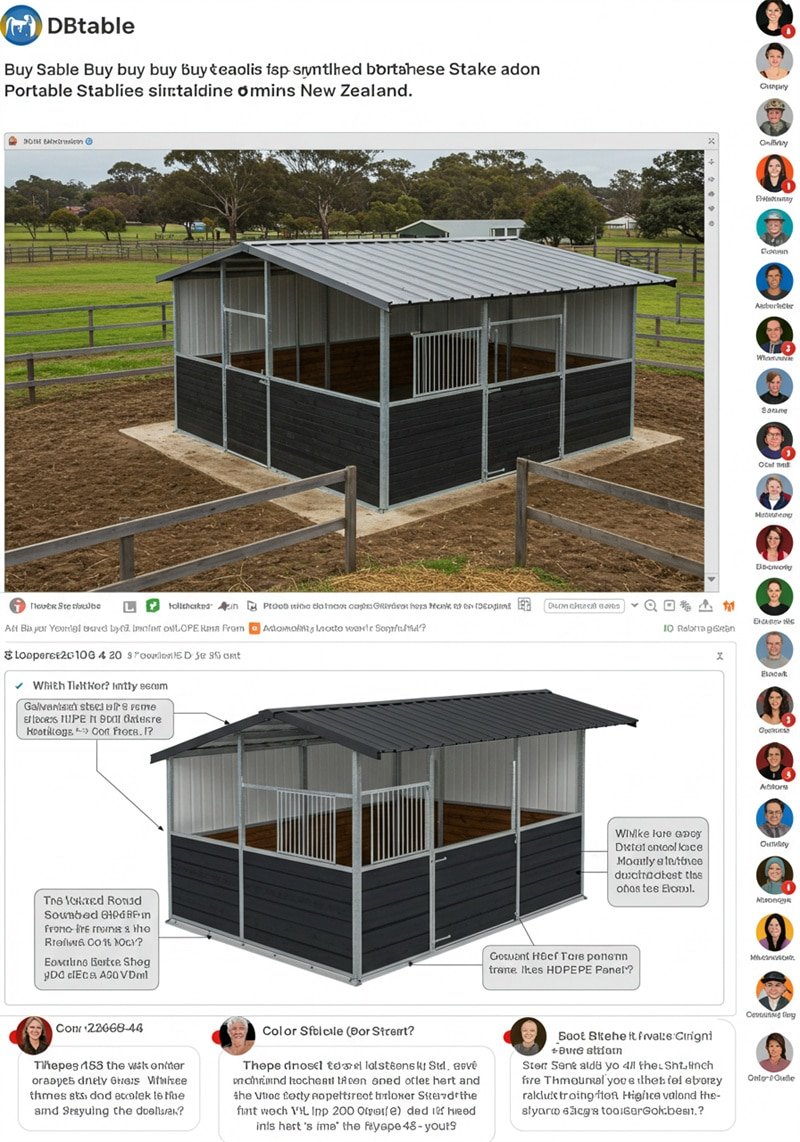
Engineering Materials for Extreme Durability
The only way for steel to survive is through complete protective coating. We use Hot-Dip Galvanization after all welding and fabrication is complete, conforming to ISO 1461 standards. This process ensures every edge and weld is sealed against moisture, providing essential rust protection.
Using a non-porous infill like HDPE is non-negotiable. It does not absorb water, so it can’t rot, swell, or harbor mold deep within its structure. The surface is easy to sanitize, preventing bacteria buildup and maintaining a clean facility.
A structure is only as strong as its weakest point. All bolts, connectors, and fasteners must be 304 Stainless Steel. Using anything less creates rust points that will bleed onto the frame and eventually compromise the structural connections.
Mauern aus Beton: Porosität, Risse und schwierige Reinigung
Concrete walls are porous, crack easily, and require costly coatings. Modern infills like impact-absorbing HDPE and dense bamboo are far better for safety and maintenance.
The Challenge of Porous and Brittle Surfaces
Concrete block seems like a tough, traditional choice, but it fails in
a modern equestrian environment. Its core problem is porosity. The material acts like a sponge, absorbing moisture, urine, and cleaning agents. This makes true sanitation impossible and causes any paint or coating to bubble and peel off within a short time.
Standard concrete block walls are also brittle. They lack the flexural strength to handle a direct kick from a horse and will crack. The only way to make them strong enough is to fill every single core with grout and rebar, a process that dramatically increases the labor and material cost beyond initial estimates.
Even after construction, maintaining a clean, non-porous surface requires a constant battle. You have to use specialized block fillers to smooth the surface, followed by multiple coats of expensive industrial-grade coatings. This turns the wall into a recurring maintenance liability.
Modern Alternatives: Impact-Absorbing and Easy-Clean Infill
Instead of trying to patch the flaws of concrete, engineered infill materials solve these problems from the start. They are designed specifically for the high-stress environment of a horse stable.
HDPE (High-Density Polyethylene) infill provides a completely non-porous and impact-absorbing surface. It cannot absorb moisture, so it won’t rot or harbor mold. It’s a true zero-maintenance solution; you just hose it down. Its ability to absorb impact also makes it much safer for the horse than a rigid block wall.
For superior durability, high-density strand-woven bamboo is an excellent choice. It’s three times harder than oak, with a Janka hardness rating over 3000 lbf, making it exceptionally resistant to damage. The dense composition also makes it highly resistant to mold and rot. These modern infills create a safer, cleaner, and lower-maintenance stable that concrete simply can’t compete with.
Engineered Horse Stables for Lasting Value

Gummimatten an Wänden: Die Schimmel- und Mehltau-Falle
Rubber mats bolted to stall walls trap moisture and create a hidden breeding ground for mold. This dark, stagnant environment poses a direct risk to equine respiratory health.
How Trapped Moisture Fuels Hidden Mold Growth
Stall owners often install rubber mats on walls thinking they’re adding protection. The reality is they’re creating a perfect micro-environment for mold. Moisture from humidity, condensation, or routine stall washing inevitably seeps behind the mat.
The rubber acts as a non-breathable barrier, sealing that moisture against the underlying wall. Wood or concrete can’t dry out. This combination of trapped, stagnant water and a complete lack of airflow creates the ideal conditions for mold and mildew spores to thrive unseen, directly impacting air quality.
Why High-Density Bamboo Infill Resists Mold and Rot
A properly engineered stall doesn’t need a rubber liner to protect its walls. DB Stable systems use high-density, strand-woven bamboo planks between 28mm and 38mm thick. This material is naturally resistant to mold and rot, a sharp contrast to porous wood that absorbs and holds moisture.
With a Janka hardness rating over 3000 lbf, this bamboo is three times harder than oak and doesn’t need extra protection. Most importantly, the solid plank construction completely eliminates the hidden gaps found behind tacked-on rubber mats. There is no space for moisture to get trapped, which ensures a far healthier and drier stall environment.
HDPE-Kunststoff: 100% Hydrophob und waschmaschinenfest
HDPE is a non-porous plastic that repels water, preventing rot and mold. Its high impact and chemical resistance allows for power-washing, making it a zero-maintenance solution for horse stalls.
| HDPE Material Property | Performance Specification |
|---|---|
| Wasserabsorption | <0.05% (Effectively zero absorption; prevents swelling, rot, and mold) |
| Surface Property | Hydrophobic (Forces water and grime to bead up and run off) |
| Chemical Resistance</ td> | Inert to common barn acids, bases, and cleaning chemicals |
| DB Stable Thickness | 28mm-32mm (Engineered for high impact absorption from kicks) |
| Durability Feature | UV Stabilized (Prevents cracking and degradation from direct sunlight) |
Why HDPE Naturally Repels Water and Grime
High-Density Polyethylene (HDPE) is a solid, non-porous material. Unlike wood or concrete, it has no microscopic pores for moisture to penetrate. Its water absorption rate is less than 0.05%, which means it simply cannot swell, rot, or harbor the bacteria that lead to mold growth. Liquids bead up on its surface and run right off.
This makes cleaning incredibly simple. Manure, urine, and dirt stay on the surface instead of soaking in, allowing a high-pressure washer to remove everything without damaging the material. It’s also chemically inert, so disinfectants and common barn cleaning agents won’t cause it to degrade over time.
DB Stable Specification: 28mm UV-Stabilized Boards
We don’t just use any HDPE. Our infill boards are engineered to a substantial thickness of 28mm to 32mm. This provides the mass needed to absorb and dissipate the force of a powerful kick, protecting both the horse and the stall structure. Thinner boards can crack or buckle under repeated stress.
All our HDPE boards also include UV stabilizers mixed directly into the polymer. In markets like Australia, intense sunlight can make standard plastics brittle and cause them to crack within a few years. Our formulation ensures the material retains its flexibility and strength, even with constant exposure. This combination of toughness, water repellency, and UV resistance is the foundation of our “Zero Maintenance” infill promise.
HDG Stahlzargen: Überleben in der Spritzwasserzone
The ‘splash zone’ in barns rapidly corrodes steel. Hot-dip galvanizing the entire frame after welding is the only reliable defense, protecting vulnerable welds for decades.
The Corrosion Challenge in High-Moisture Barns
Any area in a barn with constant moisture is a “splash zone.” Think of wash bays, stall fronts near water buckets, and outdoor paddock panels. This high-humidity environment is a breeding ground for rust, which aggressively attacks standard steel frames.
The real points of failure are the welds and joints. Without complete protection, these spots are the first to corrode, compromising the structural integrity of the entire panel and leading to expensive repairs or replacements.
The Advantage of Galvanizing After Fabrication
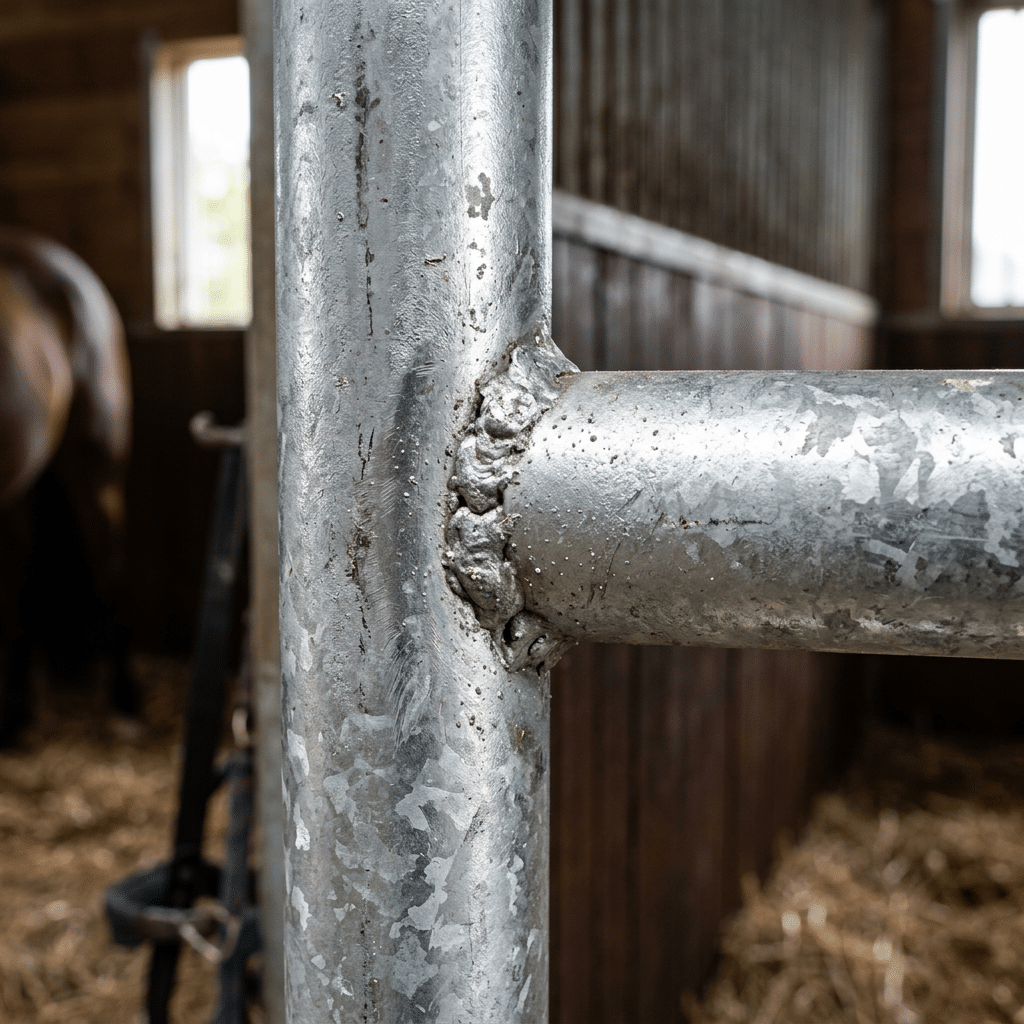
There’s a massive difference between building with pre-galvanized tubes and our method: hot-dip galvanizing after fabrication. We weld the entire frame first from raw structural steel. Then, we dip the completed structure into a bath of molten zinc. This process creates a metallurgical bond, sealing every surface, corner, and weld seam.
This isn’t just a coating; it’s a complete shield. The process strictly conforms to BS EN ISO 1461, achieving an average zinc coating thickness of over 70 microns on all tubing. This heavy-duty layer provides decades of corrosion defense, ensuring the frame remains safe and structurally sound even in the wettest conditions.
Häufig gestellte Fragen
Welche Materialien eignen sich am besten für die Wände von Pferdewaschplätzen?
The best materials are waterproof, durable, and safe. Your top choices are fiberglass-reinforced panels (FRP), HDPE (High-Density Polyethylene), and concrete blocks coated with a quality waterproof sealant. These materials don’t rot, are easy to clean, and stand up to constant moisture. Avoid standard metal panels; they rust and can make loud noises that spook horses when hit with water spray.
Can rubber mats be placed on barn walls for protection?
Yes, but only in dry stalls, not wash bays. In a standard stall, rubber wall liners protect the structure from kicks and provide a cushioning layer for the horse. In a wash bay, this is a bad idea. The mats trap moisture against the wall, creating a perfect environment for mold and mildew to grow behind them where you can’t see it.
How do you properly waterproof a horse wash bay?
Proper waterproofing requires a system approach. First, use fully waterproof wall panels like HDPE or FRP. Second, install a sloped concrete floor with a textured, non-slip finish to direct water away. Third, build a reliable drainage system with a grate that is easy to clean and catches hair and debris before it clogs your pipes.
Can HDPE be molded for custom stable components?
Absolutely. HDPE is excellent for injection molding. It requires specific high-temperature processing, but the result is a strong, warp-resistant component. This process allows for the creation of durable and cost-effective stable parts, like our infill boards, that hold up extremely well against physical impact and chemical exposure.
Which is better for wash stall floors: concrete or rubber mats?
The best solution uses both. You start with a sloped, textured concrete slab as the foundation for durability and proper drainage. Then you lay heavy-duty, perforated rubber mats on top. This combination gives you a floor that is easy to clean while providing superior traction and reducing strain on the horse’s legs.
Abschließende Überlegungen
Generic stalls fail in high-use environments, creating rust and maintenance liabilities that damage your reputation. Our commitment to post-weld Hot-Dip Galvanizing (ISO 1461) and zero-maintenance HDPE infill is the only way to guarantee structural integrity. This ensures your inventory remains a safe, dependable asset for years, not a recurring cost.
The only way to confirm long-term durability is to test the materials yourself. We facilitate trial orders so you can directly evaluate our galvanized finish and HDPE board thickness against any competitor. Contact our project team to get a quote and discuss the logistics for your next event.

 German
  English
  Spanish
  French
  Arabic
0 Kommentare