


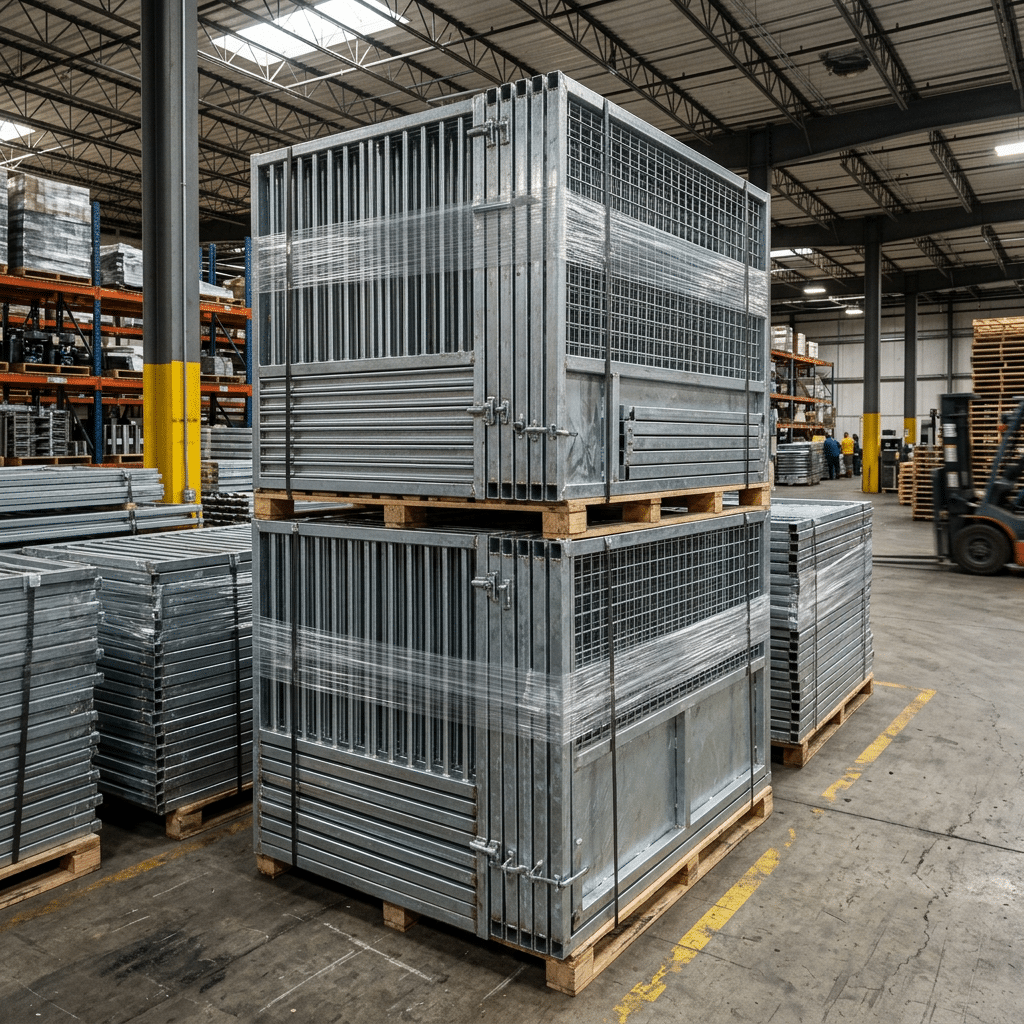
A viable boarding facility ROI is directly threatened by premature material failure. Standard building components corrode and rot in high-humidity equestrian environments, triggering unplanned repair costs that systematically destroy payback period calculations and erode long-term asset value.
This analysis benchmarks material choices against commercial engineering standards. We model the financial impact of specifying ISO 1461 hot-dip galvanized steel and non-porous infills like HDPE, providing an empirical framework for projecting accurate operational costs.
Das Mikroklima in einer Waschbucht: Wärme, Wasser und Gülle
A wash bay’s high-humidity, high-contamination environment requires managing water, waste, and temperature to avoid regulatory risks, high labor costs, and material degradation.
Managing Runoff
for Environmental and Operational Control
Uncontrolled runoff from a wash bay is a significant liability. The water carries manure particles and sediment that easily contaminate local groundwater and surface water supplies. This isn’t just an environmental problem; it’s a financial one. Facilities with non-compliant water management systems face serious regulatory penalties and legal action.
A properly designed system isn’t an expense, it’s a control measure. Effective drainage, using gutters and sealed pipelines, is critical. It works by separating contaminated wash water from clean rainwater, which dramatically reduces mud, simplifies waste handling, and keeps your operation on the right side of compliance.
Material Selection for Corrosive, High-Humidity Zones
The constant moisture and corrosive manure in a wash bay will destroy standard building materials. Protecting your investment starts with the steel framework. The only reliable solution is Hot-Dip Galvanization *After Fabrication*. This process ensures every cut, corner, and weld is coated in a protective zinc layer conforming to BS EN ISO 1461, creating a barrier against rust.
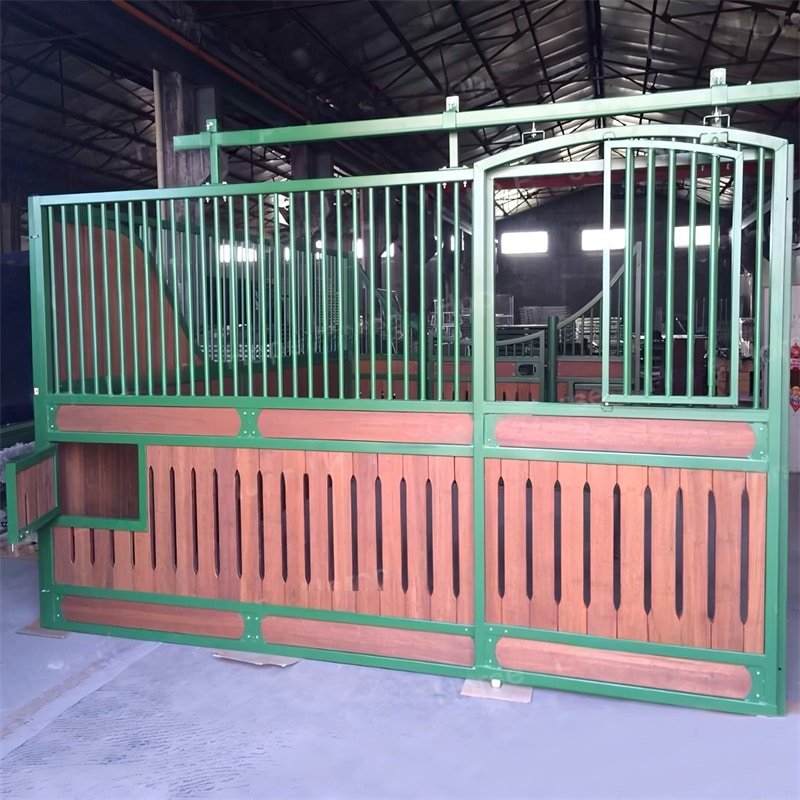
The infill material is just as important. Waterproof options like High-Density Polyethylene (HDPE) are essential. HDPE panels don’t absorb moisture, so they can’t rot, warp, or degrade over time. This makes them a true zero-maintenance solution. Choosing robust materials from the start eliminates the cycle of frequent repairs and replacements, directly lowering the facility’s long-term operational costs.
Mauern aus Beton: Porosität, Risse und schwierige Reinigung
Concrete’s porous nature lets it absorb moisture through capillary action. This process leads to cracking, mold growth, and high maintenance costs, creating a long-term structural liability.
How Capillary Action Causes Structural Decay
Concrete is not as solid as it looks. The curing process creates a microscopic network of capillary pores. These tiny channels act like straws, allowing water vapor and moisture to pass straight through the wall.
This structure enables capillary action, a process where the concrete actively pulls moisture up from the ground and into the wall. It’s a continuous feed o
f water into the core of the structure, day after day.
As water travels through these pores, it dissolves the calcium compounds that hold the concrete together. This enlarges the pore network and weakens the material from the inside out, accelerating its decay. The end result is cracking, which provides the perfect dark, damp environment for mold. The acid produced by mold then eats away at the concrete, making the problem even worse.
HDPE and Bamboo: A Zero-Maintenance Alternative
Unlike concrete, engineered infill materials solve the moisture problem at its source. They are designed to be non-porous and resistant to the conditions found in equestrian facilities.
- HDPE Infill: Our High-Density Polyethylene planks are completely non-porous. They block moisture absorption and stop capillary action entirely. The surface is genuinely ‘Zero Maintenance’—it won’t support mold or algae and is simple to clean.
- High-Density Bamboo: DB Stable’s strand woven bamboo is a natural alternative that is inherently resistant to mold and rot. Its dense composition prevents the water penetration that destroys concrete over time.
Get Durable, Compliant Stables Shipped Globally
Erkunden Sie die Optionen für benutzerdefinierte Stallungen →
Gummimatten an Wänden: Die Schimmel- und Mehltau-Falle
Installing rubber mats directly on walls traps moisture, causing the underlying wall to grow mold. This leads to hidden structural damage and poor air quality for horses.
How Trapped Moisture Damages Wall Substrates
The problem isn’t the rubber itself, it’s the installation. When you press a rubber mat flush against a stall wall, you eliminate all air circulation. This creates a sealed pocket that traps any humidity, condensation, or water from wash-downs. The wall never gets a chance to dry out.
That trapped moisture saturates the wall substrate—whether it’s plywood or drywall. The damp, dark environment turns the organic material of the wall into a perfect food source for mold and mildew spores. The rubber mat hides this process completely.
This hidden damage silently compromises the structural integrity of your barn. By the time you notice a problem, you’re not just replacing a mat; you’re dealing with extensive rot and costly structural repairs that could have been avoided.
The Alternative: High-Density, Mold-Resistant Bamboo Infill
A better approach is to use a material that doesn’t rely on being sealed against a vulnerable substrate. Our high-density, strand-woven bamboo is naturally resistant to the mold and rot that destroys traditional porous wood infills. It doesn’t act as a food source for mold to begin with.
Critically, our bamboo planks are integrated into a steel frame system. They aren’t sealed against a solid wall. This design allows for natural air movement around the infill, preventing moisture from ever getting trapped and ensuring the structure can breathe.
This material is also exceptionally durable. With a Janka Hardness rating over 3000 lbf, it is three times harder than Oak. You get extreme impact resistance without creating the moisture trap that rubber mats on walls introduce.
HDPE-Kunststoff: 100% Hydrophob und waschmaschinenfest
HDPE is a non-porous plastic that repels water, stopping rot and mold. It’s power-washable, making it a true ‘zero maintenance’ solution for hygienic equestrian facilities.
| Attribut | Traditionelle Holzausfachung | DB Stable HDPE Infill |
|---|---|---|
| Wasserabsorption | Porous; absorbs urine and water. | Non-porous; 100% hydrophobic. |
| Hygiene Risk | Breeding ground for mold and bacteria. | Inert surface prevents pathogen growth. |
| Reinigungsmethode | Difficult to sanitize; requires scraping. | Power-washable for complete sanitation. |
| Long-Term Maintenance | Requires sealing and painting; prone to rot. | Zero; requires no sealing or painting. |
Why Water Resistance is Critical for Stall Hygiene
Traditional stall materials like wood create serious hygiene problems. Wood is porous, so it acts like a sponge, absorbing urine and water from wash-downs. This constant moisture turns the stall walls into a breeding ground for bacteria, mold, and fungus, which can lead to respiratory issues and infections. The ammonia buildup from trapped urine is particularly damaging to a horse’s health.
HDPE completely avoids this problem. Its surface is 100% non-porous and hydrophobic, meaning it repels all liquids. Urine, water, and manure stay on the surface instead of soaking in. This makes sanitation simple and effective. A quick wash-down removes all waste completely, leaving no residue behind to harbor pathogens. This clean environment directly improves equine health and can even reduce the amount of bedding needed to absorb moisture.
The ‘Zero Maintenance’ Standard of UV-Stabilized HDPE
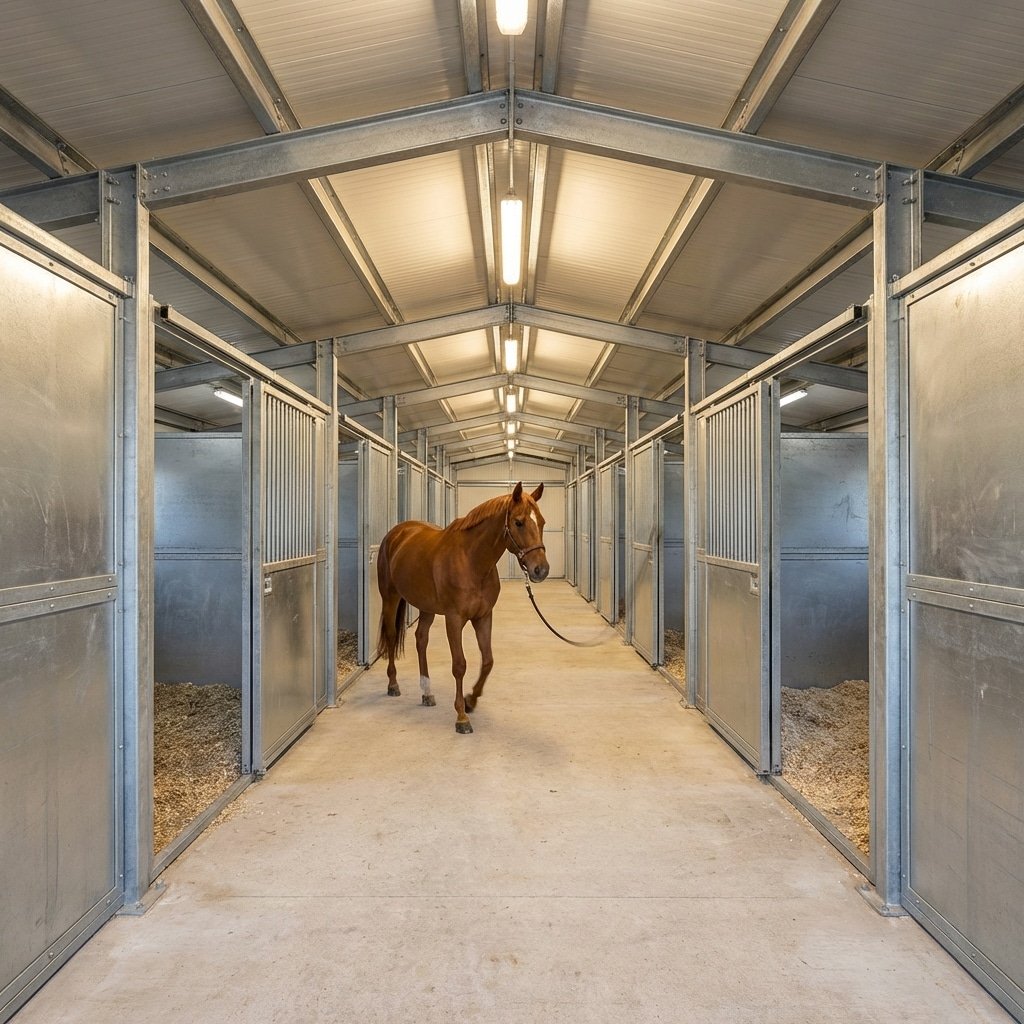
Our stalls use thick, 28mm to 32mm HDPE planks designed for high-impact commercial environments. This material is genuinely kick-proof. It absorbs impact without cracking, splintering, or breaking like wood or brittle plastics. This durability is a baseline requirement for any professional facility focused on animal safety and long-term asset value.
Each board is formulated with UV stabilizers during production. This is non-negotiable for facilities in sun-intensive markets like Australia, as it prevents the material from becoming brittle or degrading over years of sun exposure. The ability to hit the planks with a power washer for rapid sanitation fulfills our “Zero Maintenance” promise. Facility managers never need to budget time or money for future painting, sealing, or board replacement due to rot. The material looks good and performs its function from day one, for years to come.
HDG Stahlzargen: Überleben in der Spritzwasserzone
The splash zone’s wet-and-dry salt spray cycle is the most corrosive environment for steel. Frames survive by getting a thick zinc coating applied after fabrication, as specified by ISO 1461.
The Science of Splash Zone Corrosion
Corrosion in coastal or high-humidity areas isn’t just about getting wet. It’s a cyclical process. Salt spray wets the steel surface, reacts with the protective zinc coating, and then dries out. This cycle washes away the protective layer it just created, exposing fresh zinc to the next wave of salt.
This constant wetting and drying eats through the zinc coating much faster than if the steel were fully submerged. Field research shows that steel with inferior protection can show visible rust within 5 to 7 years in direct coastal exposure.
Engineering a Defense with ISO 1461 Galvanization
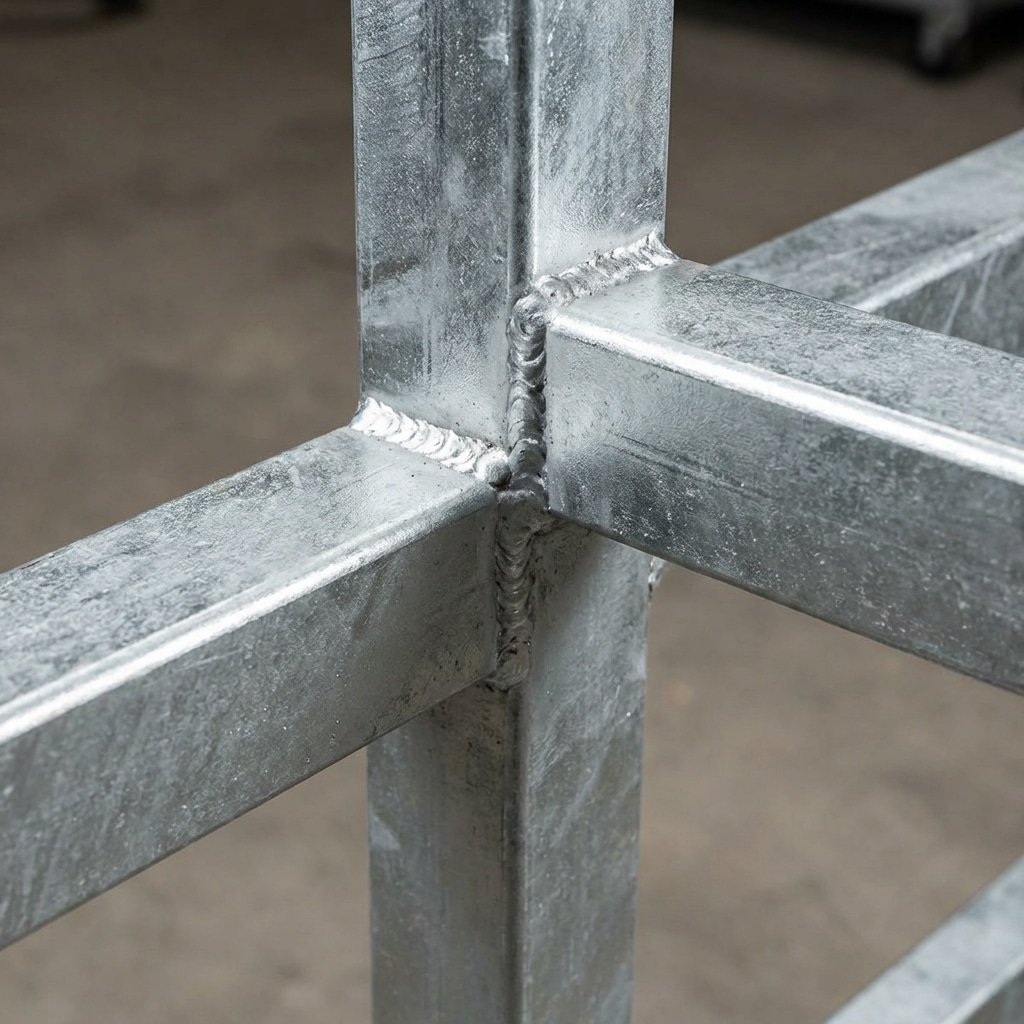
To fight this, every DB Stable frame undergoes Hot-Dip Galvanization *After Fabrication*. We weld the entire panel first, then dip it into molten zinc. This process conforms to the BS EN ISO 1461 standard, which is critical for structural integrity in corrosive environments.
The result is a thick, uniform zinc coating of over 70 microns that covers every surface, including the welds which are typical failure points. This creates a robust sacrificial barrier designed to withstand prolonged salt spray exposure and protect the steel structure underneath.
Häufig gestellte Fragen
Welche Materialien eignen sich am besten für die Wände von Pferdewaschplätzen?
The best materials for wash rack walls are fiberglass-reinforced panels (FRP), Tuff Board, and waterproof-coated concrete blocks. These options provide excellent water resistance, are easy to clean, and maintain a smooth, safe surface. High-density polyethylene (HDPE) is another durable choice. Materials like metal panels should be avoided because they can rust and create loud noises that may startle horses.
Kann man Gummimatten an Stallwänden anbringen?
Yes, rubber mats are specifically designed for barn walls in professional facilities. These mats protect the wall’s structure from kicks and impacts while also cushioning a horse’s joints, reducing the risk of injury. They are a practical investment for improving horse welfare and lowering maintenance costs.
Wie kann man eine Pferdewaschanlage abdichten?
Waterproofing a horse wash bay involves three key steps: protecting the walls, managing water flow, and sealing all joints. Use waterproof wall panels like fiberglass or Tuff Board. Install a properly sloped concrete floor (at least 6 inches thick) with a central drain to direct water away efficiently. Finally, caulk all corners, edges, and screw heads with silicone, performing annual checks to maintain the seal.
Can HDPE be used for custom molded parts?
Yes, HDPE is an excellent and cost-effective material for injection molding. It is relatively easy to mold due to its good flow properties. While its high shrinkage rate requires careful design to prevent warping, the final parts deliver great stiffness, high impact resistance (even in low temperatures), and strong chemical and moisture resistance.
Abschließende Überlegungen
Choosing a barn based on upfront price ignores the real cost of ownership. Our standard is Hot-Dip Galvanization After Fabrication (ISO 1461) and Zero Maintenance HDPE infill. This isn’t an upgrade; it’s the baseline for eliminating the rot, rust, and repair costs that destroy your payback period.
Your ROI calculations depend on verified material integrity. We recommend a small trial order to confirm our engineering and finish firsthand. Contact our team to get the technical specifications for your next project or to discuss your private label requirements.

 German
  English
  Spanish
  French
  Arabic
0 Kommentare