

An insulated stall is sold on warmth. Far less often it is drawn with an answer to the second question, which is where the moisture goes. A vapor barrier is a layer that slows warm, moisture-carrying air from reaching a cold surface inside the panel, and it is what decides whether condensation forms on the face you can wipe down, or inside the assembly and behind the liner where nobody sees it until something is rotten or rusting.
Look at what the published record for this manufacturer actually covers, and where it stops. Two durability figures are stated: 20 years of rust resistance for hot-dip galvanized steel, and 15 years of service life for UV-resistant PVC. Stall liners are documented as bamboo, HDPE or pine. No thermal resistance value, no panel build-up and no vapor-retarder specification is published for the stabling range. That is a materials record rather than an assembly drawing. In a cold barn, the assembly is where condensation is decided.
Key Takeaways
- A vapor control layer is a drawing decision, not a product feature. Nothing in a published materials list tells you whether a stall panel carries a retarder, or on which face it sits.
- Ask which side, in one sentence. A barrier placed on the wrong face can trap moisture inside the panel rather than keep it out of the assembly.
- Continuity fails at four places: panel-to-panel joints, window and door openings, liner fixings, and the floor-to-wall junction.
- Two figures are published; thermal build-up is not. The 20-year hot-dip galvanized steel and 15-year UV-resistant PVC statements describe materials, not an insulated wall section.
- Climate changes the question, not the physics. A stated -10°C winter exposure in Poland and the drainage-led posture for the UK and New Zealand are the markets where condensation is raised in buyer conversations.
- What the water lands on is also a specification. Bamboo, HDPE and pine liners behave differently against a damp face, and none of them is a vapor control layer.
What the barrier is doing in a stall
A horse produces moisture continuously. Water vapor from the lungs, damp from bedding, and moisture rising from an unsealed floor all load the air inside a stall with more water than the same volume of cold outside air can hold. Warm air moves outward through a wall assembly carrying that vapor. Where it hits a surface cold enough to fall below the dew point, it stops being vapor.
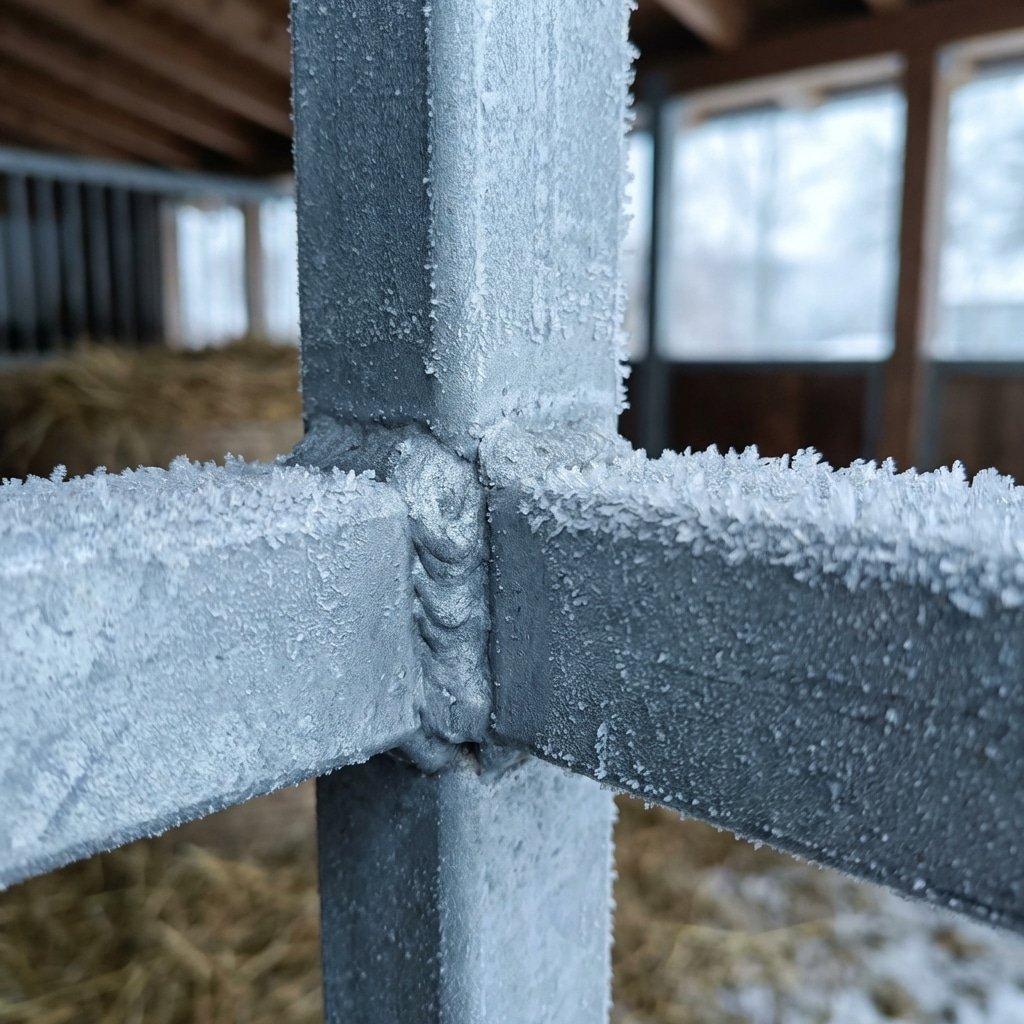
That is the whole mechanism, and it explains why the failure is rarely dramatic in year one. Wet insulation loses thermal performance and dries poorly inside a closed panel. Timber darkens and swells at the face. Steel fasteners and welded nodes corrode from the wrong side, and the published 20-year hot-dip galvanized statement does not say whether it covers a permanently damp cavity — ask which exposure it assumes. In a stall lined with bamboo or pine, the liner hides the evidence until the surface is stained.
Which side, and who has to draw it
The practical question is not whether a barrier exists but which face of the assembly it sits on, because that follows the direction the moisture is driven. In a heated stall in a cold market, vapor generally moves from inside the box outward, so the retarder belongs on the warm-inward side of the insulated section. In an unheated shed row that breathes through gaps and openings, the same layer can be a liability if it closes the assembly on the side where the structure needs to dry.
Nobody publishes a vapor-control layer as standard in the material record here, so treat it as something you ask for. As far as that record goes, stall systems are specified around sizes, liner material and hardware, and a thermal build-up usually originates with the barn designer or the local builder. The failure mode is a handoff gap: the drawing has a wall section, the order has a panel spec, and the two never get reconciled line by line. Make one party own the reconciliation and name them in writing. Choosing the insulation level itself is treated separately on this site in insulated horse stalls for extreme climates; this article stays with what the drawings and the order paperwork have to state.
Four details that decide continuity
A vapor control layer is only as good as its weakest interruption, and a stall row is mostly interruptions. Panels meet each other, openings cut through them, liners are screwed back through the assembly, and the bottom edge has to meet a floor that is deliberately wet-work. Each of the four has to appear on a drawing rather than be left to the fitter on the day.
| Einzelheiten | What the drawing has to state | Who signs it off |
|---|---|---|
| Panel-to-panel joint | Whether the layer is continuous across the vertical joint, and what closes the gap | Panel manufacturer, on a production drawing |
| Window and door openings | How the layer turns at head, sill and reveal, and what seals the frame | Designer or specifier |
| Liner fixings | Whether brackets penetrate the layer, and what is sealed on which face | Installer method statement |
| Floor-to-wall junction | How the wall meets the slab, drain line and mat edge without bridging | Site contractor |

Ask for these four as marked sections, not as reassurance. A supplier who can point at the joint detail has designed the assembly. A supplier who answers the question from the liner catalog has answered a different one.
What the published record covers, and what to ask
Read the published material for what it is. This site documents stall systems for indoor, portable and temporary use with adjustable dimensions, liners in bamboo, HDPE or pine, CNC machining with automated 360-degree welding, and stated monthly capacity of 500+ sets. Company credentials are ISO 9001 and CE, with alignment to BHS, ASPCA and EU Directive 98/58/EC stated and no certificate numbers published. None of that answers a build-up question, and a quality system certificate is not a thermal detail.
So put six questions in writing before the order, and expect six written answers. Does the panel assembly include a vapor-retarding layer, and on which face. What is the insulation material and thickness, since neither is published. How are the four details above drawn. What the liner is assumed to do about moisture. Which market condition the build-up is intended for, given that a stated -10°C winter exposure in Poland and a 40°C UV exposure in Australia and Spain are not the same wall. And who signs the reconciled drawing. Air movement does most of the work anyway, and dead-zone mapping for an existing barn is covered here: barn airflow mapping. The stall range itself is on the stabling systems page.
Häufig gestellte Fragen
Do these stall panels come with a vapor barrier?
Nothing published says so. The documented range is stall systems with bamboo, HDPE or pine liners, and no panel build-up or retarder layer is stated. Ask for it in writing on a production drawing.
Is an HDPE liner the same as a vapor barrier?
No. HDPE is generally a low-permeability sheet, but what is published here is a liner: a wearing surface fixed through the assembly, not a designed control layer with sealed edges and continuity at openings.
Should the barrier face the horse or the outside?
It belongs on the side the moisture arrives from, which for a heated stall is normally the inward face. Unheated shed rows dry in both directions, so confirm the assumption for your building with the designer rather than the catalog.
Will condensation void a durability claim?
The published 20-year and 15-year figures carry no warranty terms, exclusions or remedies. Whether site moisture affects them is a written question, not something to infer from a marketing page.
Schlussfolgerung
Condensation is settled before the panels are loaded, in four drawing details and one sentence about which side the layer sits. A specification that cannot answer those is not thinner insulation; it is an unanswered question that will be answered by water.
Take your wall section to the supplier and ask for it back marked up, with a name against each of the four details. If the reply comes as a brochure instead of a drawing, that tells you which part of the build you will be managing yourself.


 German
 English
 Spanish
 French
 Arabic
0 Kommentare