
A paddock gate latch is among the most-used pieces of hardware on a fence line and the least-specified. Panels, posts and heights go onto a purchase order. The latch, the hinges behind it and the bolts holding them are usually whatever the gate arrived with.
That omission shows up as sag first. A gate that drops a few millimeters stops meeting its keeper, someone forces the latch closed, and the bent hardware is charged back to the gate. This manufacturer publishes galvanized horse fence panels and UV-resistant PVC arena fencing, and publishes nothing about gate hardware: no hinge sizes, no coating thickness in microns, no cycle-life figures. So the hardware questions have to be asked in writing, before the order is placed.
Key Takeaways
- Wear travels in one direction. Hinges wear, the gate drops, the latch stops lining up, the latch gets forced. Replacing it first treats the symptom.
- Sag is measurable before it is expensive. Photograph the gap at the latch-side corner and the bottom rail with a rule and a date in frame.
- The published record stops at the panel. Hot-dip galvanized steel carries a stated 20-year rust-resistance claim; no coating microns, no wall thickness, no hardware catalog.
- Field hardware and barn hardware are different jobs. An exterior gate takes wind, hoof contact and weather at the hinge; a Dutch door takes moisture and dust.
- Traffic sets the wear rate. One gate shared by several paddocks, a water run and a feeder can out-wear a boundary line in a season.
- Spares have their own math. Published minimums are 10 stall sets or 50 fence panels; delivery is 4-6 weeks globally, 1-2 weeks expedited from Sydney and Warsaw.
What fails first, and in what order
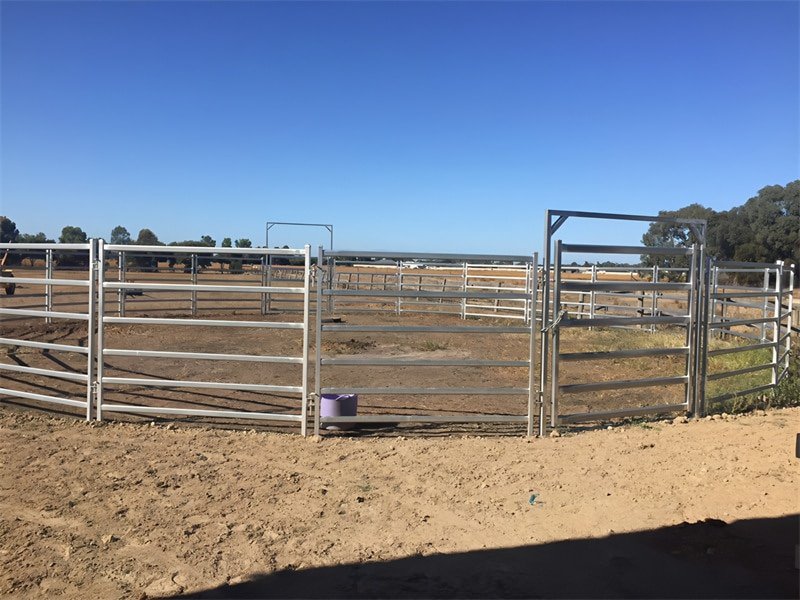
A gate hangs on its hinge points — how many, and of what size, is a supplier answer rather than a rule of thumb. The latch is not a load-bearing part in most designs; it is the component that reports the wear, because it is the only one whose geometry has to stay exact for the gate to close.
The sequence is consistent. Wear at the hinge face or pin takes up slack, the hanging corner drops, and the bolt stops entering its keeper squarely. Someone lifts the gate with a hip to make it close and tightens the latch instead of the hinge. Forcing elongates the fixing holes and bends the bolt; eventually the frame takes the load, rails lose squareness, and the gate stops being repairable by hardware alone. Wind speeds this up, because a half-latched gate presents a sail and pumps the hinge bolts. Latch trouble is usually a hinge message.
Latch types and what each one gives away
You will be shown a handful of designs, and each fails in a way that describes the gate it lives on. The table is buyer-side vocabulary, not a catalog: this site publishes no gate hardware range, so ask which design is included with a gate and what the replacement part is called.
| Latch you are shown | How it gives out | Ask in writing |
|---|---|---|
| Spring-loaded sliding bolt | The spring weakens or dirt packs the housing, and the bolt stops returning | Is the spring a stock spare? |
| Rotary latch with a keeper | Keeper bolts loosen and the holes ovalize; the latch outlives its fasteners | Bolt size, grade and count per fitting |
| Hook-and-eye or gate dog | Cheap, easily opened by a curious horse; the hook deforms before anything breaks | Is a horse-proof option offered? |
| Ring-and-pin | The pin goes missing and the ring wears an oval in its eye | Are pins supplied as matched spares? |
| Self-closing latch | Depends on spring force and alignment; sag disables it quietly | How much sag it tolerates, in millimeters |
A position on a shared fence line: a simple bolt or rotary latch on a heavy keeper is easier to keep working than a self-closing mechanism, because its failure is visible. You see a misaligned keeper; you do not see a spring that quietly stopped pulling.
Reading hinge wear before the gate jams
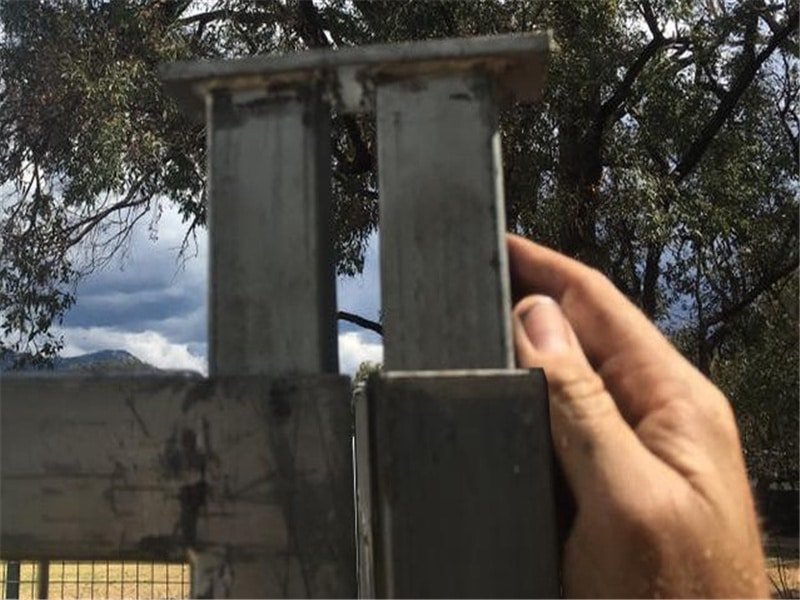
Hinges fail in three places, all checkable with a rule in ten minutes. The bearing: typically metal riding on metal, and an ungreased outdoor hinge wears faster in grit than in clean rain. The fixing: bolted plates loosen over a season of wind slap and the holes grow oval. The hinge edge itself, where thin strap material can tear around a bolt on a heavy gate.
Record the check instead of remembering it. Close the gate, read a rule against the gap at the latch-side top corner and at the bottom rail, photograph both with the date in frame, and keep the set. Two dated photographs a season apart show a wear rate rather than a wear, and the rate decides whether you re-bush, re-bolt or replace. The same discipline applies to finishes: a spangled zinc surface is not a specification, and the stated 20-year rust resistance is offered for hot-dip galvanized steel with no coating thickness published. Ask whether the fittings were hot-dipped like the panels; if they were run by a different route, that bolt is the part you will be replacing.
High-traffic fence lines: what changes the wear rate

Traffic is the variable buyers underestimate. A boundary gate opened twice a week is nearly static. A gate serving several paddocks, a water run, a feeder and a daily muck-out is worked dozens of times a day, and each cycle puts hand pressure on the latch and a small twist into the hinges.
Four site conditions move the rate. Hoof contact on the latch side bends bolts and marks rails. Wind load on a gate that cannot swing free pumps its fixings, so an exposed site needs the same thinking about its gate as about its panels. Ground that stays wet under the gate keeps the hanging corner sitting in mud and wears the hinge base faster; drainage is a design condition here, not an afterthought. And the published climate ratings describe product lines rather than any one fitting: UV-resistant material for Australian and Spanish conditions at 40°C, frost-rated structures for Poland at -10°C.
One manufacturing question is visible on the gate itself. CNC machining and automated 360-degree welding, at a stated capacity above 500 sets a month, produces joints you can inspect on arrival. Ask where the hinge load enters the frame: welded to the same member as the rail, or bolted to a thin section.
Six hardware questions to send before you order
Send one email with six questions and keep the reply in the project file.
- What hardware comes with a gate? Hinge type and count, latch type, bolts and keeper, named as items rather than as “fitted”.
- Which parts are stock spares? Pins, springs, latch bolts and hinge plates, under a name a warehouse will recognize in three years.
- How was the finish applied to the fittings? Hot-dip or pre-galvanized, and whether the 20-year figure covers hardware or only structural steel.
- What adjustment exists? Whether hinge or latch can be taken up after a season without taking the gate down.
- What quantity will you ship? Published minimums are 10 stall sets or 50 fence panels, so ask how a hardware-only spare load is packed and priced.
- How long does a replacement take? Global delivery is published at 4-6 weeks, with 1-2 weeks expedited from the Sydney and Warsaw hubs. Ask whether a hardware parcel follows the same clock.
Company credentials are not answers to those six. ISO 9001 and CE are published at company level here, alignment to BHS, ASPCA and EU Directive 98/58/EC is stated, and no certificate numbers are given. The named regional account manager published for orders of 20 sets or more is stated without limiting it to a product line, so ask what it covers on a hardware order.
Two boundaries for the file. Where the openings go and how traffic flows is a layout question, covered in arena gate placement and traffic flow. Barn-door and stable-window fittings wear from moisture and dust indoors rather than from wind and hoof contact outside, and are treated in Dutch door hardware in humid climates. The panel and post questions live in the fencing range.
Häufig gestellte Fragen
Why does my gate latch stop working every spring?
Usually the gate moved, not the latch. Wet ground, frost and a season of cycles drop the hanging corner, and the bolt stops reaching its keeper. Check the hinges first.
Should I buy a heavier latch to stop the failure?
No. A heavier latch on a sagging gate loads fixings that are already loose. Align hinge and keeper first, then replace hardware only if it is genuinely worn.
How many hinges does a paddock gate need?
It depends on gate height, mass and how often it is opened, none of which this site publishes for gate hardware. Ask the supplier to state hinge count and fixing size for the gate you order.
Can I order spare pins and latch parts on their own?
Ask in writing before you need them. Published minimums are written for stall sets and fence panels, so confirm the hardware quantity, the part name and which delivery clock applies.
Schlussfolgerung
A fence line is only as quiet as its gate hardware. Hinge wear is the cause, latch trouble is the report, and telling them apart decides whether you re-bolt a fitting or rebuild a gate mid-season.
Put the six questions into the order, keep dated photographs of the gaps, and name the spares you would need in year three. That paperwork is what turns a hardware failure into a phone call.

 German
 English
 Spanish
 French
 Arabic
0 Kommentare