
UV stabilized PVC rails are sold on a promise about sunlight, and almost never on a document. Two phrases carry most of the trade — ‘UV resistant’ and ‘UV stabilized’ — and they do not mean the same thing. One describes a result somebody measured. The other describes what is in the compound. A buyer specifying arena or paddock fencing for an Australian summer, a Spanish paddock or a US training yard has to know which one is written into the order.
The failure is not dramatic. It arrives as surface chalk, then color drift, then a rail that cracks where a year earlier it would have bent. By then the fence is installed, and the conversation is about liability rather than the report nobody asked for.
Key Takeaways
- ‘UV stabilized’ is a formulation claim about the compound; ‘UV resistant’ should be a measured result. Ask which one you are buying, and ask for the paper behind the result.
- Two protection routes are in play: carbon black pigment, or a UV absorber and hindered-amine package built into the compound so a light-colored rail can survive. Ask which, and at what loading.
- An accelerated weathering report names the standard and edition, the lamp, the exposure cycle, the hours and the properties measured before and after — not just a number of hours.
- Read the mechanical results before the color ones. Color change is visible; loss of impact toughness is what turns a rail into a liability.
- Do not accept a conversion of lab hours into service years unless the report states the correlation basis. The published figure for this range’s UV-resistant PVC is a 15-year service life, and the paperwork should say what that refers to.
- Commercials for the fencing line: panels from a 50-piece minimum, 5-15% volume discount on larger runs, 4-6 weeks worldwide, 1-2 weeks expedited from the Sydney or Warsaw hub.
Two Claims Wearing One Label
Sunlight damages PVC in two ways at once. Ultraviolet radiation breaks the polymer chains near the surface, which is what makes a rail chalk and then go brittle. The heat that follows does the rest: a black rail in an Australian paddock runs far hotter than the air around it, and each day cycles the profile through expansion and cooling. A compound that survives one and fails the other still fails the fence.
Manufacturers answer this in two ways. Carbon black is the old and honest one — dark pigmented components generally weather better than light-colored ones, which is why dark parts tend to hold their surface longer. The other is a stabilizer package inside the compound, typically UV absorbers plus hindered amines, which is what makes a white or cream rail possible at all. Both work. They are not equivalent, and which one you are buying changes what a test report has to prove. This article stays on the documents; what a 15-year lifespan claim has to survive in a hot climate is what our UV-resistant PVC fencing guide for 40°C climates deals with.
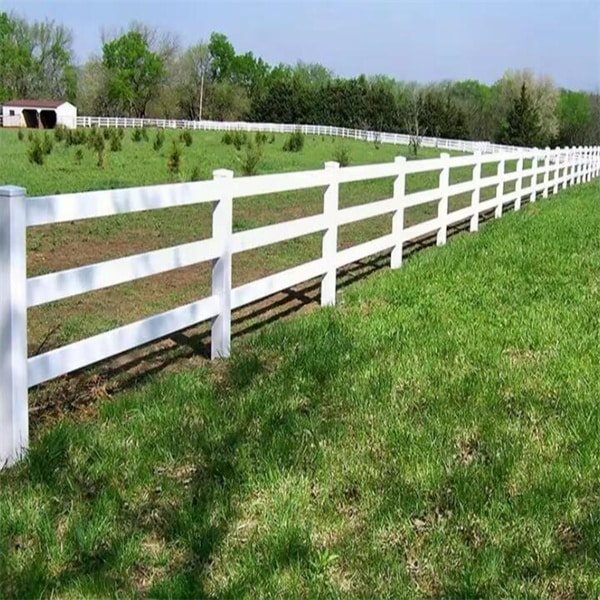
This range sells UV-resistant PVC arena fencing with a published 15-year service life and a design target of 40°C exposure for the Australian and Spanish markets. What it does not publish is the protection route, the loading, or whether the 15 years is a warranty term or a measured result. Treat the label as the start of a document request, not the end of one: a claim about the compound is marketing until a report names the property it measured.
What an Accelerated Weathering Test Measures
Accelerated weathering means a laboratory cycle, not a sun lamp and a stopwatch. The fluorescent UV family — ASTM G154, with ISO 4892-3 as the equivalent — blasts a sample with UV lamps and alternates those periods with dark, wet ones, because a paddock rail gets dew as well as noon. Sample temperature is controlled and reported, usually as a black-standard temperature, and that single line decides most of the difference between two reports that both claim the same hours.
The xenon-arc family (ASTM G155, ISO 4892-2) reproduces more of the solar spectrum and usually adds water spray, so it is closer to what an outdoor fence actually sits in. Neither test tells you anything unless the after-numbers are printed beside the before-numbers. Ask for three of them: color change against a defined scale, gloss or surface chalking, and mechanical retention — impact strength or elongation at break after exposure.
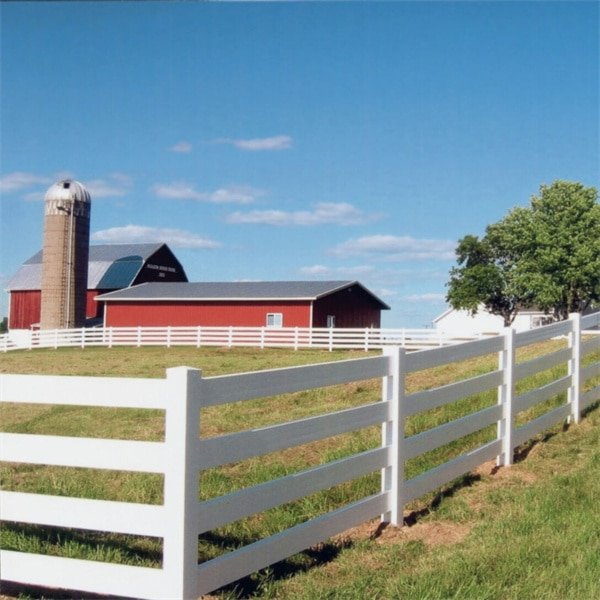
Then refuse the conversion. Lab hours are not service years: a supplier who turns exposure hours into a number of years outdoors owes you the correlation basis and the outdoor exposure behind it. A useful report is read for method and for the before-and-after deltas; the warranty is a separate document, and it says what somebody will stand behind.
Five Documents to Ask For
Five papers, requested before the proforma invoice, cover almost every argument about a weather-exposed fence line. Ask for them as a bundle and note how quickly each supplier produces them.
| Document | What a usable copy shows |
|---|---|
| Weathering test report | Standard and revision, lamp type, exposure cycle, hours, black-standard temperature, and before-and-after results for color, surface and mechanics |
| Compound declaration | Which UV protection route, at what loading, the pigment system, and whether the outer layer is virgin or regrind material |
| Warranty text | What is covered — color change, chalking, embrittlement — the term, the exclusions, and the test basis it is written against |
| Quality certificates | ISO 9001 scope and certificate number, the CE route, and the welfare references the range is sold against (BHS, ASPCA, EU Directive 98/58/EC) |
| Purchase specification | Your thresholds in your units, agreed before production, including what the 15-year claim refers to |
Certificate numbers are the row people skip. A logo in a PDF is not a certificate: the number, the issuing body, the scope and the expiry are what engineers or insurers typically ask to see. For this range the ISO 9001 and CE status is stated, while certificate numbers are not published in the catalog — so ask for them, and check that the scope covers the profiles you are buying.
What You Can Still Check on Site
A container gives you one afternoon of leverage. Compare rail color and surface texture between cartons — a tone shift across batches usually means a different compound lot, which is exactly when the stabilizer package changes. Wipe a rail with a white glove: powder on the glove is chalking, and it belongs in a photograph before installation.
Then look at the wall at a cut end or a drilled hole rather than the printed label, since wall profile is where a re-grind-heavy outer layer shows first. Ask how the rails were stored before crating: PVC stacked outdoors under shrink wrap can act as a slow oven, and a supplier who cannot say where the stock sat is telling you something.

For mixed yards, keep the two material stories apart. The galvanized steel side of this range carries a 20-year rust-protection specification and its own inspection points, while the PVC side carries the 15-year weathering claim; a fence line that uses both needs two documents, not one brochure. Our UV-resistant PVC fencing guide for 40°C climates covers what that lifespan claim has to survive, installing PVC arena fencing covers post setting, tensioning and expansion gaps, and the full horse fence range page is where the specification conversation starts.
Häufig gestellte Fragen
Is UV resistant the same as UV stabilized?
No. Stabilized describes additives in the compound; resistant describes a result measured on a sample. Buy on the second, and ask which standard produced it.
Which weathering test report should I ask for?
One to a named fluorescent UV or xenon-arc standard, showing lamp, cycle, hours, sample temperature and before-and-after color, surface and impact results. A certificate of UV resistance with no method behind it is not a report.
Do lab hours equal years outdoors?
Not on their own. A conversion needs a stated correlation basis and a reference outdoor exposure. Without those, treat hours as a comparison between samples, not a service life.
What is the minimum order for PVC rails?
Fence panels start at 50 pieces, with a 5-15% volume discount on larger runs. Lead time is 4-6 weeks worldwide, or 1-2 weeks expedited from the Sydney and Warsaw hubs.
Why does white fencing cost more to verify than black?
Carbon black protects by pigment, so a black profile generally needs less chemical stabilization. A white rail depends on a stabilizer package, which is the claim that has to be tested, documented and warranted.
Schlussfolgerung
The difference between a fence line that fades and one that fails is documented before production, not after the first summer. A named test method, the properties it measured, a compound route stated in writing and a warranty that says what it covers will outlive any brochure adjective.
Send those five document requests to every supplier on the shortlist — including this one — and keep whoever answers with reports instead of adjectives.

 German
 English
 Spanish
 French
 Arabic
0 Kommentare