


Immediate Touch-Up & Care during installation determines whether your steel infrastructure survives the ammonia-rich stable environment. While Feuerverzinkung offers self-healing properties, ignoring deep gouges caused by forklift offloading creates critical entry points for rust. These unsealed abrasions compromise the structural integrity of the frame and accelerate depreciation.
This guide details the DB Protocol for restoring the 85-micron zinc barrier using high-load cold galvanizing sprays. We explain the chemical mechanism of sacrificial anodic protection and the correct application required to seal exposed Q235B steel. Adhering to this repair standard prevents creep corrosion and preserves the long-term value of your facility.

The Reality of Moving Heavy Steel Horse Stall Panels
Zusammenfassung: Professional stall panels weigh between 250kg and 450kg, making manual handling dangerous and inefficient. DB Stable utilizes a Steel Pallet Flat-Pack system to enable safe, rapid forklift unloading, eliminating the labor costs and injury risks associated with loose-loaded containers.
Operational Risks of Heavy Steel Installations
Most distributors underestimate the sheer mass of professional-grade stabling until the container doors open. A single professional stall set (Front + Partition) weighs between 250kg and 450kg, depending on whether you choose Bamboo or HDPE infills. This is not hardware that two workers can safely offload by hand.
Attempting to move these units manually is a liability. Without mechanical aid, your crew risks severe back strain, crushed fingers, and shoulder injuries. Professional installation teams do not rely on muscle; they use specific heavy-lifting protocols to manage this weight safely.
- Weight Reality: A 14-gauge steel frame with high-density bamboo is dense and unforgiving.
- Safety Hazards: “Walking” panels off a truck is the leading cause of pinch-point injuries in stable construction.
- Equipment Needs: efficient sites use engine hoists, plate lifters, or lifting magnets to position panels without physical strain.
The Solution: Steel Pallet Flat-Pack Logistics
Many manufacturers “loose load” containers to maximize space, stacking panels individually floor-to-ceiling. While this saves them shipping costs, it transfers the burden to you. You are forced to manually unload hundreds of heavy steel gates one by one—a process that takes days and frequently damages the galvanization.
DB Stable solves this logistics bottleneck with a strict Stahlpaletten Flat-Pack system. We bundle components into structural steel pallets that a forklift can remove immediately. This shifts the workflow from a multi-day manual labor nightmare to a clean, mechanized operation that takes a few hours.
- Eliminating Loose Loading: We refuse to loose-load. Every component is secured within a pallet system designed for international transit.
- Mechanized Unloading: Your team stays off the container floor. A standard forklift handles the entire offloading process.
- Schutz des Gewinns: Mechanical handling prevents the scratches, dents, and drag marks common in manual unloading, protecting your margins and the hot-dip galvanized finish.
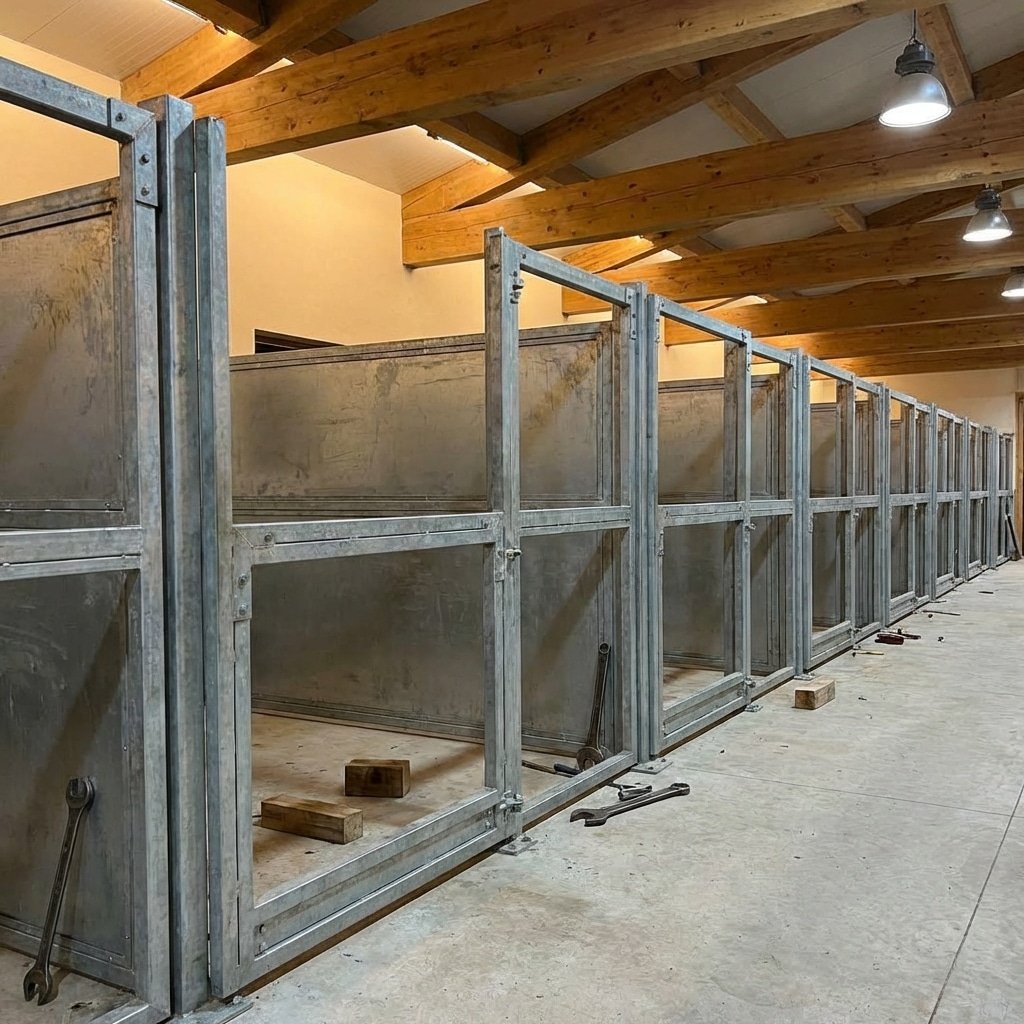
Surface Scratches vs Deep Gouges
Zusammenfassung: Use the fingernail test to distinguish cosmetic mars from structural risks. Surface marks affect aesthetics, while deep gouges penetrate the 85-micron zinc layer, requiring immediate cold galvanizing.
Diagnosing the Severity: The Fingernail Test
Stable managers often panic when they see marks on a new installation, assuming the rust protection has failed. Most of the time, these are superficial scuffs transferred from rubber mats, hooves, or other equipment. You need a binary way to assess if the steel is actually at risk. We use the “Fingernail Test” to classify damage immediately.
- The Tactile Check: Gently run your fingernail across the mark. If your nail glides over it without interruption, this is a surface scuff (Level 1A). It is purely cosmetic and usually buffs out with a standard cleaner.
- The Catch Point: If your fingernail “clicks” or gets caught in the groove, the scratch has penetrated the outer coating. This requires closer inspection to see if it breached the zinc layer.
- Visual Inspection: Look at the color of the scratch bottom. On our Royal Series (powder coated), a white or silver line indicates you only scratched the paint, revealing the zinc underneath. A dull grey or reddish tint warns that you have hit the bare steel.
- Moisture Trap Risk: Deep gouges act as reservoirs. In a stable environment, these traps collect urine and wash-down water, accelerating corrosion significantly faster than on a flat surface.
Anatomy of a Scratch: Zinc Barrier vs. Bare Metal
To understand why some scratches rust and others don’t, you have to look at the cross-section of the steel. DB Stable products are not just painted metal; they are an engineered system of layers. The critical component is the hot-dip galvanized layer, which we apply nach fabrication to an average thickness of 85 microns on structural parts.
- The Buffer Zone (Zinc Layer): The 85-micron zinc coating is a sacrificial barrier. If a scratch is 40 microns deep, it has not touched the steel. The zinc will oxidize slowly to protect the core, forming a protective patina.
- Cosmetic vs. Critical: On our Royal Series, a scratch in the powder coat is annoying but harmless structurally. A gouge that cuts through the zinc to expose the Q235B or Q345B steel core is critical. This exposes the iron to oxygen and moisture, triggering immediate oxidation.
- The Self-Healing Limit: Zinc has cathodic self-healing properties. It can “throw” protection over very narrow cuts (hairline scratches). However, wide gouges (>2mm) exceed this capacity. These specific wounds require the Cold Galvanizing Spray included in your installation kit.
- Installation Impact: Horses rarely cause deep gouges with their teeth or hooves. In our experience, 90% of deep gouges occur during offloading (forklift errors) or assembly. Inspect your steel immediately upon arrival.
World-Class Stables With 20-Year Durability Guarantee

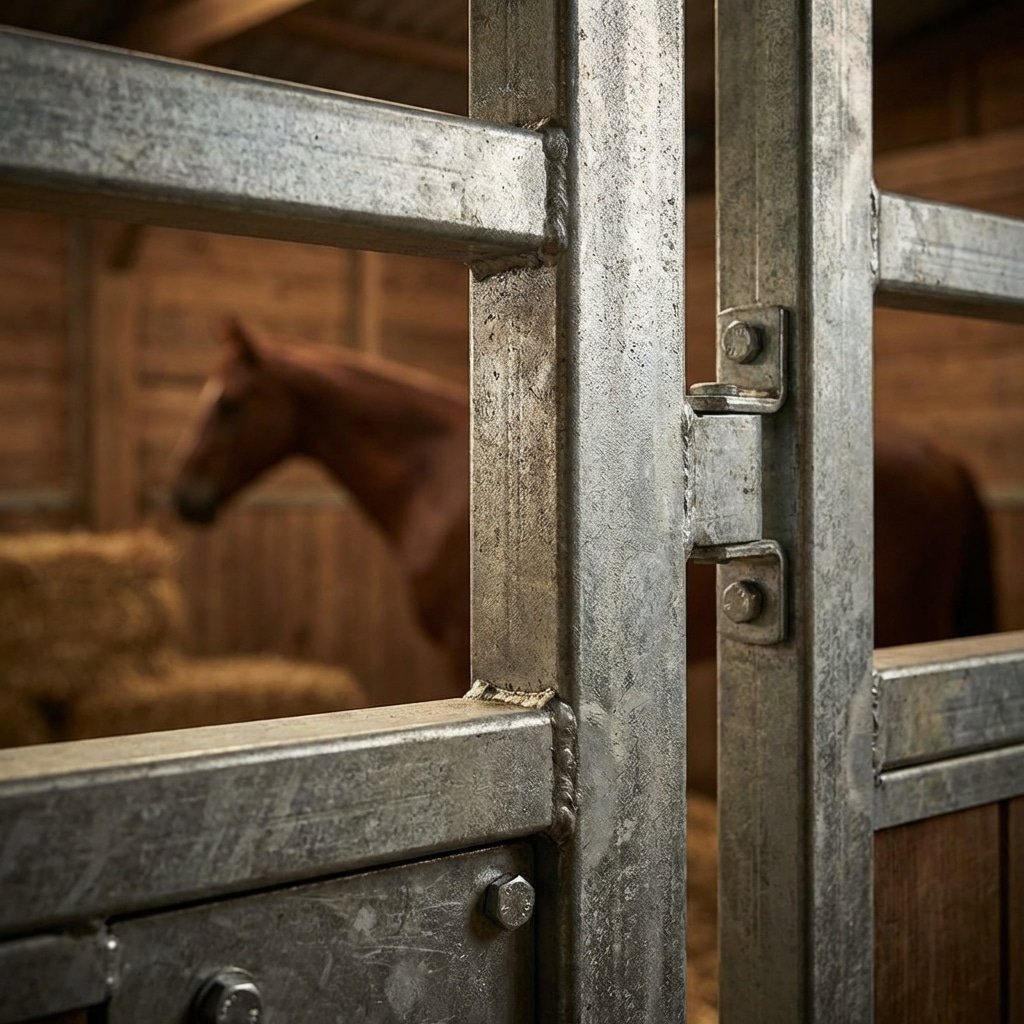
The DB Protocol: High-Zinc Cold Galvanizing Spray
The DB Protocol utilizes a high-zinc compound with over 90% metallic dust to instantly seal installation scratches, restoring the 85-micron barrier and preventing creep corrosion at connection points.
The Science of Sacrificial Zinc Anodization
Standard silver paint acts as a passive barrier that fails the moment it is scratched. The DB Protocol relies on a chemical mechanism known as cathodic protection. The spray acts as a sacrificial anode, meaning the zinc layer oxidizes in place of the steel substrate if the surface is breached. This prevents the “bleeding” rust often seen on cheaper, painted alternatives.
- Zinc Load: The formula contains 85-95% metallic zinc dust in the dried film, meeting strict ASTM A-780 repair standards for galvanized surfaces.
- Bond Strength: It fuses chemically with the steel to stop “creep corrosion,” where rust spreads invisibly underneath a paint layer.
Restoring the 85-Micron Factory Barrier
Our structural components leave the factory with an average zinc coating exceeding 85 Mikrometer, complying with ISO 1461 standards. Maintaining this thickness after assembly is critical for the system’s lifespan. We include this industrial-grade compound in every hardware box to address the unavoidable scratches that occur during unloading or when torquing 304 stainless steel bolts.
Field application is mandatory for valid warranty coverage. Installers must spray any cut ends or abrasion points immediately during setup. This seals the Q235B (or Q345B) steel core against moisture and salt, making the connection points as durable as the hot-dipped frame itself.
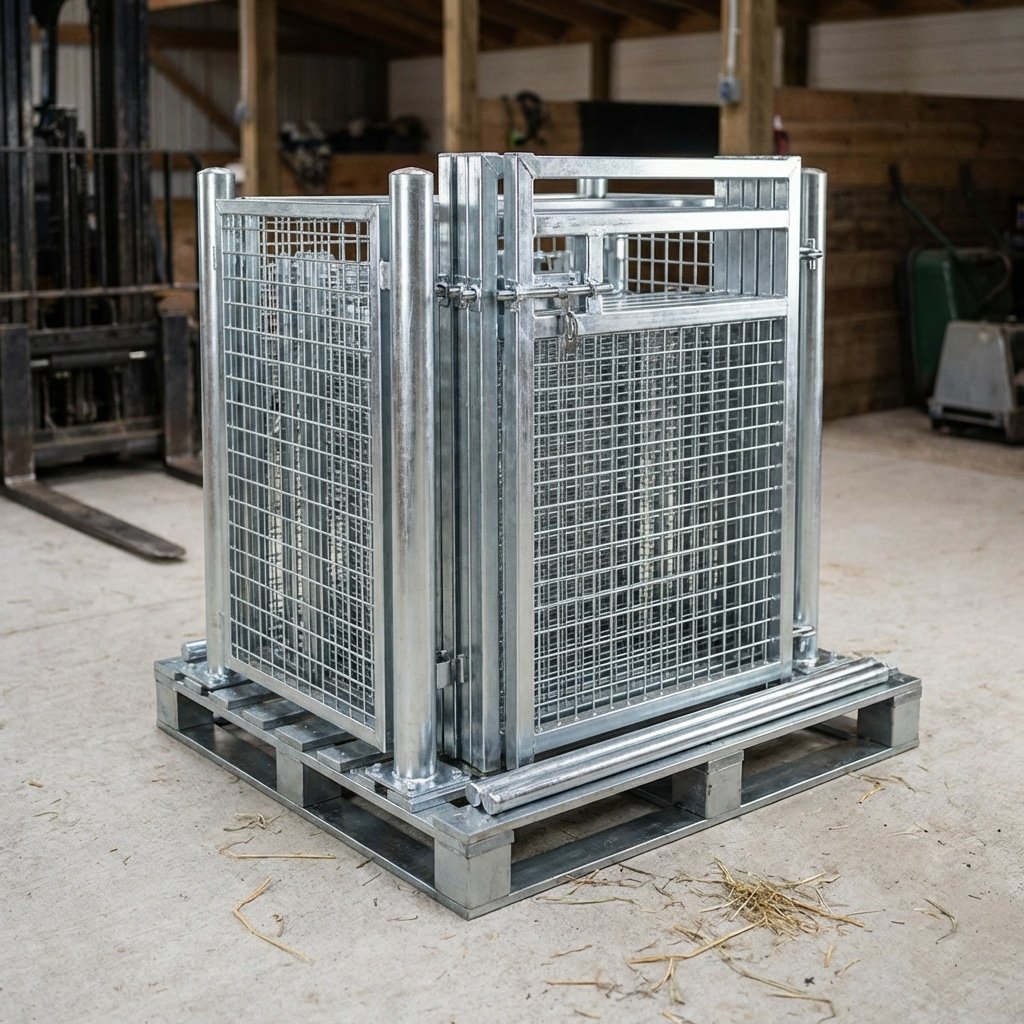
How to Prep and Spray a Scratched Stall Post
Clean the impact zone to remove debris, smooth jagged edges with sandpaper, and apply the provided cold galvanizing spray immediately to restore the zinc barrier on exposed steel.
| Repair Step | Action Required | Technician Note |
|---|---|---|
| 1. Preparation | Clean & Abrade | Must be free of oil and stable dust. |
| 2. Activation | Shake Can Vigorously | Zinc particles are heavy and settle quickly. |
| 3. Application | Short Bursts | Build layers; do not flood the scratch. |
Surface Cleaning and Abrasion
Proper adhesion relies entirely on the surface condition of the steel. When a Q235B or Q345B structural post takes an impact, the protective zinc layer may compromise, exposing the raw steel to the ammonia-rich environment of a stable. You must remove all contaminants before attempting to reseal the metal. Paint or zinc spray applied over stable dust or grease will fail within weeks.
- Remove contaminants: Clean the scratched area thoroughly to eliminate dust, oil, or embedded debris that prevents the zinc from bonding to the steel.
- Smooth edges: Use a wire brush or light sandpaper to level out any jagged steel burrs caused by the impact.
- Verify dryness: Ensure the steel surface is completely dry; trapped moisture under the coating accelerates hidden corrosion.
Applying the Cold Galvanizing Spray
We include a specific Cold Galvanizing Spray in every DB Stable hardware kit for this exact purpose. Unlike standard silver paint, this spray contains a high percentage of heavy zinc dust (typically 85-95% in dry film) to mimic the cathodic protection of the original hot-dip galvanization. Because of this high metal content, the application technique differs from standard spray paints.
- Agitate the mixture: Shake the can vigorously for at least one minute to mix the heavy zinc particles that settle at the bottom.
- Apply correctly: Use the Cold Galvanizing Spray provided in the installation kit to match the zinc profile of the post.
- Layer the finish: Spray in short, light bursts to build a layer that blends with the surrounding hot-dip galvanized finish, rather than one heavy coat that drips.
Routine Maintenance for Your Stable Hardware
Quick Maintenance Protocol: Clear bedding from hidden tracks weekly to prevent door jamming, and retighten all 304 stainless steel fasteners every six months to counteract vibration.
Cleaning Sliding Tracks and Swivel Mechanisms
The primary cause of failure in sliding stable doors isn’t component breakdown—it is bedding accumulation. Our Professional Series features a Hidden Track System designed to protect the rollers, but the bottom guides remain exposed to the stable floor environment. When shavings, straw, or manure get packed into these guides, the door is forced off its alignment, causing it to stick or derail entirely.
- Clear the Guides: Vacuum or sweep dust and compacted bedding from the bottom door guides weekly. A buildup of just a few millimeters can obstruct smooth operation.
- Test Feeder Pins: The Aluminium Swivel Feeder relies on a spring-loaded locking pin. Test this mechanism monthly to ensure it engages fully without resistance; a sticky pin is a safety hazard that allows horses to push the feeder open.
Inspecting 304 Stainless Steel Fasteners
We supply a complete 304-Edelstahl-Beschlagsatz with every installation to prevent rust. While this material is corrosion-resistant, it is not immune to physics. Horses are large, dynamic animals that constantly rub, lean, and kick against partitions. This constant vibration and impact will gradually loosen anchor bolts and connector screws over time, regardless of the initial installation torque.
A loose frame loses its structural rigidity, transferring stress to the welds rather than the floor anchors. To prevent fatigue cracking, facility managers must inspect these fittings every six months. Tighten any loose anchor bolts or assembly screws immediately to restore the frame’s tension and stability.
Abschließende Überlegungen
Leaving deep installation gouges exposed compromises the 85-micron zinc barrier that defines our Professional Series quality. You invested in hot-dip galvanized steel for a 50-year lifespan, not to lose it to a preventable forklift error. Swift application of our high-zinc compound ensures your facility remains rust-proof and preserves the structural integrity of the Q235B steel core.
We include industrial-grade cold galvanizing spray in every hardware kit because we refuse to compromise on finish. Equip your installation crews with this protocol to protect the “Profit Protection” built into our logistics system. Contact our engineering desk today to secure your next container of maintenance-free, high-margin stabling.


 German
  English
  Spanish
  French
  Arabic
0 Kommentare