


Hidden custom fees are the primary source of budget overruns in equestrian facility projects. Trading companies and mass-production factories penalize non-standard dimensions, transforming necessary millimeter adjustments for retrofits into costly upcharges that destroy distributor margins.
This analysis explains how a B2B OEM/ODM workflow is structured to eliminate these penalties. By integrating direct CAD engineering with a Steel Pallet Flat-Pack system, a source factory accommodates custom dimensions as a standard procedure, not a costly exception.
The “Standard Size Only” Business Model (Trading Companies)
Trading companies often sell standard-sized stables bought in bulk. This model keeps their costs low but leaves buyers with no options for custom dimensions.
How ‘Standard Size’ Resellers Operate
Many resellers and trading companies operate on a simple principle: buy in bulk, sell from stock. They purchase massive container loads of predetermined, standard-sized horse stalls to get the lowest possible unit cost and simplify their logistics. This model works as long as the end customer has a perfectly standard new barn.
The problem is they have no direct link to the factory’s engineering team. When a customer needs to fit stalls into an older, non-standard barn, the reseller can’t fulfill the request. They are selling from a fixed inventory and lack the manufacturing connection to produce custom-dimensioned panels.
The OEM/ODM Alternative for Custom Needs
A B2B OEM/ODM manufacturer like DB Stable is built differently. The entire process is designed to handle specific project requirements, including custom sizes for distributors and large-scale facilities. Direct factory collaboration means we can produce panels to precise measurements, which is essential for retrofit projects where standard sizes simply won’t fit.
This approach avoids the “one-size-fits-all” issue completely. Instead of selling from a pre-made stock, we manufacture to order, ensuring every component aligns with the project’s actual dimensions.
Retrofit Realities: Why No Barn is Exactly 12×12
Older barns shift and settle, making rigid, pre-welded stalls impossible to install cleanly. A flat-pack modular system is designed to absorb these real-world inconsistencies for a precise fit.
Common Causes of Dimensional Drift in Barns
When you’re equipping an existing structure, you’re not working with perfect CAD drawings. You’re dealing with a building that has a history. Concrete floors heave, and timber posts move. The idea of a perfect 12-foot opening is usually a myth. Expecting a fully welded, rigid stall front to slide right in is a recipe for frustration and extra costs on-site.
The most common issues we see in retrofits include:
- Foundation Settling: Over decades, ground movement and frost heave can shift posts out of plumb, narrowing or widening the openings between them.
- Original Construction: Many older barns were hand-built. Post spacing was often set by eye, not by laser, resulting in non-standard bay sizes from day one.
- Internal Layouts: Existing support columns, water lines, or electrical conduits often create unique obstructions and force non-uniform stall dimensions.
Adapting with a Modular Flat-Pack System
A modular system sidesteps these problems entirely. Instead of forcing a single, rigid unit into an imperfect space, you build the stall within the space. This approach is designed for reality, not theory.
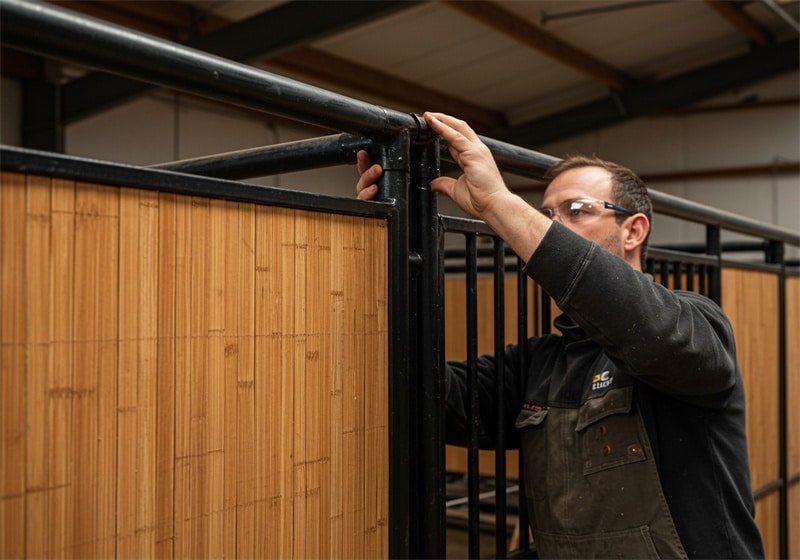
- The flat-pack design separates panels from posts. This gives the installer the wiggle room to make minor adjustments on-site and achieve a clean, tight fit in openings that aren’t perfectly square.
- This built-in flexibility eliminates the need for expensive and time-consuming custom fabrication for every single stall. It standardizes the solution for non-standard problems.
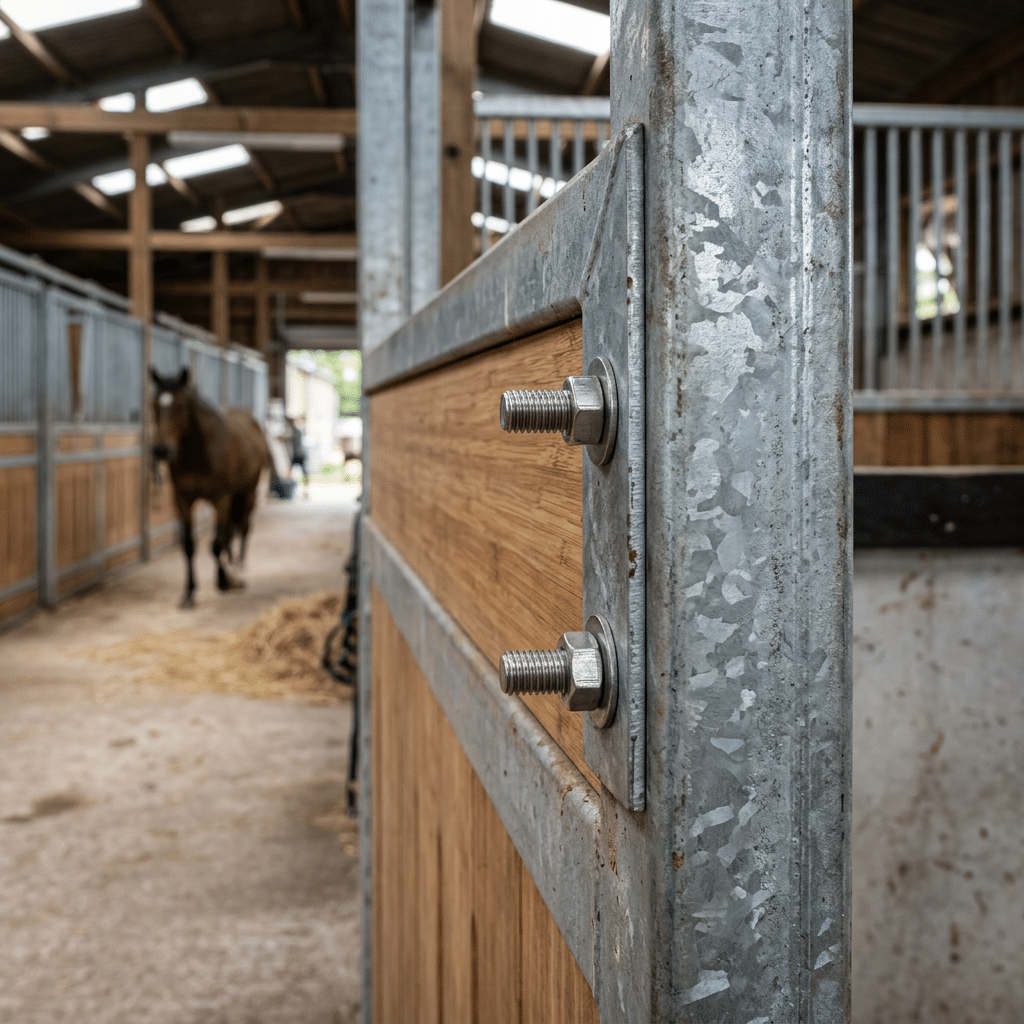
- Every DB Stable system includes a complete 304 Stainless Steel hardware kit, providing a secure, adjustable, and corrosion-resistant connection between all components.
Globally Compliant Stables, Built to Last.

The OEM Advantage: Factory Direct CAD Engineering
Direct CAD engineering sends digital designs to manufacturing equipment, ensuring millimeter precision. This enables advanced, freight-saving flat-pack systems that protect distributor profit margins.
| Attribut | Traditional Process | Direct CAD Engineering (OEM) |
|---|---|---|
| Data Transfer | Manual data entry from paper drawings. | Automated transfer of CAD files to machinery. |
| Error Rate | High potential for typos and misinterpretations. | Near-zero; eliminates manual data entry mistakes. |
| Component Fit | Inconsistent; often requires on-site adjustments. | Millimeter-perfect fitment for every part. |
| Design Capability | Limited to simple, fully welded structures. | Enables complex, modular systems like flat-packs. |
From Digital Model to Physical Product
The core of modern manufacturing is a direct line from the engineer’s screen to the factory floor. We send high-fidelity digital models directly to our production equipment, like laser cutters and CNC machines. This automated workflow removes the most common source of production mistakes: human error.
Manual data entry from paper blueprints is a recipe for typos, omissions, and costly rework. By transferring design specifications digitally, we guarantee the physical product is an exact match to the approved model. Every hole aligns, every bracket fits, and every panel slides into place without force or on-site modification.
Engineering for Logistics: The DB Flat-Pack System
This level of precision makes new product innovations possible. Our Steel Pallet Flat-Pack system is a direct result of CAD-driven engineering. We can design complex, interlocking components that assemble perfectly thousands of miles away because we know every part is manufactured to sub-millimeter tolerances. This isn’t just an engineering detail; it’s a massive commercial advantage for our distributors.
The impact on shipping costs is significant. A modular design changes container loading capacity completely, directly protecting the profit margins of our B2B clients.
- Traditional Welded Sets: Fit only 12-15 sets in a 40HQ container.
- DB Flat-Pack System: Loads 30-45 sets into the same 40HQ container.
- The Bottom Line: This triples the shipping efficiency and reduces freight costs by over 60%.
Why DB Doesn’t Penalize for “Millimeter Precision”
Our OEM factory is built for custom projects. We don’t charge extra for non-standard dimensions because our entire workflow—from engineering to logistics—is designed for variability, not repetition.
The Industry Norm: Why Custom Sizes Usually Cost More
Most mass-production factories are built for one thing: churning out a standard-sized product as efficiently as possible. Their entire operation, from fixed welding jigs to automated production lines, is optimized for repetitive tasks. When a buyer requests a non-standard dimension, it disrupts that entire system.
This forces a costly production halt. Engineers have to create new drawings, workers must perform manual adjustments, and unique setups are required for a single order. Those disruption costs get passed directly to the buyer, often labeled as a “customization fee.” It’s less a fee for service and more a penalty for breaking their rigid workflow.
Our Factory Model: Built for B2B Customization
We operate on a completely different model. As a B2B OEM/ODM manufacturer, our process doesn’t just accommodate custom projects; it starts with them. Every order begins with our client’s specific project dimensions, whether it’s for a new build or a tricky retrofit.
Our engineering and fabrication workflow is designed for variability, not inflexible repetition. This approach extends all the way to our logistics. The Steel Pallet Flat-Pack system we use is inherently flexible. It can accommodate panels of various sizes without the constraints of pre-boxed retail kits. Because our system is built for customization from the ground up, we don’t have “disruption costs” to pass on.
Ordering Custom Layouts: The B2B Process
Our B2B process moves from client-approved CAD drawings to production. Orders ship via our flat-pack system, maximizing container space and protecting your margins.
Step 1: From Initial Quote to CAD Approval
The process starts with your specific facility requirements. We translate your architectural plans or simple measurements into precise engineering documents ready for sign-off. This ensures there are no surprises before manufacturing begins.
- Provide your barn layout, post-to-post measurements, or existing architectural plans.
- Our engineering team creates detailed CAD drawings for your review and formal approval.
- Designs are finalized to ensure millimeter precision before any steel is cut or welded.
Step 2: Defining Order Volume and Scheduling Production
Once designs are locked in, we move to the commercial and logistics phase. We confirm the order size, schedule the production run, and plan the shipment to optimize freight costs and protect your project budget or resale margins.
- Confirm Order Tier: We work with trial orders (3-5 sets), project orders (one 20GP container), or full distributor orders (one 40HQ container).
- Schedule Production: A lead time of 35-45 days is standard, which includes the critical hot-dip galvanizing process after fabrication.
- Plan Logistics: We use our Steel Pallet Flat-Pack system to load 30-45 stable sets into a single 40HQ container, significantly reducing per-unit shipping costs.
Häufig gestellte Fragen
Are you a factory or a trading company?
We are a B2B OEM/ODM source factory. We specialize in manufacturing for distributors and large-scale projects, not direct retail to individual horse owners. Our focus is on engineering safe, standardized systems for our partners.
What does ‘Hot-Dip Galvanization After Fabrication’ mean?
This is our core quality standard. It means we fully weld the entire stable panel from raw black steel first, and then dip the complete, finished panel into molten zinc. This process, compliant with ISO 1461, ensures every weld, corner, and edge is sealed against rust, unlike cheaper pre-galvanized tubes that have exposed welds.
Can I order stalls in metric sizes instead of feet?
Absolutely. While many markets use standard 12×12 foot dimensions, our OEM model is built for customization. We provide CAD engineering to produce stalls that fit precise metric measurements for European or Australian barn layouts.
What is the minimum order quantity (MOQ)?
We support our partners with flexible options. A trial order can be as small as 3-5 stable sets. For projects, a 20GP container (about 10-15 sets) is typical, and our distributor partners usually order full 40HQ containers (30-45 sets) to maximize freight savings with our flat-pack system.
What is included in a standard stable set?
Each set is a complete system. It includes one stable front panel with a door, one partition panel, all the pre-cut infill planks (HDPE or Bamboo), and a full hardware kit with 304 stainless steel bolts and connectors. We also include a can of cold galvanizing spray for any touch-ups needed after installation.
Abschließende Überlegungen
Standard-size stalls from resellers create installation risks and erode your margins with inefficient freight. Our factory-direct, flat-pack system is engineered for custom dimensions without the custom price tag. This protects your profit on every container and ensures a perfect fit for your clients.
Stop leaving projects to chance with off-the-shelf inventory. Request CAD drawings for your specific layout to see the precision for yourself. We can then schedule a small trial order to prove the fit, finish, and freight savings.

 German
  English
  Spanish
  French
  Arabic
0 Kommentare