

Arena gate placement is the cheapest layout decision on a stable yard, and the one most often left to the fencer’s judgment call on installation day. A gate set in the wrong spot does not fail loudly; it just makes every horse, every wheelbarrow and every trailer slightly harder to route, every day, for the life of the fence.
Get it right by reading the yard as flows rather than as drawings: who moves between the stable rows and the riding surface, what they are pulling, what spooks, and what has to get in when something breaks. This guide walks each of those lines, then closes with the order-list details that decide whether the gate you planned is the gate that arrives.
النقاط الرئيسية
- Plan gates by counting daily flows — ridden traffic, hand-walked traffic, maintenance and delivery traffic — and give each one a route that does not cross a horse’s head-on approach.
- On the arena side, keep openings out of corner pockets and away from the mounting line; a gate sitting on the cantered line becomes a training subject whether or not you planned for it.
- On the barn side, the gate wants a firm apron and an aisle that stays clear of it; soft ground at a hinge line is where sagging hardware starts.
- Where regular use justifies it, two openings beat one: a primary route and an escape or service route, far apart, that never share a pinch point with the first.
- Opening width, post spacing at gaps, swing hardware and standoffs are not published figures on this site — they belong on the purchase order, in writing, per gate.
- Fence orders start at 50 panels and production runs 4-6 weeks, so extra gate sections and spares belong on the first order, not the emergency one.
What Arena Gate Placement Actually Decides
A gate is a gap with a schedule. Ridden traffic enters and leaves at walking pace, horse first, usually wanting the shortest line from the barn aisle. Hand-walked traffic — yard to arena to grass — needs a route that never crosses live riding space. Maintenance traffic, from a tractor leveling the arena surface to a vet’s vehicle on a bad day, needs the opening to be wide, firm and unobstructed, including when horses are out. And on layouts with real traffic, the flows want a second option: a way in, a way out, and a way around a queue.
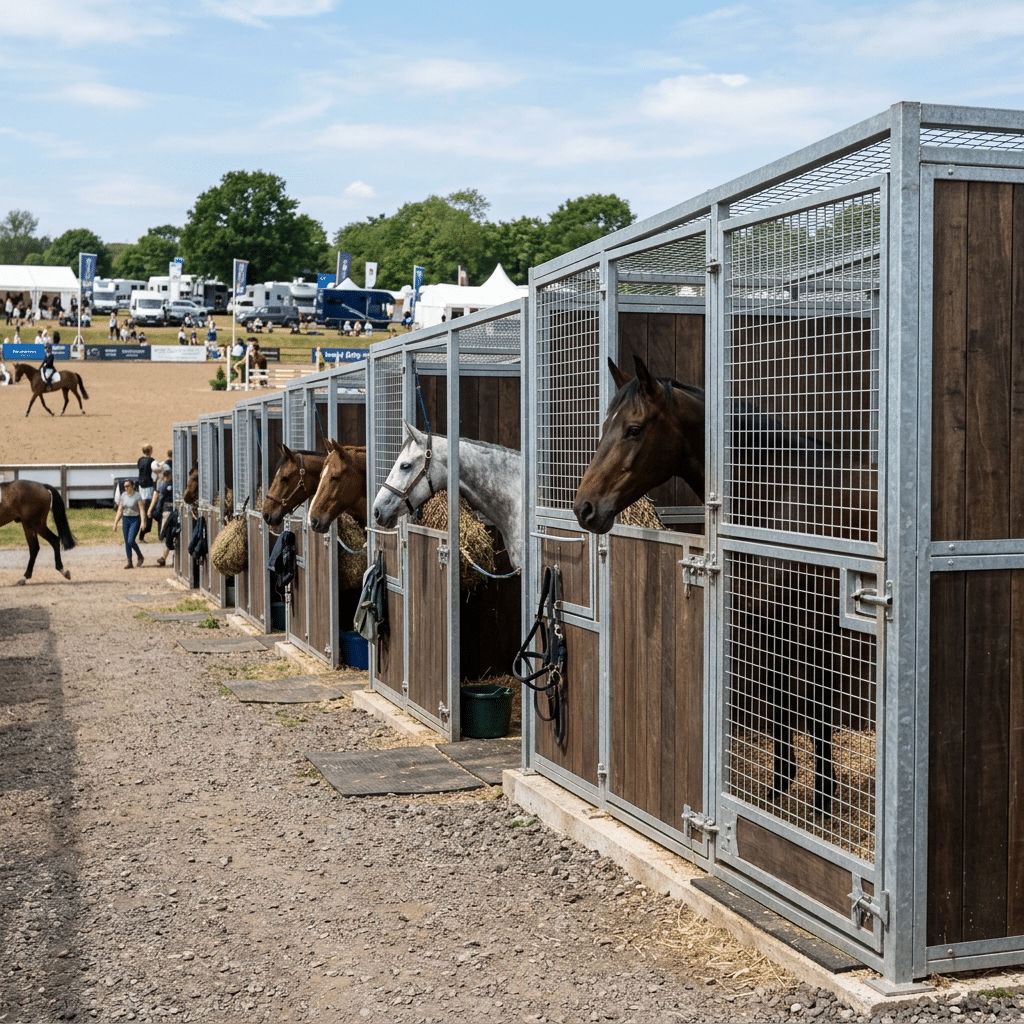
Count those flows on paper before counting panels. On competition-style layouts the same math scales up: this site’s guide to temporary stabling for competition seasons walks through how staged stall rows and arena access get ordered together, and the gate logic carries over to permanent yards unchanged.
The Arena Side: Corners, Approaches and Wear
Keep the opening out of the corner pockets. A gate set where two fence lines converge puts hardware inside the zone where a loose horse runs fastest and turns tightest, and it steals the corner the footing needs for drainage falls. Corner geometry and sightlines around outdoor schools have their own guide on this site — arena fencing sightlines and corner design — and the placement rule borrows its reasoning: straighten the view, protect the corner, put the gap on a long run instead. On the arena side, a gate sitting on the line a cantered horse follows is a training subject of its own; keeping it out of that line is the placement win.

Watch the approach angle. A horse leaving the barn lane should meet the opening square-on, not at a slant that reads as a dead end at speed. And treat the strip outside the gate as traffic, not scenery: repeated hoof pick-up and dragged harrows concentrate wear on the short stretch of rail just outside the opening — exactly where the coating is already working hardest. Ask the supplier to state the wear-protection spec for gate bands with the rest of the line. The corrosion-zone reading in this site’s guide to galvanized panels applies to gate bands harder than to any other rail on the property.
The Barn Side: Rows, Aisles and Aprons
On the stable-row side, the gate inherits whatever the aisle gave it. An opening that lands at the end of a narrow aisle turns every trailer-backed delivery into a backing lesson; aisle width and its tractor math are worked through in the stable aisle width guide, and the gate placement decision is simply where that aisle is allowed to empty out.
Give the barn-side opening an apron — compacted or paved standing big enough for horse, handler and a parked vehicle at the same time, the same firm-footing logic you would demand at a stall front. On soft sites, the apron is not decoration: a hinge post standing in mud each winter moves, and a moving post is how a well-planned gate slowly becomes a scraped one. Drainage falls should carry water away from both faces of the gap, not toward them. This site states twenty-year rust resistance for its hot-dip galvanized line; a gate band that never dries is where any coating claim, here or anywhere, learns humility first.
Hardware, Swings and the Order Lines
Swing, stand and latch are where a planned gate and a shipped gate part company. Decide which way each leaf opens before it is built — away from standing horses is the default worth arguing — and ask what holds it when a horse leans on the latch side. Heavy duty hinges and their load paths are covered in this site’s panel connection systems guide; a gate is that guide’s worst case, because a gate works its hardware daily, all year, while a line panel mostly holds still.

Put the gate specifics on the same order that covers the panels. Opening width, post spacing at the gap, hardware per leaf and stand or standoff type are not published figures on this site, and a verbal “we’ll make it work” is not a specification:
| Order line | Why it settles at placement |
|---|---|
| Clear opening width per gate | Tractor, vet van and delivery must all fit without a second plan |
| Hinge, latch and bolt type per leaf | Daily opening is a hardware schedule, not an accessory |
| Swing direction and standoff method | Decided once on paper, argued forever on site |
| Extra full-height sections for escape gaps | The second way out can be removable hardware, at the same spec as the line |
| Spare hinge and latch set | With 4-6 week production, a stripped latch should not wait for a container |
Our position: treat every planned opening as either a gate or a documented removable-section gap, and refuse the in-between “they’ll leave a slack panel.” The fence product lines and configuration requests start at the riding arena product page; the drawing that says which gaps are which belongs in the same email.
الأسئلة المتداولة
How many gates does a riding arena actually need?
For routine use, at least two separate ways to move horses between barn and arena — a primary and an alternate far from it. This site publishes no gate-count standard; send your flows and layout to the supplier and ask for the openings to be drawn.
Should the arena gate open in or out?
Common practice opens riding-school gates away from the arena surface so a leaf never swings into a horse’s line, with hardware arranged so the open leaf sits flat against the fence. Confirm the specific swing, stops and latch side per opening on your order.
How wide should the opening be for vehicles?
Wide enough for the widest vehicle that will ever enter, plus margin for a nervous horse beside it — the aisle width guide explains the turning logic. No gate-width figures are published for this site’s fencing, so put your vehicle dimensions on the RFQ and let the spec answer them.
Can I use a removable panel instead of a second gate?
A removable section can carry the same escape or service role, specified at the same panel grade as the rest of the line so the pins and connectors interchange. Ask for the removal method and connector count in writing before relying on it.
Where does the gate order sit in the MOQ and lead time math?
Gates and sections ship within the same fence-line structure: 50-panel ordering floor, 5%-15% volume discounts, 4-6 weeks global production, with 1-2 week regional replenishment from Sydney or Warsaw stock where available. Ordering spares with the initial line is usually cheaper than a solo emergency run.
الخاتمة
Arena gate placement is flow planning with permanent consequences: the corner stays clear, the approach runs square, the apron keeps the hinge out of mud, and every opening has a written spec instead of an installer’s mood. Do it once on the drawing and the yard spends its life moving easily through it.
Sketch your flows before requesting the quote, mark the primary gate and the alternate, and send both the flows and the openings to the supplier — the horse fence product page is where the configuration conversation starts.


 Arabic
 English
 Spanish
 French
 German
0 تعليق