


An outdoor riding school is judged on its perimeter before its footing. Outdoor arena fencing has to hold a horse cantering on a circle, stay readable to an instructor watching six riders at once, and survive being leaned on and struck every teaching day. A paddock line can be ugly and still work; a school line cannot, because it has to contain the horse and be seen by it.
DB HorseStable has built stabling and fencing for equestrian projects since 2013, and the arenas that still look right years later share two decisions made on paper: an uninterrupted sightline from where the instructor stands, and corners treated as engineered load points rather than where leftover panels get joined.
النقاط الرئيسية
- Design from the teaching position, not the property line: if the instructor cannot see a horse come onto the corner, the layout is wrong before panels are bought.
- Corners and gates carry the load — the turn takes lateral pressure, the entry takes hoof, bucket and wheel, and those two positions set post and hardware spec.
- Visibility is safety, not cosmetics: British Horse Society field guidance flags poor-visibility wire as unsuitable alone and recommends about 1.25 m with the lower rail 0.5 m off the ground.
- Match material to exposure: hot-dip galvanized steel carries a 20-year rust-protection specification; UV-resistant PVC is specified to a 15-year service life in full sun.
- Fix the water first — unless the perimeter is graded away from it, water collects at the fence line, and standing water at the base starts the rack.
- Order the geometry, not just panels: a 50-panel MOQ, 4-6 weeks global delivery, 1-2 weeks from Sydney or Warsaw hub stock.
What a Lesson Program Does to a Fence Line
A school arena is not a paddock with a gate in it. It runs the same traffic pattern dozens of times a day: horses turned onto the track, circles repeated at trot and canter, animals pulled up at the mounting block, and float movements at both ends of the session. The perimeter absorbs all of it, and absorbs it unevenly. Most contact happens in three or four places — the two ends of the long sides, the corner nearest the mounting area, and whichever gate the equipment actually goes through.
That unevenness is why school fencing fails in bands rather than everywhere at once: the turn gets leaned on, the gate post gets struck, and the far side nobody walks past simply ages quietly. Buy one uniform specification and you will typically be replacing the working ends long before the quiet run needs anything — which is why the specification below is split by position, not by budget.
Sightlines: Build the Perimeter Around the Instructor
In a lesson arena the fence is also the instructor’s instrument panel. With a group moving on both reins, the person teaching needs to see a horse arrive at the corner before it gets there, and needs the rider’s leg and the horse’s feet in view, not just its head. A perimeter that blocks the low third of the picture — a solid board run, a dense mesh skirt — forces the instructor to walk to keep the view, which is how corners get missed.
So set the profile against the sightline before you set the height against the horse. Open rail panels read the arena through; solid infill reads it as a wall. Both are legitimate, and the choice is positional — transparency where the teaching eye travels, something more solid where a horse needs a boundary to respect. The logic runs in reverse for the horse. British Horse Society field guidance is blunt that low-visibility fencing is unsuitable as a standalone boundary, and its general field recommendation of roughly 1.25 m with the bottom rail about 0.5 m clear of the ground exists to keep a fence both seen and hard to step through. Arena heights by discipline are a separate calculation, set out in our guide to riding arena fence heights by discipline.
Two checks are worth doing on the drawing. Stand at the teaching position and trace the sightline to the middle of each corner: anything opaque inside that arc is a hazard you designed in. Then look at the entry — a gate that turns a corner into a blind approach is the most common school-arena fault we see discussed at order stage.
Corners Take the Traffic — Detail Them First
A horse on a circle does not meet the fence square on; it arrives at the turn with lateral load still in it and reads the corner as the place where the arena ends. Square 90-degree corners frame and set out simply, with fewer specialty parts, and suit flatwork on a respected track. Where a school runs jumping work or keen young horses, a soft radius — angled panels instead of one hard right angle — gives the horse a line to follow rather than a wall to argue with.
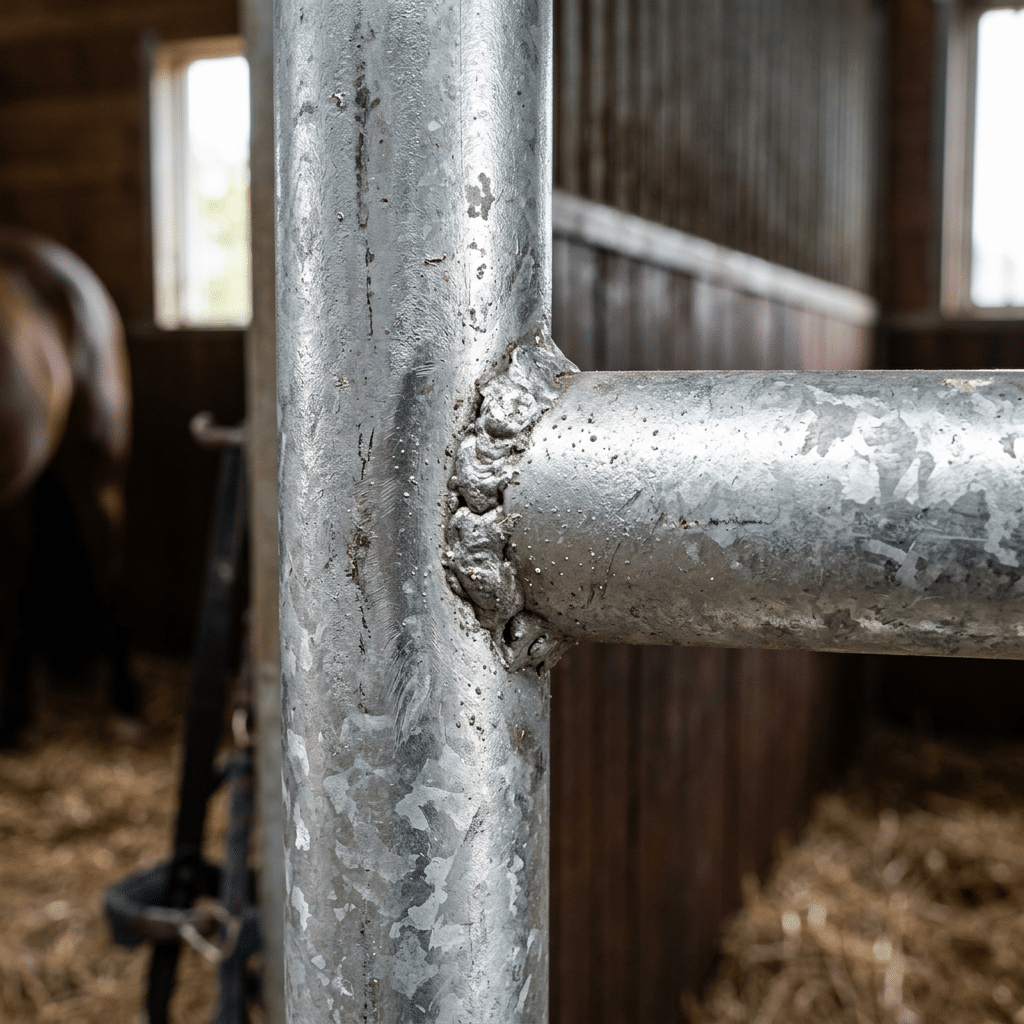
The corner is also where the connection method stops being a brochure point: a pinned or clamped joint that behaves on a straight run is under different forces at a turn, where two panels pull one post from different directions. That position wants the strongest post and a documented joint — pin, sleeve and clamp options are compared in our guide to horse fence panel connection systems. Water sitting at that base is what ages a galvanized line fastest, which is worked through in our guide to corrosion zones along a fence line.
| Position | What it takes | What to order |
|---|---|---|
| Corners and turns | Lateral load from a horse on a circle; two panels pulling one post | Heavier corner post, bracing, welded joint, radius panels where needed |
| Gate and entry | Hoof, bucket and wheel impact every session | Re-tensionable hardware, hinge and latch stated, no blind approach |
| Long sides | Wind load plus the sightline requirement | Open rail profile where the instructor looks; span set to panel width |
| Base and ground line | Water, mud and hoof impact on the coating in one band | Fall away from the arena, free-draining backfill, hot-dip spec at the base |
Specifying Panels, Base Detail and Delivery
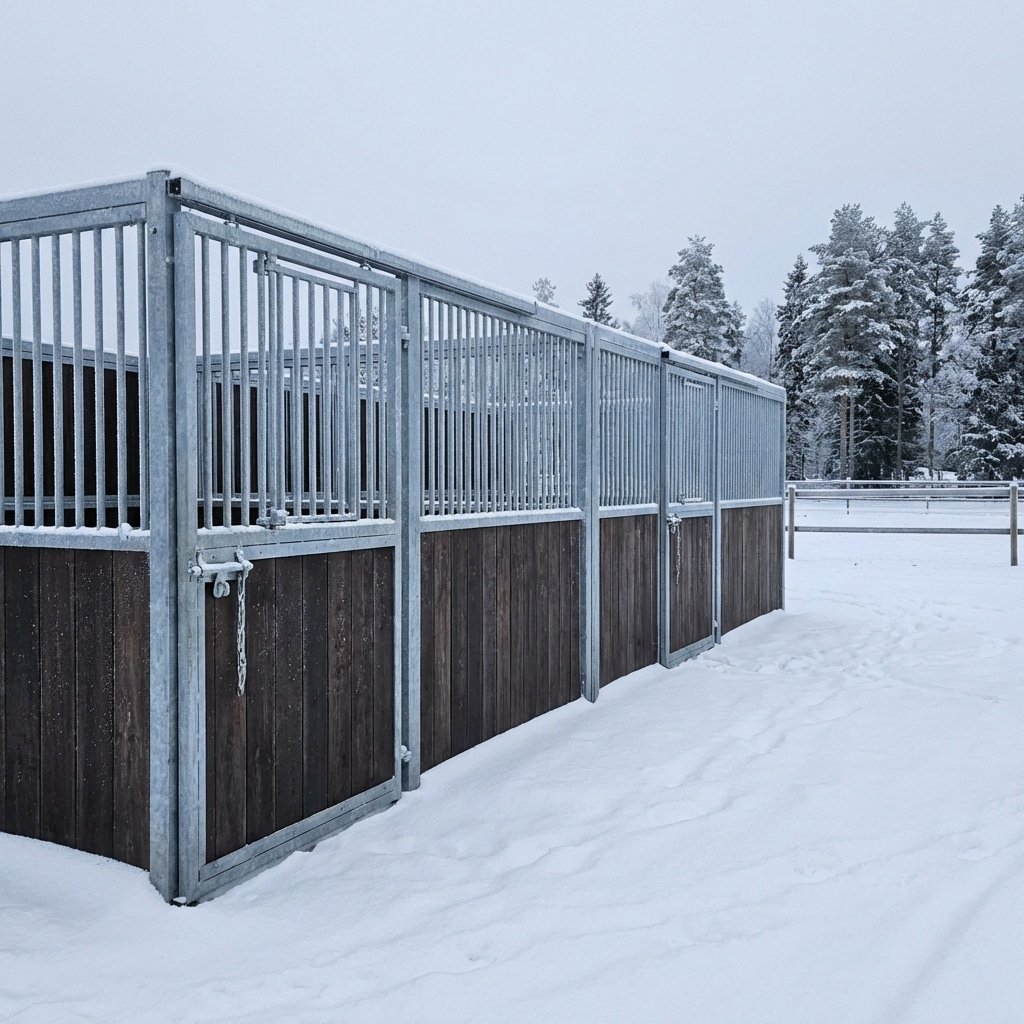
Two lines cover most school arenas and answer different problems. Hot-dip galvanized steel carries a 20-year rust-protection specification and takes the punishment — leaning, struck rails, corner load. UV-resistant PVC, specified to a 15-year service life, suits open-sun arenas where nobody wants a repainting cycle; the finish choice is worked through in our horse fence panel line. Many schools run steel on the working ends and turns, PVC on the quiet sides.

What the drawing cannot tell you is wall thickness — the number most often left vague on a school project. Panel and post gauge, tube size and the base fixing are stated per configuration on request: confirm them in writing against your own layout rather than accepting a catalog figure, and read our breakdown of how to verify steel gauge on delivery before you sign for a load.
Commercially, a school arena is a panel order rather than a set order: fencing starts at a 50-panel MOQ with a 5-15% tiered volume discount on batch orders. Global production and shipping run 4-6 weeks, with Sydney and Warsaw hub stock shortening expedited regional supply to 1-2 weeks, and orders of 20 sets and up get a dedicated regional account manager. Manufacturing runs on CNC machining and automated 360-degree welding at 500-plus sets a month under ISO 9001 and CE certification. Time the order against the ground, not the school term: base work and footings want finishing before the wet season closes the site.
الأسئلة المتداولة
Does an outdoor school arena need a different fence than a paddock?
Yes. A school perimeter is a sightline instrument as well as a barrier, and its load concentrates at the turns and gate rather than spreading evenly. Specify those positions separately.
Should arena corners be square or rounded?
Square corners frame and set out simply, with fewer specialty parts, and suit flatwork. A soft radius of angled panels gives a horse on a long stride a line to follow, worth specifying where the school runs jumping or keen young horses.
Steel or PVC for a school arena perimeter?
Hot-dip galvanized steel takes impact and corner load on a 20-year rust-protection specification; UV-resistant PVC carries a 15-year service life and suits full-sun sites. Many schools mix the two by position.
What makes a school arena fence line rack out of true?
Usually water and corner load together. Where fall is not set away from the arena, water collects at the fence line, the base softens, and repeated pressure from horses on the circle works the softened post until the line goes out of square.
How many panels does a school arena order need?
Fencing is ordered from a 50-panel minimum, so quantity is set by your perimeter length and panel span. Confirm the count against your own drawing and ask for gauge and tube size in writing per position.
الخاتمة
A school arena fence that lasts is designed twice: once for the person teaching, who has to see the whole track and every approach to the corner, and once for the positions that actually take the load. Corners, gates and the ground line are where the money goes; the straight sides are where it can be saved.
Set the perimeter out by position, confirm panel and post gauge with the factory against your own drawing, and put arena and fencing in front of the same supplier so base detail and rail spec are decided together — start from our riding arena page.


 Arabic
 English
 Spanish
 French
 German
0 تعليق