

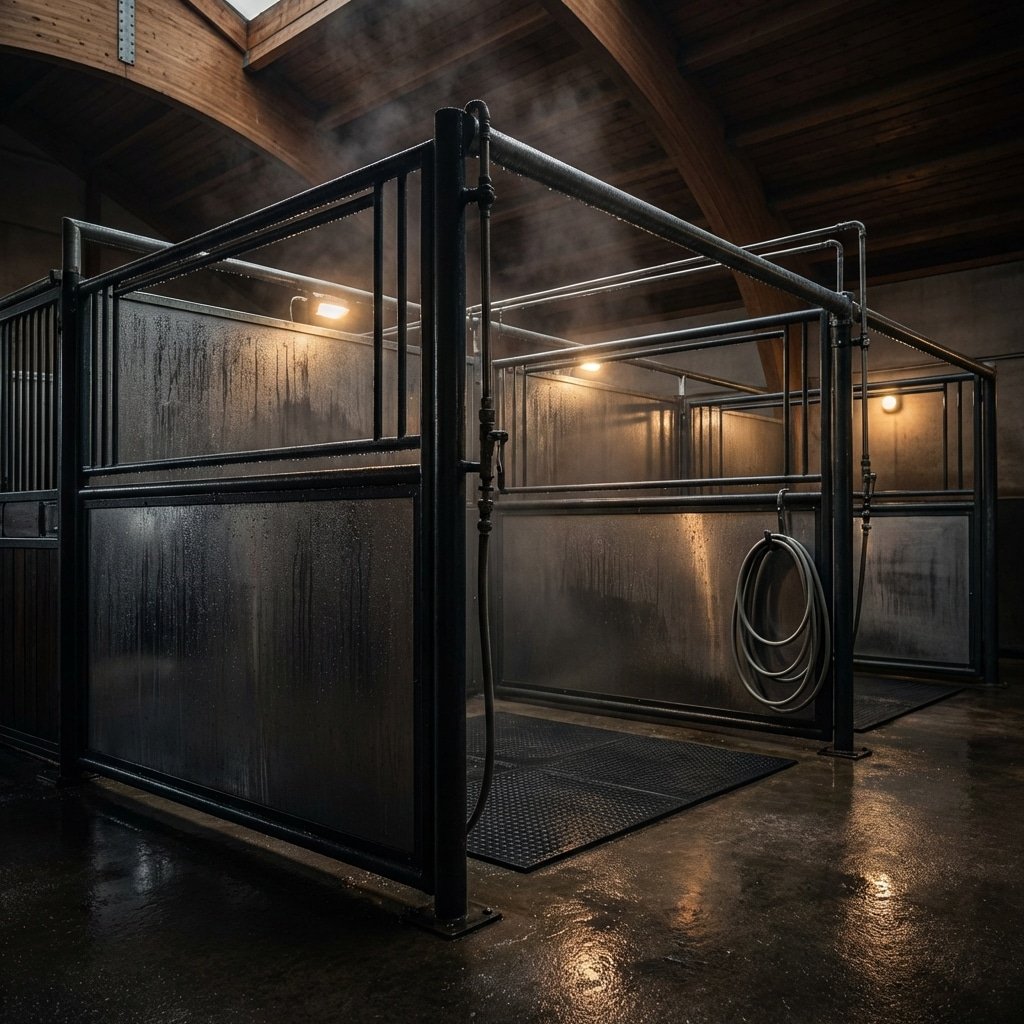
Defective Wash Bay Partitions generate immediate operational losses through bedding spoilage and rapid infrastructure corrosion. Standard open grills or wood infills fail to contain high-pressure overspray, turning adjacent aisles into slipping hazards while trapping acidic waste that eats through basic powder coats.
We solve this by utilizing 28mm-32mm solid HDPE panels that provide a non-porous, hydrophobic barrier against moisture. Combined with Q235B structural steel frames processed via Hot-Dip Galvanization After Fabrication to ISO 1461 standards, this system eliminates rust points and creates a zero-maintenance sanitation zone.

The Messy Reality of the Indoor Wash Rack
Indoor wash racks create a hostile mix of humidity and acidic waste that destroys standard steel. Without hot-dip galvanization to ISO 1461 standards, frames corrode rapidly from the inside out.
The Corrosive Impact of Constant Humidity
Wash bays are not just wet; they are chemically aggressive zones. Unlike an outdoor paddock where wind dries surfaces quickly, indoor wash racks trap moisture. You deal with daily cycles of saturation and drying, which accelerates oxidation on metal surfaces far faster than constant immersion. This humidity hangs in the air, penetrating microscopic gaps in standard paint or powder coats that look fine on day one but fail within months.
- Daily Oxidation Cycles: Frequent wetting and drying stresses the metal surface more than continuous submersion.
- Microscopic Penetration: High indoor humidity seeps into joints and crevices that spray guns miss.
- Acidic Runoff: Ammonia from urine mixes with standing water, creating a corrosive solution that eats through basic steel protection.
Why Hot-Dip Galvanization (ISO 1461) is Critical
Standard “pre-galvanized” steel—where manufacturers weld pre-coated tubes and paint over the burns—cannot survive this environment. Rust will inevitably start at the weld points and eat the frame from the inside. At DB Stable, we strictly use الجلفنة بالغمس الساخن بعد التصنيع. We weld the black steel frame first, then dip the entire unit into molten zinc. This ensures the zinc bonds to the steel at a molecular level, covering every weld, seam, and internal surface.
- Total Coverage: The dipping process coats internal tubing surfaces that spray/brush methods cannot reach.
- ISO 1461 Compliance: We adhere to BS EN ISO 1461, guaranteeing a zinc coating thickness greater than 85 ميكرون for structural parts.
- Sacrificial Protection: The thick zinc layer acts as a sacrificial anode, corroding in place of the steel when exposed to salt spray and moisture.
Why You Can’t Use Open Grills Near the Wash Area
Open grills in wash bays fail to contain overspray, soaking adjacent bedding, while complex welded joints trap acidic soap scum that accelerates corrosion risks.
The “Spray-Through” Risk: Preventing Bedding Spoilage
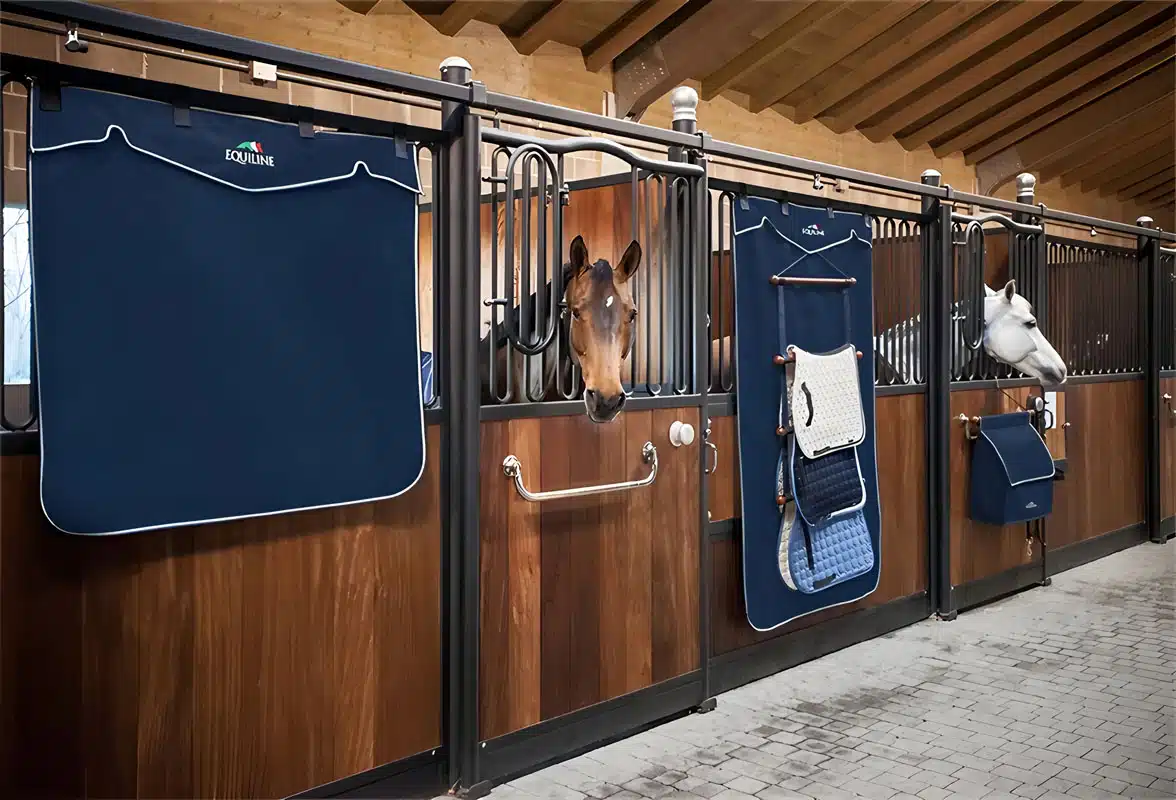
Standard stable partitions rely on airflow, but in a wash bay, this permeability becomes a liability. High-pressure sprayers do not respect property lines. A standard 50mm bar spacing offers zero resistance to water deflection, meaning the stall immediately next to the wash area absorbs the overspray.
This “spray-through” effect causes immediate operational losses:
- Bedding Contamination: Water soaks into shavings or straw in adjacent stalls, rendering them unusable before the horse even enters.
- Ammonia Spikes: Wet bedding accelerates the breakdown of urine and manure, creating respiratory hazards.
- Material Waste: Staff must strip and replace bedding frequently, driving up material and labor costs.
Maintenance Challenges on Tubular Steel Profiles
Hygiene maintenance differs drastically between a solid wall and a barred grill. Solid walls allow for a quick squeegee clean, but barred surfaces trap filth. Soap scum, horse hair, and body oils accumulate rapidly on the surface of 50mm RHS (Square Hollow Section) or 114mm Round Post profiles. Staff cannot easily wipe these down, leading to a buildup of organic matter.
The structural complexity of a grill also introduces corrosion risks specific to wash environments:
- Chemical Traps: Complex welded joints trap moisture and acidic shampoo residues that sit against the steel for prolonged periods.
- Zinc Degradation: While we utilize BS EN ISO 1461 hot-dip galvanization, constant exposure to acidic cleaning agents at the weld points tests the limits of the protective zinc layer.
- Cleaning Difficulty: Manual scrubbing of individual bars is labor-intensive, often leading staff to neglect these areas.
إسطبلات مصممة بدقة متناهية مع متانة تدوم 20 عاماً

The Impervious Barrier: Floor-to-Ceiling Solid HDPE Panels
Solid HDPE provides a non-porous, waterproof barrier that eliminates the rot and corrosion risks inherent to wood and steel, making it the only logical choice for high-moisture wash bays.
| مقياس الأداء | DB Solid HDPE (28-32mm) | Treated Pine/Bamboo | Painted Steel Infill |
|---|---|---|---|
| Moisture Absorption | 0% (Hydrophobic) | High (Swells & Rots) | N/A (Rusts at Seams) |
| Chemical Resistance | Inert to Solvents | Stains & Degrades | Paint Peels |
| الصيانة | Spray & Wipe | Annual Varnishing | Scrape & Repaint |
| Biological Risk | Antibacterial | Mold & Fungus Host | Corrosion Bleed |
Defying Moisture and Chemical Corrosion
Water kills stable infrastructure. In a wash bay environment, traditional infills like bamboo or pine act like sponges. Even with marine-grade varnish, the constant expansion and contraction from wet-dry cycles inevitably breaches the seal, leading to internal rot and black mold. Solid HDPE (High-Density Polyethylene) creates a biologically inert wall. It has zero porosity, meaning water physically cannot penetrate the surface regardless of exposure time.
Chemical corrosion poses an equally significant threat in commercial operations. Daily use of antifungal shampoos, disinfectants, and lineament solvents will strip the paint off steel panels and discolor wood finishes. HDPE withstands these aggressive agents without degrading. We see this often in high-turnover barns where hygiene protocols are strict; the plastic remains unaffected while metal components in competitor products begin to bleed rust onto the wash bay floor.
Technical Specs: UV-Stabilized Impact Resistance
You cannot simply use standard plastic sheeting in an equestrian facility. We engineer our panels to withstand the specific physical abuse of a wash bay, where horses may become agitated by cold water or confined spaces.
- 28mm-32mm Profile Thickness: We strictly prohibit thinner profiles. This gauge provides the mass necessary to absorb the kinetic energy of a hoof strike without shattering.
- التثبيت بالأشعة فوق البنفسجية: Essential for Australian and American markets. The polymer mix includes stabilizers that prevent the “chalking” and brittleness common in cheap plastics exposed to sunlight.
- “Zero Maintenance” Surface: The material requires no varnishing, painting, or rust treatment. A simple pressure wash returns the panel to a like-new condition.

Securing Tie Rings to the Hot-Dip Galvanized Frame
ملخص تنفيذي: Anchor tie rings directly to the 50mm structural steel posts, never the infill. Treat field-drilled holes immediately with cold galvanizing spray to maintain corrosion resistance.
Why Tie Rings Must Anchor to the Structural Posts
A common installation error is mounting tie rings or cross-tie hardware directly through the infill planks. This is a safety hazard. While our HDPE and Bamboo infills are impact-resistant (kick-proof), they are not designed to withstand high tensile loads. A frightened horse pulling back can exert over 1,000 lbs of force. If the hardware is anchored to the infill, the horse will rip the bolts through the material, destroying the panel and creating a dangerous projectile.
You must utilize the structural integrity of the steel frame. Our stabling uses 50mm x 50mm RHS Q235B structural steel, which provides the necessary yield strength to withstand sudden, violent pulling without deformation.
- سعة الحمولة: Structural posts handle the static and dynamic loads of a pulling horse; infill panels do not.
- Steel Grade: We use Q235B (ASTM A36 equivalent) specifically for this type of structural resilience.
- Panel Protection: Anchoring to the frame prevents tearing or warping of the HDPE or Bamboo boards.
- Safety Positioning: Structural points are typically located at the strongest junctions of the stable, keeping the horse safely positioned.
Installation Protocol: Stainless Hardware & Cold Galvanizing Repair
Modifying a “Hot-Dip Galvanized After Fabrication” frame requires specific steps to maintain the rust warranty. When you drill a hole for a tie ring on-site, you break the protective zinc seal that was applied at the factory. If left untreated, rust will begin at this drill point and spread beneath the coating.
To maintain the integrity of the system, follow this protocol using the components included in the DB Stable installation kit:
- Seal the Breach: Immediately after drilling into the frame, spray the exposed raw steel inside the hole with the provided Cold Galvanizing Spray (Touch-up Spray). This restores the zinc barrier.
- Hardware Selection: Use the included 304 Stainless Steel bolts and washers. Do not use standard zinc-plated hardware from a local hardware store.
- Prevent Galvanic Corrosion: Stainless steel is compatible with galvanized surfaces. Cheaper metals can cause a galvanic reaction in wet environments, leading to rapid corrosion and unsightly rust streaks.
- Lifetime Standard: Proper sealing and hardware selection ensure the modified area remains as rust-resistant as the rest of the factory-dipped frame.
الأسئلة المتداولة
What are the best materials for indoor wash bay walls?
You need materials that are completely impervious to moisture. Waterproof options like solid HDPE (High-Density Polyethylene), Fiberglass-Reinforced Panels (FRP), or properly sealed concrete are the only viable commercial choices. Avoid standard wood, even if treated, as the constant humidity in a wash bay eventually causes rot and bacterial buildup. For steel components, we strictly use Hot-Dip Galvanized steel to prevent rust in these wet environments.
Is solid HDPE plastic suitable for wash racks?
Yes, it is the industry standard for low-maintenance facilities. Solid HDPE (specifically the 28mm-32mm thickness we use) is non-porous, meaning it cannot absorb water, urine, or cleaning chemicals. Unlike wood which swells, or coated metal which can chip, HDPE remains unaffected by daily hosing and steam. It allows for “Zero Maintenance” operations since it requires no painting or sealing to fight off mold.
How do I stop water overspray from reaching the barn aisle?
The most effective method is installing solid, high partitions rather than open bars. We recommend solid floor-to-ceiling partitions or high HDPE walls (at least 2.2m) between the wash bay and the aisle. These barriers physically contain the spray within the stall footprint. Drainage slope is also critical here; the floor must slope away from the aisle to prevent water from running under the partition.
Can I use standard galvanized steel partitions in a wash stall?
No, “standard” pre-galvanized steel will fail. Most cheap partitions are made from pre-galvanized tube that is welded together, which burns the zinc off the joints. These weld points will rust almost immediately in a wash bay. You must use steel that is **Hot-Dip Galvanized After Fabrication** (conforming to ISO 1461 standards). This process dips the entire finished door into molten zinc, sealing every weld and joint against water ingress.
الأفكار النهائية
Relying on pre-galvanized steel or porous wood in a wash bay guarantees warranty claims and angry clients within months. Our ISO 1461 Hot-Dip Galvanization paired with non-porous HDPE provides the only permanent defense against acidic runoff and humidity. Your installation reputation depends on materials engineered to survive this hostile environment, not just the showroom.
Eliminate the risk of corrosion in your next project by verifying our specs directly. Request a material sample kit to test our 32mm HDPE impact resistance and zinc thickness firsthand. Contact our project team now to discuss OEM dimensions for your facility.

 Arabic
  English
  Spanish
  French
  German
0 تعليق