


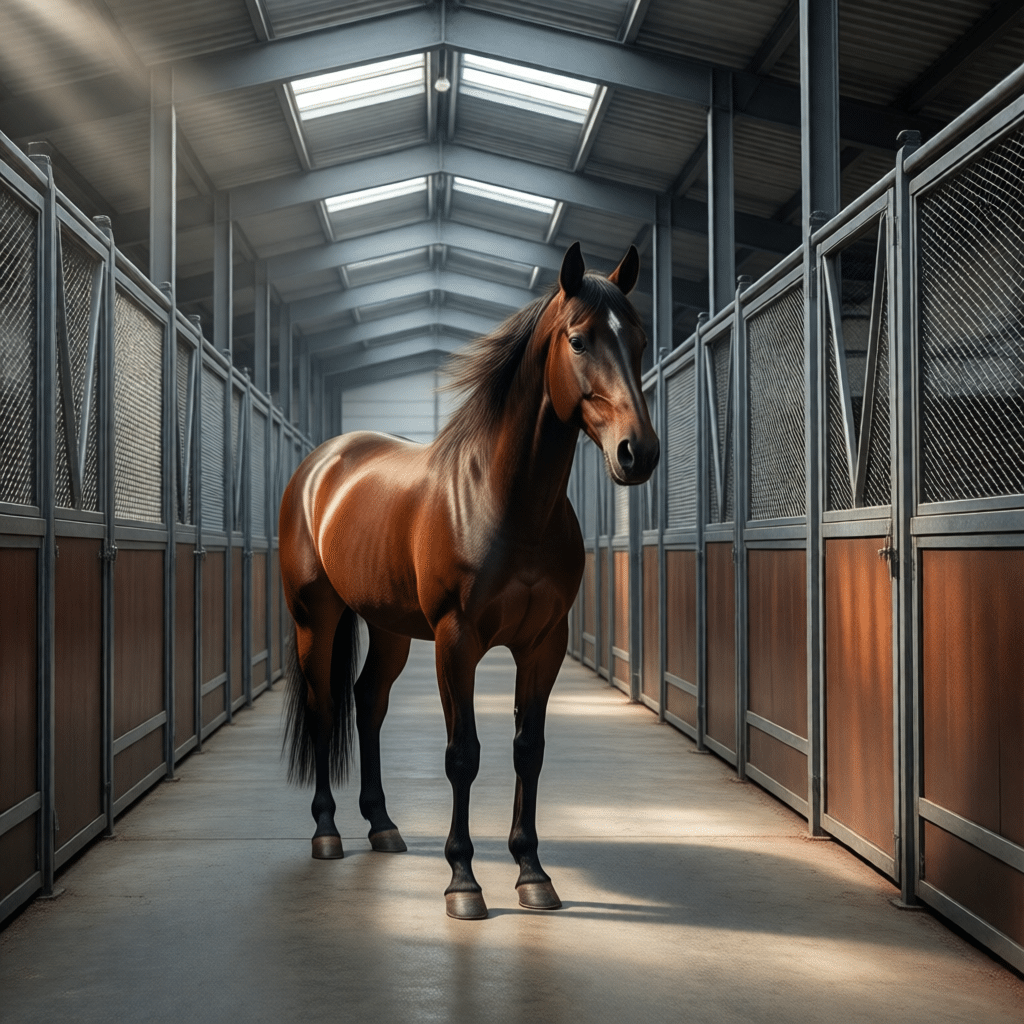
Housing Warmbloods in Germany demands infrastructure that exceeds standard safety specifications to prevent catastrophic injury liability. Standard 2.2m boxes often fail to contain the kinetic energy of a 17-hand Holsteiner, turning minor behavioral outbursts into expensive veterinary emergencies or structural failures.
We engineer our Professional Series using Q345B Low Alloy High Strength Steel to guarantee impact resistance in freezing climates. By upgrading to 2.4m mesh dividers and utilizing Hot-Dip Galvanization After Fabrication (ISO 1461), we align strict animal welfare standards with zero-maintenance durability for professional equine facilities.
The Physical Demands of Housing Hannoverians and Holsteiners
Hannoverians and Holsteiners require housing that exceeds standard specifications due to their mass. We analyze critical spatial adjustments and cast-proof engineering needed to prevent injury.
German Warmbloods are not just tall; they are dense, powerful athletes designed for high-impact performance. Standard housing assumptions often fail these breeds because they underestimate the sheer volume of the animal. A Holsteiner typically stands between 16 and 17 hands, carrying significant muscle mass across the chest and hindquarters. Hannoverians, averaging 16.2 hands, possess deep, barrel-shaped bodies that require more turning radius than a standard thoroughbred.
We strongly advise against the industry-standard 12′ x 12′ box for these breeds. Research and practical experience dictate that a 12′ x 14′ footprint is the baseline for comfort and safety. Beyond dimensions, the structural integrity of the stall front must match the horse’s power. High muscle mass translates to increased kinetic force applied to stable walls during rubbing, impact, or behavioral stress. Flimsy infill or thin-gauge steel will not withstand the lateral pressure a 1,400 lb warmblood can exert.
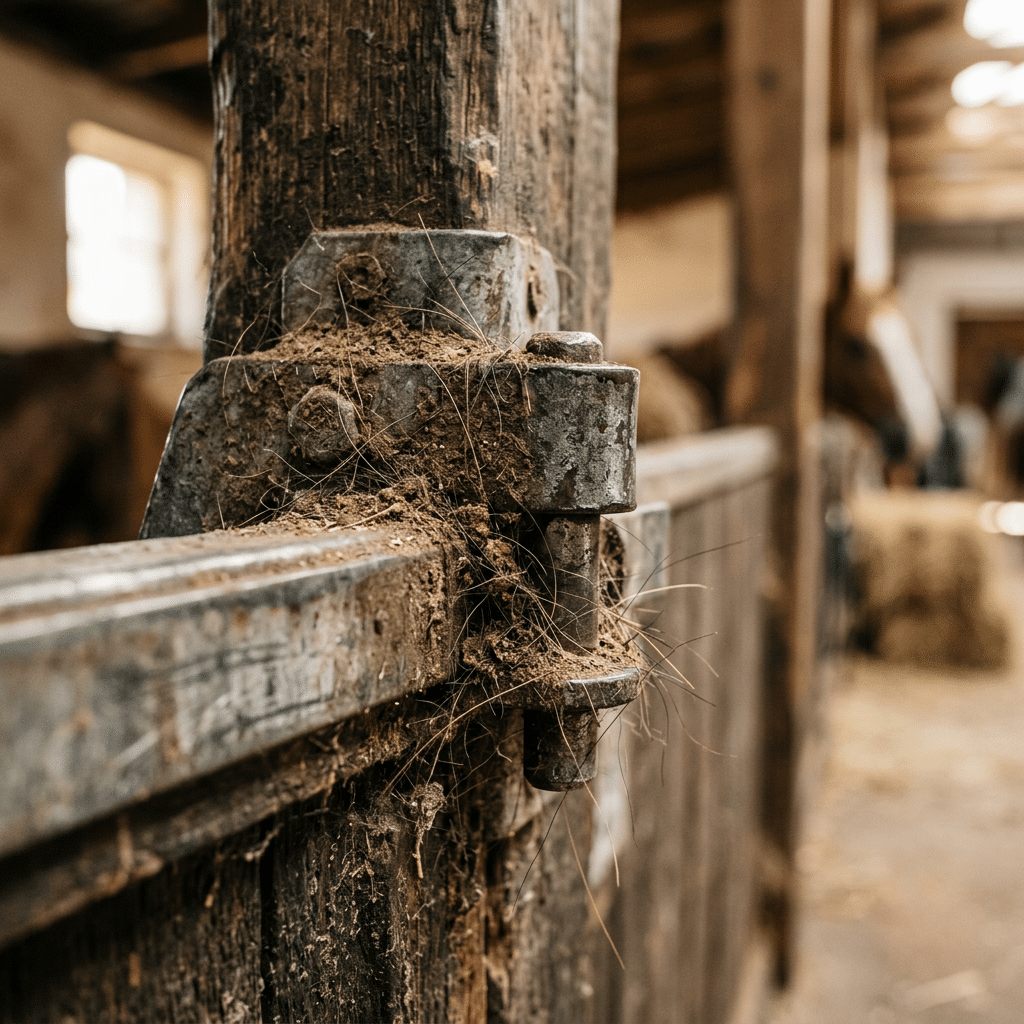
Mitigating Injury Risks with Cast-Proof Design
The deep, sprung ribs and large barrel bodies of Hannoverians and Holsteiners significantly increase the risk of getting “cast”—trapped against a wall while rolling. When a large horse cannot gain the leverage to stand, panic sets in, often resulting in severe musculoskeletal injuries as they thrash against the partition or door.
- تصميم مقاوم للصب: DB Stable engineers every stall front to minimize the gap between the bottom of the door and the floor.
- 50mm Safety Standard: We strictly limit bottom clearance to approximately 50mm. This prevents a hoof from sliding under the door during a roll, eliminating the leverage point that causes leg fractures.
- Injury Prevention: By removing the gap, we remove the entrapment zone, ensuring that performance horses remain safe even when lying down in fully bedded stalls.
Height Matters: Upgrading to 2.4m Tall Horse Stall Fronts
Upgrading to 2.4m fronts aligns with European safety standards, preventing large Warmbloods from rearing while enhancing Stack Effect ventilation. We use Q345B structural steel to maintain rigidity without warping.
Safety and Ventilation: The Shift to 2.4m European Standards
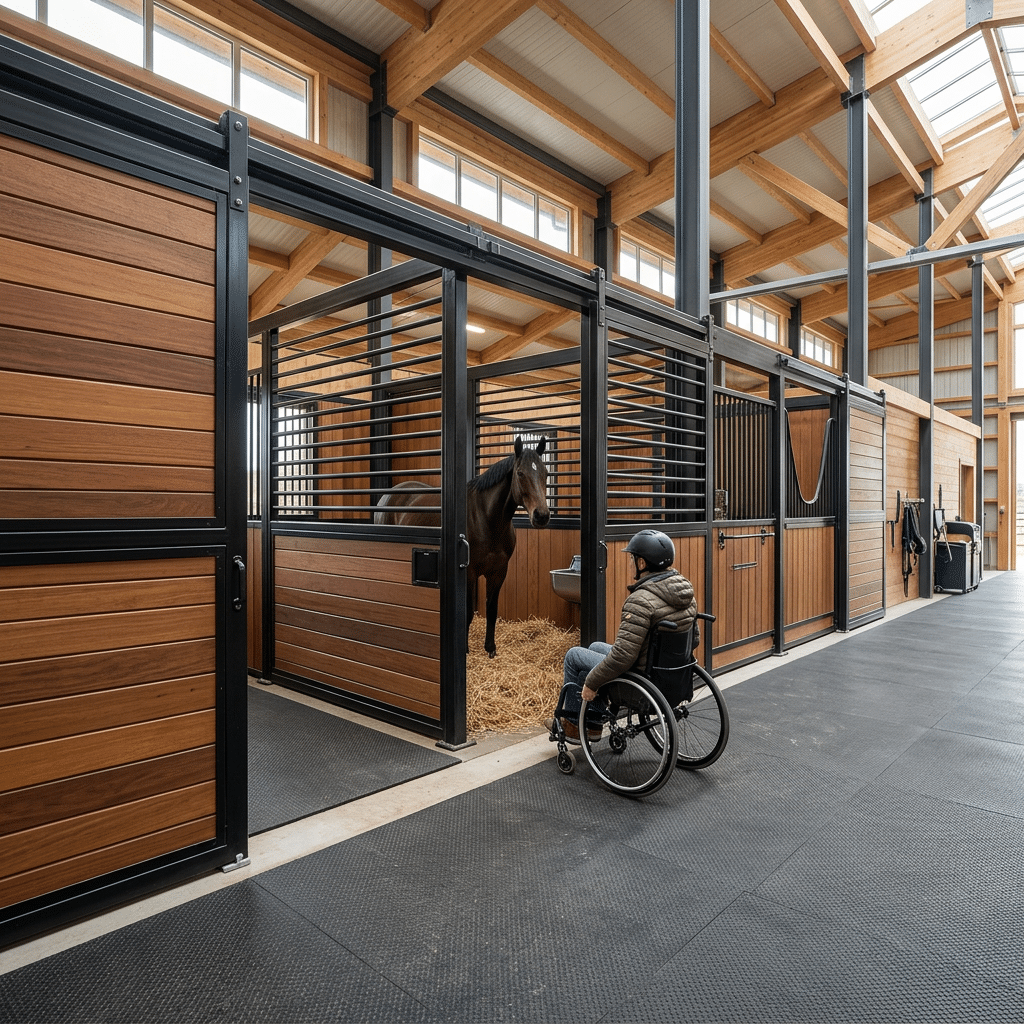
The modern sport horse is getting larger, and stable infrastructure must adapt. Traditional 2.2m stall fronts often fall short for breeds like Hannoverians and Holsteiners, presenting a severe safety risk where an agitated horse can rear and get a hoof over the top door. Moving to a 2.4m standard effectively eliminates this danger, providing the necessary vertical containment for high-performance warmbloods. This height upgrade is now a baseline requirement in many EU markets that enforce stricter animal welfare regulations regarding vertical clearance and confinement safety.
Beyond containment, height drives airflow. Increasing the vertical profile allows for a larger open grill area, which significantly enhances “Stack Effect Ventilation.” Heat naturally rises; a taller stall front allows this warm, stale air to escape efficiently through the upper mesh rather than trapping ammonia at the horse’s respiratory level. This open design also facilitates better light penetration and visual contact between horses, directly reducing stall vices and separation anxiety common in isolated, high-value competition horses.
Ensuring Rigidity: Heavy-Duty Q345B Steel Frameworks
You cannot simply stretch a standard stall frame to 2.4m without reinforcing the core engineering. Added height increases the leverage placed on the structure, making standard steel prone to flexing or warping under impact. DB Stable solves this by exclusively utilizing **Q345B Low Alloy High Strength Steel** for these taller profiles. This material offers superior tensile strength compared to standard commercial steel, ensuring the frame remains rigid and square even when a 600kg animal leans or strikes against it.
- السلامة الهيكلية: We maintain a strict **14-Gauge (2.0mm – 2.5mm)** wall thickness to withstand the increased leverage of higher panels.
- Corrosion Defense: Every frame undergoes **Hot-Dip Galvanization After Fabrication (ISO 1461)**, protecting the expanded surface area from rust, inside and out.
- Impact Safety: The design integrates our **”Kick-Proof Guarantee,”** ensuring the bottom solid portion remains impact-resistant despite the added height.
Premium Custom Stables With 20-Year Durability

Q345B Steel: The Only Choice for Warmblood Impact
Standard steel risks brittle fracture against Warmblood kicks in freezing temperatures. Q345B offers ASTM Grade 50 impact toughness essential for professional safety and cold climates.
The Physics of Impact: Why Standard Steel Fails
Housing warmbloods requires a different engineering approach than housing ponies or light riding horses. A 17-hand Holsteiner or Hanoverian generates massive kinetic energy during a kick. When this force connects with a stall front, the steel must absorb and dissipate that energy instantly. Standard carbon steel often lacks the necessary yield point to handle this specific load without deformation.
The risk is not just bending; it is “brittle fracture.” Most generic stable manufacturers use Q235 (equivalent to ASTM A36). At moderate temperatures, this material performs adequately. But as temperatures drop, the ductility of standard carbon steel decreases significantly. If a powerful horse kicks a standard Q235 bar in freezing conditions, the metal is more likely to snap cleanly rather than bend.
A bent bar is a maintenance annoyance. A snapped bar creates a jagged spear capable of inflicting catastrophic injuries. For facilities housing high-value p
erformance horses, relying on standard construction grade steel is a liability we do not accept.
Q345B Specifications: ASTM Grade 50 Low Alloy Performance
To mitigate fracture risks, we engineer our “Professional Series” and “Cold Climate Options” using Q345B Low Alloy High Strength Steel. This material is the structural equivalent of ASTM Grade 50. It provides a higher tensile strength and, more critically, superior impact toughness in low temperatures compared to standard mild steel.
We do not offer this as a luxury upgrade but as a safety necessity for regions with harsh winters or facilities housing large breeds. The increased yield strength ensures the steel absorbs impact energy effectively, bending under extreme duress rather than shearing.
- Material Standard: Q345B Low Alloy High Strength Steel (ASTM Grade 50 Equivalent).
- حد الخضوع: 345 MPa minimum (approx. 1.5x stronger than standard Q235).
- سماكة الجدار: Strictly 14-Gauge (2.0mm – 2.5mm) to prevent denting.
- Primary Application: DB Stable “Professional Series” and projects in freezing climate zones.
Mesh Horse Stall Dividers: Airflow Meets Ultimate Strength
Our mesh dividers utilize the “Stack Effect” to drive out ammonia and engineered Q345B steel to withstand heavy impact, solving the conflict between ventilation and security.
| المواصفات | DB Stable Engineering | Standard Market Option |
|---|---|---|
| Steel Grade | Q345B Low Alloy High Strength | Q235 Mild Steel |
| Rust Protection | Hot-Dip Galv. After Fabrication (ISO 1461) | Pre-Galvanized (Welds spray-painted) |
| Ventilation Logic | Vertical “Stack Effect” Flow | Passive / Stagnant |
| Frame Profile | 50mm x 50mm RHS (14-Gauge) | 30mm or 40mm (Thin wall) |
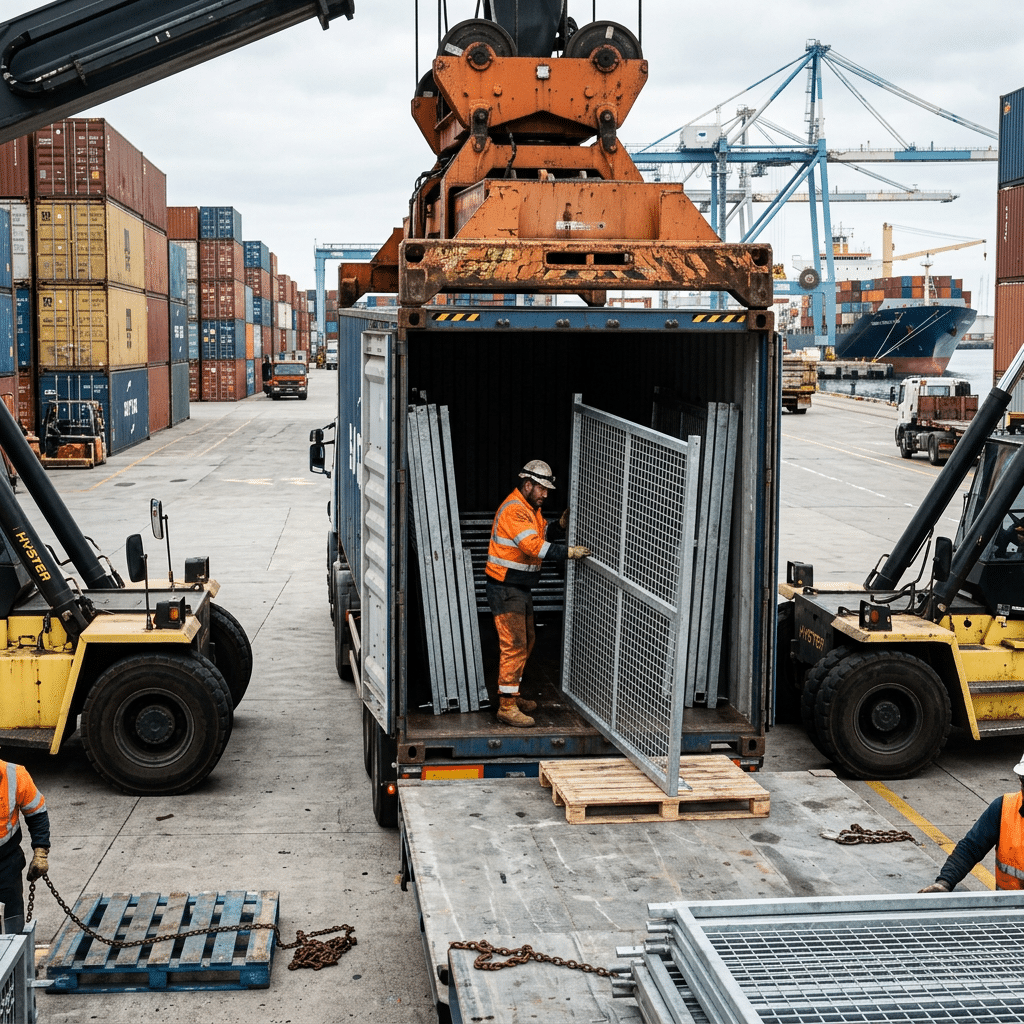
Leveraging the Stack Effect for Respiratory Health
Stagnant air is the silent killer in professional stables. Ammonia from urine is heavier than air and settles at the horse’s nose level when they sleep. Solid partitions trap this gas, leading to chronic respiratory issues. Our mesh dividers are designed to trigger the “Stack Effect.” Body heat generates a vertical updraft, and the open mesh allows this warm, stale air to escape into the aisle rafters rather than recirculating in the stall.
Beyond physical health, these dividers address the psychological needs of the herd. Horses are social animals that rely on visual contact to feel secure. Solid walls isolate them, causing stress that manifests as stable vices like weaving, cribbing, or stall walking. By opening up the sightlines, we reduce cortisol levels across the barn.
- Vertical Air Movement: Facilitates the removal of dust and ammonia via thermal buoyancy.
- Herd Connection: Enables horses to see neighbors, significantly reducing isolation stress.
- Vice Prevention: Drastically lowers the incidence of boredom-related behaviors like cribbing.
- Balanced Design: 2.4m height configurations offer security while maintaining open socialization.
Engineering Strength: Q345B Steel and Hot-Dip Galvanization
Mesh implies “lightweight” to some, but in our facility, it means heavy-duty engineering. We do not use standard mild steel for these critical barriers. Instead, we utilize فولاذ Q345B منخفض السبائك عالي القوة. This material is equivalent to ASTM Grade 50 and offers superior impact toughness, particularly in cold climates where standard steel becomes brittle and prone to fracture under the force of a kick.
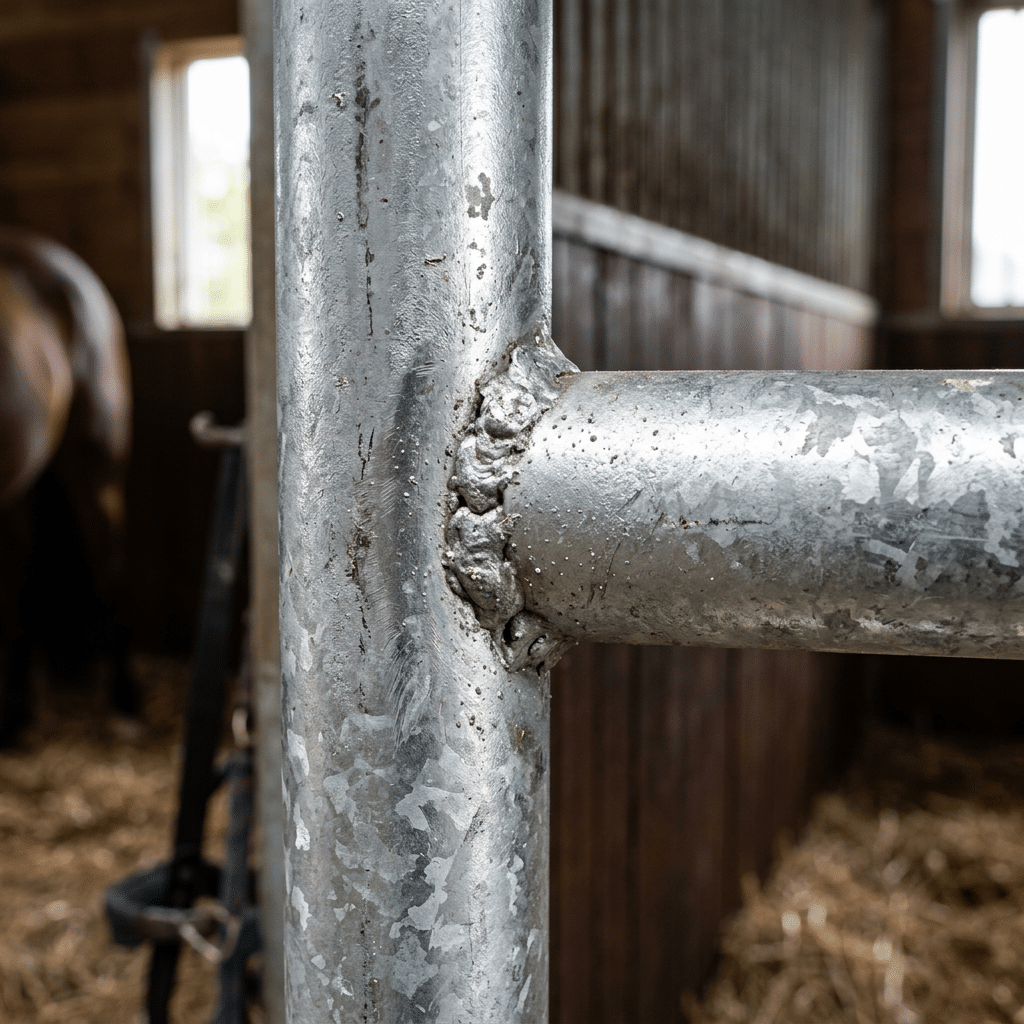
The manufacturing process is equally aggressive. Many competitors cut costs by using pre-galvanized wire, welding it together, and then covering the burnt, rusty weld spots with silver spray paint. We reject this method. We weld the raw black steel first, then submerge the entire divider into a zinc bath—a process known as Hot-Dip Galvanization After Fabrication (ISO 1461). This seals every wire weave point and joint with over 70 microns of zinc, creating a monolithic barrier against rust.
- Q345B Steel Advantage: Delivers superior low-temperature impact toughness compared to standard Q235.
- ISO 1461 Galvanization: Total submersion after welding eliminates the rust-prone “painted welds” found on cheaper products.
- Kick-Proof Resilience: Framed with 50mm x 50mm RHS tubing to absorb high-velocity impacts.
- السلامة الهيكلية: Eliminates the weak spots inherent in pre-galvanized welded wire mesh.
Precision CNC Bolting for Rattle-Free Stalls
Rattling stalls indicate loose tolerances that lead to structural failure. Our CNC bolting achieves a zero-gap fit, while 304 stainless steel hardware prevents loosening from heavy horse impact.
CNC Machining: Eliminating the Vibration Gap
Standard bolts are the silent killers of stable safety. Most manufacturers treat fasteners as an afterthought, using loose-tolerance hardware that allows microscopic movement. When a 600kg warmblood leans or kicks against the partition, that movement amplifies. Over time, this “rattle effect” backs nuts off their threads, compromising the entire wall’s structural integrity.
We take a different approach. We use CNC machining to achieve geometric tolerances within ±2 microns. This precision creates a friction-lock fit between the bolt and the steel frame. The result is a mechanical bond that refuses to vibrate loose, regardless of how active the horse is inside the stall.
فولاذ مقاوم للصدأ 304: The High-Tensile Hardware Spec
Precision means nothing if the material snaps under shear force. While many competitors cut costs by using galvanized iron screws that rust and shear, we strictly adhere to a higher standard found in our installation kits.
We utilize فولاذ مقاوم للصدأ 304 for every single anchor bolt, connector, and screw in the DB Stable system. This material choice serves two critical functions:
- Tensile Strength: It resists the massive shear forces generated by kicks, preventing immediate catastrophic failure.
- Corrosion Immunity: Stables are high-ammonia environments. 304 grade steel ensures threads remain intact and do not corrode, allowing for future adjustments or disassembly without stripping heads.
الأسئلة المتداولة
What is the recommended stall size for Warmbloods?
Warmbloods typically stand 16 to 18 hands and struggle in standard 12′ x 12′ boxes. We strongly recommend a minimum footprint of 3.6m x 4.0m (12′ x 14′), with 4.0m x 4.0m (14′ x 14′) being optimal. This isn’t just about comfort; it prevents “casting.” Larger horses need the extra diagonal length to lie down, roll, and stand back up without getting their legs trapped against the wall.
Why upgrade to a 2.4m (8ft) high stall front?
Standard European fronts often cap at 2.2m. While sufficient for average horses, athletic Warmbloods and stallions can rear high enough to get a foreleg over a shorter door, leading to catastrophic injuries. Upgrading to 2.4m creates a necessary safety barrier that contains the horse’s head and neck during behavioral outbursts, ensuring they stay safely inside the box.
How does Q345B steel differ from standard structural steel?
Q345B is a low-alloy, high-strength steel (equivalent to ASTM Grade 50) that we specifically utilize for cold-climate projects. Unlike standard Q235B (ASTM A36), Q345B retains superior impact toughness at freezing temperatures. Standard steel can turn brittle and snap under the force of a kick in winter conditions; Q345B absorbs that energy without fracturing, making it our “Kick-Proof” standard for harsh environments.
Are mesh dividers better than solid partitions?
For most professional facilities, yes. Mesh dividers facilitate the “Stack Effect,” allowing fresh air to sweep ammonia fumes off the floor and out of the stable. They also solve behavioral problems. Horses are herd animals; seeing their neighbors reduces isolation stress, which directly lowers the incidence of stable vices like weaving, cribbing, or stall walking.
Can stable fronts be customized to fit existing barn columns?
Yes. As a B2B OEM manufacturer, we don’t rely on fixed-width inventory. We fabricate frames to match your specific clear-span openings. Whether you need a 3.0m front for a pony stall or a 4.2m front for a large foaling box, we adjust the manufacturing dimensions to retrofit precisely into your existing structure without requiring masonry changes.
الأفكار النهائية
Housing high-value Warmbloods in standard-grade steel is a liability your facility cannot afford. Our Q345B Hot-Dip Galvanized system provides the certified ASTM Grade 50 impact toughness required to withstand the kinetic force of a 17-hand Holsteiner. Investing in this “Professional Series” specification eliminates the risk of brittle fracture and ensures your infrastructure meets strict EU animal welfare standards.
Do not compromise on structural integrity; verify our engineering firsthand with a trial order. Our flat-pack logistics model allows you to import these heavy-duty systems at a fraction of local fabrication costs, protecting your margins while delivering superior safety. Contact our technical team today to configure a custom 2.4m solution tailored to your project requirements.

 Arabic
  English
  Spanish
  French
  German
0 تعليق