


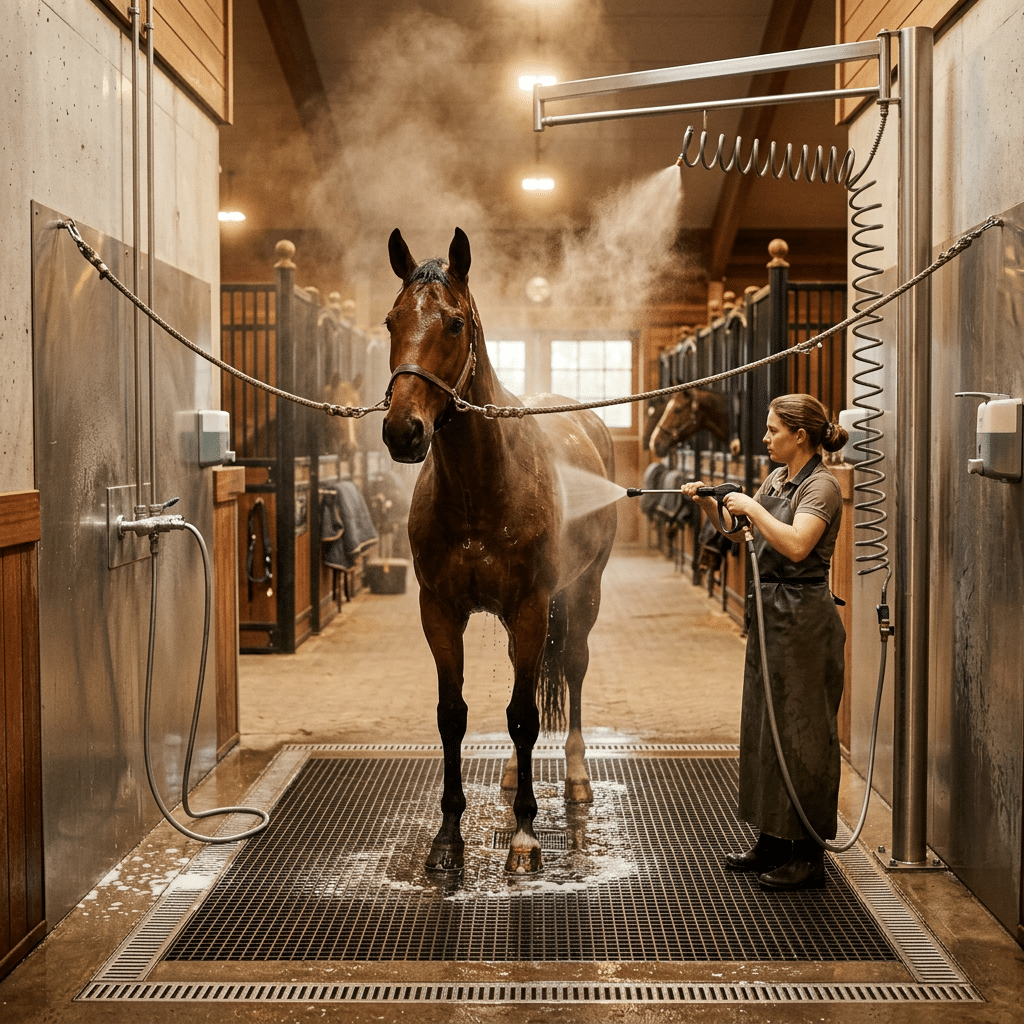
Expanding a Draft Horse Rescue facility demands heavy-duty infrastructure that balances immediate capacity with long-term solvency. Relying on standard timber or residential-grade steel for these heavy breeds inevitably leads to structural failure and wasted donor capital on repetitive repairs.
This analysis benchmarks institutional stabling solutions using the Q235B structural steel and ISO 1461 hot-dip galvanization standard. We examine how flat-pack logistics and high-density bamboo infill reduce freight costs by 60% while eliminating maintenance liabilities for non-profit operations.
صعود الحوكمة البيئية والاجتماعية وحوكمة الشركات في مجال الإنشاءات
By 2026, ESG is a mandatory compliance framework, not a marketing option. We prioritize decarbonization through recyclable steel, durable HDPE, and strict Scope 3 emission controls via high-density logistics.
Mandatory Decarbonization and the Circular Economy
ESG is transitioning from voluntary corporate guidelines to mandatory compliance infrastructure by 2026. In the past, sustainability was a “nice-to-have” add-on for premium projects. Now, regulators and institutional investors demand explicit carbon budgets before a single shovel hits the ground. This shift forces developers to account for “whole-life carbon,” which penalizes the use of temporary or disposable building materials that require frequent replacement.
The industry is aggressively pivoting toward the circular economy. Materials like treated timber, which often ends up as hazardous waste due to chemical preservatives, are losing favor. Instead, the focus is on materials like structural steel (Q235B/Q345B) and HDPE. These materials support infinite recyclability without performance degradation, aligning with the strict decarbonization mandates that now control project funding and approval.

Reducing Scope 3 Emissions with Flat-Pack Logistics and HDPE
Scope 3 emissions—those generated up and down the supply chain—are the hardest to quantify and control. In the equestrian infrastructure market, the biggest carbon offender is inefficient freight. Shipping fully welded stable fronts involves moving mostly “air,” which spikes the carbon footprint per unit significantly. We address this directly through our engineered logistics.
- Legacy Logistics: Traditional welded frames allow only 12-15 sets per 40HQ container.
- DB Stable Efficiency: لدينا Steel Pallet Flat-Pack system loads 30-45 sets per 40HQ container.
- Carbon Impact: This density reduces shipping-related carbon emissions by over 60% per unit.
- Zero Maintenance Lifecycle: HDPE Infill و مغلفن بالغمس الساخن steel prevent the need for chemical treatments or replacement cycles common with wood.
By extending the lifespan of the equipment and maximizing freight density, we lower the embodied carbon of the facility. This allows developers to meet rigorous 2026 ESG standards without sacrificing durability or profitability.
الابتعاد عن أخشاب الغابات القديمة (البلوط/الصنوبر)
Traditional softwoods compromise stable hygiene and safety. We replace these vulnerable materials with High-Density Strand Woven Bamboo, delivering 3x the hardness of oak and immunity to rot.
The Maintenance Liabilities of Pine and Oak
For decades, traditional timber
served as the default for stable infills, but its performance in active equine environments is fundamentally flawed. Wood is porous by nature. In a stable, this porosity acts as a sponge for urine and moisture, creating a permanent breeding ground for bacteria and ammonia buildup that no amount of scrubbing can fully eradicate.
Beyond hygiene, structural failure is a constant risk. Pine and standard oak are fibrous softwoods that splinter under impact. When a horse kicks or cribs on these boards, the wood fractures into sharp shards, posing immediate injury risks to the animal. To keep these materials functional, facility managers must commit to a cycle of stripping, sanding, and varnishing every few years—a massive operational cost that modern facilities can avoid.
Engineered Bamboo: A Janka Hardness of 3000+ lbf
We moved exclusively to High-Density Strand Woven Bamboo to solve the durability deficit of natural wood. This is not the hollow bamboo used in garden furniture; it is an engineered board created by compressing bamboo fibers under extreme heat and pressure with eco-friendly resins.
- Janka Hardness Rating: Exceeds 3000 lbf (Red Oak sits at ~1290 lbf).
- مقاومة الصدمات: 3x harder than traditional hardwood, preventing kick fractures.
- Moisture Immunity: Naturally resistant to mold, rot, and urine absorption without heavy chemical treatments.
- Fire Resistance: Meets B1 fire safety standards due to high material density.
الأسئلة المتداولة
كيف تبني مركزاً للفروسية متوافقاً مع المعايير البيئية والاجتماعية والمؤسسية؟
Building an ESG-compliant facility requires a strategic shift in energy, water, and social responsibility practices. You cannot simply claim “sustainability”—you must demonstrate it through measurable infrastructure changes.
- Energy & Emissions: Transition to renewable generation. Leading facilities now generate up to 80% of their electricity via on-site solar panels.
- Water Management: Implement closed-loop water cycles. Collect rainwater and treat groundwater to achieve 100% self-sufficiency for wash bays and irrigation.
- Biodiversity: Convert unused pasture edges into biodiversity-rich zones with native planting to offset the facility’s physical footprint.
- Social Responsibility: Enforce strict safety protocols and provide wellness facilities for staff to address the industry-wide issue of veterinary and groom burnout.
هل الخيزران مادة بناء مستدامة؟
Yes, bamboo is a superior renewable alternative to traditional hardwood, provided it is properly engineered for durability. Its agronomic profile allows it to outpace timber in almost every sustainability metric.
- Rapid Regeneration: Bamboo reaches maturity for harvest in 3–5 years. In contrast, oak and maple require 30–50 years.
- Carbon Sequestration: A bamboo forest absorbs up to 4x more CO2 than a comparable stand of trees and releases 35% more oxygen.
- Zero Deforestation: Bamboo is a grass that regenerates from its own root system after harvesting, eliminating the need for replanting and soil disturbance.
التأثير البيئي للحظائر الفولاذية مقابل الحظائر الخشبية؟
The choice between steel and wood depends on whether you prioritize initial embodied carbon or long-term lifecycle efficiency. Wood has lower production emissions but fails faster; steel consumes more energy to produce but lasts indefinitely.
- Wood (Short-Term Carbon Benefit): Wood-framed buildings have lower initial embodied carbon because trees grow naturally. However, they require frequent chemical treatments and eventual replacement due to rot and warping.
- Steel (Long-Term Circularity): Steel, particularly the Q235B grade we use, is 100% recyclable without loss of strength. It does not warp, rot, or burn, and modern production uses high percentages of recycled scrap.
بالنسبة لـ commercial B2B projects, steel offers a superior lifecycle ROI and aligns with circular economy principles by eliminating demolition waste.
الشهادات الخضراء لإسطبلات الخيول؟
There is no specific global certification solely for horse stables. However, developers utilize commercial building standards to validate their environmental claims. The most common framework is LEED (Leadership in Energy & Environmental Design).
While LEED does not have an “equestrian” category, stables can earn credits through:
- Site Planning: Managing stormwater via bioswales and pervious pavement.
- المواد: Using recycled steel and rapidly renewable bamboo.
- Efficiency: Natural ventilation designs (Stack Effect) that reduce reliance on electric fans.
In specific regions like California, agricultural structures must also comply with the CalGreen Code, which mandates strict water conservation and construction waste reduction.
الشركات المصنعة لحظائر الخيول الصديقة للبيئة؟
The market divides into two categories: those using mass timber and those utilizing recyclable modular steel. Several manufacturers have established reputations for prioritizing sustainability in their production processes.
- Modular Steel Fabricators: Companies like MD Barnmaster and our own DB Stable production lines focus on pre-fabrication. This reduces on-site waste to near zero and utilizes steel that is 100% recyclable at the end of its life.
- Mass Timber Specialists: Firms like DC Structures utilize heavy timbers from responsibly managed forests in the Pacific Northwest, focusing on renewable sourcing.
- Master Planners: Groups like Sustainable Stables do not just manufacture; they design the entire ecosystem, integrating pasture management and passive design principles to lower the facility’s operational carbon footprint.
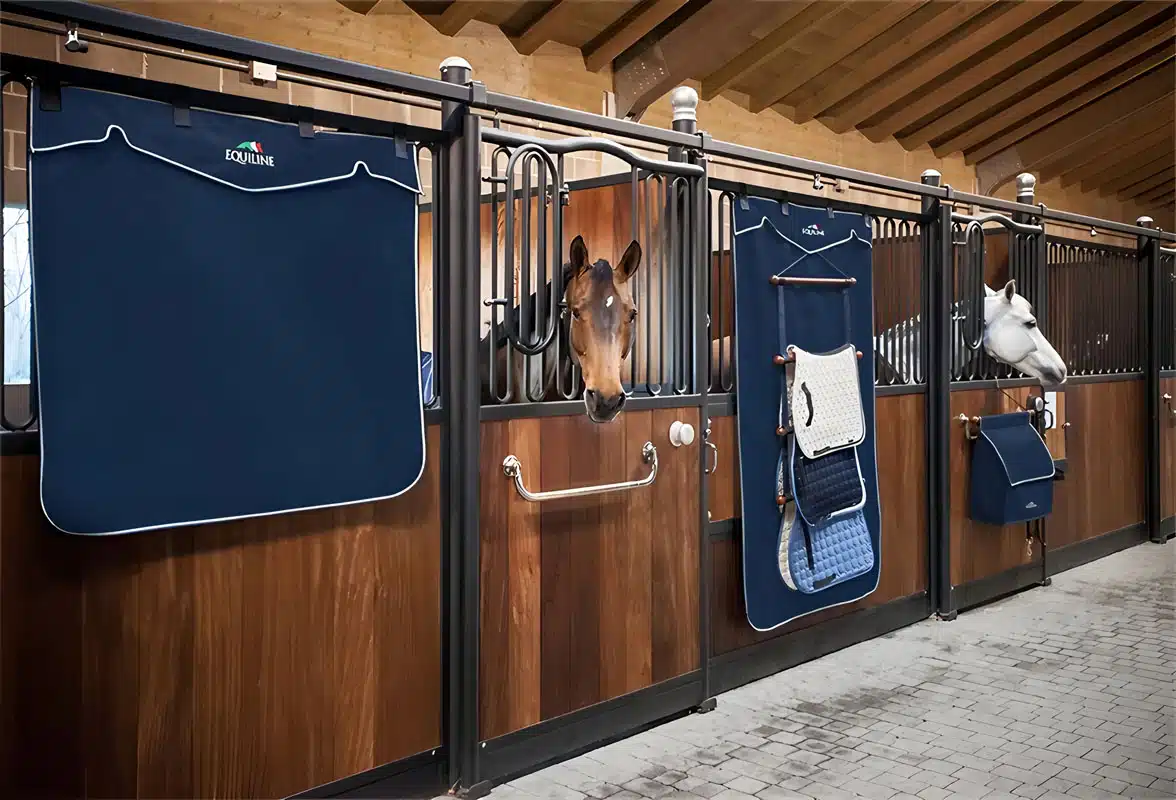
Factory-Direct Stables Built For Extreme Durability
أفضل المصانع التي تتبنى المواد المستدامة
Global leaders like Siemens and First Solar are shifting from simple compliance to integrated circular ecosystems. We mirror this industrial standard by prioritizing Q235B recyclable steel and high-density bamboo.
Sustainability in manufacturing has evolved from a marketing buzzword to a hard operational requirement. Major industrial players are no longer just buying “green” energy; they are fundamentally re-engineering their supply chains to ensure materials can be recovered, recycled, and reused. This shift sets a new baseline for B2B procurement: if your supplier isn’t thinking about material lifecycle, they are selling you future liability.
| الشركة المصنعة | Primary Sustainable Material | Key Operational Metric |
|---|---|---|
| First Solar | Cadmium Telluride (CdTe) | 90% material recovery rate via global recycling programs. |
| سيمنز | Low-Carbon Steel & Recycled Resins | Digital Twins used to reduce design-phase waste by 30%+. |
| Lego Group | Recycled PET (rPET) | Targeting 100% sustainable packaging and materials by 2032. |
| مستقر دي بي | Q235B/Q345B Steel & Bamboo | 100% Recyclable Framework + ISO 1461 Galvanization. |
Benchmarking the Giants: First Solar and Siemens
The standard for “green factories” is defined by closed-loop systems. First Solar, a leader in photovoltaic manufacturing, does not just sell panels; they operate a high-recovery recycling program. They recover over 90% of the semiconductor materials and glass from their modules, reintegrating them into new products. This proves that heavy industry can decouple growth from raw material extraction.
Similarly, Siemens employs “Digital Twin” technology to simulate production lines before a single machine is turned on. This eliminates trial-and-error waste and optimizes energy consumption precisely. These facilities demonstrate that sustainable manufacturing requires a dual focus: material longevity and process efficiency.
The Equestrian Standard: DB Stable’s Approach
We apply these same high-level industrial principles to equestrian infrastructure. A horse stable is a long-term asset, and its sustainability profile depends entirely on the durability and recyclability of its core components. We strictly avoid composite materials that cannot be separated at the end of their life.
- The Steel Framework (Q235B/Q345B): We use structural steel grades that are 100% recyclable. Unlike wood, which degrades, or concrete, which is carbon-intensive to crush, our steel can be re-smelted indefinitely without losing strength.
- Hot-Dip Galvanization (ISO 1461): Sustainability means longevity. By dipping our fronts in molten zinc بعد fabrication, we achieve a lifespan of 50+ years. This prevents the need for replacement and the associated manufacturing carbon footprint for decades.
- حشو الخيزران: We utilize high-density strand-woven bamboo, a material that sequesters carbon during its rapid 3-5 year growth cycle. This offers a hardness rating 3x higher than oak while acting as a carbon sink rather than a drain.
- كفاءة الخدمات اللوجستية: Our flat-pack system loads 30-45 sets per 40HQ container, compared to the 12-15 sets typical of welded frames. This drastically reduces shipping emissions per unit.
By aligning our production specs with global sustainability benchmarks, we ensure that distributors are not just buying a product, but investing in a system designed for the circular economy.
خيزران منسوج من الخيزران: بالوعة كربون عالية الإنتاجية
Bamboo acts as a massive biological vacuum, sequestering up to 60kg of CO2 per culm before we lock that carbon into high-density structural boards for decades.
Carbon Sequestration Efficiency in Bamboo Growth
Bamboo operates differently from traditional timber. While hardwoods like oak take decades to mature, Moso bamboo reaches maturity in 3-5 years, allowing for rapid harvest cycles that do not deplete the forest. This speed creates a high-volume carbon capture engine that outpaces standard forestry.
- Per Culm Absorption: A single bamboo culm sequesters 50–60 kilograms of CO2 over its lifespan.
- Annual Yield: Managed plantations store approximately 12 tons of carbon per hectare annually, nearly double the rate of typical forests.
- Root Storage: The dense rhizome system remains intact after harvest, continuing to store carbon in the soil while fueling immediate regeneration.</li
>

Locking Carbon via the Strand-Woven Process
Raw sequestration is only half the equation. To make this relevant for construction, we must lock that carbon into a durable product. The strand-woven process compresses bamboo fibers under immense pressure, transforming a hollow grass into a solid structural board. This effectively traps the sequestered carbon within the stable infrastructure for the duration of the product’s life.
- مواصفات المواد: DB Stable utilizes 28mm-38mm High Density Bamboo specifically for this purpose.
- Durability Lock: With a Janka Hardness > 3000 lbf (3x harder than Oak), the material resists impact and decay, ensuring the carbon remains stored for decades rather than releasing back into the atmosphere through rot.
- Carbon Negative Lifecycle: By replacing carbon-intensive alternatives like concrete or steel, the finished stable infill maintains a negative carbon footprint over its full lifecycle.
فولاذ Q235B: إطار 100% القابل لإعادة التدوير
Q235B structural steel matches ASTM A36 performance and is 100% recyclable, offering a 50-year lifecycle when protected by ISO 1461 hot-dip galvanization.
Sustainability in heavy infrastructure isn’t just about the material you choose; it’s about how long that material stays standing. We build our frameworks using Q235B structural steel, the standard for heavy engineering in our region. This isn’t a cost-cutting measure—it is a deliberate engineering choice to ensure safety and circular economy compliance.
Structural Equivalence: Q235B vs. ASTM A36
There is often confusion or skepticism regarding steel grades sourced internationally. The reality is straightforward: Q235B is the chemical and mechanical equivalent of the American Standard ASTM A36. It provides the ductility and yield strength required to contain large animals safely, without the brittleness found in lower-grade recycled metals.
- حد الخضوع: 235 MPa (Matches A36 minimums).
- Tube Wall Thickness: Strictly مقاس 14 (2.0mm – 2.5mm). We do not use 1.5mm tubing, regardless of industry trends.
- مقاومة الصدمات: Engineered to withstand direct kicks without structural failure.
Lifecycle Extension via Hot-Dip Galvanization
Steel is 100% recyclable, but the greenest building material is the one you don’t have to replace. Unprotected steel in an ammonia-rich stable environment (urine and manure) will corrode rapidly. To prevent this, we refuse to use “pre-galvanized” tubing where the welds are left exposed to rust.
Instead, we use الجلفنة بالغمس الساخن بعد التصنيع. We weld the black steel frame first, then dip the entire unit into molten zinc. This seals every joint, weld, and internal crevice.
- Standard: BS EN ISO 1461.
- سُمك الطلاء: >85 microns for structural parts; >70 microns for tubing.
- End-of-Life: After decades of use, the steel framework can be melted down and repurposed with no loss of material properties, aligning with zero-waste goals.
الأسئلة المتداولة
Why is hot-dip galvanized steel considered a better investment than wood for rescue barns?
Wood initially costs less but often fails under heavy use due to cribbing, rot, and structural fatigue. Our hot-dip galvanized steel (specifically Q235B/Q345B grades) adheres to ISO 1461 standards with an 85+ micron zinc coating. This barrier resists rust for decades and withstands impacts from heavy draft horses that would shatter timber. While wood ends up in landfills, our steel is 100% recyclable, offering a lower long-term environmental impact and eliminating recurring repair costs.
Is bamboo infill strong enough to contain feral or draft horses?
Yes. We use High Density Strand Woven Bamboo (28mm-38mm thick) with a Janka Hardness rating exceeding 3,000 lbf. This makes it three times harder than Red Oak. The extreme density prevents cribbing and withstands kick impacts from unpredictable animals. You get the carbon sequestration benefits of bamboo without sacrificing the industrial-grade structural integrity required for safety.
How does the flat-pack design specifically help non-profit organizations?
Shipping costs often consume a project’s budget. Traditional fully welded stalls are bulky, limiting a 40HQ container to just 12-15 sets. Our modular steel pallet flat-pack system allows us to load 30-45 sets in the same space. This logistical efficiency cuts ocean freight costs per unit by over 60%, allowing non-profits to direct donor funds toward facility expansion and animal care rather than shipping lines.
What makes the HDPE option suitable for quarantine and isolation units?
Quarantine demands sterility. Wood grain traps pathogens, moisture, and bacteria. Our 28mm-32mm HDPE (High-Density Polyethylene) infill is non-porous and impervious to fluids. Staff can sanitize the entire stall with power washers and disinfectants without degrading the material. This “Zero Maintenance” surface ensures a sterile environment for sick or new arrivals and eliminates the cross-contamination risks inherent in organic materials.
Do I need a specific foundation for these stables?
The system adapts to your site. For existing concrete aisles, you can bolt panels directly using our included 304 Stainless Steel anchor bolts. If you build on dirt or crushed rock, we recommend pouring concrete footings under the posts. This keeps the galvanized steel out of permanent ground moisture, preserving the zinc coating and ensuring the 20+ year rust protection holds up.
الأفكار النهائية
Philanthropic capital demands long-term impact, not recurring repair bills. Choosing ISO 1461 Hot-Dip Galvanized steel over temporary timber ensures your facility survives decades of heavy use without diverting funds to maintenance. You secure both 2026 ESG compliance and operational solvency by investing in a circular, zero-waste infrastructure today.
Maximize your donor’s dollar through our high-density flat-pack logistics, which slash ocean freight costs by over 60%. Contact our engineering team to model your site layout and secure a factory-direct proposal for high-capacity Q235B steel stabling. Build a legacy that lasts, not a liability that rusts.

 Arabic
  English
  Spanish
  French
  German
0 تعليق