


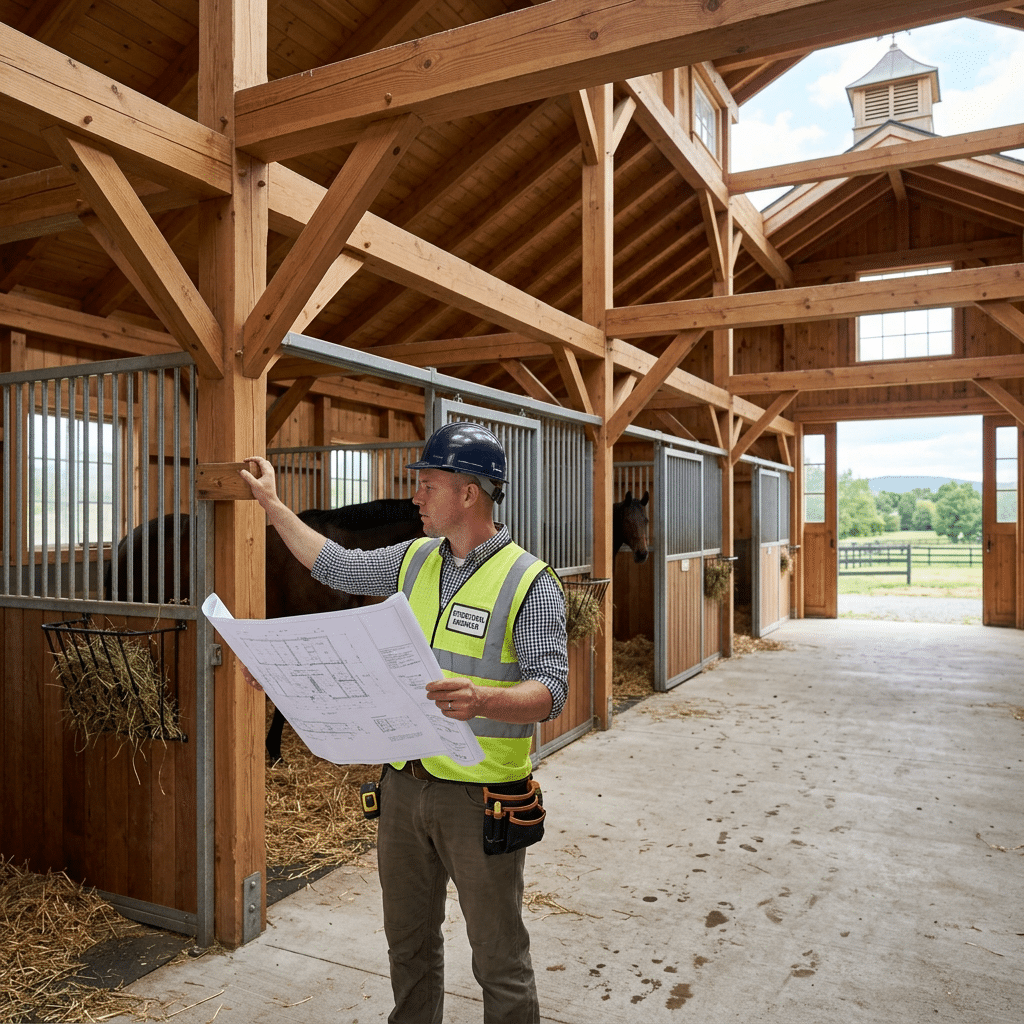
Olympic Training facilities demand infrastructure that balances elite performance with strict asset protection. Syndicates and investors face significant financial exposure when inferior stabling compromises the safety of high-value horses or fails to meet emerging ESG mandates.
We analyze the engineering behind high-performance base camps, specifically evaluating Q345B Low Alloy High Strength Steel frameworks and High Density Strand Woven Bamboo infills. This report benchmarks durability against ISO 1461 galvanization standards to secure long-term operational viability.
صعود الحوكمة البيئية والاجتماعية وحوكمة الشركات في مجال الإنشاءات
By 2026, ESG mandates force a shift from voluntary green goals to strict Scope 3 compliance. Success now depends on validated supply chains, durable materials, and logistics efficiency.
The 2026 Landscape: Regulatory Mandates and Scope 3 Accountability
The era of voluntary “green” reporting is over. We have moved from narrative corporate communications to third-party verified legal disclosures. Regulators now demand hard data, not just marketing fluff. This shift impacts every layer of the construction industry, specifically regarding Scope 3 emissions—the carbon footprint of your supply chain.
Procurement teams must now evaluate vendors based on carbon performance alongside price. If a supplier cannot validate their emissions or verify the origin of their steel, they become a liability. We also see a mandatory shift toward climate-responsive design. This reduces reliance on mechanical heating and cooling systems by using materials and layouts that naturally regulate temperature.
Reducing Carbon Footprint: Flat-Pack Logistics and ISO 1461 Durability
Meeting ESG goals requires attacking the two biggest offenders in the supply chain: transport emissions and material replacement waste. At DB Stable, we engineer our systems to directly address these metrics through specific manufacturing and logistics standards.
- الكفاءة اللوجستية (الحد من النطاق 3): Traditional welded stalls fill a container with just 12-15 sets, wasting massive amounts of space. Our نظام العبوات المسطحة maximizes density, fitting 30-45 مجموعة in a 40HQ container. This slashes freight-related carbon emissions by over 60% per unit.
- دورة الحياة الممتدة (الحد من النفايات): We strictly adhere to BS EN ISO 1461 for الجلفنة بالغمس الساخن (85+ microns). This ensures the steel resists rust for decades, preventing the environmental cost of manufacturing replacements every few years.
- Sustainable Material Sourcing: We utilize High Density Strand Woven Bamboo as a standard infill. Bamboo matures in 3-5 years compared to 50 years for hardwoods, providing a rapidly renewable alternative that absorbs more carbon during growth than traditional timber.
الأسئلة المتداولة
كيف تبني مركزاً للفروسية متوافقاً مع المعايير البيئية والاجتماعية والمؤسسية؟
Building an ESG-compliant center requires a three-pronged approach. First, tackle Environmental factors by installing renewable energy sources (like solar) to cover at least 80% of consumption and implementing closed-loop water systems for wash bays. Second, address Social responsibility by enforcing strict safety protocols for staff and ensuring fair labor practices in your procurement. Finally, handle Governance by establishing a clear framework for measuring and reporting your data—you need to track emissions and waste diversion year-over-year to prove actual progress rather than just claiming “zero waste.”
هل الخيزران مادة بناء مستدامة؟
Yes, bamboo is highly sustainable due to its rapid renewability. A bamboo stalk matures in 3-5 years, whereas traditional hardwoods like oak take 30-50 years. It also sequesters significantly more carbon and releases 35% more oxygen than equivalent tree forests. However, raw bamboo lacks durability against rot and insects. To make it a viable construction material, it must be engineered—specifically High Density Strand Woven Bamboo—which increases hardness (3x harder than oak) and longevity while maintaining its eco-friendly profile.
التأثير البيئي للحظائر الفولاذية مقابل الحظائر الخشبية؟
This depends on whether you prioritize initial embodied carbon or long-term lifecycle. Wood initially has a lower carbon footprint during production compared to steel manufacturing. However, wood is prone to rot, warping, and chewing, often requiring replacement within 10-15 years. Steel (specifically Q235B/Q345B) is 100% recyclable and, when Hot-Dip Galvanized to ISO 1461 standards, lasts 30-50 years with zero structural degradation. For a long-term facility, steel often wins on total lifecycle impact because you build it once, not three times.
الشهادات الخضراء لإسطبلات الخيول؟
There is no specific “Green Stable” certification globally. However, facilities often adapt LEED (Leadership in Energy & Environmental Design) principles or adhere to regional codes like California’s CalGreen. To comply, focus on site planning (stormwater management via bioswales), energy efficiency (LED lighting and natural ventilation stacks), and material selection (recycled steel or certified timber). You achieve “green” status through measurable operational efficiency rather than a specific equestrian label.
الشركات المصنعة لحظائر الخيول الصديقة للبيئة؟
The market is splitting into timber-focused and steel-focused sustainable manufacturers. Companies like DC Structures and MD Barnmaster are noted for integrating responsible timber and efficient pre-fab designs. On the steel side, manufacturers utilizing recycled steel and modular systems (like DB Stable’s flat-pack model) significantly reduce construction waste and transport emissions. The most “eco-friendly” choice comes down to the manufacturing process: look for factories that use Hot-Dip Galvanization for longevity and flat-pack logistics to minimize the carbon cost of shipping air.
الابتعاد عن أخشاب الغابات القديمة (البلوط/الصنوبر)
Traditional timber is slow to grow and high maintenance. The industry is pivoting to High-Density Bamboo and HDPE for superior durability and sustainability.
The Ecological and Functional Limits of Traditional Timber
For decades, oak and pine were the default choices for stable infills, but they no longer make sense for modern commercial facilities. The primary issue is the regeneration cycle. Old-gro
wth oak requires 30 to 50 years to reach harvest maturity. This creates a supply bottleneck and raises significant sustainability concerns for projects targeting ESG compliance. You simply cannot regrow the material fast enough to match global construction demand.
Functionally, softwood like pine presents an operational liability. It has a low density, making it an easy target for horses that crib (chew) or kick. In a high-traffic commercial barn, pine boards often require replacement within a few years due to structural damage. Beyond physical wear, traditional timber is porous. It absorbs urine and ammonia, which accelerates rot and creates a breeding ground for mold unless staff aggressively varnish and seal the wood annually.
The Superior Alternative: High-Density Strand Woven Bamboo
We have shifted our production focus to High-Density Strand Woven Bamboo because it solves both the ecological and mechanical deficits of wood. Bamboo is technically a grass, not a tree, and it reaches maturity in just 3-5 years. This rapid renewal cycle makes it a highly sustainable resource that aligns with modern environmental standards without sacrificing availability.
At DB Stable, we engineer our bamboo infills to meet specific performance metrics that natural timber cannot achieve:
- Extreme Hardness: Our bamboo rates > 3000 lbf on the Janka Hardness scale, making it approximately 3x harder than oak.
- مقاومة الصدمات: The high density makes the boards virtually impact-proof against kicks and resistant to cribbing.
- Zero Maintenance Option: For clients demanding a “set and forget” solution, we offer UV-stabilized HDPE (High-Density Polyethylene). It mimics the look of wood but is completely rot-proof and requires no varnishing.
Precision-Engineered Stables Built to Last 20+ Years
أفضل المصانع التي تتبنى المواد المستدامة
Sustainability has shifted from a PR bonus to a supply chain mandate. Industry giants now use circular materials and digital optimization to secure long-term profitability and compliance.
The concept of the “Green Factory” has evolved. It is no longer just about solar panels on the roof; it is about the raw materials entering the loading dock and the lifecycle of the finished product. Major manufacturers are decoupling growth from resource depletion by integrating materials like recyclable steel, engineered bamboo, and low-carbon composites.
| Factory / Leader | Core Material Strategy | Operational Impact |
|---|---|---|
| First Solar | Cadmium Telluride (CdTe) & Glass Recycling | 90% material recovery rate; 40% lower carbon than silicon panels. |
| Metso Outotec | Circular Mineral Processing | Technology focused on limiting global warming to 1.5°C targets. |
| سيمنز | Digital Twins & Smart Manufacturing | Optimization of material usage via AI to reduce industrial waste. |
| Global B2B OEMs (Equestrian) | Q235B/Q345B Steel & High-Density Bamboo | 100% recyclable frames with renewable, carbon-negative infills. |
Global Benchmarks in Sustainable Manufacturing
Leading facilities treat energy choices as pragmatic project decisions rather than ideological positions. First Solar exemplifies this by operating a closed-loop semiconductor recovery program, ensuring that valuable materials from end-of-life panels re-enter the supply chain rather than landfill. Similarly, سيمنز utilizes “Digital Twin” technology to simulate production lines before a single machine runs, identifying inefficiencies that would otherwise result in material scrap and wasted energy.
For heavy industry, Metso Outotec و Mahindra & Mahindra are redefining parameters by demanding supplier transparency. They enforce embodied carbon limits, effectively pushing the entire supply chain—from steel mills to component fabricators—toward greener practices.
The Materials Driving the B2B Shift
While giants headline the news, specialized B2B manufacturers (like DB Stable) drive sustainability through specific material standards. The focus is on two primary elements: Structural Steel and Engineered Bamboo.
- Q235B & Q345B Steel: We utilize Q235B (structural) and Q345B (low alloy high strength) steel because they are 100% recyclable without property loss. Unlike wood framing which often ends in landfills, hot-dip galvanized steel enters a perpetual reuse cycle.
- High-Density Bamboo (Strand Woven): This is the fastest-growing sustainable alternative to hardwoods like Oak. Moso bamboo sequesters up to 40 tons of carbon per acre annually. Our specific Strand Woven Bamboo (Janka Hardness > 3000 lbf) is 3x harder than oak, offering extreme durability without the decades-long regeneration cycle of old-growth forests.
- HDPE Infills: For projects requiring zero maintenance, UV-stabilized HDPE (High-Density Polyethylene) prevents chemical leaching and eliminates the need for paints or varnishes, reducing the chemical load on the environment over the facility’s lifespan.
Logistics as a Sustainability Metric
A truly sustainable factory looks beyond the product to how it is delivered. The “Carbon Footprint of Logistics” is a critical metric often ignored by retail-focused brands. Traditional fully welded stable systems are inefficient to ship, fitting only 12–15 sets in a container.
We counter this with a نظام العبوات المسطحة that fits 30–45 sets in a single 40HQ container. This increases shipping density by over 150%, drastically reducing the maritime carbon emissions per unit. For distributors, this aligns profit protection with environmental responsibility—saving 60% on freight costs while reducing the logistical carbon footprint.
خيزران منسوج من الخيزران: بالوعة كربون عالية الإنتاجية
Strand-woven bamboo sequesters 50–60kg of CO2 per culm and delivers a Janka hardness over 3000 lbf—three times harder than oak—creating a durable, high-yield carbon sink.
The Science of Sequestration: Bamboo vs. Hardwood
Traditional hardwoods require decades to reach maturity, but bamboo is harvest-ready in just four to six years. This rapid growth cycle allows bamboo forests to absorb 57 times more carbon per hectare than comparable timber stands, making it one of the most efficient biological carbon vacuums available to the construction industry.
Harvesting methods further distinguish bamboo from timber. Unlike clear-cutting, which often triggers soil erosion and habitat destruction, selective bamboo harvesting leaves the root system intact. This preserves topsoil stability and allows for immediate regeneration without replanting. A single culm captures between 50 and 60kg of CO2 during its growth, and once processed, that carbon remains locked within the fiber rather than releasing back into the atmosphere.
Engineered Density: Locking Carbon with 3000+ lb
f Hardness
Carbon storage provides little value if the material fails or rots within a few years. We utilize a strand-woven manufacturing process that compresses shredded bamboo fibers under immense pressure, resulting in a board with a Janka Hardness rating exceeding 3000 lbf. This engineering directly impacts the material’s environmental and structural performance:
- 3x Harder than Oak: The extreme density renders the material impervious to horse kicks and chewing, significantly reducing replacement frequency compared to softwood or standard hardwood.
- Decay Resistance: High-density compression creates superior resistance to mold and rot.
- Extended Carbon Storage: By preventing decay and extending the product lifespan, the carbon trapped in the bamboo fiber remains sequestered for decades rather than releasing through decomposition.
فولاذ Q235B: إطار 100% القابل لإعادة التدوير
Q235B steel matches Olympic weightlifting standards for tensile strength while offering 100% recyclability and a 50+ year lifespan for sustainable equine infrastructure.
Sustainability and Strength in Sports Engineering
Engineers widely utilize Q235B low-carbon steel in professional gymnasiums and Olympic training centers because it handles massive loads without failure. We apply this same logic to equine safety. A horse kicking a stall wall generates impact forces similar to dropping heavy weights. High ductility allows Q235B to absorb this energy without suffering the brittle fractures common in lower-grade metals or rigid wood.
This material choice also aligns strictly with circular economy principles. Unlike treated lumber, which often ends up in landfills due to chemical contaminants, Q235B steel is 100% recyclable. At the end of its 50-year lifecycle, you can melt down the entire stable framework and repurpose it with zero loss of material properties. This creates a closed-loop system that drastically reduces the long-term carbon footprint of your facility.
The DB Standard: ASTM A36 Compliance and مقاس 14 Tubing
We do not guess with structural integrity. Our Q235B steel is chemically equivalent to ASTM A36, the international benchmark for structural steel. This ensures consistent tensile strength and yield points across every batch we manufacture. Many competitors cut costs by using thinner 1.5mm or 1.6mm tubing, which warps under pressure. We strictly mandate a heavier specification to guarantee safety and longevity.
- سماكة الجدار: Minimum 14-Gauge (2.0mm – 2.5mm) for all structural posts.
- Galvanization Optimization: The specific steel composition allows for a zinc coating thickness exceeding 85 microns.
- مقاومة التآكل: Meets BS EN ISO 1461 standards for hot-dip galvanizing after fabrication.
الأسئلة المتداولة
كيف تبني مركزاً للفروسية متوافقاً مع المعايير البيئية والاجتماعية والمؤسسية؟
Building an ESG-compliant center requires a focus on energy, waste, and longevity. Start by integrating renewable energy sources like solar panels to offset operational consumption. For water management, install rainwater harvesting systems for wash bays and irrigation. Crucially, choose materials with long lifecycles to minimize replacement waste. Using hot-dip galvanized steel (recyclable) and bamboo infill (rapidly renewable) instead of treated timber reduces environmental impact. Establish a waste management plan that tracks manure composting and bedding recycling to close the operational loop.
هل الخيزران مادة بناء مستدامة؟
Yes, bamboo is highly sustainable. It reaches maturity in 3-5 years, compared to 30-50 years for hardwoods like oak, and self-regenerates from its roots after harvest. This rapid growth cycle allows for frequent harvesting without deforestation. DB Stable uses High-Density Strand Woven Bamboo, which is 3x harder than oak and resists mold and rot. This durability ensures the material acts as a long-term carbon sink rather than a disposable product.
التأثير البيئي للحظائر الفولاذية مقابل الحظائر الخشبية؟
Wood has lower initial embodied carbon during production but suffers from shorter lifespans due to rot, warping, and horse chewing. This leads to frequent replacement and waste. Steel has higher initial production energy but offers 100% recyclability and superior durability. A hot-dip galvanized steel barn lasts 50+ years with minimal maintenance. Over the full lifecycle of a facility, steel often proves the more sustainable choice by eliminating the need for repeated reconstruction and material disposal.
الشهادات الخضراء لإسطبلات الخيول؟
There is no specific global “Green Stable” certification, but facilities can pursue LEED certification by classifying the project under commercial or agricultural frameworks. Key credits come from site sustainability (stormwater management), water efficiency, and materials and resources. Using steel with high recycled content and certified bamboo contributes to these points. Regional codes, like California’s CalGreen, also mandate specific water and energy standards that apply to agricultural structures.
الشركات المصنعة لحظائر الخيول الصديقة للبيئة؟
Manufacturers committed to eco-friendly practices prioritize materials like recycled steel and bamboo over virgin timber and PVC. DB Stable focuses on sustainability through our “Hot-Dip After Fabrication” process, which extends product life to prevent landfill waste, and our use of Q235B recyclable steel. We also utilize flat-pack logistics (30-45 sets per container) to significantly reduce shipping emissions per unit compared to fully welded alternatives.
الأسئلة المتداولة
Is bamboo infill durable enough for commercial equestrian centers?
Yes. Our High Density Strand Woven Bamboo is engineered specifically for impact resistance, featuring a Janka Hardness rating of >3000 lbf—making it three times harder than Oak. Unlike hollow garden bamboo, this material is compressed under extreme pressure to create a dense, solid board. It combines the rapid renewability of grass (regenerating in 6-9 years) with the structural resilience required to withstand heavy kicks in commercial facilities.
How does hot-dip galvanized steel compare to wood framing for environmental impact?
While steel production uses energy upfront, our Q235B and Q345B frames are 100% recyclable and designed for decades of service without replacement. Wood framing often requires toxic preservatives or paints to prevent rot and chewing, which can leach into the ground. Our Hot-Dip Galvanization process (ISO 1461) bonds zinc to the steel at over 85 microns thick, eliminating the need for chemical maintenance and preventing the “build-rot-rebuild” cycle common with timber barns.
What makes the flat-pack system a more sustainable logistics choice?
Logistics efficiency is often overlooked in sustainability discussions. Traditional fully welded stalls are mostly “air,” limiting a 40HQ container to just 12-15 sets. Our modular flat-pack design allows us to load 30-45 sets in the same container. This density drastically reduces fuel emissions per unit and cuts freight costs by approximately 60%, making it the smarter choice for both the environment and your landed cost.
Do the HDPE planks require chemical maintenance or painting?
No. Our 28mm-32mm HDPE infills are UV stabilized and impervious to moisture, acids, and bacteria. They require absolutely zero painting, staining, or varnishing. This prevents chemical runoff into your stable environment and reduces operational maintenance to simple cleaning with water. You save on labor and materials while maintaining a sanitary environment for the horses.
Does the manufacturing process adhere to international quality standards?
Yes. We manufacture strictly under ISO 9001 (Quality Management) and ISO 1461 (Galvanizing) standards. These certifications aren’t just badges; they ensure consistent material usage, controlled waste management, and documented durability. For B2B buyers and facility planners, this compliance aligns with the operational governance required for modern, high-standard projects.
الأفكار النهائية
Compliance with Scope 3 mandates is no longer optional for elite facilities; it determines your asset’s long-term viability. While generic welded frames risk obsolescence through rust and logistical waste, our ISO 1461 galvanized steel and high-density bamboo safeguard your project against regulatory penalties. You secure future profitability by building with materials engineered for decades of circular utility.
Do not rely on datasheets alone to validate these sustainability metrics. We invite you to audit our flat-pack logistics efficiency and test the impact resistance of our bamboo infills directly. Contact our engineering team today to configure a trial order that aligns with your specific ESG targets.

 Arabic
  English
  Spanish
  French
  German
0 تعليق