

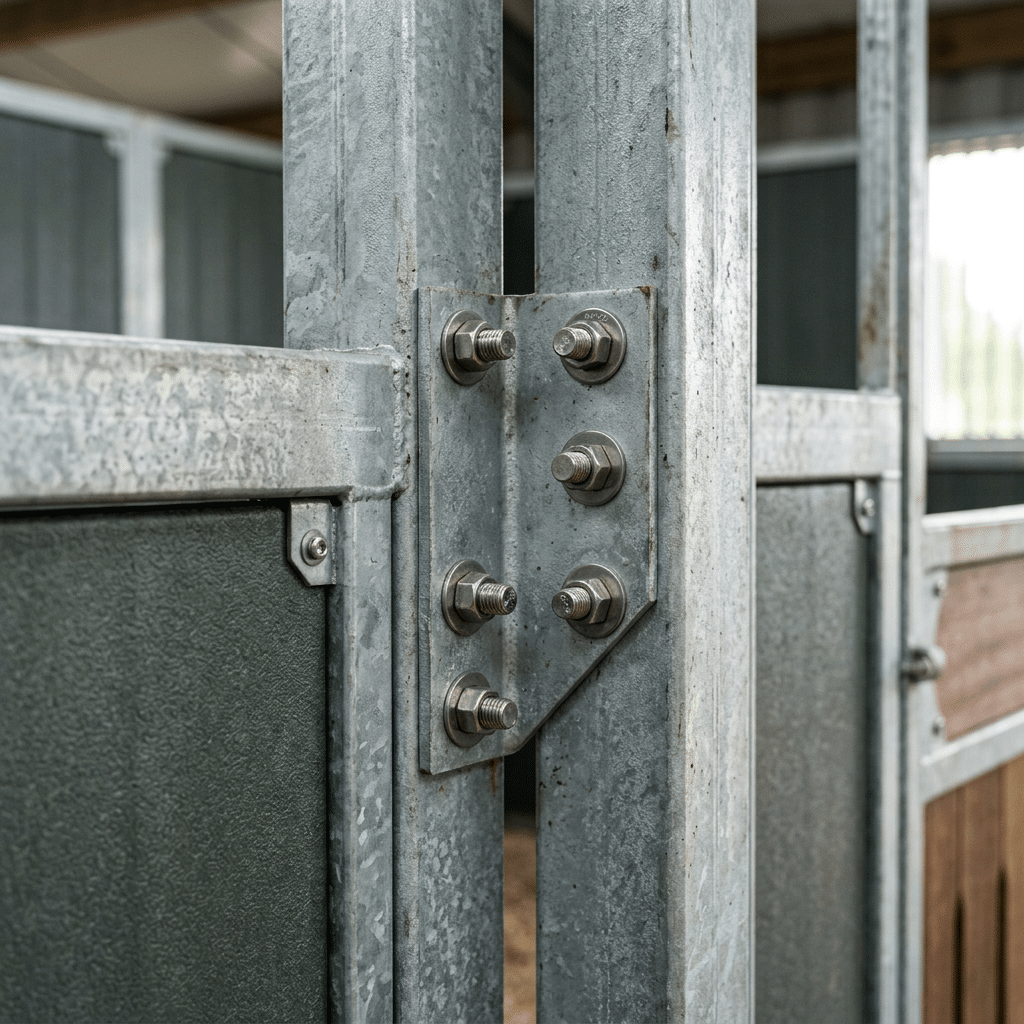
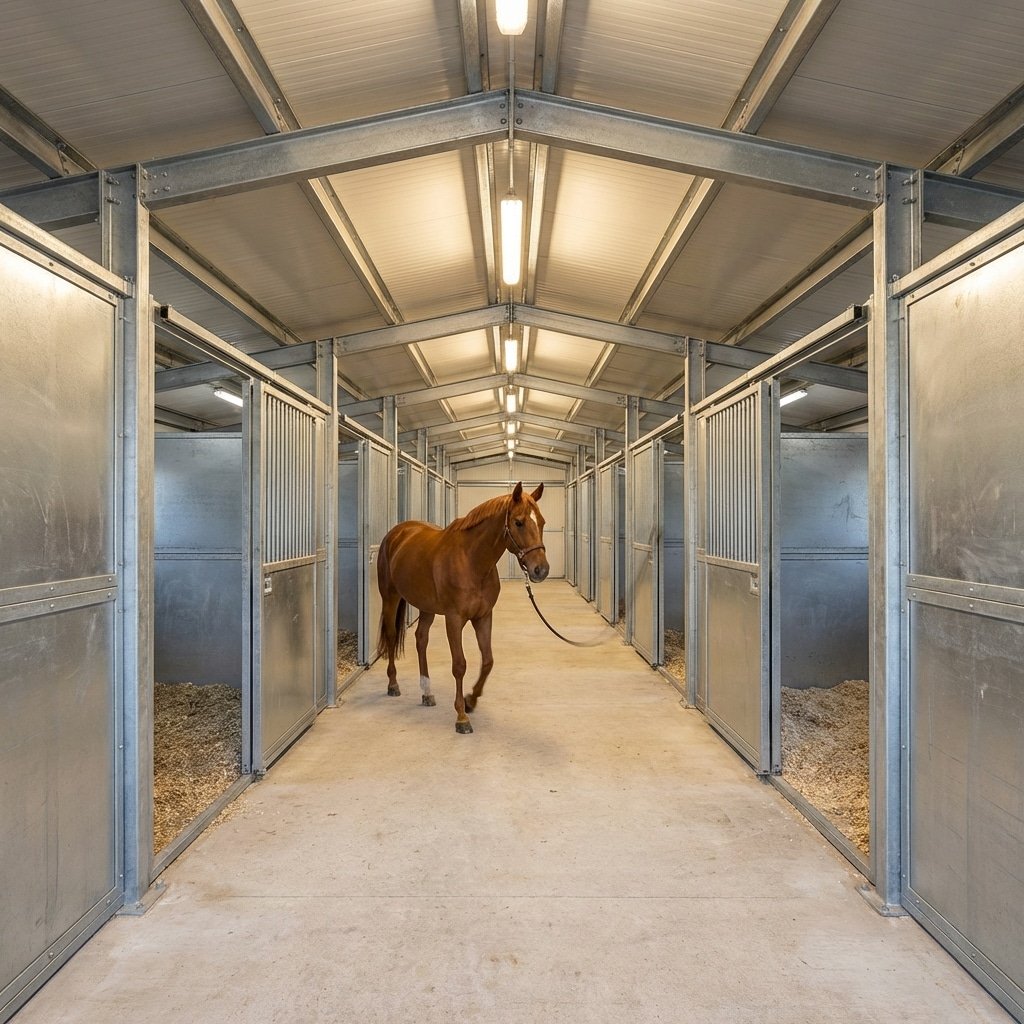
Correct Warmblood Dimensions are critical, but they are irrelevant if the materials fail, leading to expensive repairs and safety liabilities. Stables using pre-galvanized steel or porous wood infill cannot withstand the impact and moisture generated by high-performance horses, creating a cycle of maintenance costs that damages a facility’s profitability.
This analysis outlines the required engineering standards for elite equestrian facilities. We detail the specifications for Hot-Dip Galvanization after fabrication (ISO 1461) and impact-absorbing HDPE infill, the core components of a genuinely kick-proof and zero-maintenance stable design.
المناخ الجزئي لخليج الغسيل: الحرارة والماء والسماد
A wash bay’s micro-climate of humidity, water, and manure requires smart solutions. These include compost heating for hot water and hot-dip galvanized steel for rust-proof, long-lasting structures.
Harnessing Compost Heat for Wash Bay Water
A constant challenge in rural equestrian facilities is sourcing consistent, affordable hot water. A manure-based heating system solves this by using a resource every barn has in abundance. The system works through compost heat recovery. As microbes break down the farm waste, they generate significant thermal energy. It’s a simple, biological engine.
Hydronic loops, basically long runs of plastic tubing, are placed directly inside the compost pile. Water circulates through these pipes, absorbing the heat from the decomposition process. This heated water is then piped to the wash bay. The system reliably produces water temperatures in the 100-110°F (around 43°C) range, perfect for washing horses without any external fuel costs. It turns a waste management problem into an energy solution.
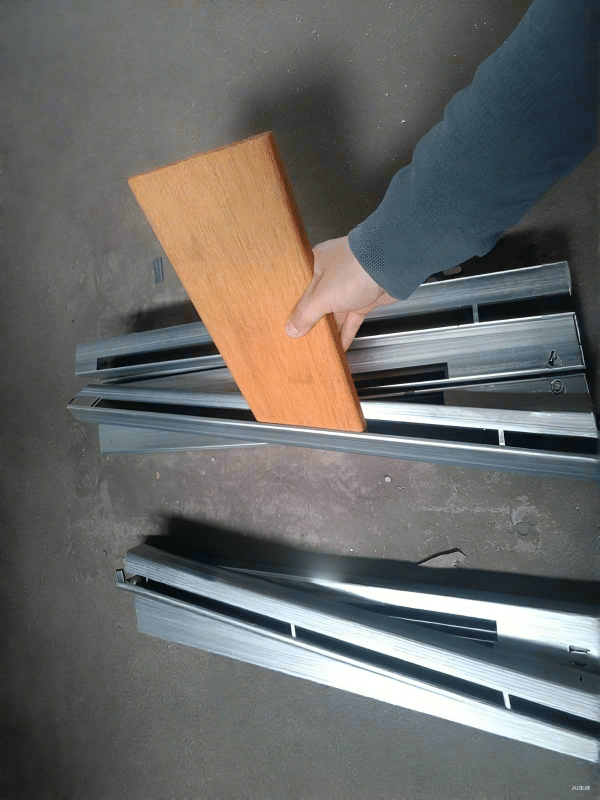
Material Resilience in a High-Moisture Zone
The wash bay is the most corrosive area in any barn. The combination of constant water, high humidity, and acidic manure aggressively attacks steel. Any structural components, like stall partitions or support posts, will fail quickly without the right protection. Paint and pre-galvanized tubing just don’t hold up; rust will find its way through weld points and scratches.
This is why Hot-Dip Galvanization After Fabrication is the required standard for this environment. First, we fabricate the entire steel frame—welding all joints and connections. Then, the completed structure is dipped in molten zinc. This process, compliant with ISO 1461, creates a thick, protective zinc coating that fully encapsulates every surface, corner, and weld. Our standard ensures this coating is over 70 microns thick on all tubing, preventing corrosion and giving the equipment a functional service life measured in decades, not years.
الجدران الخرسانية: المسامية، والتشقق، وصعوبة التنظيف
Concrete walls are porous, absorbing moisture that harbors bacteria and causes salt deposits. Cracking and difficult cleaning create ongoing hygiene and maintenance problems in stables.
The Problem with Porous Surfaces in Stables
Concrete’s biggest weakness in a stable i
s its porosity. At a microscopic level, it acts like a sponge, wicking moisture, urine, and soluble salts deep into the material. This absorption leads to efflorescence—the familiar chalky white salt deposits that appear on the surface as the water evaporates.
Trying to clean these porous walls often makes the situation worse. Aggressive acid-based cleaners can etch the mortar and stain the masonry. Sandblasting literally erodes the surface, creating an even more porous wall that will absorb future moisture faster. You end up in a cycle of damaging the wall to clean it.
This constant moisture, combined with the inevitable cracks that form over time, creates an ideal breeding ground for bacteria and mold. These aren’t just surface stains; they are embedded within the wall, posing a persistent hygiene risk that simple washing can’t solve.
HDPE and Bamboo Infill: A Zero-Maintenance Alternative
The practical solution is to abandon porous materials altogether. We offer non-porous infill options that eliminate the issues concrete creates. Our UV-stabilized HDPE provides a true ‘Zero Maintenance’ surface. It’s completely impervious to moisture, so it won’t absorb urine, stain, or support mold growth.
For maximum durability, our high-density strand woven bamboo is another option. It’s naturally resistant to mold and rot. Its extreme hardness—over three times that of oak—means it won’t crack or chip from horse kicks, preventing the formation of crevices where dirt and bacteria accumulate.
Both materials are also impact-absorbing, which is safer for the horse. Cleaning is simple: just wipe them down. There’s no need for harsh chemicals or pressure washing that damages the material over time. This ensures a consistently hygienic environment without the constant upkeep and degradation associated with concrete.
Durable & Compliant Stables for Any Climate

الحصائر المطاطية على الجدران: فخ العفن والعفن الفطري
The best way to prevent mold is using materials that don’t absorb water. Engineered solutions like non-porous HDPE and naturally mold-resistant bamboo eliminate the risk, ensuring a dry stall.
How Trapped Moisture Creates Unhealthy Environments
When moisture gets trapped between a wall lining and the main structure, it creates a dark, damp space. This is the perfect breeding ground for mold and mildew. Any gap, no matter how small, can let humidity or water in, and it often has no way to escape.
Poor ventilation makes the problem much worse. Without airflow, the damp area never dries out. This compromises the air quality inside the stable and can eventually rot the barn’s structural components, leading to expensive and difficult repairs.
Choosing Non-Porous Infill: HDPE and Bamboo Solutions
Our High-Density Polyethylene (HDPE) infill is completely non-porous. It cannot absorb water, which makes it a true zero-maintenance solution. With HDPE, rot and mold simply have no place to start.
For a natural alternative, we use high-density strand woven bamboo. This material is specifically engineered to be mold and rot resistant. Its incredible density—three times harder than oak—provides exceptional durability without the risk of moisture damage.
بلاستيك HDPE: 100% مقاوم للماء وقابل للغسل الكهربائي
High-Density Polyethylene is a non-porous plastic that won’t absorb water, rot, or mold. It withstands power-washing without damage, creating a truly zero-maintenance stall environment.
The infill material you choose for a horse stall dictates your long-term maintenance burden. Traditional materials like wood are porous and degrade with moisture, while HDPE is a solid, non-organic polymer that is completely inert to water. This makes it the only practical option for facilities that prioritize hygiene and operational efficiency.
| الميزة | البولي إيثيلين عالي الكثافة (HDPE) | Traditional Wood Planks |
|---|---|---|
| Water Absorption | style=”padding: 12px; text-align: left; border: 1px solid #ddd;”>Zero. It’s non-porous and repels moisture. | High. Absorbs urine and water, leading to swelling. |
| Cleaning Method | Power-washable with any detergent. | Scrubbing only; power-washing damages the fibers. |
| Long-Term Issues | None. Resists stains, rot, and impact. | Rot, mold, warping, and splintering. |
| مستوى الصيانة | Zero. Clean as needed. | Requires regular sealing, staining, and eventual replacement. |
The Science of a Non-Porous Surface
HDPE’s molecular structure makes it inherently moisture-impervious. Water, urine, and cleaning fluids simply sit on the surface instead of being absorbed. This prevents the swelling, warping, and degradation that destroys wood planks. The material’s low surface friction also means manure, bacteria, and dirt have nothing to bond to. A simple wash removes all contaminants, allowing for complete sanitation without harsh scrubbing. Because nothing penetrates the surface, the planks resist both stains and odors, which helps maintain a healthier stable environment.
Our UV-Stabilized, Impact-Absorbing HDPE Planks
We engineer our HDPE infill planks to be 28mm-32mm thick. This substantial thickness provides exceptional impact absorption, which is a core component of our Kick-Proof Guarantee. Each plank is also infused with UV stabilizers during manufacturing. This is critical for preventing the material from becoming brittle or fading after years of sun exposure, a non-negotiable feature for our distributors in Australia and North America. This combination of durability and permanent water resistance is what delivers on the promise of “Zero Maintenance” for busy equestrian facilities.
إطارات HDG الفولاذية: النجاة من منطقة الرذاذ
Standard hot-dip galvanized steel fails rapidly in splash zones from repeated wet-dry cycles. A duplex system—powder coating over galvanization—is the required solution for long-term survival.
The Challenge of Wet-Dry Corrosion Cycles
Splash zones are uniquely destructive to standard galvanized steel. It’s not about being constantly wet or constantly dry; it’s the repeated cycle between the two that causes the problem. Unlike fully immersed or dry environments, this continuous wet-dry process systematically strips away the protective zinc coating.
This accelerated corrosion means facility managers could be looking at maintenance in as little as 2-3 years. Visible rust often appears on exposed surfaces within 5-7 years, compromising both the structure’s integrity and its professional appearance.
The Dual Protection Solution: Powder Coating Over Galvanization
For these aggressive environments, a single layer of galvanization isn’t enough. The correct engineering solution is a duplex system, which is a standard feature in our Royal Series. This process applies a durable powder coat over the hot-dip galvanized frame, creating a formidable dual-layer barrier.
The two layers work together, extending the frame’s service life by 1.5 to 2.3 times compared to galvanizing alone. This is the specification required to meet the high salt spray protection demands for coastal markets like Australia, ensuring the structure withstands the harshest conditions.
الأسئلة المتداولة
ما هي أفضل المواد المستخدمة في حوائط رفوف غسيل الخيول؟
The best materials are fiberglass-reinforced plastic (FRP) panels or concrete blocks with a waterproof sealant. Both are fully waterproof, easy to clean, and resist mold and mildew without needing constant maintenance.
Can you put rubber mats on barn walls?
Yes, rubber mats are specifically designed for barn walls to protect both the horse and the wall surface. They provide cushioning to reduce injury risk and can be mounted directly onto concrete or wood walls with appropriate fasteners.
How do you waterproof a horse wash bay?
A fully waterproof wash bay requires three components: waterproof walls (like FRP), durable flooring (such as a thick, scored concrete slab), and an effective drainage system installed underneath the floor to manage water runoff.
Can DB Stable’s HDPE infill be injection molded?
Yes, HDPE is commonly injection molded to produce strong, durable parts with excellent impact and chemical resistance. The process requires careful management of temperature and cooling to control natural material shrinkage and prevent warping.
Is concrete or plastic better for wash stalls?
While plastic offers excellent waterproofing, pervious concrete is often considered better for wash stall flooring because of its superior drainage. It allows water to slowly filter through rather than creating immediate runoff, which helps manage water and soap.
الأفكار النهائية
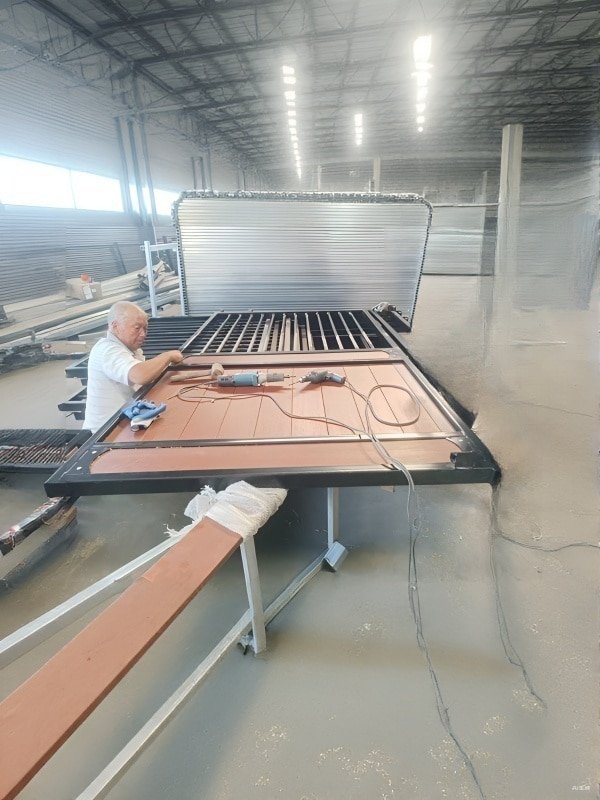
Choosing stalls built from generic materials creates a long-term liability of rust, rot, and constant maintenance. Our commitment to Hot-Dip Galvanization After Fabrication and non-porous HDPE infill is the required standard for a zero-maintenance facility. This level of engineering directly protects your facility’s operational budget and professional reputation.
The specifications determine the outcome, so don’t guess on the engineering. The next step is to request our technical catalog to review the full system or arrange a trial order to test our fitment and finish firsthand. Contact our team to discuss your project requirements and container load configurations.

 Arabic
  English
  Spanish
  French
  German
0 تعليق