

Selecting the right post shapes for a stable project is a critical decision that directly impacts animal safety and project liability. An unradiused square corner, a common feature in lower-cost options, is a latent design flaw that can lead to laceration injuries, triggering costly insurance claims and damaging a facility’s reputation.
This technical comparison evaluates both square and round profiles against our mandatory 14-Gauge (2.0mm) Q235B steel specification. We analyze the engineering trade-offs, from installation mechanics to the critical safety step of finishing all edges before hot-dip galvanization, giving you a clear framework for your design.
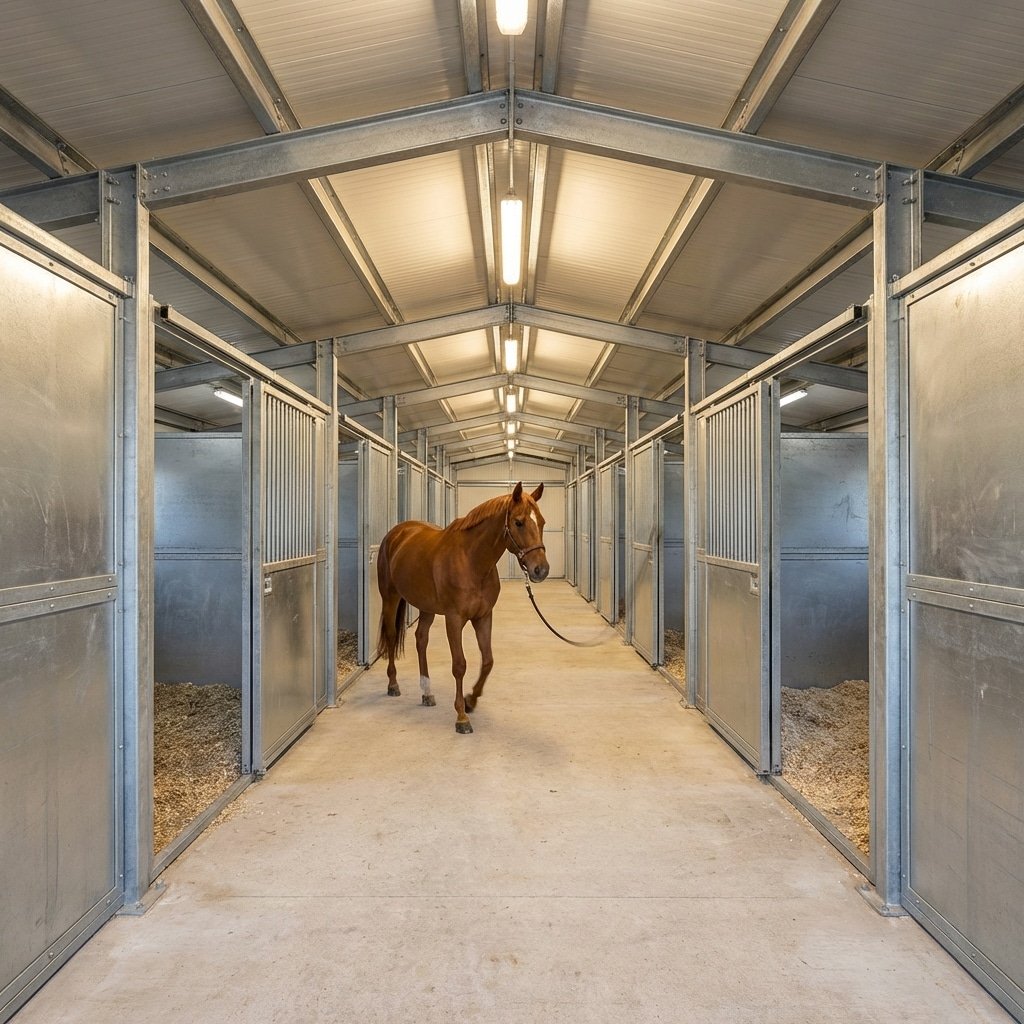
The Anatomy of a Stall Frame
A stall frame’s anatomy consists of vertical posts and horizontal girts. The steel used, such as Q235B or Q345B for cold climates, directly determines the stall’s strength and safety.
Core Components: Vertical Posts and Horizontal Girts
Every horse stall relies on a simple, strong skeleton. This frame is built from two fundamental parts: vertical posts and horizontal girts. The vertical posts, or columns, create the foundation. They establish the stall’s corners and define the entry points, bearing the primary structural load.
Horizontal girts are the connecting members that span between these posts. They provide essential lateral stiffness, preventing the structure from twisting or racking under pressure. These girts also create the mounting surfaces for the infill planks, whether you’re using bamboo or HDPE. Together, these components form a rigid grid that contains the horse and transfers any impact forces safely through the frame.
Material Selection: Q235B vs. High-Strength Q345B Steel
The steel selected for the frame is not a minor detail; it’s central to the stall’s long-term safety and durability. Our standard frame material is Q235B Structural Steel, equivalent to ASTM A36. It provides a robust and reliable structure that handles the daily demands of most equestrian facilities.
For operations in cold climates, we upgrade the material to Q345B Low Alloy High Strength Steel. This isn’t just about being stronger. Q345B has superior low-temperature impact toughness. In freezing temperatures, standard steel can become brittle. A powerful kick from a horse could cause a brittle fracture. Q345B resists this, ensuring the frame remains ductile and safe year-round, even in the harshest winters.
50x50mm RHS (Square): The Modern, High-Rigidity Standard
The 50x50mm square hollow section provides excellent rigidity without excess weight. Its flat surfaces simplify fabrication, making it the efficient standard for durable horse stalls.
The Balance of Strength and Efficiency
Square tubing delivers an optimal weight-to-strength ratio. It provides the high rigidity needed for a stable frame without adding unnecessary material or cost. This efficiency makes it the go-to profile for modern structural applications where perform
ance and practicality matter.
The flat surfaces are a major advantage during manufacturing. Unlike round profiles, square tubes allow for simpler, stronger, and more consistent connections, whether welded or bolted. This directly improves the overall integrity and alignment of the final stall frame.
Our Standard: 14-Gauge (2.0mm) Wall Thickness
All our stable posts are constructed from Q235B structural steel. We mandate a minimum wall thickness of 14-Gauge (2.0mm), strictly prohibiting the use of thinner, less resilient tubing common in the market.
This thickness is not an arbitrary number. It’s engineered to ensure the frame can resist bending and deformation from powerful horse kicks. This is a critical factor in our kick-proof design philosophy, ensuring both animal safety and long-term product durability.
إسطبلات خيول متينة ومتوافقة مع المعايير، يتم تشييدها في جميع أنحاء العالم.

114mm Round Posts: The Classic European Look
The 114mm round post offers a classic, softer European aesthetic. We engineer this timeless style using high-strength structural steel with hot-dip galvanization for modern durability.
The Appeal of Rounded Profiles in Stable Design
Round posts provide a visually softer, less industrial appearance compared to angular square profiles. This look integrates better into rural and estate landscapes, creating a more organic feel.
The design evokes the look of traditional timber posts, which aligns perfectly with classic European agricultural and equestrian architecture. It’s a deliberate choice for facilities that prioritize a timeless, high-end appearance.
Modern Engineering for a Timeless Style
While the look is classic, the engineering is modern. We build these posts to last, focusing on material strength and complete corrosion protection.
- Material Strength: Posts are constructed from 114mm diameter Q235B structural steel, providing significant rigidity and impact resistance.
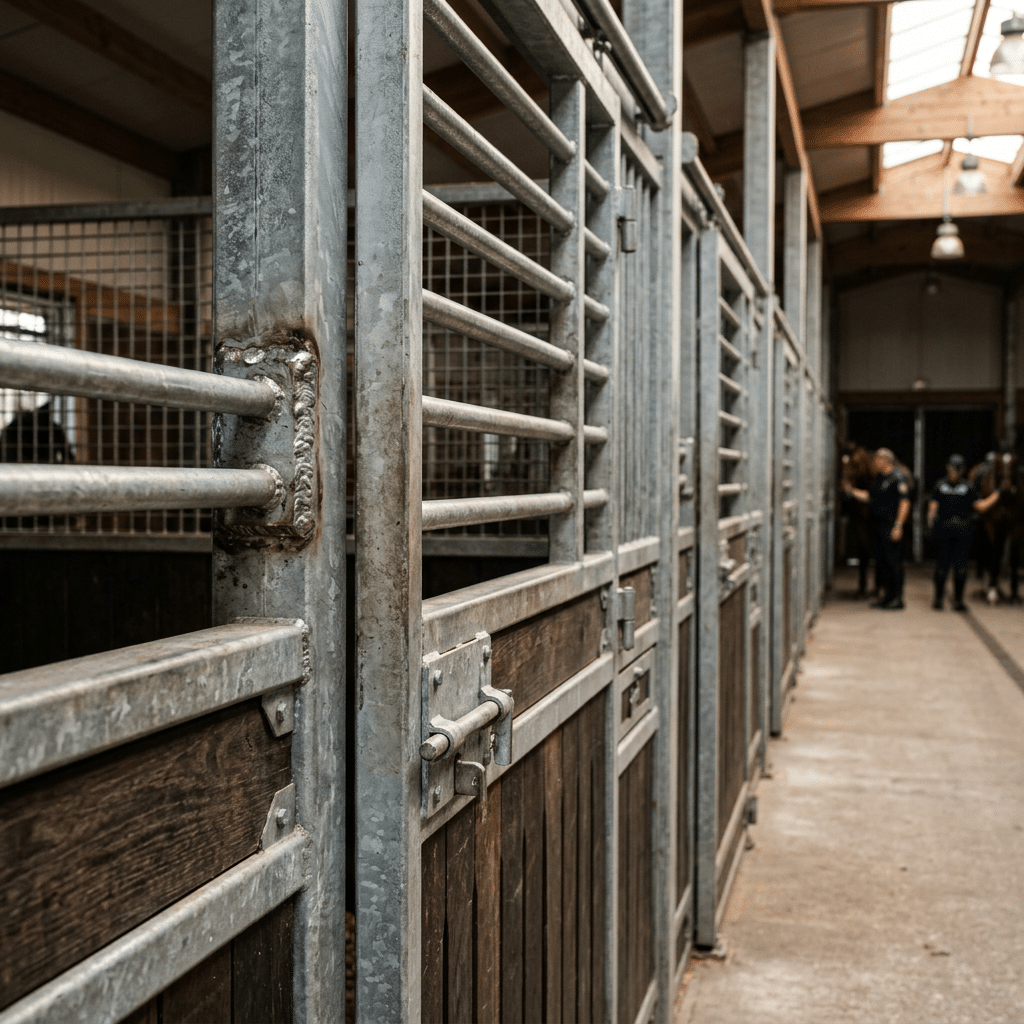
- Rust Prevention: The entire post is protected by a Hot-Dip Galvanization coating after all cutting and welding is complete. This process meets ISO 1461 standards and ensures superior, long-term rust prevention inside and out.
Edge Safety: Why DB Radiuses Every Square Corner
We radius every square corner on our steel components to eliminate sharp edges that can injure horses. This safety finish is a standard step in our manufacturing process.
In stable equipment manufacturing, small details make a big difference. One of the most critical, yet often overlooked, is how square corners on steel tubing are finished. A raw 90-degree steel corner is a liability. We treat it as a design flaw from the start, which is why we physically round every single one.
| The Hazard: Unfinished Square Corners | The DB Standard: Radiused & Galvanized |
|---|---|
| Creates a high risk of lacerations and deep tissue injuries for horses that panic, lean, or roll against stall walls. Also a significant safety hazard for handlers. | All corners are mechanically smoothed to create a safe, rounded surface. This simple step drastically reduces the potential for cuts and scrapes. |
| The radiusing process happens *before* hot-dip galvanization. This ensures the protective zinc coating covers the smoothed edge completely and uniformly. |
The Hidden Risks of Sharp Steel Edges
A horse’s skin is surprisingly delicate. A sharp edge on a steel post or gate frame can easily cause a serious cut if a horse spooks or leans against it. These injuries are not just superficial; they can lead to infections, costly vet bills, and downtime for the animal. The risk extends to people, too. Handlers, vets, and owners working inside the stall are just as exposed to these unnecessary hazards.
A Standard Process for All Steel Framework
This isn’t an optional upgrade; it’s a fundamental step in our production. Every piece of Q235B structural steel, including the 50mm x 50mm RHS posts, goes through this process. We smooth all corners before the component enters the galvanizing tank. This “Hot-Dip After Fabrication” method is critical. It ensures the zinc coating fully adheres to the rounded surface, creating a seamless barrier against rust and maintaining a safe, smooth finish for the life of the stable.
Installation: Bolting Square vs. Round Profiles
Square posts use side-to-side bolt measurements and may need reinforcement. Round posts use a more accurate diagonal bolt circle. We supply a complete 304 stainless steel hardware kit for both.
Practical Differences in Bolt Patterns and Stability
The geometry of the post directly affects how you measure and secure it. Bolt patterns for square profiles are measured along the flat side. Round profiles rely on a diagonal measurement across the center, often called a bolt circle, which provides a more accurate reference for anchor bolts.
There’s also a mechanical difference. When tightening bolts on a hollow square tube, there’s a risk of deforming the tube walls before achieving the proper clamping force. This can lead to a loose connection over time. The joint may require internal reinforcement to ensure a secure clamp load and long-term stability.
Standardized 304 Stainless Steel Hardware for Secure Connections
To eliminate installation variables, every stable system we ship includes a complete hardware kit. We’ve engineered this kit to provide a secure fit for both our 50x50mm square posts and our 114mm round posts, so your assembly is straightforward and reliable.
Each kit contains high-grade 304 stainless steel anchor bolts, screws, and connectors. Using 304 stainless steel provides maximum corrosion resistance, which is essential for the demanding conditions of any equestrian facility.
الأفكار النهائية
Cheaper stalls often skip critical finishing, leaving sharp edges that create injury liability. Our process of radiusing every corner before hot-dip galvanization is non-negotiable. It protects your brand from safety claims and ensures the product’s long-term integrity.
Verify the engineering for yourself. A trial order of 3-5 stalls allows you to test our fitment, finish, and the “Hot-Dip After Fabrication” quality directly. Contact our team to align your project requirements with our OEM capabilities.

 Arabic
  English
  Spanish
  French
  German
0 تعليق