


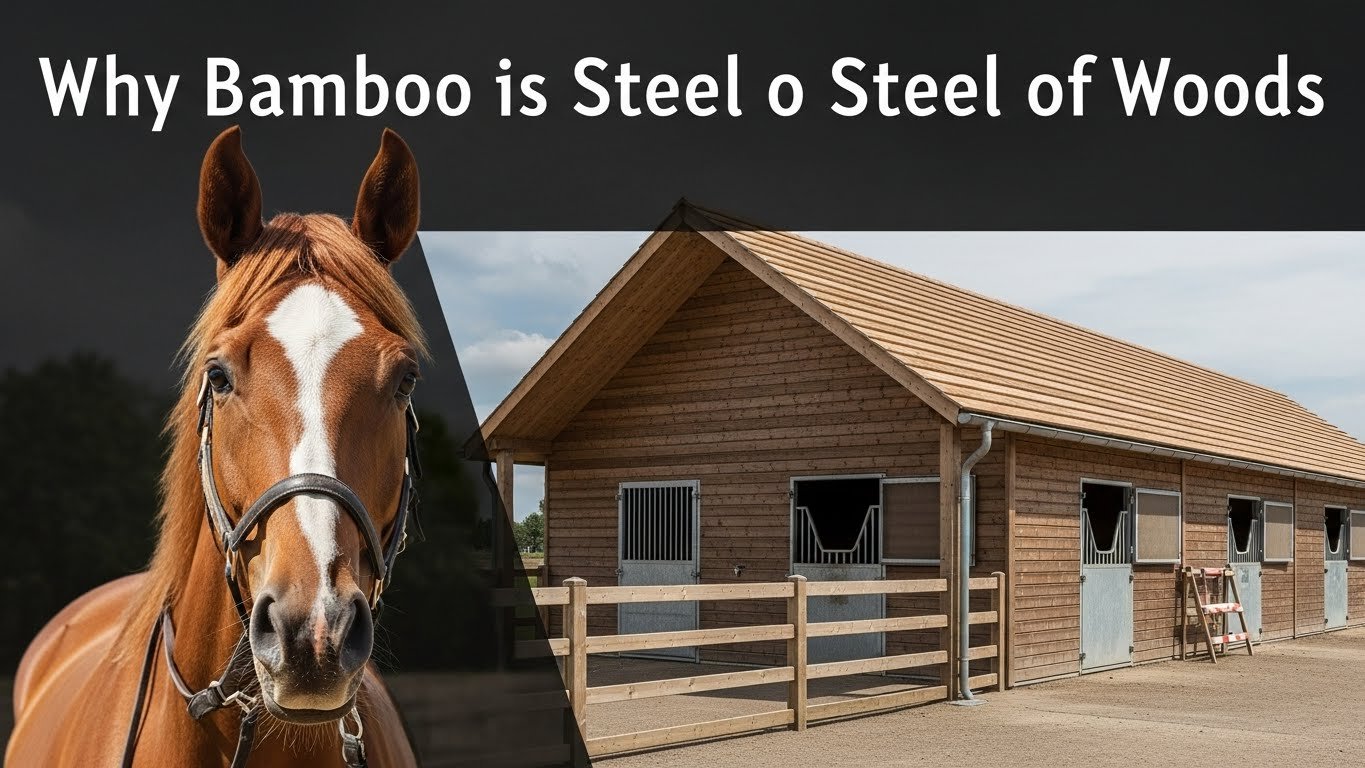
Creating a durable, safe, and sustainable equestrian facility means making smart material choices. Traditional options often present compromises between strength, fire safety, and environmental responsibility. What if a natural material could offer the resilience of steel while providing advanced protection and eco-friendly benefits for your barn?
This article explores strand woven bamboo, showing how its unique engineering process results in extreme density—up to 1,250 kg/m³—which helps it withstand horse impacts. We will also examine its proven Class A fire resistance and why its rapid renewability, with harvests every 4–6 years, makes it a leading sustainable option for modern مرافق الفروسية.
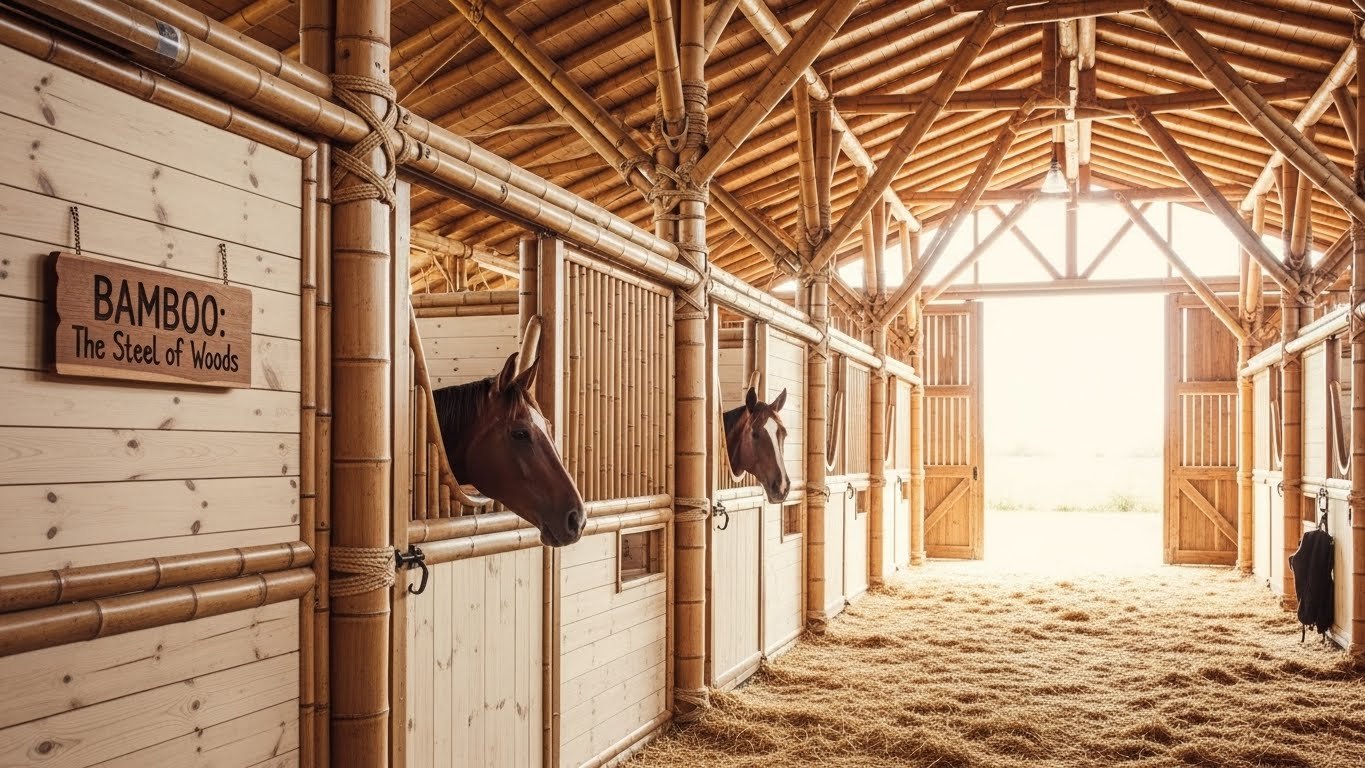
How Strand Woven Bamboo is Made
Strand woven bamboo is manufactured through a specialized multi-step process. It begins by preparing bamboo culms into strands, followed by treatments to remove sugars and starches. These strands are then impregnated with eco-friendly resins and hot-pressed under extreme pressure, reaching densities exceeding 1100 kg/m³, before being cured and precision-machined into final products.
From Raw Culms to Treated Strands
Selection of Phyllostachys spp. culms, primarily Moso bamboo, with skin and inner pith removed, utilizing only the structurally uniform central wall.
Mechanical crushing of bamboo strips into individual strands or fibres, ensuring optimal surface area for subsequent adhesive impregnation.
Boiling or chemical treatment of strands, often in boric-acid solutions, to remove natural sugars and starches, enhancing resistance to termites and mould.
Optional carbonisation through controlled steaming at temperatures between 150–250 °C, resulting in darker hues and improved material stability.
High-Pressure Consolidation and Finishing
Impregnation of kiln-dried bamboo strands with No Added Urea-Formaldehyde (NAUF) resin systems, with careful control over resin loading to optimize mechanical performance.
Hot-pressing of resin-laden strands in moulds under extreme pressure, typically around 2800 tons, to achieve a target density of at least 1100 kg/m³.
Kiln-curing of the pressed high-density blocks at temperatures approximately 125–133 °C to stabilize the adhesive and reduce moisture content to below 4%.
Precision machining of the consolidated blocks into final products like flooring boards or panels, often utilizing advanced CNC and HOMAG-class equipment for tongue-and-groove profiles.
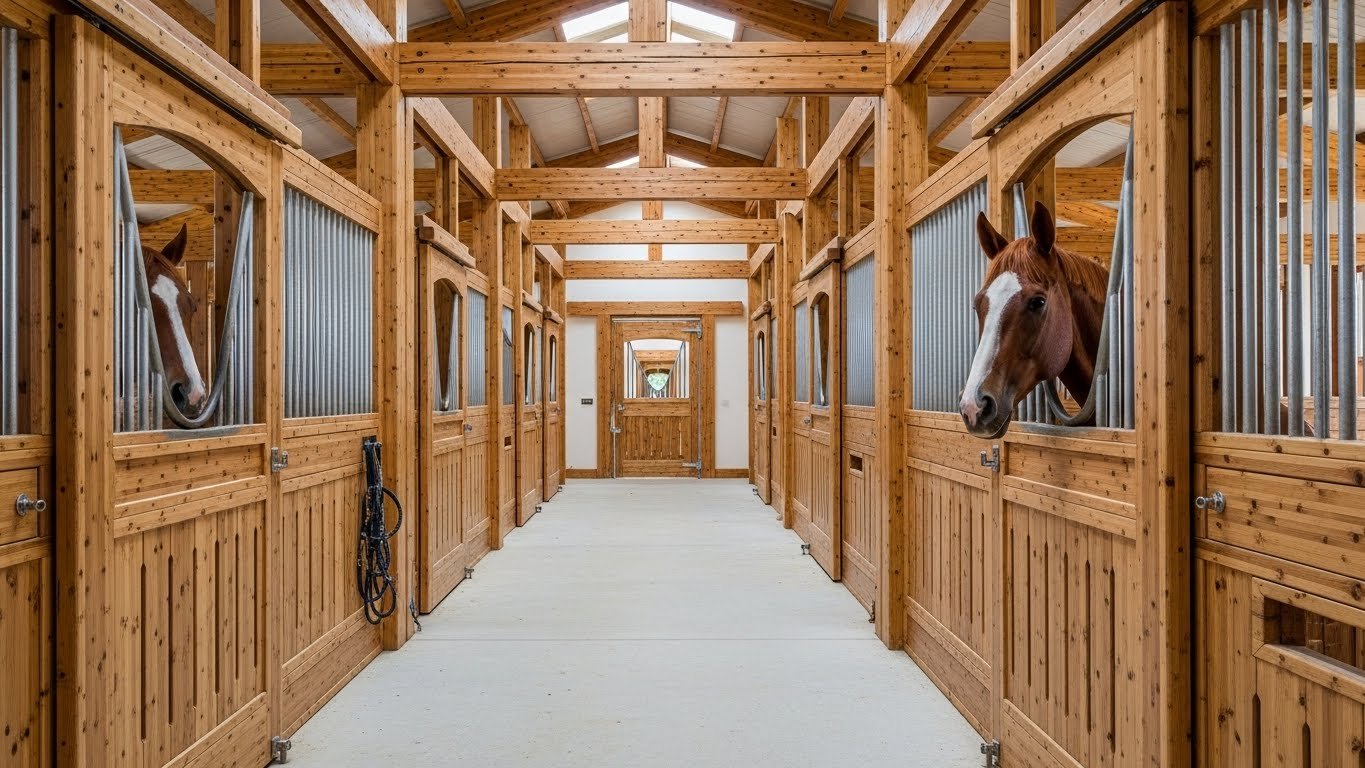
Benefit 1: Extreme Density (Impact Proof)
Strand woven bamboo boasts a density of 1,150–1,250 kg/m³, making it significantly denser than most softwoods and comparable to or exceeding dense hardwoods. This inherent density, combined with high surface hardness and impact toughness, is engineered to withstand severe equestrian impacts, preventing damage and ensuring long-term structural integrity in الإسطبلات.
| الخاصية | المواصفات | Relevance to Equestrian Use |
|---|---|---|
| Bulk Density | 1,150–1,250 kg/m³ | Significantly denser than softwoods, resists deformation. |
| Static Hardness | 104 ميجا باسكال | Resists surface damage from kicks and abrasion. |
| صلابة التصادم | 114.7 كيلو جول/م³ | Withstands concentrated, sudden القوات without splintering. |
| Panel Thickness (Kick Zones) | 30–38 mm | Provides robust structural strength against horse impacts. |
| Temperature Durability | –30 °C to 65 °C | Maintains integrity in varied stable climates. |
| محتوى الرطوبة | 8–10% | Ensures dimensional stability, prevents warping and cracking. |
| الشهادات | SGS/ISO 9001 | Guarantees manufacturing quality and product reliability. |
The Foundation: Understanding Strand Woven Bamboo Density
Achieves a bulk density of 1,150–1,250 kg/m³ (1.15–1.25 g/cm³), placing it 50–80% denser than common softwoods and within the range of dense hardwoods.
Processes bamboo fibers under high pressure with resin binders, resulting in a composite material with superior structural integrity.
Exhibits a static hardness of approximately 104 MPa and an impact toughness of 114.7 kJ/m³, crucial for resisting concentrated impacts from horse kicks.
Engineered for Resilience: Key Specifications and Performance
Utilizes panel thicknesses of 30–38 mm, specifically designed for high-impact kick zones, often integrated with galvanized إطارات فولاذية (50×50 mm SHS sections) for structural reinforcement.
Maintains an optimal moisture content of 8–10% and incorporates outdoor-grade treatments like anti-corrosion and anti-mould oils to ensure dimensional stability and durability across a –30 °C to 65 °C temperature range.
Backed by industry certifications such as SGS/ISO 9001 and offered with extensive warranties (e.g., 10-20 years), confirming its long-term performance and reliability in demanding stable environments.

Benefit 2: Fire Resistance (Class A)
By 2026, Class A fire resistance for مرافق الخيول mandates high safety levels for structures over 5,000 sq ft, governed by NFPA 150, 101, and 13. High-performance strand woven bamboo contributes to this by demonstrating Class A flame-spread and smoke-developed indices (ASTM E84), integrating with sprinkler systems, and supporting fire compartmentation.
| Fire Safety Aspect | Specific Requirement/Criterion | Relevance/Source |
|---|---|---|
| Horse Facilities Code | NFPA 150 (Category 2), Class A facilities >5,000 sq ft | Highest protection requirements. [1] |
| Life-Safety Standard | NFPA 101, Chapter 42 (storage occupancies) | Egress, travel distance, emergency lighting, general fire protection. [1] |
| Automatic Sprinkler Systems | NFPA 13, quick-response sprinkler heads | Mandatory for Class A facilities. [1] |
| Portable Extinguishers | 2-A:10-B:C rating, within 50 ft travel distance | Selected per NFPA 10; higher Class A recommended due to fuel loads. [1] |
| Firewalls/Barriers | 1-hour fire protection, extends ≥18 in above roof, fire-rated self-closing doors | Maintained integrity with sealed penetrations. [2] |
| Fire-Retardant المواد | UL or FM marks, AWPA standards compliance | Ensures stable flame-spread/smoke indices. [2] |
| Heavy Timber Fire Behavior | Chars to ~1 inch depth | Char layer insulates, preserves core, improves structural fire endurance. [2] |
| Automatic Vent Release | Open at ~212°F (100°C) | Releases hot gases and smoke. [2] |
| Facility Classification Impact | Class A/B facilities > Class C (≤5 horses) | Triggers higher engineered fire protection levels. [1] |
Defining Class A Fire Resistance for Equine Stables
A Class A rating applies to equine facilities exceeding 5,000 square feet, requiring high safety levels. The National Fire Protection Association (NFPA) sets the core fire safety framework. This framework includes NFPA 150 (Category 2: Horse Facilities), NFPA 101 (Life Safety Code), and NFPA 13 (Standard for the Installation of Sprinkler Systems). Materials used in these facilities must integrate with automatic sprinkler systems, tolerating water discharge and thermal conditions. Effective fire containment and reduction of fuel load depend on measurable contributions from all components.
Fire protection for Class A horse facilities, those larger than 5,000 square feet, follows NFPA 150 (Category 2). This standard layers on requirements from NFPA 101 and NFPA 13. Facilities of this size need full automatic sprinkler coverage with quick-response heads, designed per NFPA 13. They also require code-compliant egress, emergency lighting, and alarm/detection systems, referenced through NFPA 101. This framework establishes the performance bar for stall systems; any material, such as bamboo composites, must be compatible with wet-pipe sprinklers, potential water loads, and the thermal/smoke conditions assumed in NFPA-based design.
Achieving Compliance with Tested Bamboo Materials
Achieving يتطلب الامتثال several key components. Automatic sprinkler systems must use quick-response heads, adhering to NFPA 13 standards. Portable extinguishers, with a minimum 2-A:10-B:C rating, need placement within 50 feet of travel distance from any point in the stable. Firewalls provide at least 1-hour fire protection, extending 18 inches above the roofline. Specifically, bamboo panels must demonstrate Class A flame-spread and smoke-developed indices, verifiable through ASTM E84 or similar testing. Stall designs also ensure compatibility with smoke ventilation systems, which typically open near 212°F.
Within the stall structure, fire resistance focuses on quantifiable contributions to fire compartments and fuel load, not simply marketing “fireproof” claims. Technical guidance for stables emphasizes using materials like masonry, heavy timber, or fire-retardant-treated wood with proven flame-spread and fire-endurance ratings. Heavy timber components char to about 1 inch, which insulates and preserves the load-bearing core, enhancing structural fire endurance. Fire-retardant-treated wood products must carry UL or FM marks and conform to AWPA standards to ensure مستقر flame-spread and smoke-development indices, even in high-humidity, ammonia-rich barn environments. A bamboo stall panel claiming Class A performance needs documentation of ASTM E84 or similar flame-spread/smoke-developed indices. Ideally, UL/FM listing, similar to treated wood, helps integrate it credibly into this framework.
At the building level, compartmentation and rating continuity significantly influence performance. Technical تصميم الحظيرة defines a “true firewall” as one delivering at least 1-hour fire resistance. This wall must extend a minimum of 18 inches above the roof and incorporate fire-rated, self-closing doors with sealed penetrations. This directly impacts how واجهات الأكشاك, partitions, and bamboo linings interact with rated walls and ceilings. Any stall system should not compromise these assemblies’ hourly rating. Venting and smoke control are also engineered components; فتحات التلال, monitors, or unit vents often use heat-fusible elements set around 212°F to open during a fire and exhaust hot gases. Stall fronts and doors must support this flow path function and facilitate rapid horse egress.
Portable extinguishing systems and on-site response further define what “fire-resistant” means in practice. NFPA 150 and related guidance require 2-A:10-B:C extinguishers at entries and within 50 feet of travel distance. Personnel receive mandatory training and annual drills. Barns contain dense Class A fuel loads—hay, shavings, wood framing—leading authorities to recommend extinguishers with higher Class A ratings than the minimum. Stable-rated electrical installations also help reduce ignition sources. For a high-end buyer, the value of bamboo stalls under a Class A fire-resistance banner includes: independently tested Class A flame-spread/smoke ratings, compatibility with NFPA 13 sprinkler discharge, and stall integration that preserves 1-hour-rated fire separations, smoke vent function, and egress routes documented in NFPA 150/101 layouts.
Custom Horse Stables, Engineered for Every Climate
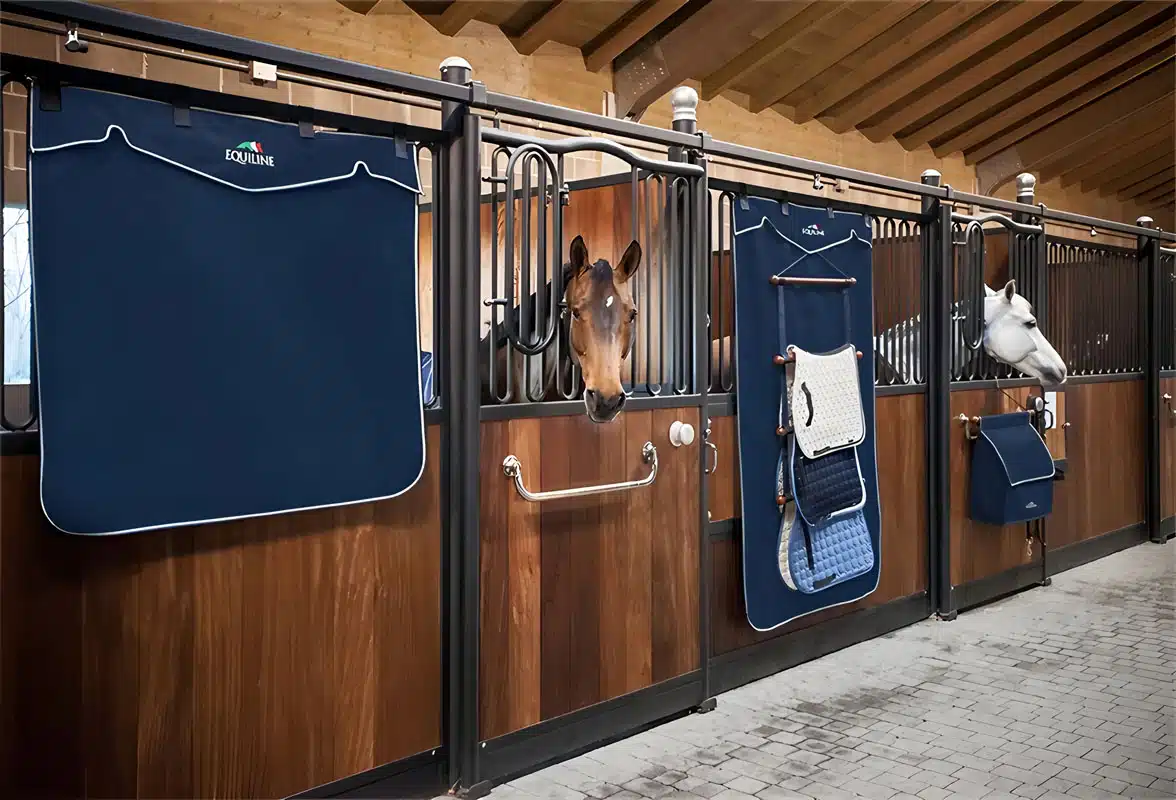

Benefit 3: Eco-Sustainability
Strand-woven bamboo offers significant eco-sustainability benefits for إسطبلات الخيول, primarily through its rapid renewability and superior carbon sequestration. Engineered with low-emission glues and high dimensional stability, these boards ensure a healthier environment and extended product lifespan, aligning with modern ecological standards for construction materials in 2026.
Rapid Renewability and Carbon Absorption
Bamboo is harvestable in 4–6 years, significantly faster than traditional timber.
Bamboo stands absorb about 35% more CO₂ than similar tree stands.
This rapid growth and carbon capture make it a premier renewable resource for بناء مستقر.
Low Emissions and Durable Material Design
Achieves low formaldehyde emissions, with ratings like E1 and even E0 (0.2 mg/L) by 2026 standards.
Uses non‑toxic, low-formaldehyde glue and eco‑friendly outdoor preservative oil for animal safety.
High dimensional stability and natural moisture‑resistance extend product lifespan, reducing replacement frequency and material consumption.
Products from suppliers like MOSO® Bamboo E‑quine and REBO offer these verified environmental standards.
Maintenance Guide
Strand woven bamboo horse stalls are designed for low maintenance, requiring simple daily spot cleaning and weekly full cleaning routines. Their inherent durability, combined with protective treatments, ensures long-term performance and hygiene with minimal effort.
Routine Care for Optimal Hygiene
Perform daily spot cleaning to promptly remove manure and wet spots. Conduct weekly full cleaning by removing all bedding, scrubbing the الأرضية, and ensuring it is thoroughly dry before re-bedding. These hygiene practices are easy to implement without requiring specialized tools.
Engineered for Long-Term, Low-Effort Durability
Strand woven bamboo’s high hardness (Brinell Hardness ≥9.5) and abrasion resistance (≥1500 cycles) enable robust, low-maintenance protocols. Easy-clean surfaces, coupled with UV-coatings and pre-oiled finishes, actively minimize deformation, rot, and bacteria build-up. These material advantages and maintenance practices contribute to an impressive lifespan of 15-30 years.
![مطابقة الحشو بالأرضيات لماذا يتناسب الخيزران مع [الحصائر المطاطية] (2)](https://dbhorsestable.com/wp-content/uploads/2025/12/Matching-Infill-to-Flooring-Why-Bamboo-Pairs-Best-with-Rubber-Mats-2.jpeg)
الأفكار النهائية
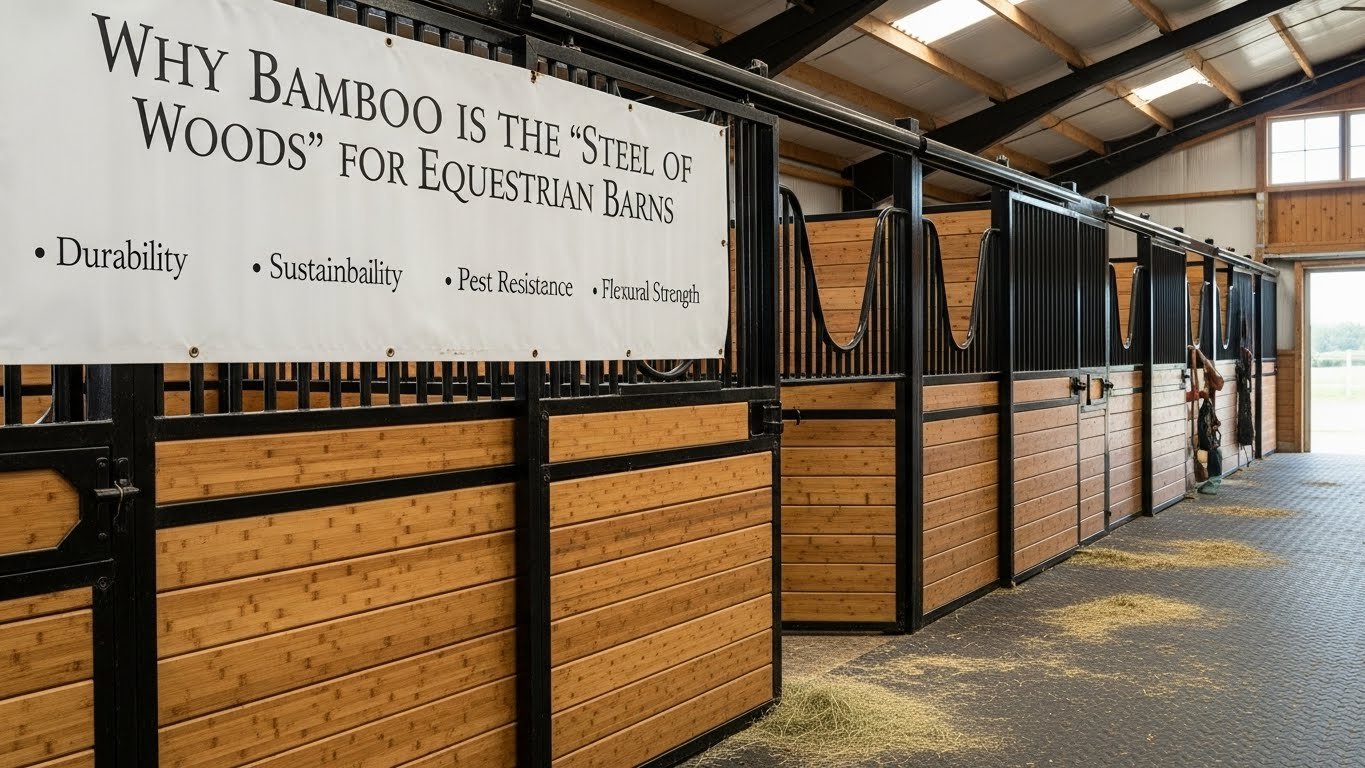
Strand woven bamboo earns its reputation as the “Steel of Woods” for حظائر الفروسية by delivering on multiple fronts. Its specialized manufacturing creates a material with extreme density, giving it exceptional impact resistance against horse kicks. This material also achieves Class A fire resistance, meeting stringent safety standards, and offers a highly eco-sustainable option. Beyond that, its design supports minimal maintenance.
Choosing strand woven bamboo for بناء مستقر offers lasting benefits. This material provides peace of mind through its proven durability and fire safety, safeguarding both horses and investments. Its eco-friendly nature also aligns with modern sustainability goals, making it a smart, forward-thinking option for today’s مرافق الفروسية.
![مطابقة الحشو بالأرضيات لماذا يتناسب الخيزران مع [الحصائر المطاطية] (7)](https://dbhorsestable.com/wp-content/uploads/2025/12/Matching-Infill-to-Flooring-Why-Bamboo-Pairs-Best-with-Rubber-Mats-7.jpeg)
الأسئلة المتداولة
Are bamboo stalls expensive?
For premium buyers, bamboo horse stalls are priced similarly to high-end European steel/wood systems. They typically cost around USD $450–$650 per 12′ front or panel, which translates to roughly $1,800–$2,600 per standard 12’×12′ stall, excluding الشحن and installation. Manufacturers position bamboo as an “affordable quality” or “economical” upgrade compared to exotic hardwoods, not as a budget option against basic softwood.
Is bamboo fire resistant?
Raw bamboo is flammable. However, thermo-treated or processed bamboo products achieve high fire resistance ratings. For instance, they can meet Class A under ASTM E84 (Flame Spread Index of 10) and Euroclass B-s2,d0 under European standards, making them suitable for building applications, including areas with high fire risk.
Does bamboo rot in a barn?
Properly manufactured engineered bamboo panels designed for stalls resist rot in a barn environment under normal use. They are produced and tested as “durability Class 1” (very durable) exterior products under ENV 807 / EN standards and are sold as “rot‑resistant” bamboo إسطبل خيول boards. This performance is comparable to or surpasses many tropical hardwoods, suggesting decades of service life in a ventilated barn when not exposed to standing water or chronic urine saturation.
Can horses kick through bamboo?
While there is no published equine‑safety standard explicitly stating ‘kick‑proof,’ properly engineered strand‑woven bamboo kickboards/panels (at least 15 mm thick, steel‑framed, with a density of about 1,100–1,250 kg/m³) are specifically marketed as horse kickboards and stable panels. This indicates their design intent is to withstand typical horse kicks without being kicked through. No engineering data suggests horses can kick through such panels when correctly specified and installed; however, thin or non‑engineered bamboo should not be assumed kick‑resistant.
How to clean bamboo horse stalls?
Clean bamboo horse stall surfaces by washing superficial discoloration with a sponge and water, then applying bamboo care oil to prevent weathering and mold growth. Avoid high-pressure cleaners or steam jets to prevent surface damage. Utilizing sliding أقسام (standard sizes 3m, 3.5m, 3.6m, 4m) allows for easy access during cleaning. Using approximately 42 cubic feet of bamboo bedding per 12’x12’ stall can reduce cleaning time by 35% through clumping and requires 50% less bedding removal compared to pine shavings.
Is bamboo eco-friendly?
Yes, bamboo is eco-friendly. It grows rapidly, sequesters carbon effectively (releasing 35% more oxygen than traditional forests per area), has low production emissions, and can replace high-emission materials like plastics and steel while maintaining a carbon-negative status across its lifecycle.

 Arabic
  English
  Spanish
  French
  German
0 تعليق