
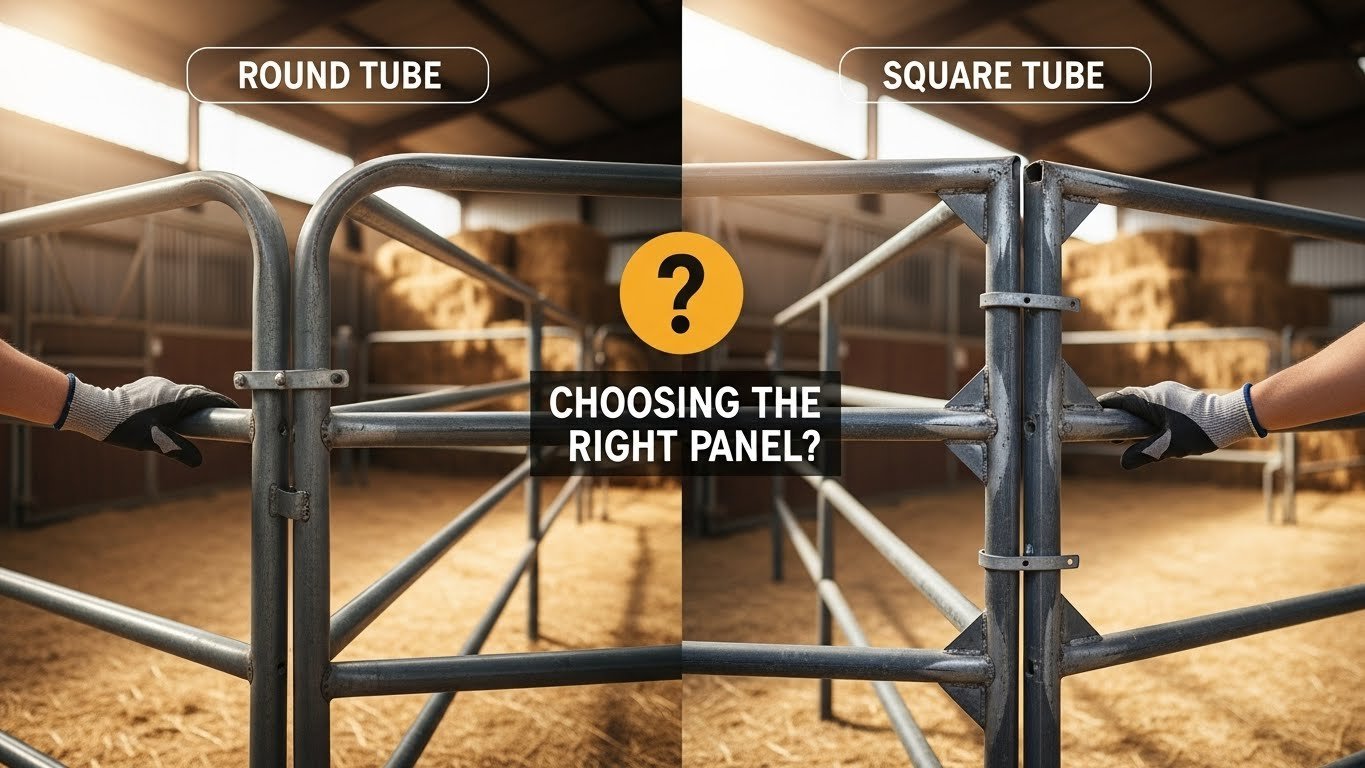
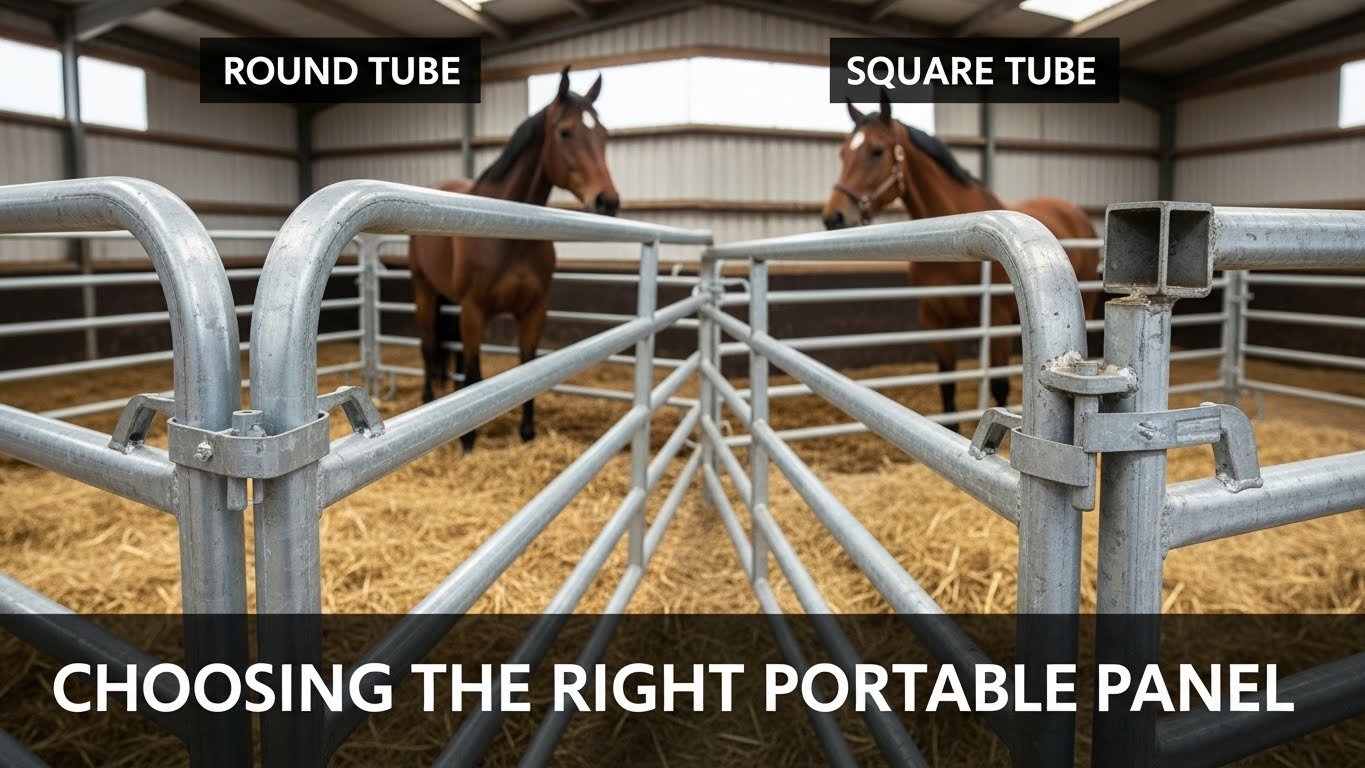
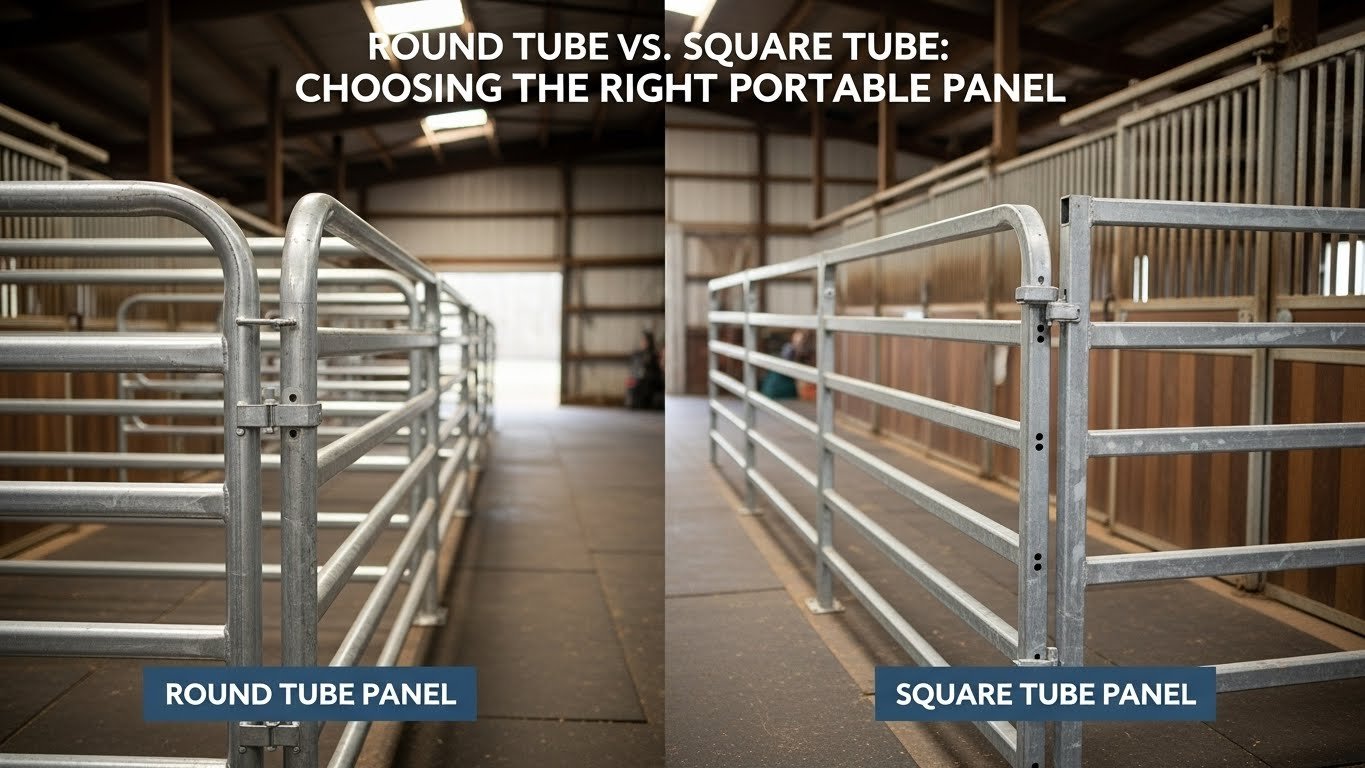
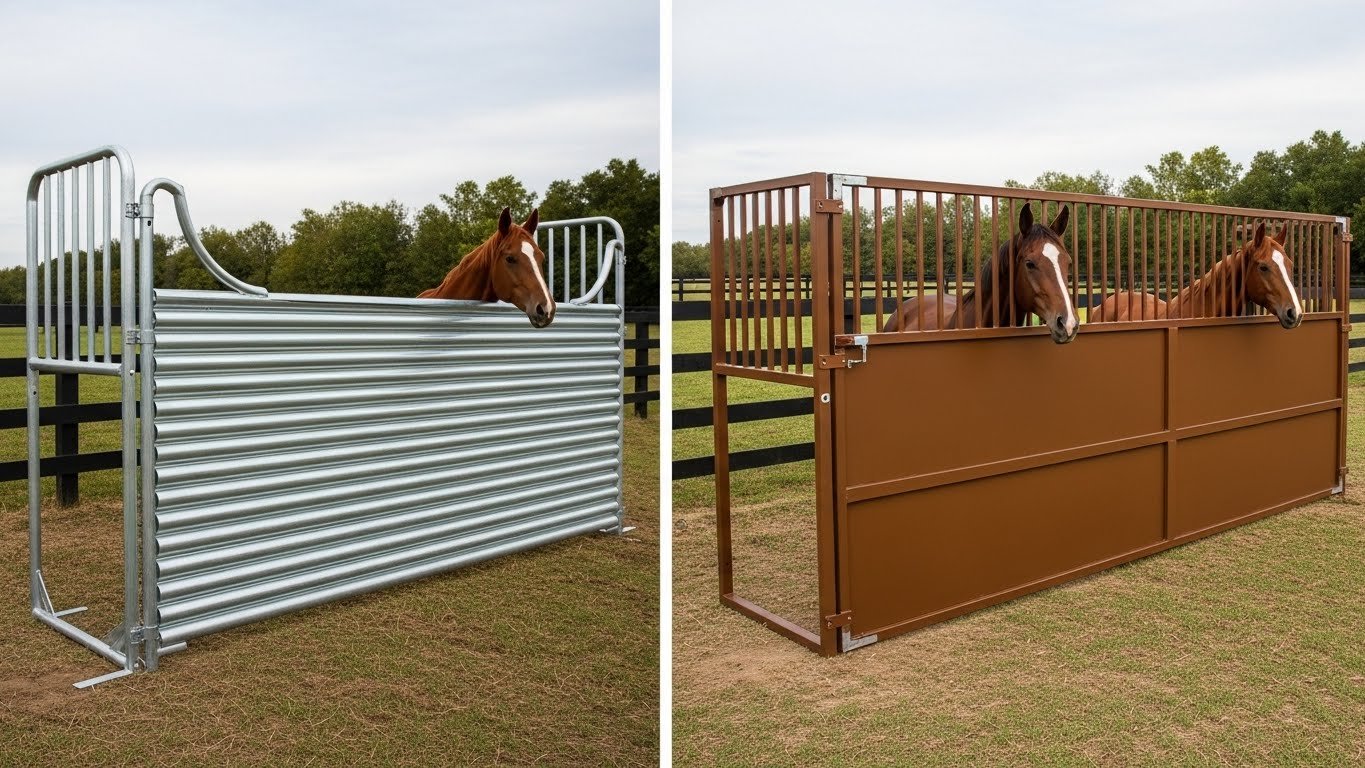
For businesses sourcing temporary panels, especially galvanized corral panels, deciding between round and square tubing is a practical choice that influences safety, durability, and long-term value. This selection isn’t just about appearance; it’s about engineering performance under pressure, whether for livestock containment or event management.
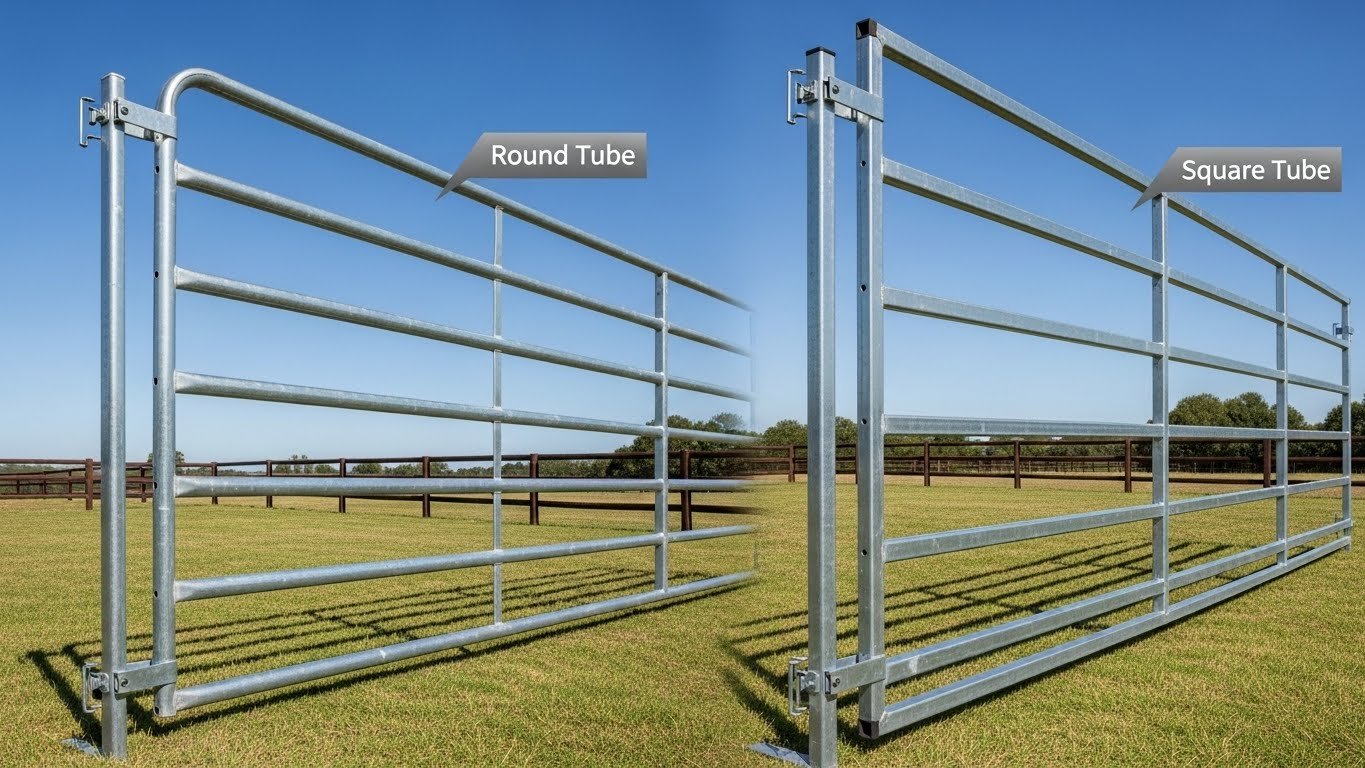
This article examines the core distinctions, offering insights into why round tubing remains an industry standard for horse corral panels due to its strength distribution, and how it can be approximately 20% lighter than equivalent square tubing while maintaining a greater strength-to-weight ratio. We’ll compare deflection limits and structural strength metrics to help you make an informed decision for your temporary panel needs.
The Geometry of Steel Strength
In 2026, steel corral panels utilize specific geometries like optimized tube diameters, strategic rail spacing, and integrated bracing to achieve high strength-to-weight ratios. Welded joints and robust support legs further distribute loads, ensuring effective and portable containment solutions for various applications.
Structural Design for Load Distribution
Strength-to-weight optimization is critical for portability and resisting forces from animals or crowds in temporary enclosures.
A tube diameter–wall pairing (e.g., 1-3/4 in to 2 in OD with 16-20 gauge) provides adequate section modulus for horizontal bending resistance.
Six evenly spaced horizontal rails and integrated vertical Z-braces effectively shorten the span of each rail, which enhances overall panel stiffness.
Continuous-welded saddle joints and 360° welds create a rigid, closed-frame geometry, distributing impact loads over the entire perimeter rather than local points.
Key Dimensions and Reinforcement Features
Common tube outer diameters include 1-3/4 in (44.5 mm) and 2 in (50.8 mm) for galvanized corral panels.
Wall thicknesses typically range from 16 ga, 19 ga, or 20 ga (approximately 1.6 mm, 1.0 mm, 0.9 mm), with some heavier designs reaching 2.5 mm.
Standard panel heights are 5 ft (1.52 m), 62 in (1.57 m), or 72 in (1.83 m), with lengths like 10 ft, 12 ft, or 16 ft.
Six-rail panels often incorporate two vertical “Z” braces; heavy-duty 16 ft versions can feature four vertical braces to increase bending resistance.
Support systems like loop legs or J-legs are used to spread ground bearing pressure, preventing panel sinking on soft terrain.
For lighter-duty applications, 4-gauge galvanized wire grids (e.g., 6 in × 8 in or 8 in × 8 in openings) provide distributed strength and reduced weight.
Round Tube (Deflection/Safety)
Round tube deflection is a key safety concern, especially for temporary structures, governed by flexible pipe standards. Limits are set by material properties and installation conditions, with specific testing protocols and design equations ensuring structural integrity under expected loads.
| Standard/Material | Parameter/Context | Limit/Value |
|---|---|---|
| WisDOT | Polyethylene/Polypropylene Pipe Deflection Testing | Mandrel at 92.5% of nominal inside diameter |
| USBR | Flexible Pipe Deflection (Reclamation Equation) | Embedment to 0.7 OD, Design Factor Fd=0.67 |
| PVC Pipe | Vertical Ring Deflection Limit | Withstands 30% before reverse curvature |
| HDPE Pipe | Testing Standards | Per ASTM D2321 (Pipe stiffness EI/r³) |
| Structural Tubing | Extreme Deflection Limit | Length/depth ratio of 24 |
Understanding Deflection Limits in Flexible Round Tubes
Deflection in round tubes, particularly for temporary galvanized corral panels, is governed by flexible pipe standards.
Safety hinges on preventing excessive ovaling, buckling, or collapse under crowd or event pressures.
Standards focus on installation loads, soil embedment, and material stiffness to ensure structural integrity.
Key Standards and Technical Data for Deflection Control
WisDOT mandates mandrel testing at 92.5% of nominal inside diameter post-installation for pipe ≥24 inches diameter.
USBR’s Reclamation Equation predicts deflection, emphasizing embedment to 0.7 OD with a design factor of Fd=0.67.
PVC pipe withstands up to 30% vertical ring deflection before reverse curvature.
HDPE pipe is tested per ASTM D2321 standards, considering pipe stiffness (EI/r³) and dimension ratios.
For structural tubing, an extreme deflection limit is set at a length/depth ratio of 24.
Deflection in round tubes/pipe, particularly for temporary galvanized corral panels, is governed by flexible pipe standards focusing on installation loads, soil embedment, and material stiffness to prevent failure under crowd/event pressures. WisDOT mandates mandrel testing at 92.5% of nominal ID post-installation (ideally 30 days after), with 100% coverage for larger diameters to ensure no excessive ovaling from backfill or joint misalignment—critical for safety in temporary setups where panels may act as buried or semi-buried barriers[1]. USBR’s method predicts deflection via the Reclamation Equation, emphasizing embedment to 0.7 OD and soil modulus (E’), with trench types (1-3) based on wall support; softer soils (E’n <500 psi) require wider trenches to limit deflection under prism loads[2].
For galvanized steel round tubes in panels, structural limits like AISC guidelines cap extreme deflection at length/depth 24:1, while PVC/HDPE analogs (relevant for hybrid or comparative safety) allow up to 30% ring deflection before structural compromise, tested per ASTM standards[3][6]. Safety for event managers hinges on these thresholds to avoid buckling or collapse under lateral crowd forces, with no direct corral panel standards found but pipe deflection protocols providing authoritative proxies for round tube integrity.
Square Tube (Structural Strength)
Square tubes provide robust structural strength due to material grade, efficient wall thickness, and precise cross-sectional geometry, optimizing load-bearing and strength-to-weight ratios. This makes them ideal for demanding applications like frames and panels in 2026.
| Material/Property | Key Metric | Value/Details |
|---|---|---|
| ASTM A500 Grade B (Square/Rectangular) | Yield Strength | 46,000 psi (317 MPa), Tensile Strength 58,000 psi (400 MPa) |
| ASTM A500 Grade C | Yield Strength | 50,000 psi (for sizes over 2-1/2″ to 3-1/2″), Tensile Strength 62,000 psi (427 MPa) |
| Q235 Steel Square Tube | Strength Behavior | Resists static loads (tensile, compressive, flexural, shear), commonly used |
| Q355 and ASTM A500 | Design Metrics | Yield strength, tensile strength, elongation, hardness for structural design |
| Carbon Steel (50x50mm, 3mm wall) | Tensile Strength | 400 MPa, Strength-to-weight ratio: 90.3 × 10⁶ N/kg |
| Wall Thickness (0.25-inch vs 0.125-inch) | Performance | 0.25-inch significantly stronger, better load-bearing and buckling resistance |
| 1026 Steel | Material Grade | Meets ASTM A500/A513, high-strength low-alloy, suitable for heavy loads |
| ASTM A500 Tolerances | Squareness | ±2°, crucial for ensuring structural integrity |
Engineering Principles of Square Tube Strength
The structural strength of square tubes comes from several core factors. These include the material grade, the wall thickness, and the overall cross-sectional area. ASTM A500 is a widely used standard for high-strength low-alloy steel in structural applications.
Hollow sections, characteristic of square tubing, offer superior strength-to-weight ratios compared to solid shapes. This material efficiency is a key advantage. Square tubes are designed to withstand various static and dynamic forces, such as tension, compression, bending, and shear loads.
Performance Metrics and Applications
Specific material properties dictate the performance of square structural tubing. For example, ASTM A500 Grade B square or rectangular tubing provides a yield strength of 46,000 psi (317 MPa). Grade C offers an even higher yield strength of 50,000 psi for larger sizes, specifically those over 2-1/2 inches to 3-1/2 inches.
Common carbon steels, like Q235 and Q355, are often used. They provide yield strengths up to 317 MPa and tensile strengths up to 427 MPa. For instance, a 50x50mm square tube with a 3mm wall, made from carbon steel, has a tensile strength of 400 MPa and an impressive strength-to-weight ratio of 90.3 × 10⁶ N/kg.
Wall thickness greatly impacts performance. A 0.25-inch thick wall performs much better than a 0.125-inch wall when resisting loads and preventing buckling. Adhering to ASTM A500 tolerances, such as ±2° squareness, is also vital for maintaining structural integrity in applications like frames and temporary structures, including galvanized corral panels.
`
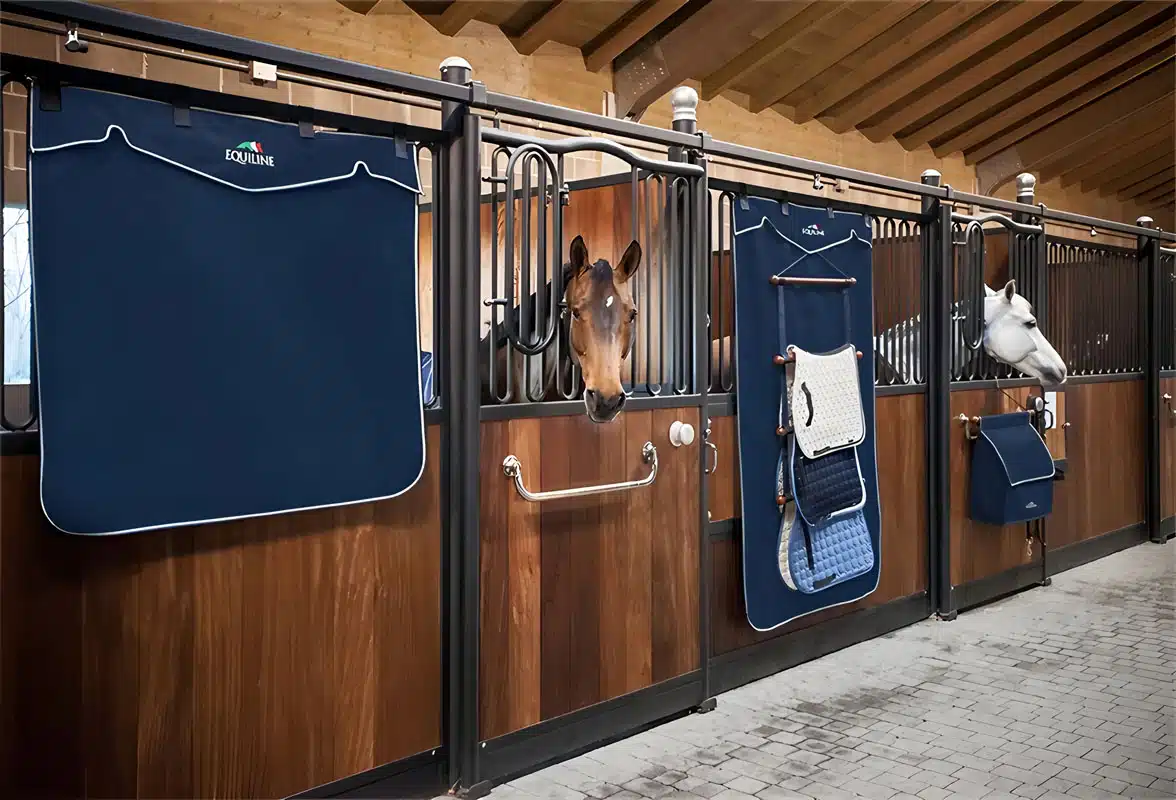
Globally Engineered, Locally Customized: Superior Horse Stables for Any Climate
The “Oval Rail” Compromise
The “Oval Rail” Compromise refers to specialized engineering solutions for effectively joining dissimilar rail sections, ensuring continuous alignment of running surfaces and track gauge. This system uses compromise rails, transition rails, or specific joint bars with alternating round and oval holes, accommodating oval-neck bolts for secure, fatigue-resistant connections.
Compromise Joint Design and Purpose
Connects dissimilar rail sections like RE 90 lb, 112 lb, 115 lb, 119 lb, 132 lb, and 136 lb.
Ensures precise alignment of track gauge and running surfaces across transitions.
Utilizes compromise joint bars with a 6-hole design, often 36” in length.
Features alternating round and oval holes specifically for 1” oval neck track bolts.
Comprises both gauge side and outside joint bars for comprehensive support.
Technical Specifications and Installation
Joint bars are made from high strength steel, with tensile strength 550-650 MPa and elongation ≥18%.
Conforms to industry standards including AREMA Chapter 4, BS47-1, and UIC864-4/8.
Rail joint opening is maintained at 1/8” for proper function.
Compromise welds adhere to AREMA Chapter 4, Part 2.3 (Electric-Flash Butt Welding) specifications.
Bolting torque is applied at 650 ft-lbs, starting with center bolts and moving outwards.
Installation requires 4 anchors per tie for effective box anchoring and longitudinal restraint.
Final Thoughts
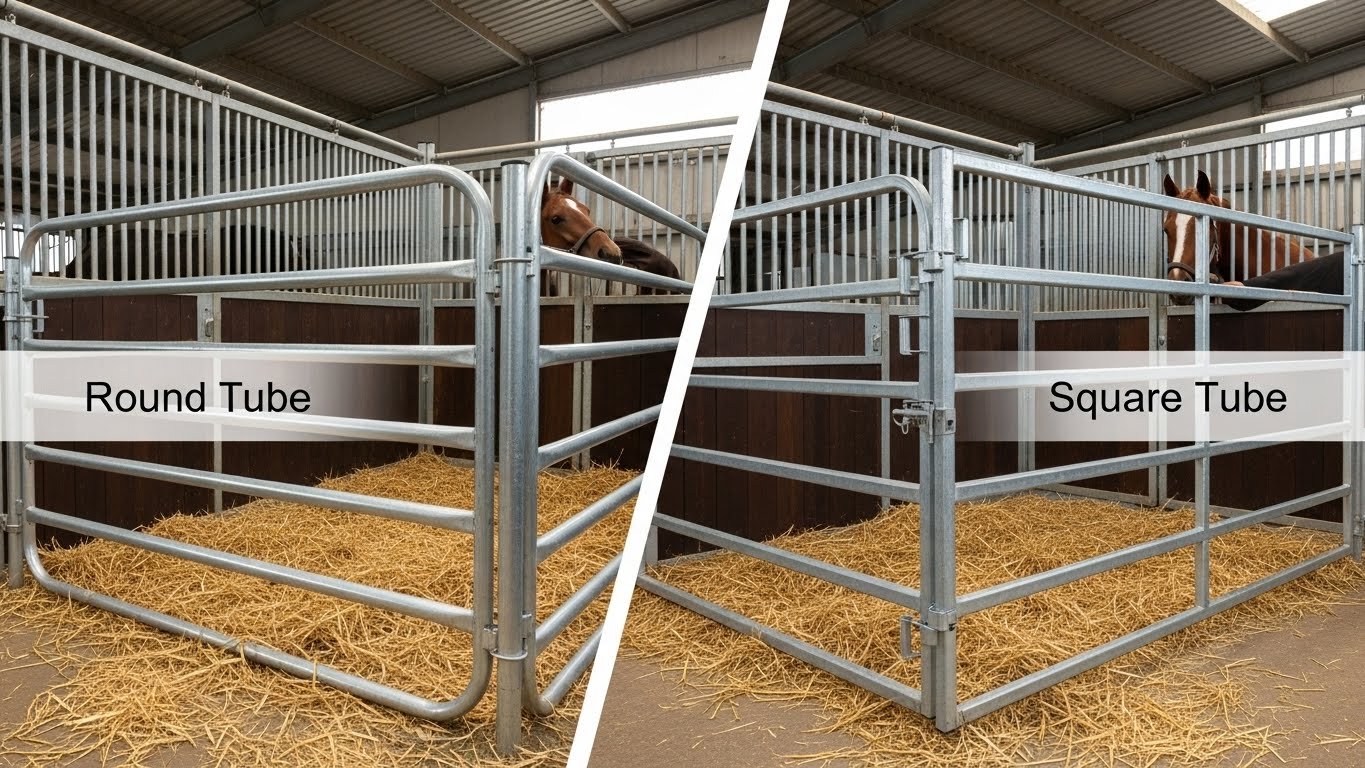
For portable panels, especially those used for livestock, round tubing stands out as the industry preference. Its circular shape naturally distributes stress evenly, making it more resilient to impacts and external forces common in animal containment. While square tubing offers good structural strength and is simpler to fabricate, round tubing generally performs better against torsion and uneven loads, providing enhanced safety and durability for both animals and handlers.
Choosing round tubing for portable panels often means a safer and more reliable product. It combines superior strength-to-weight ratios with design features like smooth surfaces, reducing the risk of injury to animals. When selecting panels, prioritize those made from heavy-duty galvanized round steel tubing, typically 16-gauge and 1-3/4 to 2 inches in diameter, to ensure they meet the demands of practical use while maintaining essential safety standards.
Frequently Asked Questions
Which is better for horses: round or square tubing?
Round tubing is the industry standard for horse corral panels. It offers superior strength, durability, and distributes stress evenly, enhancing safety by reducing failure risk from animal impact. Square tubing is easier to fabricate but performs weaker against torsion and uneven loads. Round tubing is also approximately 20% lighter than equivalent square tubing while maintaining a greater strength-to-weight ratio.
Are portable corral panels safe for livestock?
Yes, portable galvanized corral panels are safe for livestock and handlers. They are constructed with heavy-duty galvanized steel tubing, featuring smooth edges, rounded corners, and no sharp points. These panels meet industry practices for animal containment in farms, ranches, and events. Typical safe specifications include 1-3/4 inch to 2 inch diameter steel round tubing (16-20 gauge) with full-welded saddle joints and vertical ‘Z’ braces.
What constitutes the strongest cattle panel design?
The strongest cattle panel designs are heavy-duty bull panels. These use either 1-gauge wire (standard welded wire type) or 1.5 inch x 16-gauge hi-tensile 58,000 psi steel tubing (tubular corral type). Both significantly outperform standard 4-5 gauge cattle panels in weight-bearing capacity and resistance to bending under livestock pressure. For instance, a 1-gauge bull panel weighs 82 lbs per 16-foot section.
What is the difference between oval rail and round rail?
Oval rails are typically 7x9mm carbon fiber, designed for increased vertical stiffness. Round rails are standard 7mm diameter, made from materials like chromoly, titanium, or steel. Oval rails provide a superior strength-to-flex ratio for carbon components but require compatible seatpost clamps, unlike universal round rails. The standard dimensions are 7x9mm for oval and 7mm for round.
What gauge steel is commonly used for corral panels?
Most galvanized corral panels for cattle and event use are built from 16-gauge steel tubing (about 0.065 inch wall) for standard and heavy-duty applications. Heavier “bull” or extra-heavy panels may use 14-gauge tube or 4–5 gauge welded wire where mesh is incorporated. For example, Rarin’ To Go Corrals use 1‑7/8 inch 16‑gauge galvanized steel tube, while Baird Gate Extra Heavy Duty panels feature 2 inch diameter 16‑gauge round horizontals with 2 inch x 2 inch 14‑gauge square ends. For temporary event corrals, 16‑gauge tubular panels or 4–5 gauge galvanized wire panels are common for safe, heavy-duty use. 14‑gauge tube or 1‑gauge wire is reserved for highly aggressive livestock. The dominant industry specification is 16-gauge galvanized steel tubing for heavy-duty corral panels, with 4-gauge wire as the common equivalent for welded wire cattle panels.
What are the best panels for building a round pen?
For a safe and durable round pen constructed from galvanized corral panels, industry best practice recommends using 6-foot high, 14–16 gauge tubular steel panels that are 10–12 feet long, featuring 6 rails. These panels are typically made from Q195/Q235 hot-dip galvanized tube with an outer diameter range of 1⅝–2 inches. Such pens are commonly configured into 40–60 foot diameters for horse training, utilizing 15–19 panels plus one gate, depending on the desired pen size.

 English
  Spanish
  French
  Arabic
  German
0 Comments